Anthocyanins
Anthocyanins / Anthocyanins / Anthocyanidins / Anthocyanosides / Total Anthocyanins
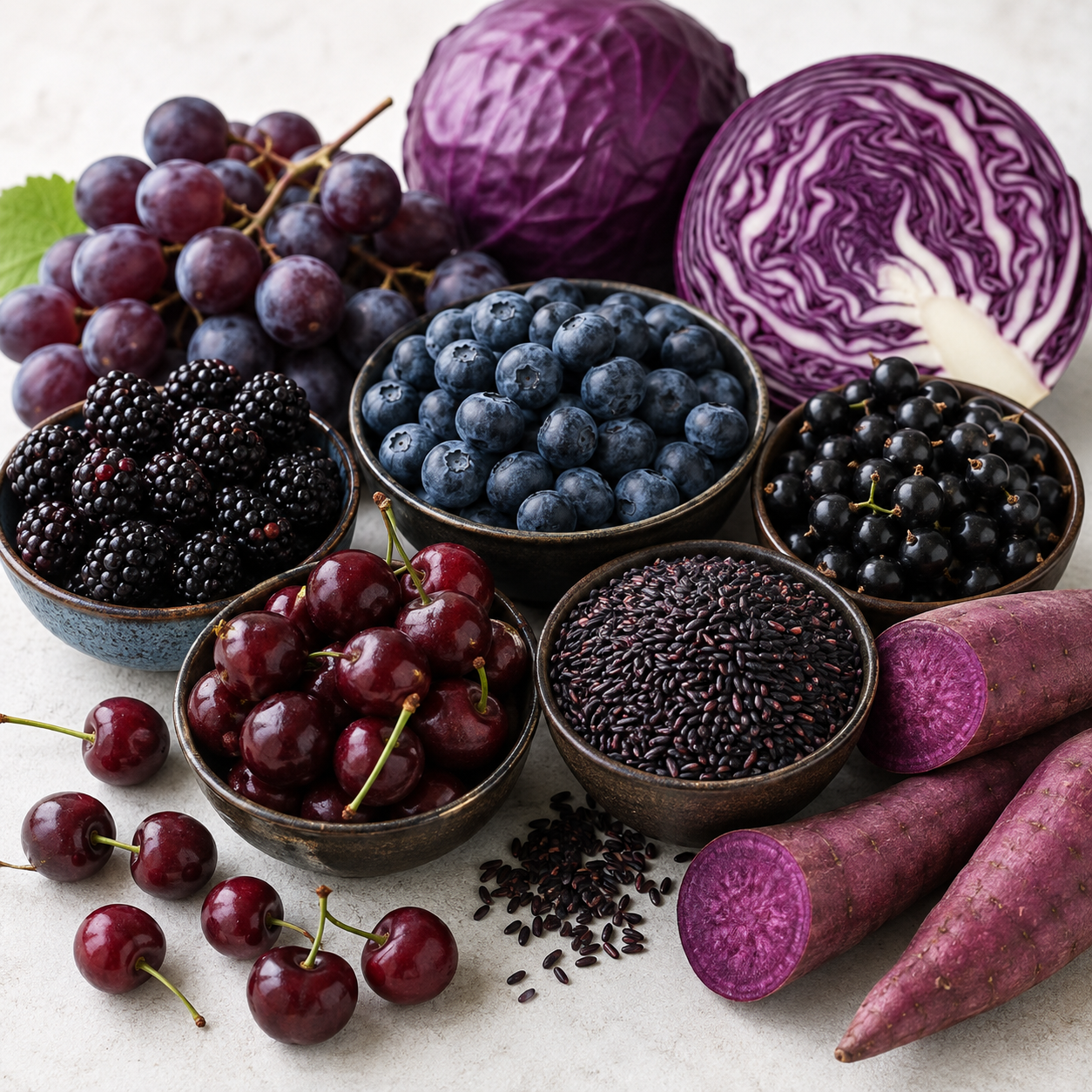
Anthocyanins are water-soluble flavonoid pigments widely found in dark-colored plants such as blueberries, blackcurrants, blackberries, and red cabbage. In nature they occur mainly as glycosylated anthocyanins. They are not essential nutrients and there is no traditional deficiency syndrome.
30-second check: which situation fits you best?
I just want everyday anti-inflammatory or antioxidant support
If you are considering long-term supplements simply because “anthocyanins are powerful antioxidants,” they are usually not necessary. Whole foods such as blueberries, blackberries, and red cabbage provide anthocyanins together with fiber, vitamins, and other plant bioactives.
I have one clear goal I want to improve
If your goal is vascular function, exercise recovery, age-related cognition, screen-related eye fatigue, or dry eye, review the human evidence. Distinguish food, total anthocyanins, and specific standardized proprietary extracts; they are not interchangeable.
I am planning to use it or already taking it
The easiest mistake is not dosing frequency but assuming the total berry-extract weight equals the anthocyanin dose. Anthocyanins, anthocyanidins, anthocyanosides, and proanthocyanidins are different label concepts and should not be added together as if they were the same.
Basic Overview
What it is
Anthocyanins are a large family of natural pigments found in red, blue, and purple plants. They belong to the flavonoid family and occur mainly as sugar-bound anthocyanins. They are not essential nutrients, and humans do not synthesize them. Common supplement sources include bilberry, blueberry, blackcurrant, maqui berry, and other plant extracts.
Why people use it
- Increase everyday anthocyanin intake
- Your diet contains few dark berries or purple fruits and vegetables
- Try short-term support for vascular function
- Support post-exercise recovery
- Explore cognitive support in middle-aged or older adults
- Target specific eye concerns or screen-related eye fatigue
How it relates to healthy aging
Anthocyanins are linked with antioxidant activity, inflammation regulation, and endothelial function, mechanisms that may be relevant to long-term health.
But having plausible mechanisms does not prove slower aging. There is no reliable human evidence that anthocyanin supplements reverse aging or extend lifespan. They are better viewed as potentially offering limited support for specific functional goals.
Supplement Assessment
There is no deficiency-testing logic for anthocyanins. Whether they are worth using depends on diet, a specific goal, the study population, formulation, and actual active dose.
Low supplementation priority
- No specific outcome you want to improve
- Mainly interested because of antioxidant or anti-inflammatory marketing
- You already regularly eat blueberries, blackberries, red cabbage, and similar foods
- You simply want to be “healthier” or “anti-aging” in general
- Planning to take it indefinitely
Your next step:
First improve the dietary pattern by adding dark berries, purple vegetables, and varied plant foods. If you still want to try a supplement, define a specific goal first.
Clear goal: a trial may be reasonable
- Is the goal supported by human evidence?
- Does the study population resemble you?
- Did the research use food, total anthocyanins, or a specific proprietary extract?
- Does the label use total anthocyanins, anthocyanidins, or another measurement convention?
- Is the dose truly comparable?
- When will you reassess whether it is helping?
- Is the improvement clinically meaningful?
Your next step:
First find human evidence matching the goal, population, and product form, then decide on the product and trial period.
Talk with a healthcare professional first
- You take anticoagulant or antiplatelet medication
- You are preparing for surgery or an invasive medical procedure
- Pregnancy or breastfeeding
- Infants and children
- You are receiving complex medical treatment
- You plan long-term use of a high-dose concentrated extract
- You are stacking multiple polyphenol or berry-extract products
Your next step:
If you take medication or belong to a special population, ask a doctor or pharmacist to review the product, dose, and overall risk.
Quick self-check
Do you rarely eat berries, purple vegetables, or dark-purple grains?
Is your goal vague antioxidant support, or a specific outcome?
Are you trying to buy a whole-food powder or a standardized extract?
Can you identify the true target ingredient on the label?
Will you set a trial period rather than taking it indefinitely?
Food Sources
Anthocyanins have no formal RNI, RDA, or AI, so this table does not show a percentage of adult reference intake. China DRIs 2023 sets an SPL of 50 mg/day; SPL can help put dietary exposure in context, but it is not a supplement recommendation or a required nutrient intake.
Representative Food Sources
| Food Form | Anthocyanins per 100 g | Common Serving | Approx. per Serving |
|---|---|---|---|
| Fresh Black Raspberries | Approx. 687 mg | 100 g | Approx. 687 mg |
| Fresh Wild Blueberries | Approx. 487 mg | 100 g | Approx. 487 mg |
| Fresh Blackcurrants | Approx. 476 mg | 100 g | Approx. 476 mg |
| Fresh Cultivated Blueberries | Approx. 387 mg | 100 g | Approx. 387 mg |
| Raw Red Cabbage | Approx. 322 mg | 80 g | Approx. 258 mg |
| Fresh Blackberries | Approx. 245 mg | 100 g | Approx. 245 mg |
| Fresh Cranberries | Approx. 140 mg | 100 g | Approx. 140 mg |
| Fresh Black Plums | Approx. 125 mg | 100 g | Approx. 125 mg |
How to read the numbers
Black raspberries, wild blueberries, and blackcurrants are representative high-anthocyanin foods; red cabbage is also notable among common vegetables. Even within “blueberries,” wild and cultivated varieties can differ substantially. Research averages are not fixed values for every package of fruit, and per-serving values are more useful for understanding real intake.
How Much Can Food Provide in a Day?
Example 1
100 g cultivated blueberries provide about 387 mg anthocyanins, well above the SPL reference level of 50 mg/day, showing that food alone can provide substantial amounts.
That does not mean intake above 50 mg is excessive; SPL is not a UL.
Example 2
80 g red cabbage + 100 g black plums can provide a meaningful amount of anthocyanins.
You also get fiber, vitamin C, and other plant bioactives, making this a more balanced approach than relying heavily on one food to imitate a supplement dose.
Cooking and storage tips
Avoid prolonged cooking: Long high-heat cooking accelerates anthocyanin degradation; shorter heating is usually better.
Keep cool and away from light: Temperature and light affect stability, so berries and juice products are best stored cool and protected from light.
Seal after opening: Oxygen also affects stability, so powders and extracts should be resealed promptly.
Do not use color as a dose estimate: Color is affected by variety, ripeness, and pH and cannot be converted directly into milligrams of anthocyanins.
Whole foods vs supplements
Whole Foods
- Also provides fiber, vitamins, and other plant bioactives
- Fits better into a long-term dietary pattern
- Anthocyanin dose varies widely
- Hard to standardize precisely
- Better suited as an everyday baseline source
Supplements
- Target ingredient is more concentrated
- Dose per serving is easier to standardize
- Can be matched more directly to specific study doses
- Labels are easier to misread
- Requires extra attention to formulation differences and safety
Dosage
SPL, regulatory ingredient-use levels, and human-study doses represent different concepts and should not be combined into a dose axis from “recommended intake” to “UL.”
Official Dose Status, Regulatory References, and Human Research
China DRIs 2023 & Everyday Reference
RNI / RDA / AI have not been established; no formal UL has been established; no universal daily supplement recommendation has been established.
Specific Novel Food Regulatory Conditions
These apply only to the corresponding standardized ingredient and are not a universal UL, safety ceiling, or supplement recommendation.
Human-Study References
Doses must be interpreted together with the study population, goal, and formulation.
Do not write:“Recommended intake 50 mg/day,” “optimal dose 80–320 mg/day,” or “safe upper limit 315–320 mg/day.”
Important Note
There is no RNI, RDA, AI, or general formal UL; SPL 50 mg/day is not a supplement prescription.
The 320 mg and ≤315 mg figures come from regulatory use conditions for two specific Novel Food ingredients and are not universal safety limits for all products.
40, 80, and 320 mg/day are research doses in specific populations, not default recommendations for generally healthy adults. Product comparisons must use the actual target ingredient and preserve the original label terminology.
How Formulation Affects Exposure
Anthocyanins are rapidly metabolized in humans, so absorption cannot be judged only by intact anthocyanin levels in blood.
Stable-isotope tracing suggests that when metabolites are included, human utilization is more complex than early estimates suggested.
Food matrix, anthocyanin structure, and extract form all affect systemic exposure, so a single fixed absorption rate is not appropriate.
How to Read Common Product Doses
Package number ≠ actual anthocyanin dose. Total Anthocyanins, Anthocyanidins, and Anthocyanosides should retain the terminology used on the original label.
| Product | Package / Label Number | Dose That Is Actually Comparable | Formulation | How to Interpret It |
|---|---|---|---|---|
| Life Extension Standardized European Bilberry ExtractOfficial product link | 100 mg Bilberry Extract | 36 mg Total Anthocyanins per capsule | MirtoSelect® Standardized to 36% Total Anthocyanins |
100 mg is the extract weight, not 100 mg anthocyanins. For comparison, use the 36 mg total anthocyanins. |
| Nature’s Way BilberryOfficial product link | 160 mg Bilberry Extract / 2 capsules | 40 mg Total Anthocyanins / 2 capsules | 25% Total Anthocyanins Also contains elderberry |
160 mg is total extract weight; the standardized anthocyanin amount is about 40 mg. Elderberry cannot automatically be added to that figure. |
| GNC Bilberry Extract 60 mgOfficial product link | 60 mg Bilberry Extract | 15 mg Anthocyanosides per capsule | 25% Anthocyanosides Keep the label wording |
The label reports Anthocyanosides; that wording is not exactly equivalent to Total Anthocyanins. |
| GNC Bilberry Extract & LuteinOfficial product link | 100 mg Bilberry Extract | 25 mg Anthocyanidins per capsule | 25% Anthocyanidins Also contains lutein + zeaxanthin |
The label says Anthocyanidins, so it should not be rewritten as 25 mg total anthocyanins. |
| NOW Foods Bilberry ComplexOfficial product link | 80 mg Bilberry Extract | ≥20 mg Total Anthocyanidins per capsule | 25% Total Anthocyanidins Combination formula |
The package number is not the target dose; compare using at least 20 mg Total Anthocyanidins. |
| Swanson MaquiBrightOfficial product link | 60 mg Maqui Berry Extract | ≥21 mg Total Anthocyanins per capsule | ≥35% Total Anthocyanins Delphinidin-enriched |
60 mg is the total proprietary extract weight; at the standardized percentage it provides at least about 21 mg total anthocyanins. |
Life Extension Standardized European Bilberry Extract
Official product link- Package / Label Number
- 100 mg Bilberry Extract
- Dose That Is Actually Comparable
- 36 mg Total Anthocyanins per capsule
- Formulation
- MirtoSelect®
Standardized to 36% Total Anthocyanins
- How to Interpret It
- 100 mg is the extract weight, not 100 mg anthocyanins. For comparison, use the 36 mg total anthocyanins.
Nature’s Way Bilberry
Official product link- Package / Label Number
- 160 mg Bilberry Extract / 2 capsules
- Dose That Is Actually Comparable
- 40 mg Total Anthocyanins / 2 capsules
- Formulation
- 25% Total Anthocyanins
Also contains elderberry
- How to Interpret It
- 160 mg is total extract weight; the standardized anthocyanin amount is about 40 mg. Elderberry cannot automatically be added to that figure.
GNC Bilberry Extract 60 mg
Official product link- Package / Label Number
- 60 mg Bilberry Extract
- Dose That Is Actually Comparable
- 15 mg Anthocyanosides per capsule
- Formulation
- 25% Anthocyanosides
Keep the label wording
- How to Interpret It
- The label reports Anthocyanosides; that wording is not exactly equivalent to Total Anthocyanins.
GNC Bilberry Extract & Lutein
Official product link- Package / Label Number
- 100 mg Bilberry Extract
- Dose That Is Actually Comparable
- 25 mg Anthocyanidins per capsule
- Formulation
- 25% Anthocyanidins
Also contains lutein + zeaxanthin
- How to Interpret It
- The label says Anthocyanidins, so it should not be rewritten as 25 mg total anthocyanins.
NOW Foods Bilberry Complex
Official product link- Package / Label Number
- 80 mg Bilberry Extract
- Dose That Is Actually Comparable
- ≥20 mg Total Anthocyanidins per capsule
- Formulation
- 25% Total Anthocyanidins
Combination formula
- How to Interpret It
- The package number is not the target dose; compare using at least 20 mg Total Anthocyanidins.
Swanson MaquiBright
Official product link- Package / Label Number
- 60 mg Maqui Berry Extract
- Dose That Is Actually Comparable
- ≥21 mg Total Anthocyanins per capsule
- Formulation
- ≥35% Total Anthocyanins
Delphinidin-enriched
- How to Interpret It
- 60 mg is the total proprietary extract weight; at the standardized percentage it provides at least about 21 mg total anthocyanins.
Health Effects
Endothelial Function
A systematic review in healthy adults found a small improvement in flow-mediated dilation (FMD) with anthocyanin intake, making endothelial function one of the more consistent findings. FMD is still a surrogate marker and should not be equated with a proven reduction in heart attack or stroke risk.
View meta-analysis
Glucose & Metabolic Stability
Evidence in healthy adults does not support describing anthocyanins as a routine supplement that clearly lowers glucose or consistently improves insulin resistance. Some markers may change slightly, but results are not stable enough for strong claims.
View meta-analysis
Inflammation & Oxidative Stress
In people with dyslipidemia and other specific populations, there are signals of improvement in some inflammatory and oxidative-stress markers. These are mostly laboratory outcomes, and participants were not ordinary healthy adults, so the results should not be generalized into routine supplementation for everyone.
View meta-analysis
Post-Exercise Recovery
Some studies and systematic reviews suggest anthocyanin-rich foods or extracts may help muscle-soreness recovery or selected muscle-damage markers. Food sources and formulations vary greatly, so this should not be summarized as improved exercise performance.
View meta-analysis
Cognition & Brain Function
In healthy middle-aged and older adults, anthocyanin-rich foods or supplements may provide small support for some cognitive domains such as processing speed, but have not consistently improved all aspects of cognition.
View meta-analysis
Dry Eye & Screen Use
A 2026 systematic review of human maqui-berry studies found eye-related outcomes were among the more consistent signals: standardized maqui extract may increase tear production and improve some dry-eye symptoms in short-term studies. However, total sample sizes remain small, follow-up is short, and most trials used a specific maqui extract, so these results should not be generalized to all anthocyanins, blueberry, or bilberry products.
View systematic review
Product Selection
What matters most is not the total milligrams of berry or bilberry, but the standardized active ingredient and exact label terminology.
Check These Four Things
What is the active ingredient?
First determine whether the label lists Total Anthocyanins, Anthocyanidins, Anthocyanosides, or oligomeric proanthocyanidins (OPC / Proanthocyanidins). When comparing anthocyanin products, look for clearly standardized total anthocyanins rather than only the words “blueberry extract.”
How much do you actually get per serving?
100 or 160 mg Bilberry Extract may correspond to only 20–40 mg of the standardized target compounds. Use the standardization percentage and Serving Size to calculate the actual target amount per day.
Are there unnecessary added ingredients?
Lutein, zeaxanthin, or other berry polyphenols change the purpose of the product and should not be added to the anthocyanin dose. Gummies, drinks, and flavored powders also require a look at added sugar, syrup, flavors, and sweeteners.
Is quality control credible?
Prioritize botanical source, plant part, standardization, batch-level active content, and contaminant/heavy-metal testing. Clear standardization matters more than a large-looking brand or package number.
How to Read the Label5 Steps to Verify the Actual Target Ingredient
Total extract weight is not the actual anthocyanin dose; calculate combination ingredients separately.
OPCs, lutein, and other combination ingredients are listed separately
Calculate the actual target ingredient from the number of daily servings.
Botanical Source | Plant Part | Standardization | Lot Number | Quality Testing
Bilberry Extract 100 mg × 36% = 36 mg Total Anthocyanins. This is a label-calculation example, not a recommended dose.
Find the target ingredient first
Find Total Anthocyanins or Total Anthocyanidins and first preserve the exact terminology used on the label.
Check the raw material and standardization percentage
For example, Bilberry Extract 100 mg standardized to 36% Total Anthocyanins.
Confirm the serving size and calculate actual intake
First check how many capsules are in a Serving Size; 100 mg × 36% = 36 mg Total Anthocyanins, then multiply by daily servings.
Evaluate added active ingredients separately
Interpret lutein, zeaxanthin, oligomeric proanthocyanidins (OPCs), and other berry extracts separately rather than adding them to the anthocyanin dose.
Then check formulation and quality
Confirm botanical source, plant part, standardization, daily servings, lot number, and verifiable quality information.
How to Choose Among Common FormsSources and analytical terminology may differ
Whole Berry Powder / Fruit Powder
Main features
Retains more of the whole-food matrix, but the proportion is usually not standardized, so grams of berry powder cannot be reliably converted into total-anthocyanin milligrams.
Site guidance
A reasonable option if you value a whole-food approach; less useful than a standardized extract when you want to match a study dose precisely.
25% Standardized Bilberry Extract
Main features
A common market form with a clearer standardized fraction, but check whether the label says Total Anthocyanins or Anthocyanidins.
Site guidance
Useful for people who want a simple product with an easy-to-understand dose. Even when both products say 25%, the analytical basis may not be identical.
36% Standardized European Bilberry Extract
Main features
For example, MirtoSelect®; the total-anthocyanin percentage is clearly defined, making the per-serving dose easier to calculate and compare with research.
Site guidance
Convenient when transparent dosing and easy label interpretation matter. Whether it is worth paying more still depends on your goal and budget.
Maqui Berry / Delphinidin-Enriched Extract
Main features
Some products emphasize delphinidins in addition to total anthocyanins, creating a profile that differs from ordinary blueberry or bilberry extracts.
Site guidance
If your goal is dry eye or screen fatigue and you want to match the research more closely, favor products closer to the studied formulation.
Polyphenol Combination Products
Main features
Often combined with lutein, zeaxanthin, OPCs, or other berry extracts, making the product more of a broad eye-health or antioxidant formula.
Site guidance
If you only want to evaluate anthocyanins, a complex combination is not the best starting point. If you do choose one, interpret each active ingredient separately.
How to Take
Set an evaluation period around your goal rather than taking it indefinitely because of antioxidant claims.
Default plan (healthy adults)
Official recommended dose: No universal official recommended dose has been established
China Reference: SPL 50 mg/day, not an RNI
Frequency: Decide based on the specific product and goal
With food?: Usually fine with regular meals
Split doses?: No universal need to divide doses
Long-term use?: Set an evaluation period and reassess
Missed dose: If you miss a dose, skip it; do not double up
Frequently asked questions
Is 50 mg/day a supplement recommendation?
No. The 50 mg/day figure is the SPL for anthocyanins in China DRIs and is used to understand a dietary reference level. It is not a supplement recommendation.
Do I have to take it on an empty stomach?
No clear fasting requirement has been established. It can usually be taken with normal meals.
Do I need to take it with fat?
No. Anthocyanins are water-soluble plant pigments, and there is no evidence that you need to add fat specifically for absorption.
Can blueberry, bilberry, and maqui products simply be added together?
Only after you know the label terminology and actual target ingredient. Total extract weight, total anthocyanins, and OPCs should not be mixed together.
How long should I use it before reassessing?
For a specific goal, set a fixed evaluation period rather than continuing indefinitely because of antioxidant claims.
How do I know whether it is working?
Define the goal first. Vascular function, exercise recovery, dry eye, and screen fatigue require different ways of judging benefit; without a specific outcome, it is difficult to know whether the supplement matters.
Risks & Precautions
Common Side Effects
- Stomach upset
- Diarrhea
- Headache
- Dark-colored stool
- Mild skin discomfort or individual intolerance
- These are usually mild reactions, and tolerability varies with the product and formula.
Higher-Dose Risks
- No formal UL does not mean long-term high-dose use has been proven safe
- Concentrated extracts should not be treated as equivalent to ordinary dietary intake
- Some higher-dose studies have changed selected platelet-function measures
- Safety data are limited for long-term stacking of multiple high-dose polyphenol extracts
- Highly standardized or proprietary formulations may create different systemic exposure from ordinary foods
People Who Need More Caution
- You take anticoagulant or antiplatelet medication
- Preparing for surgery or an invasive procedure
- Pregnancy or breastfeeding
- Infants and children
- You are receiving complex medical treatment
- You plan long-term use of a high-dose concentrated extract
- Novel Food conditions for blueberry anthocyanins and maqui anthocyanins both list infants/young children, pregnant women, and breastfeeding women as unsuitable populations.
Medications & Special Situations
- Anticoagulant / antiplatelet drugs: It is not accurate to say anthocyanins definitely interact with these drugs. Some studies suggest higher doses may affect platelet function, so medication users should not add high-dose concentrated extracts on their own.
- Preparing for surgery: If you use standardized bilberry, blueberry, or maqui extract, tell your clinician before surgery; some commercial products also advise temporary discontinuation before procedures.
- Complex disease treatment: Findings from disease populations should not be rewritten as a routine plan for healthy adults. People undergoing treatment should first confirm that supplementation does not conflict with current goals.
Stop and Ask for Advice
If you develop persistent diarrhea, headache, rash, unusual discomfort, bruising, or bleeding, stop use and consult a doctor or pharmacist.
Seek Medical Care Promptly
Seek prompt medical care for difficulty breathing, swelling of the face, lips, or tongue, clearly abnormal bleeding, a severe systemic allergic reaction, or another rapidly worsening serious symptom.
Sources
Sources on this page support anthocyanin reference values, food content, stability, human evidence, safety, absorption, and representative product labels.
Nutrition Standards & Basic Data
Use: anthocyanin SPL 50 mg/day.
Health Effects & Scientific Evidence
Safety, Products & Use
Mainstream Product Dose Examples
Data Boundaries
Primarily applies to generally healthy adults and does not directly apply to children, pregnancy, breastfeeding, or disease-treatment populations. Product examples are only for understanding labels, standardization, and actual target ingredients; they do not establish an optimal dose, recommended intake, or safety ceiling. Different sources, varieties, analytical methods, and formulations should not be treated as fully equivalent.
Last updated: August 12, 2026