Matcha Powder
Matcha Powder / Green Tea Powder / Tencha Powder / Camellia sinensis
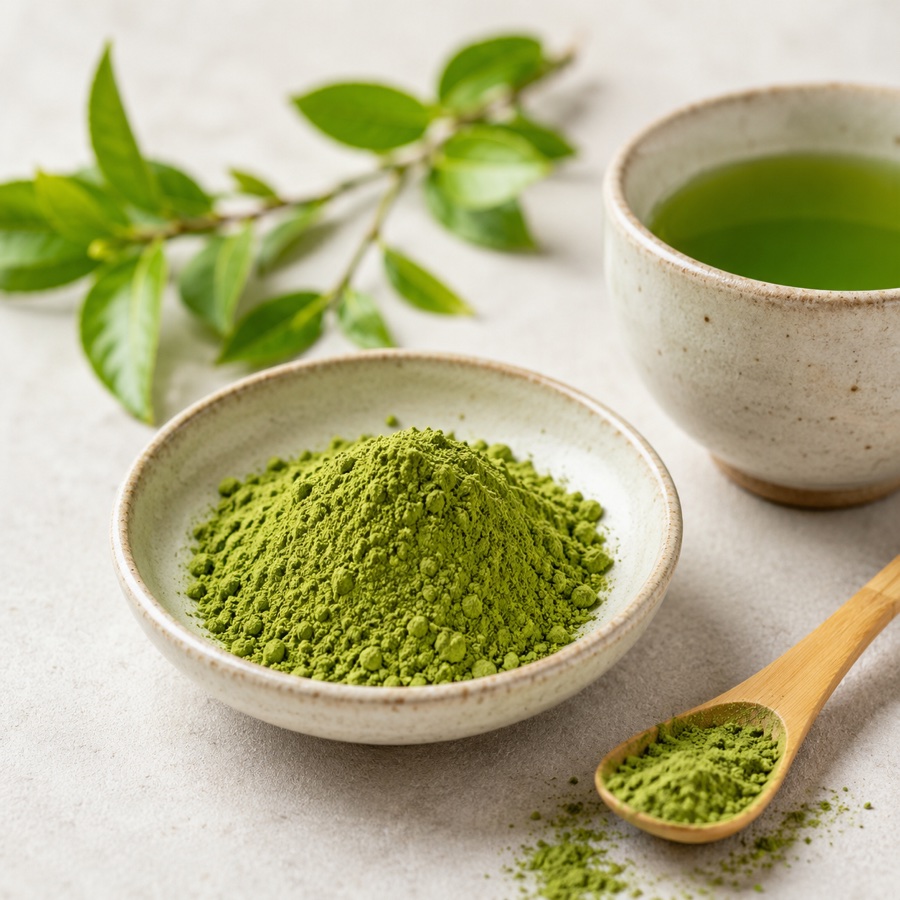
Matcha is a green tea powder made by grinding tencha produced from shade-grown tea leaves, so the tea leaf itself is consumed rather than only an infusion. EGCG is one of matcha’s major and most studied catechins; it also contains EGC, ECG, other catechins, L-theanine, and caffeine. Matcha fits best as an everyday tea and source of plant compounds, not a functional supplement that must be consumed in a fixed daily dose.
30-second check: which situation fits you best?
For everyday antioxidant-rich eating
Matcha can be used as an everyday tea and provides catechins such as EGCG, plus L-theanine and caffeine. Human green-tea research supports improvement in some antioxidant markers, but healthy people do not need a fixed daily amount, and this does not prove that matcha slows human aging.
A specific goal: lipids, blood pressure, or metabolic health
Human research on green tea and tea catechins suggests small improvements in total cholesterol, LDL, blood pressure, and some glucose markers, with relatively clearer evidence for antioxidant status. Many studies use green tea extracts or standardized catechins, so their effects and doses should not be treated as equivalent to ordinary matcha.
You already drink matcha every day
Confirm that it is 100% matcha, then check your actual daily amount, total caffeine intake, timing, and whether the product discloses key compounds such as EGCG, L-theanine, and caffeine. Two products can both be used at 2 g/day yet provide different amounts of these compounds.
Basic Overview
What it is
Matcha is not simply ordinary green tea leaves ground into powder. Traditional matcha is usually made from shade-grown tea leaves that are harvested, steamed, dried without rolling to make tencha, and then ground into a very fine powder.
Unlike brewed tea, where mainly the infusion is consumed, matcha includes the tea leaf itself. This means you ingest EGCG, EGC, ECG, EC, L-theanine, caffeine, and other tea polyphenols and leaf components.
Why people use it
How it relates to healthy aging
Matcha’s more plausible long-term health value comes from the limited support that tea polyphenols, catechins, and whole-tea components may provide for oxidative stress, lipids, blood pressure, and some metabolic markers. These areas are relevant to long-term cardiovascular and metabolic health.
However, there is no human clinical evidence showing that ordinary matcha extends lifespan or directly slows the rate of human aging. A more accurate interpretation is that it may support selected markers related to long-term health—not that “matcha equals anti-aging.”
Key bioactive compounds
EGCG is one of the most studied and abundant major catechins in green tea and is central to a large amount of green-tea research. However, matcha’s human effects cannot be attributed to EGCG alone.
Other catechins include EGC, ECG, and EC, which also contribute to tea’s antioxidant and other biological activities.
L-Theanine is a characteristic amino acid in tea and contributes to umami. The combination of L-theanine and caffeine is one feature of matcha that is relevant to research on attention, cognition, and alertness.
Caffeine is an important contributor to matcha’s stimulating effect, and also an important reason some people experience palpitations, nervousness, difficulty falling asleep, or lighter sleep.
Supplement Assessment
First distinguish everyday tea use from a specific health goal.
Low priority for supplementation
- You only want general antioxidant or anti-inflammatory support or to be “a little healthier”
- You already drink green tea, oolong tea, or other tea regularly
- Your diet is already varied with good intake of vegetables, fruit, and other plant foods
- You do not have a specific lipid, blood-pressure, blood-glucose, or weight goal
- You are considering long-term daily use mainly because of claims such as “high EGCG” or “anti-aging”
Your next step:
Treat it primarily as an everyday tea rather than a functional supplement that must be taken in a fixed daily amount. If you like the flavor, drink it normally; if you do not, there is no need to force yourself to continue just for “antioxidants.”
A specific goal may justify a trial
- You want to support total cholesterol or LDL
- You want to observe blood pressure or selected metabolic markers
- You want to increase intake of tea polyphenols and catechins
- You want to replace sweetened drinks, milk tea, or high-sugar coffee with a simpler tea drink
- You have a clear, observable health goal and are willing to reassess after a period of use
- You accept that current human research mainly supports small improvements
Your next step:
First identify the specific marker you want to improve, then review the matching human evidence. Much of the favorable evidence comes from brewed green tea, green tea extracts, or standardized catechins, so use it to judge direction and evidence strength rather than copying the study dose.
Consult first before deciding on long-term use
- You are sensitive to caffeine and easily develop palpitations, nervousness, or insomnia
- You currently have or previously had liver problems
- You have iron deficiency, low iron stores, or are taking iron supplements
- You take prescription medication
- Pregnancy or breastfeeding
- You also use green tea extract or an EGCG supplement
- You plan long-term matcha intake clearly above ordinary tea-drinking amounts
Your next step:
Review the specific product, daily intake, other caffeine sources, supplements, and medications together. These situations should not simply follow a routine for healthy adults; long-term risks and interactions deserve separate consideration.
Quick Self-Check
Do I actually enjoy matcha, or am I drinking it because of “anti-aging” claims?
What do I really want to improve?
How much other caffeine do I get each day?
Does the product disclose key compounds?
Are my expectations too high?
Products & Everyday Use
Understand differences between matcha products, key compounds, and practical ways to use them.
Why compare real products here?
Even when packages all say 100% matcha (100% Matcha), tea cultivar, growing region, harvest timing, shading, processing, and storage can affect catechins, EGCG, L-theanine, and caffeine.
Commercial-product analyses also show clear differences in EGCG between matcha products, and Ceremonial Grade does not reliably predict higher EGCG.
The examples below are only for understanding real market differences and are not brand recommendations or rankings.Even among 100% matcha powders
Actual composition and flavor can differ
Common Market Products
These real products illustrate label differences and are not brand recommendations or rankings. Most matcha brands emphasize region, cultivar, grade, and flavor; only a minority disclose key-compound data such as EGCG or L-theanine. The “What You Should Actually Compare” column shows what kind of transparency each product offers.
| Product | Package / Label Information | What You Should Actually Compare | Product Features | How to Interpret It |
|---|---|---|---|---|
| Ippodo Tea — IkuyoOfficial product link | Japanese matcha; typical usucha about 2 g per serving | Tea source and traditional use are relatively clear; no specific EGCG, L-theanine, or caffeine values disclosed | Traditional Tea Style From a traditional Japanese tea house; best understood by drinking experience |
Better judged by flavor, strength, and drinking experience. If your goal is precise EGCG intake, the publicly available compound data are limited. |
| Jade Leaf — Organic Ceremonial Matcha – Teahouse EditionOfficial product link | 100% Japanese Organic Matcha; Uji + Kagoshima; First Harvest | Origin, harvest, and organic information are relatively transparent; full key-compound data not disclosed | Organic | Detailed Raw-Material Info Organic certification with region and harvest information |
The raw-material information is rich, but Ceremonial Grade or region alone cannot tell you the actual EGCG content. |
| Encha — Ceremonial Grade Matcha PowderOfficial product link | USDA Organic; First Harvest; Ceremonial Grade | Emphasizes organic status, harvest, and flavor; no specific EGCG or L-theanine values disclosed | Organic | Everyday Straight-Drinking Style Organic-certified matcha intended for direct drinking |
Better selected by production method and flavor than by claims of unusually transparent key-compound data. |
| Naoki Matcha — Fragrant Yame MatchaOfficial product link | Yame, Fukuoka, Japan; First Harvest | Origin and harvest are clear; no measured key-compound values disclosed | Single Region Single-region product with clear harvest information |
A good example of how “origin transparency” and “EGCG transparency” are two different things. |
| Kettl — Okuju MatchaOfficial product link | Uji; Okumidori tencha; production year disclosed | Very detailed Cultivar, Region, and Production Year information; no measured EGCG disclosed | Single Cultivar | Strong Traceability Detailed cultivar, region, and production-year information |
Highly useful for flavor and tea identity, but Okumidori and Uji do not directly tell you actual EGCG content. |
| Yoshi En — GC1® Matcha Premium Sticks JapanOfficial product link | 2 g single-serve sachet; Kagoshima | Lists specific EGCG, EGC, ECG, L-theanine, and caffeine values per 2 g | Key-Compound Data One of the relatively few single-serve products publishing several key-compound values |
One of the few products that discloses several key compounds, but it is specifically positioned around active-compound transparency and should not be treated as representative of average matcha. |
Ippodo Tea — Ikuyo
Official product link- Package / Label Information
- Japanese matcha; typical usucha about 2 g per serving
- What You Should Actually Compare
- Tea source and traditional use are relatively clear; no specific EGCG, L-theanine, or caffeine values disclosed
- Product Features
- Traditional Tea Style
From a traditional Japanese tea house; best understood by drinking experience
- How to Interpret It
- Better judged by flavor, strength, and drinking experience. If your goal is precise EGCG intake, the publicly available compound data are limited.
Jade Leaf — Organic Ceremonial Matcha – Teahouse Edition
Official product link- Package / Label Information
- 100% Japanese Organic Matcha; Uji + Kagoshima; First Harvest
- What You Should Actually Compare
- Origin, harvest, and organic information are relatively transparent; full key-compound data not disclosed
- Product Features
- Organic | Detailed Raw-Material Info
Organic certification with region and harvest information
- How to Interpret It
- The raw-material information is rich, but Ceremonial Grade or region alone cannot tell you the actual EGCG content.
Encha — Ceremonial Grade Matcha Powder
Official product link- Package / Label Information
- USDA Organic; First Harvest; Ceremonial Grade
- What You Should Actually Compare
- Emphasizes organic status, harvest, and flavor; no specific EGCG or L-theanine values disclosed
- Product Features
- Organic | Everyday Straight-Drinking Style
Organic-certified matcha intended for direct drinking
- How to Interpret It
- Better selected by production method and flavor than by claims of unusually transparent key-compound data.
Naoki Matcha — Fragrant Yame Matcha
Official product link- Package / Label Information
- Yame, Fukuoka, Japan; First Harvest
- What You Should Actually Compare
- Origin and harvest are clear; no measured key-compound values disclosed
- Product Features
- Single Region
Single-region product with clear harvest information
- How to Interpret It
- A good example of how “origin transparency” and “EGCG transparency” are two different things.
Kettl — Okuju Matcha
Official product link- Package / Label Information
- Uji; Okumidori tencha; production year disclosed
- What You Should Actually Compare
- Very detailed Cultivar, Region, and Production Year information; no measured EGCG disclosed
- Product Features
- Single Cultivar | Strong Traceability
Detailed cultivar, region, and production-year information
- How to Interpret It
- Highly useful for flavor and tea identity, but Okumidori and Uji do not directly tell you actual EGCG content.
Yoshi En — GC1® Matcha Premium Sticks Japan
Official product link- Package / Label Information
- 2 g single-serve sachet; Kagoshima
- What You Should Actually Compare
- Lists specific EGCG, EGC, ECG, L-theanine, and caffeine values per 2 g
- Product Features
- Key-Compound Data
One of the relatively few single-serve products publishing several key-compound values
- How to Interpret It
- One of the few products that discloses several key compounds, but it is specifically positioned around active-compound transparency and should not be treated as representative of average matcha.
What You Should Actually Compare
First decide whether you are buying matcha for flavor and tea quality or for key-compound data.
Flavor / tea-quality focus
Compare Region, Cultivar, Harvest, Processing, and Production Year.
Key-compound focus
Compare Catechins, EGCG, L-Theanine, and Caffeine, and prioritize specific values plus testing evidence.
How to interpret Ceremonial Grade
“Ceremonial Grade” is common in international marketing, but it is not a chemical grade that reliably predicts EGCG content. Commercial analyses have not shown a stable, significant difference in mean EGCG between ceremonial- and culinary-grade samples. It is better used to understand product positioning, flavor, and straight-drinking experience.
Everyday Ways to Use It
Traditional matcha
Whisk about 1.5–2 g matcha with about 50–60 mL hot water.
Matcha latte
First mix the matcha with a small amount of water, then add milk or unsweetened plant milk.
Cold matcha
Shake thoroughly with cold water and add ice if desired.
Yogurt or oats
Add a small amount to plain yogurt, oats, or a breakfast bowl.
Baking & food
Add to oats, baked foods, or other dishes. There is no need to insist on raw use just to supposedly “preserve all nutrients.”
Things to Keep in Mind
Do not judge quality by color alone
Bright green color can reflect cultivar, shading, processing, and storage, but it does not tell you the specific EGCG content.
More bitter is not necessarily better
Bitterness cannot substitute for laboratory composition testing.
No need to use a lot at once for health
A traditional cup usually uses only about 1.5–2 g.
Protect freshness after opening
Keep sealed, dry, protected from light, and away from heat and strong odors.
A larger bag is not always better value
If you use matcha slowly, smaller packages are often better for preserving flavor and quality.
Dosage
There is no unified RNI, RDA, AI, or formal UL. Research doses must be interpreted in the context of matcha powder, brewed green tea, and green tea extracts, along with population and duration.
Human Research References for Ordinary Matcha Powder
Direct matcha studies by population and goal
These are doses used in human studies that directly gave participants ordinary matcha powder. They are not recommended matcha intakes.
How to interpret research doses
These values describe the scale and duration of direct matcha research and are not a unified recommendation for healthy adults.
Key reminder:Research dose ≠ recommended dose; matcha ≠ green tea extract; grams of matcha ≠ EGCG dose; higher dose ≠ stronger effect.
Important note
There is currently no official rule saying how much matcha healthy adults must drink each day.
2–3 g is not a “standard dose.” It is simply a common range in some direct matcha studies.
The same gram amount can provide different compounds. Cultivar, region, shading, processing, and storage all affect tea composition.
No UL ≠ unlimited intake. Matcha provides both caffeine and multiple catechins.
Dose interpretation
The same 2–3 g of matcha can provide substantially different amounts of EGCG, total catechins, L-theanine, and caffeine across studies and products.
Actual human exposure depends on grams of matcha × the product’s measured key-compound content, not grams alone.
500 mg green tea extract ≠ 500 mg matcha. Extract doses cannot be directly converted into grams of ordinary matcha.
Practical use
Everyday tea use | About 1.5–2 g is a common amount for one traditional usucha; adjust to taste.
Regular daily use | Keep to an amount you tolerate comfortably and watch caffeine tolerance and sleep.
Specific health goal | First confirm whether the study used matcha, brewed green tea, or an extract before deciding whether the research dose is relevant.
Health Effects
Antioxidant Status
A meta-analysis of 38 RCTs involving about 1985 participants found that green tea interventions lowered MDA and increased total antioxidant capacity, SOD, and glutathione peroxidase. Matcha is rich in catechins including EGCG, so this direction has strong related evidence; however, improved antioxidant markers do not prove that the rate of human aging slows.
View the antioxidant and inflammation meta-analysis
Systemic Inflammation
In the same meta-analysis of 38 RCTs and about 1985 participants, CRP, IL-6, and TNF-α did not improve significantly overall, although some individual markers such as IL-1β decreased. This shows that anti-inflammatory mechanisms seen in cell and animal studies do not consistently translate into broad reductions in common systemic inflammatory markers in humans. Matcha should not be described as a powerful natural anti-inflammatory.
View the antioxidant and inflammation meta-analysis
Blood Lipids
A meta-analysis of 31 RCTs and 3321 participants found average reductions of about 4.66 mg/dL in total cholesterol and 4.55 mg/dL in LDL, with no consistent improvement in HDL or triglycerides. The direction is relatively consistent but the effect is small, so this is better viewed as limited support for lipid health rather than a natural lipid-lowering treatment.
View the green tea lipid meta-analysis
Blood Pressure
An updated meta-analysis of 36 RCTs found average reductions of about 1.08 mmHg in systolic blood pressure and 1.09 mmHg in diastolic blood pressure. The overall direction is favorable but the magnitude is very small and results vary between studies. Matcha is best understood as a limited dietary adjunct, not a replacement for standard blood-pressure management.
View the green tea blood-pressure meta-analysis
Blood Glucose & Metabolism
A meta-analysis of 27 RCTs and 2194 participants found that fasting glucose fell by about 1.44 mg/dL on average, while fasting insulin and HbA1c did not improve consistently. A more accurate conclusion is that some glucose markers may improve slightly, not that matcha has been proven to meaningfully improve insulin resistance.
View the green tea glucose meta-analysis
Weight Management
Across multiple green tea meta-analyses, body weight and waist circumference may decrease slightly, but the overall effect is small and many studies use green tea extracts, high-catechin products, or catechin + caffeine formulas. Direct matcha studies have also not consistently shown that adding matcha meaningfully enhances weight loss. Matcha should not be treated as a weight-loss product.
View the green tea cardiometabolic umbrella review
View the Cochrane green tea weight review
Product Selection
Start with your reason for buying it, then compare raw material and origin, processing, ingredients and purity, key compounds, certification/testing, and packaging.
Which type fits you?Different goals call for different comparison points, even within matcha powder
Everyday drinking
For water, matcha lattes, or adding to foodPrioritize 100% matcha, a clear ingredient list, country/region of origin, basic food-safety testing, and practical package size. There is no need to pay a large premium just for “Ceremonial Grade” or the highest EGCG.
Flavor / quality focused
For people who care about umami, bitterness, aroma, origin, and tea-ceremony drinking experiencePrioritize Region, Cultivar, First Harvest, Tencha, Shade Grown, Production Year, and Processing Method. These help describe tea identity and flavor, but they do not prove higher EGCG.
Key-compound data focused
For people who truly want to know daily catechin, EGCG, L-Theanine, and Caffeine intakePrefer specific values, for example EGCG 103 mg / 2 g, rather than High in EGCG. Ideally the product also provides Analyte, Result, Unit, Laboratory, Batch, and Date information.
Whichever type you choose, treat a clear ingredient list, clear raw-material identity, and reliable food safety as baseline requirements. Organic, specific origin, and high EGCG answer different questions and cannot substitute for one another.
Check these six things in order
01 Ingredient & Origin
First confirm 100% Matcha, then look at country of origin, specific region, and cultivar—for example Uji, Yame, Kagoshima, Okumidori, Samidori, or Yabukita. A specific region or cultivar cannot replace finished-product EGCG testing.
02 Processing Method
You may see Shade Grown, Steamed, Tencha, Stone-Milled, and First Harvest. Do not mechanically interpret “stone-milled = more EGCG” or “first harvest = stronger health effects.”
03 Ingredients & Purity
For pure matcha, prefer Ingredients: 100% Matcha Green Tea Powder. If the product contains sugar, maltodextrin, creamer, flavoring, or sweetener, it is no longer plain matcha powder; Matcha Latte Mix ≠ 100% Matcha.
04 Key Compounds & Content
The most relevant compounds to compare are Catechins, EGCG, L-Theanine, and Caffeine. Matcha naturally contains EGCG, but that does not tell you how much is in the product you bought. If a specific compound matters to you, prioritize measured finished-product values.
05 Certification & Testing
Consider pesticide residues, heavy metals, microbiological testing, mold/fungi, and where relevant mycotoxins. Keep key-compound testing separate from food-safety testing: a COA for heavy metals does not prove EGCG content, and vice versa.
06 Packaging & Storage
Prefer sealed, light-protective, moisture-resistant packaging that can be resealed after opening and is sized for your use rate. Single-Serve Sachets can be useful for infrequent users. Premium packaging does not mean the original EGCG content was higher.
How to Read the Package LabelCheck in this order
Product Name:100% Matcha Powder
Ingredients:100% Matcha Green Tea Powder (no added sugar)
Raw Material:Shade-grown green tea leaves → Tencha
Origin / Cultivar:Uji, Japan | Cultivar: Okumidori (example)
Key compounds per 2 g, example
About 51.5 mg/g(converted from seller-stated data; a complete report should also include other catechins, L-Theanine, and Caffeine)
Batch Information:Batch No. (example; should match the current product)
Testing Note:Key-compound COA and food-safety testing should be listed separately (example)
Storage:Keep sealed, dry, and protected from light; refrigerate after opening or store in a cool place.
This example shows what a label with specific data can look like. It is not a recommendation for a particular brand or a requirement to maximize EGCG. 100% matcha, organic status, Ceremonial Grade, and measured EGCG answer different questions.
Start with Ingredients
Confirm 100% matcha. If you see sugar, maltodextrin, creamer, flavoring, or sweetener, it is no longer plain matcha powder.
Confirm ingredient identity
Check country of origin, specific region, Cultivar, and Harvest.
Understand the Processing Method
Terms such as Shade Grown, Tencha, and Stone-Milled mainly help describe raw material and production.
Check Key Compound Testing
If your main reason for buying is EGCG, prioritize mg/g or mg/Serving rather than High EGCG marketing.
Check Safety Testing
Do not stop at Third-Party Tested. Confirm what was tested, who tested it, which batch it applies to, and whether a specific report is available.
Which product features are worth paying more for?Meet the basics first, then decide which differences are actually worth the extra cost.
Measured key compounds
When it may be worth choosing
If you truly want to control EGCG, caffeine, or L-theanine intake, a product that publishes specific values with a testing basis may be worth prioritizing.
When it may not be worth paying extra
If you simply enjoy matcha as tea, there is no need to pay a large premium for precise EGCG data.
Specific cultivar & region
When it may be worth choosing
If you care about tea aroma, umami, bitterness, tea-ceremony experience, or traceability, clear cultivar and region information has practical value.
When it may not be worth paying extra
If your only goal is more EGCG, a specific region or cultivar cannot replace finished-product testing.
Organic certification
When it may be worth choosing
If organic production and agricultural management matter to you, legitimate organic certification can be an additional filter.
When it may not be worth paying extra
Do not equate organic with more EGCG; organic status and compound content are separate questions.
How to Take
Matcha has no unified daily recommended intake. For everyday use, a traditional cup and your caffeine tolerance are more useful guides.
Default plan (healthy adults)
Everyday amount: About 1.5–2 g per cup is a common traditional usucha reference, not a health recommendation.
How often: It can be used daily, while counting caffeine from coffee, other tea, and beverages.
Timing: If you are caffeine-sensitive, use it earlier in the day and avoid large amounts late in the afternoon or evening.
How to prepare: Whisk with water or add to milk or unsweetened plant milk.
Can it be heated?: Yes. It can be prepared with hot water, used in baking, or added to food.
Do I need to split the dose?: One everyday cup usually does not need to be split intentionally.
What if I miss a day?: Do not make it up or double the amount the next day.
Frequently asked questions
Morning or evening?
If caffeine does not affect your sleep, timing can be flexible. If you are prone to insomnia, morning or early afternoon is more practical.
Can I drink it every day?
At ordinary tea-drinking amounts, most healthy adults can use matcha as an everyday tea, but there is no need to keep increasing the amount for health effects.
Can I drink it with milk?
Yes. There is no need to force yourself to use only water for supposed “maximum absorption.”
Can I drink it on an empty stomach?
There is no requirement to drink it fasting. Some people are more likely to feel nauseated or have stomach discomfort from strong tea on an empty stomach, so with food or after a meal may be more comfortable.
Can I drink it with coffee?
Yes, but count total daily caffeine.
Should I make it stronger for more EGCG?
No. More EGCG intake does not mean health effects increase linearly.
More questions about use (click to expand)
Can I convert the LDL reduction from green tea meta-analyses into the effect of 2 g matcha per day?
No. These studies help establish the direction of effect, but they do not show that 2 g matcha will lower LDL by exactly 4.55 mg/dL. Brewing method, catechin concentration, and actual exposure vary substantially across green tea studies.
Risks & Precautions
Common adverse effects
- Palpitations: caffeine can make some people noticeably feel a faster heartbeat.
- Nervousness or jitteriness: more likely in people sensitive to caffeine.
- Stomach discomfort: may be more noticeable with strong tea or on an empty stomach.
- Headache: can occur with high caffeine intake or after suddenly stopping habitual caffeine.
- Sleep disruption: especially with later-afternoon or evening use.
Risks of higher intake
- Caffeine: for most healthy adults, total intake from all sources of about ≤400 mg/day is generally considered unlikely to raise safety concerns; during pregnancy, about ≤200 mg/day from all sources is a commonly used safety reference. These are caffeine references, not recommended matcha intakes.
- EGCG and concentrated green tea products: human safety assessments have identified liver-enzyme elevation and liver-injury signals at supplemental EGCG intakes around 800 mg/day or more. This does not mean matcha is absolutely safe below 800 mg EGCG, and 800 mg should not be treated as a matcha UL.
People who should be more cautious
- Highly sensitive to caffeine, with palpitations, anxiety, or insomnia
- Pregnancy or breastfeeding
- Iron deficiency, low iron stores, or active iron supplementation
- Use of prescription medications that require stable monitoring
- Concurrent green tea extract or EGCG supplement use
- Known significant liver problems
Medications & special situations
- Iron supplements: tea polyphenols can reduce non-heme iron absorption. Do not use matcha to swallow an iron supplement; spacing it from iron supplements and your main iron-rich meal is more practical.
- Warfarin or other anticoagulation requiring stable dietary management: do not make large sudden changes in tea intake or overall diet without medical guidance.
- Concurrent green tea extract: ordinary matcha plus concentrated green tea extract can substantially increase total catechin and caffeine exposure, so both should be counted together.
Stop and ask for advice
If matcha repeatedly causes marked palpitations, severe insomnia, persistent stomach discomfort, obvious anxiety, tremor, or other recurring symptoms.Reduce or stop use first and reassess total caffeine and other products taken at the same time.
Seek prompt medical care
Severe chest pain, fainting, or persistent obvious rhythm abnormalitiesSevere allergic reactionMarked jaundice or dark urine after use of a high-dose green tea extract
Sources
These sources support the page’s definition of matcha powder, key compounds, human research doses, health effects, product evaluation, and safety boundaries.
Authoritative Institutions & Professional Organizations
Used for: tea plant origin, relationship between green tea and other teas, overall human evidence for green tea and green tea extracts, and safety information.
Used for: EGCG and catechin safety, including differences between ordinary tea beverages and concentrated supplements.
Used for: everyday caffeine safety references, sleep effects, and pregnancy total-caffeine guidance.
Used for: rare liver-injury cases linked to green tea extracts and the distinction between tea beverages and concentrated extracts.
Used for: matcha definition, tencha, shade growing, and traditional processing.
Direct Human Matcha Studies
Related Evidence From Green Tea / Tea Catechins
Product Standards, Processing & Storage
Used for: confirming matcha within the Camellia sinensis tea system.
Used for: supporting “matcha ≠ ordinary green tea powder” and information about shading, steaming, and grinding.
Used for: showing that shading may change L-theanine, caffeine, and catechin composition without implying shading = higher EGCG.
Used for: supporting Ceremonial Grade ≠ necessarily higher EGCG.
Used for: supporting sealed, dry, light-protected storage.
Market Product References
Used for: product specifications, usucha amount, and official preparation information.
Used for: 100% Japanese organic matcha, Uji + Kagoshima, First Harvest, and related product information.
Used for: USDA Organic, First Harvest, product grade, and preparation information.
Used for: Yame, Fukuoka origin, First Harvest, and sourcing information.
Used for: Uji, Okumidori cultivar, tencha, production year, and preparation details.
Used for: 2 g single-serve packaging and labeled EGCG, other catechins, L-theanine, caffeine, and other key compounds.
Last updated: September 6, 2026