Prebiotics
Prebiotics / Prebiotic / Inulin / Fructooligosaccharides / FOS / Galactooligosaccharides / GOS / Resistant Starch / Beta-Glucan
Prebiotics are substrates that are selectively used by specific microorganisms and provide a health benefit. Food amounts, study doses, effects, and tolerance differ by type and should not be treated as interchangeable.
30-second check: which situation fits you best?
You just want general gut support
Your diet is already rich in plant foods, bowel habits are regular, and there is no specific problem you are trying to improve.
You have a specific gut or metabolic goal
You are focused on bowel habits, a specific microbial group, body weight, or selected metabolic markers and are willing to track changes over time.
You already use or plan to use one
You have bought a prebiotic powder, fiber powder, capsules, gummies, or a combination product that also contains probiotics.
Basic Overview
What it is
Prebiotics can be thought of as “food for beneficial gut microbes.” Most are not digested directly by the body. Instead, they reach the large intestine, where selected microbes can use them, supporting microbial growth and activity and producing metabolites such as short-chain fatty acids that may support the gut environment and normal bowel function.
Why people use them
- Low intake of plant foods and fermentable fiber
- To improve bowel regularity
- To selectively increase certain gut microbes
- To pair with probiotics in a synbiotic product
- To track a specific gut or metabolic goal
How they relate to healthy aging
When microbes use different prebiotics, they can produce short-chain fatty acids and other metabolites linked with gut-barrier, metabolic, and immune function. Responses vary by prebiotic type and by a person’s starting microbiome, so increasing prebiotics should not be equated with anti-aging.
Main types of prebiotics
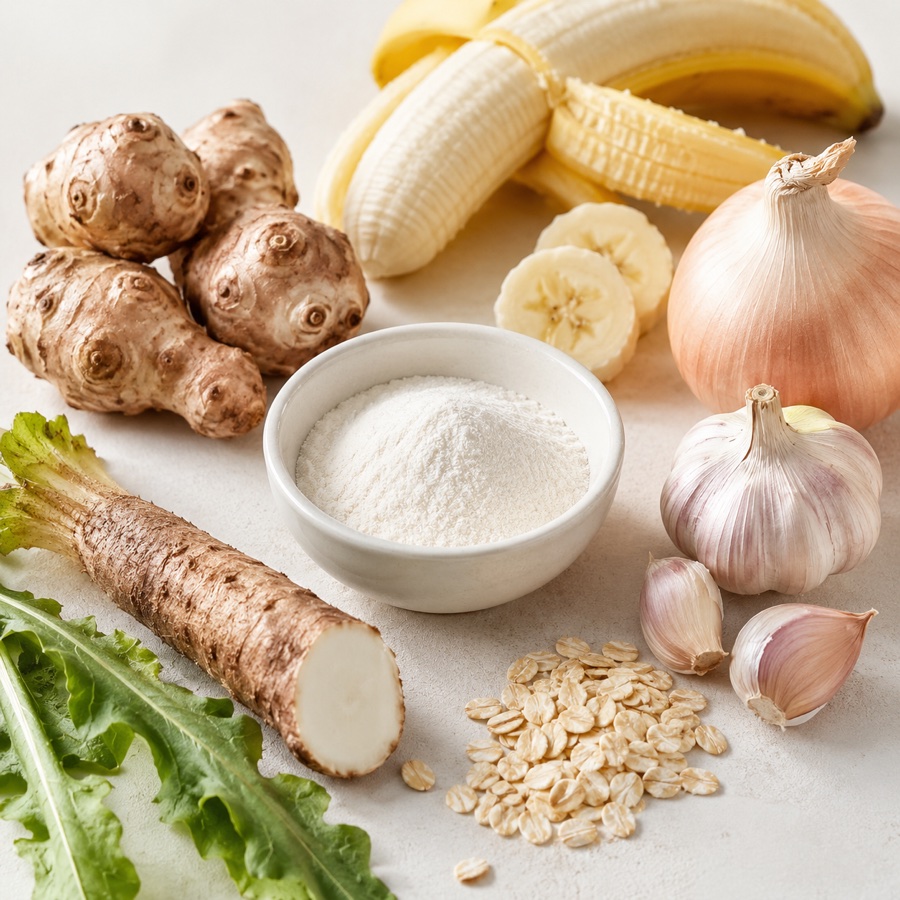
Include inulin and fructooligosaccharides (FOS). They occur naturally in foods such as chicory root, onion, garlic, leeks, asparagus, and wheat and are among the most studied prebiotic groups.
Include galactooligosaccharides (GOS) and naturally occurring α-galactooligosaccharides in legumes. They are found in human milk, legumes, and some dairy foods and are also added to some formulated foods as prebiotics.
A form of starch that is not fully digested in the small intestine and can be fermented in the colon. Common sources include legumes, oats, unripe bananas, and cooked then cooled rice, potatoes, and pasta.
A fermentable soluble fiber found mainly in oats and barley, and also in some mushrooms and yeast. Structure and physiological effects differ by source.
Include pectin, plant mucilages, arabinoxylans, and related fibers found in apples, okra, chia seeds, and many other plant foods.
Supplement Assessment
Start with your diet and goal, then judge the specific type, actual grams, duration, and tolerance.
Low priority for supplementation
- You eat vegetables and fruit every day
- You regularly eat whole grains or legumes
- Your plant-food sources are varied
- Bowel habits are generally regular
- You do not have a specific gut goal
- You are only considering it because of microbiome marketing
Your next step:
You probably do not need a dedicated supplement right now. Maintaining a varied plant-food intake is a higher priority than taking one inulin or FOS product long term.
A clear goal may justify a trial
- You have long had a low intake of vegetables, legumes, and whole grains
- Work, travel, or dietary restrictions make fiber intake inconsistent
- You have relatively infrequent bowel movements
- You want to selectively increase a particular microbial group
- You are willing to track outcomes for 4–8 weeks
- You can start low and adjust based on tolerance
Your next step:
Define the goal first, then choose inulin, FOS, GOS, or another relevant type. Low overall fiber intake does not necessarily require a prebiotic supplement.
Talk with a professional first
- Onion or garlic causes marked bloating
- Inulin has previously caused abdominal pain or diarrhea
- You are especially sensitive to fermentable foods
- You often have bloating, abdominal pain, or irregular bowel habits
- You have chronic diarrhea or a recent major change in bowel habits
- You have a gastrointestinal disorder or take regular medications
Your next step:
Do not start with a high dose of inulin or FOS, and do not keep increasing the dose to force adaptation. First clarify the symptoms, specific fiber, and tolerance.
Quick self-check
Are plant foods and fiber sources consistently limited or repetitive?
Do you have a specific goal such as bowel regularity or a particular microbial target?
Are you willing to track specific outcomes for 4–8 weeks?
Do you know the exact prebiotic type in the product?
Do you know the actual grams per serving?
Are you prone to bloating, abdominal pain, or FODMAP sensitivity?
Food Sources
Prebiotic-related compounds are spread across many plant foods. The goal is variety across types, not finding one “strongest prebiotic food.”
How to read the numbers
5 g of inulin-type fructans, 5 g of natural galactooligosaccharides, 5 g of resistant starch, and 5 g of beta-glucan do not have the same gut effects. Their structures, fermentation rates, and the microbes that can use them differ, so they should not be added together as “total prebiotics.”
Raffinose, stachyose, and other natural α-galactooligosaccharides in legumes are not the same as supplemental GOS. Resistant-starch content is strongly affected by ripeness, heating, and cooling.
Foods relatively high in these compounds
| Food | State | Prebiotic-related type | Approx. amount per 100 g | How to interpret |
|---|---|---|---|---|
| Chicory root | Fresh or dried root | Inulin-type fructans | About 15–20 g or more | One of the classic natural sources used to produce commercial inulin; much higher than most everyday vegetables. |
| Jerusalem artichoke | Fresh tuber | Inulin-type fructans | About 10–20 g | A notable everyday food source of inulin. |
| Onion | Fresh | Inulin-type fructans | About 1–5 g | Lower concentration, but typical serving sizes can be larger. |
| Chia seeds | Dry seeds | Soluble fiber + mucilage polysaccharides | About 3–7 g soluble fiber | High in dietary fiber; some can be fermented by gut microbes, making chia useful as part of a varied fiber intake. |
| Okra | Fresh | Soluble fiber + pectin-like polysaccharides | About 3.4 g soluble fiber | Okra mucilage is rich in pectin-like polysaccharides that can be used by gut microbes. |
| Soybeans | Dry beans | Natural α-galactooligosaccharides | About 3.3 g | Mainly raffinose and stachyose; these cannot be treated as gram-for-gram equivalents of supplemental GOS. |
| Green banana | Not fully ripe | Resistant starch | About 5–15 g or more | As bananas ripen, some resistant starch is converted to sugars. |
| Cooked and cooled potatoes | Cooked, then chilled | Resistant starch | About 2–5 g | Cooling can increase retrograded resistant starch. |
| Barley | Dry grain | Beta-glucan | About 5–11 g | Relatively high in beta-glucan and also provides other dietary fibers. |
| Oats | Dry grain | Beta-glucan | About 3–7 g | A practical everyday source with a different structure from inulin. |
Values refer to the listed major compound, not a single “total prebiotic” number that can be added across foods. Variety, ripeness, processing, and cooking can change actual amounts.
How to get a mix from food
Example One | Cover several types
Have oats at breakfast, add soybeans or other legumes at lunch, and use onion / garlic / leeks with vegetables and a staple food at dinner. This covers beta-glucan, natural galactooligosaccharides, and inulin-type fructans.
Example Two | Use food state to add variety
Choose oats + a slightly green banana at breakfast, legumes at lunch, and cooled then reheated potatoes with allium vegetables at dinner. This covers beta-glucan, resistant starch, natural galactooligosaccharides, and inulin-type fructans.
Cooking and storage notes
Soaking and cooking legumes can reduce some raffinose and stachyose and usually makes them easier to digest.
Cooling cooked rice, potatoes, and similar starches can increase retrograded resistant starch.
As bananas ripen, a substantial portion of resistant starch gradually converts to sugars.
Do not suddenly add large amounts of high-fructan foods, legumes, or other fermentable fibers; this can increase gas and abdominal discomfort.
Whole foods vs supplements
Whole foods
- Provide multiple fermentable fibers along with vitamins, minerals, and plant bioactives.
- Different foods can provide fructans, galactooligosaccharides, resistant starch, beta-glucan, and other fiber types.
- Well suited to long-term dietary variety, although the amount of any one prebiotic is often difficult to calculate precisely.
- Amounts vary with variety, ripeness, cooking, and processing.
Prebiotic supplements
- Make it easier to identify a specific type such as inulin, FOS, or GOS.
- Grams per serving are usually clearer, making comparison with a specific human study easier.
- Can more reliably reach study doses that may be difficult to obtain consistently from food.
- Rapidly increasing one fermentable fiber is more likely to cause bloating, abdominal pain, or bowel changes.
Dosage
There is no universal RNI, RDA, AI, UL, or recommended daily gram amount for prebiotics. Study amounts must be tied to the specific type, goal, population, and duration.
Human study reference doses by prebiotic type
Human study doses by specific type
These are research amounts for specific prebiotics and goals, not a universal “recommended prebiotic range.”
Important note
Dietary fiber and prebiotics overlap, but they are not the same concept. Dietary fiber has overall reference intakes; that does not mean prebiotics have one universal gram target.
12 g of inulin does not mean everyone should eat 12 g of every prebiotic each day.
A larger microbiome change does not necessarily mean a greater health benefit.
How dose works
The main issue with prebiotics is not how much enters the bloodstream, but whether a meaningful amount reaches the gut and can be used by microbes.
Focus on reaching the gut → which microbes use it → fermentation rate → actual tolerance, rather than the absorption percentage used for conventional nutrients.
How to read common product doses
Package weight, capsule count, blended fiber totals, and CFU do not replace the actual grams of a specific prebiotic.
| Product | Package or label number | Dose that is actually comparable | Formulation | How to interpret |
|---|---|---|---|---|
| NOW Foods Inulin Prebiotic Pure Powder, OrganicOfficial product link | About 4 g powder per serving | About 3.3 g organic inulin/FOS | Single-prebiotic powder Organic Inulin/FOS |
4 g is the total powder weight. When comparing with inulin research, use the approximately 3.3 g of actual inulin/FOS. |
| NOW Foods Prebiotic Inulin Fiber Veg CapsulesOfficial product link | 3 capsules/serving | About 1.95 g inulin/FOS/serving | Capsule format Organic Inulin/FOS |
Do not compare products by “3 capsules.” The meaningful number is about 1.95 g of the specific prebiotic per serving. |
| Benefiber OriginalOfficial product link | 6 g dietary fiber per serving | 6 g wheat-dextrin fiber | Soluble-fiber powder Wheat Dextrin |
This is not inulin. Do not treat 6 g of wheat dextrin as interchangeable with 6 g of inulin used in a study. |
| Metamucil Fiber GummiesOfficial product link | 3 gummies provide 5 g dietary fiber | 5 g plant-fiber blend/serving | Blended-fiber gummies Multiple plant fibers |
If the individual fibers are not disclosed, you cannot infer that the full 5 g is any one specific prebiotic. |
| Jarrow Formulas Jarro-Dophilus® + FOSOfficial product link | Probiotics + FOS | About 210 mg inulin-FOS/capsule | Synbiotic Probiotics with a small amount of FOS |
Probiotic CFU and prebiotic milligrams are different measures and must be interpreted separately. |
NOW Foods Inulin Prebiotic Pure Powder, Organic
Official product link- Package or label number
- About 4 g powder per serving
- Dose that is actually comparable
- About 3.3 g organic inulin/FOS
- Formulation
- Single-prebiotic powder
Organic Inulin/FOS
- How to interpret
- 4 g is the total powder weight. When comparing with inulin research, use the approximately 3.3 g of actual inulin/FOS.
NOW Foods Prebiotic Inulin Fiber Veg Capsules
Official product link- Package or label number
- 3 capsules/serving
- Dose that is actually comparable
- About 1.95 g inulin/FOS/serving
- Formulation
- Capsule format
Organic Inulin/FOS
- How to interpret
- Do not compare products by “3 capsules.” The meaningful number is about 1.95 g of the specific prebiotic per serving.
Benefiber Original
Official product link- Package or label number
- 6 g dietary fiber per serving
- Dose that is actually comparable
- 6 g wheat-dextrin fiber
- Formulation
- Soluble-fiber powder
Wheat Dextrin
- How to interpret
- This is not inulin. Do not treat 6 g of wheat dextrin as interchangeable with 6 g of inulin used in a study.
Metamucil Fiber Gummies
Official product link- Package or label number
- 3 gummies provide 5 g dietary fiber
- Dose that is actually comparable
- 5 g plant-fiber blend/serving
- Formulation
- Blended-fiber gummies
Multiple plant fibers
- How to interpret
- If the individual fibers are not disclosed, you cannot infer that the full 5 g is any one specific prebiotic.
Jarrow Formulas Jarro-Dophilus® + FOS
Official product link- Package or label number
- Probiotics + FOS
- Dose that is actually comparable
- About 210 mg inulin-FOS/capsule
- Formulation
- Synbiotic
Probiotics with a small amount of FOS
- How to interpret
- Probiotic CFU and prebiotic milligrams are different measures and must be interpreted separately.
Health Effects
Changes in selected gut microbes
One of the more consistent human findings for inulin-type fructans, FOS, and GOS is an increase in bifidobacteria or other selected microbial groups. Changes can appear with several grams per day over a few weeks. A microbiome change does not guarantee a meaningful health benefit.
View Meta-analysis
Bowel regularity
Native chicory inulin at about 10–12 g/day can increase stool frequency. This finding applies to a specific inulin, dose, and goal and should not be generalized to every product labeled “prebiotic.”
View EFSA Assessment
Gut fermentation and short-chain fatty acids
Different fibers can be fermented to produce acetate, propionate, butyrate, and other short-chain fatty acids. Responses vary by fiber type and by the starting microbiome, so this should not be interpreted as “more prebiotic = more butyrate = a healthier gut.”
View Individual-Response Study
Body weight and waist circumference
A meta-analysis of chicory-derived inulin-type fructans found possible small reductions in body weight, BMI, fat mass, and waist circumference. Populations, doses, and durations varied, so these products should not be positioned as stand-alone weight-loss supplements.
View Meta-analysis
Blood glucose and lipids
Some studies of inulin-type fructans report improvements in glucose, insulin, and selected lipid markers. Much of the evidence comes from people with diabetes or impaired glucose regulation and should not be converted into advice for healthy adults or a substitute for treatment.
View Meta-analysis
Inflammation, immunity, and healthy aging
The microbiome, short-chain fatty acids, and immune-inflammatory pathways are biologically connected, but evidence is not strong enough to show that long-term use of one prebiotic produces a clear anti-inflammatory or anti-aging benefit in healthy adults. A plausible mechanism is not the same as a proven health effect.
View Systematic Review
Product Selection
The key product questions are the specific prebiotic type, actual grams per serving, whether the formula is single or blended, and whether you tolerate it.
Check these four things
What is the active ingredient?
Confirm whether it is inulin, fructooligosaccharides (FOS), galactooligosaccharides (GOS), resistant dextrin, or another specific fiber. Do not stop at the words “Prebiotic Fiber.”
How much is actually in one serving?
Look for grams of the specific prebiotic per serving. Do not compare a 4 g powder serving, 3 capsules, or a 5 g blend by total weight alone. An undisclosed blend cannot be reverse-calculated into its individual components.
Are there unnecessary extras?
Check sweeteners, sugar alcohols, and flavors in gummies separately. Probiotic CFU, other fibers, and prebiotic grams should not be added together.
Is quality control transparent?
Look for a complete Supplement Facts panel, specific ingredient amounts, manufacturer, lot information, and quality details. Opaque proprietary blends are difficult to compare with research.
How to read the labelGeneral label for multi-fiber products
Specific prebiotic → actual grams per serving → single or blended fiber → probiotic CFU separately → additives and quality
If probiotics are included, list strains and CFU separately; do not add them to inulin grams
Start with a lower amount and adjust to tolerance. Label directions are not this site's recommended dose.
Specific type | Grams per serving | Formula breakdown | Lot | Testing
3.3 g of organic inulin per serving can be compared roughly with inulin study doses. If a product only lists a 5 g prebiotic-fiber blend without a breakdown, you can only confirm the total blend amount.
Find the specific prebiotic first
Look for inulin, FOS, GOS, or another clearly named fiber.
Check actual grams per serving
Use Serving Size to calculate how much of the target ingredient one serving actually provides.
Confirm single vs blended fiber
If a blend is not broken down, do not treat the total grams as any one prebiotic.
Keep probiotic CFU separate
In a synbiotic, CFU and prebiotic grams cannot be added or interchanged.
Then check additives and quality
Review sugar alcohols, sweeteners, lot information, and testing details.
How to choose among common formsChoose by the specific ingredient, goal, and tolerance
Inulin / FOS
Main features
Human research is relatively extensive and gram amounts are easy to verify. Fermentation is relatively rapid, so increasing too quickly can cause marked bloating.
Site guidance
These are easier to interpret when the goal is bowel regularity or comparison with existing studies. People with a sensitive gut do not need to chase high doses.
Galactooligosaccharides (GOS)
Main features
A classic non-inulin prebiotic. Adult studies using several grams per day can produce changes in bifidobacteria.
Site guidance
Check the actual grams of GOS. Do not substitute natural α-galactooligosaccharides in legumes or a blended product's total weight gram for gram.
Blended soluble fibers
Main features
May include resistant dextrin, acacia gum, wheat dextrin, and other fibers. Total fiber is often clear, while the amount of each component may not be.
Site guidance
Useful for conveniently increasing dietary fiber. If you want to match a specific prebiotic study, choose a product that discloses the ingredients and grams clearly.
Synbiotics
Main features
Combine probiotics and prebiotics, so labels may show both CFU and milligrams or grams.
Site guidance
Consider them only when both components make sense for your goal. Always interpret CFU and grams separately.
How to Take
Start with a lower amount and increase based on tolerance rather than starting at a high research dose by default.
Default plan (healthy adults)
When to take it: Most products do not require a fixed morning or evening time
With food or on an empty stomach: Follow product directions first and adjust based on tolerance
How to start: Begin with a lower serving and gradually increase if tolerated
Should it be divided?: Larger daily amounts can be split and are often easier to tolerate
How to use powders: Mix into water, beverages, or food according to the label
Does it need to be taken long term?: There is no universal requirement; reassess based on the goal and actual response
Can it be taken with probiotics?: Yes. Products intentionally combining both are called synbiotics
Do you need extra fluid?: Fiber supplements generally should be taken with adequate fluid and according to product instructions
Frequently asked questions
Does bloating mean it is not suitable for me?
Gas can increase temporarily. If symptoms are marked, persistent, or disruptive, lower the amount or stop.
Is a higher dose better?
No. Larger amounts may increase bloating, abdominal pain, and bowel changes. There is no need to chase the highest gram amount.
What is the difference between prebiotics and probiotics?
Probiotics are live microorganisms. Prebiotics are substrates selectively used by microorganisms that confer a health benefit.
Should I keep rotating different prebiotics?
Frequent switching is unnecessary. Choose one that fits the goal and observe its effects and tolerance for several weeks.
More questions about use (click to expand)
How often should I reassess?
A 4–8 week observation period is practical. Track bowel-movement frequency, bloating, abdominal pain, and the target outcome; if there is no improvement, do not simply keep increasing the dose.
Do I need a supplement if my diet is already varied?
Usually not when bowel habits are normal and there is no specific goal. Long-term diversity of plant foods is a higher priority than taking one fixed prebiotic.
Risks & Precautions
Common adverse effects
- Gas
- Increased flatulence
- Bloating and bowel sounds
- Changes in bowel habits
- More common when the amount is increased too quickly
Higher-dose risks
- There is no universal UL for all ingredients
- High research doses are not safety limits
- Abdominal pain, diarrhea, or marked intolerance can occur
- Do not keep escalating the dose just because a microbiome change is larger
Who should be more cautious
- Irritable bowel syndrome (IBS)
- FODMAP sensitivity
- Onion or garlic triggers marked symptoms
- Inulin or FOS has previously caused abdominal pain or diarrhea
- Chronic diarrhea or an abnormal bowel pattern
Medications and special situations
- People taking regular medications should check whether fiber needs to be separated from the medication
- Seek professional advice during treatment for gastrointestinal disease
- During pregnancy or breastfeeding, confirm the specific product before using large amounts
- Follow the instructions for the specific medication and product
Stop and seek advice
If marked abdominal pain, persistent diarrhea, or worsening constipation keeps recurring even after lowering the amount, stop and evaluate the cause.
Seek prompt medical care
Seek prompt care for severe or persistent abdominal pain, repeated vomiting, blood in the stool, marked dehydration, or rapidly worsening symptoms.
Sources
Source links use clean URLs from institutions, original papers, or official product pages. Product pages are used only to explain labels, not as recommendations.
Definitions & Classification
Food Sources
Dosage & Gut Microbiome
Bowel Function
Body Weight & Metabolism
Product Information
Last updated: August 17, 2026