Proanthocyanidins
Proanthocyanidins / Proanthocyanidins / Oligomeric Proanthocyanidins / Condensed Tannins
Proanthocyanidins are a large family of plant polyphenols built from flavan-3-ol units. They are also known as condensed tannins and are not a single compound. In supplements, oligomeric proanthocyanidins from grape seed are the most common form.
30-second check: which situation fits you best?
Just looking for everyday anti-inflammatory or antioxidant support
You have seen claims about antioxidant activity and want long-term general wellness support, but you do not have a specific problem or measurable goal.
You have a specific goal you want to improve
If you are focused on blood pressure, blood lipids, oxidative stress, or selected metabolic markers, review human studies that match your population, dose, and product form.
You are planning to use it or already taking it
The most important number is not the largest milligram value on the front label. First determine whether the label is reporting total grape-seed extract, total polyphenols, oligomeric proanthocyanidins, or another proanthocyanidin measure.
Basic Overview
What it is
Proanthocyanidins are oligomers or polymers made from multiple flavan-3-ol units and are also called condensed tannins. They include structural groups such as procyanidins and prodelphinidins, with procyanidins being one major group. Oligomeric proanthocyanidins are the lower-polymerization fraction within the larger proanthocyanidin family. They are not essential nutrients. Grape-seed OPCs are common in supplements, but 100 mg of grape-seed extract does not automatically equal 100 mg of OPCs.
Why people use it
- Short-term trials for specific goals such as blood pressure or blood lipids
- Obtain a more concentrated, standardized source of grape-seed OPCs
- Target oxidative-stress or selected inflammatory markers
- Choose a plant-polyphenol supplement with clearly defined active ingredients
- Use as an optional optimization, not as foundational nutrition
- Set a defined trial period and reassess whether to continue
How it relates to healthy aging
Proanthocyanidins have been studied for antioxidant, vascular, and metabolic effects. Some human studies report changes in blood pressure, blood lipids, CRP, or oxidized LDL.
These are changes in biomarkers or risk markers, not evidence of reversing aging. Reliable clinical evidence does not show that proanthocyanidins extend lifespan or make overall function meaningfully “younger” in healthy adults.
Supplement Assessment
There is no basic-nutrient question of whether you “get enough” each day. Focus instead on a defined goal, relevant human evidence, product matching, and measurable change.
Low priority right now
- No specific goal
- Interested only because of antioxidant or “free-radical scavenging” marketing
- Want a supplement to make the whole body healthier or younger
- Already eat berries, nuts, and cocoa regularly
- Lifestyle still has room for improvement
- Plan to take it indefinitely without a measurable target
- Place more weight on antioxidant capacity than on whether the product fits your goal
Your next step:
Prioritize diet, physical activity, and sleep, and turn a vague “antioxidant” goal into something observable.
Clear goal: worth a closer look
- Focused on blood pressure, blood lipids, or oxidative stress
- Willing to review human research
- Accept that benefits may be limited to small changes in markers
- Choose a standardized grape-seed extract similar to the product used in research
- Confirm whether the label reports OPCs, procyanidins, or another related measure
- Understand that different botanical sources are not interchangeable
- Set a 6–12 week observation period
- Reassess if there is no meaningful benefit
Your next step:
Define the goal first, then match the population, formulation, and dose. Grape-seed studies should not be generalized to every proanthocyanidin product.
Consult a professional first
- Pregnancy or breastfeeding
- Children and adolescents
- Low iron stores, tendency toward iron deficiency, or current iron supplementation
- Regular prescription medication use
- Use of anticoagulant or antiplatelet medication
- Preparing for surgery or an invasive procedure
- Long-term use at clearly high doses
- Use of a special high-bioavailability or carrier-based formulation
Your next step:
First review medication interactions, iron absorption, special-population risks, and whether safety data from conventional extracts apply to your product.
Food Sources
Proanthocyanidins have no established RNI, RDA, or AI, so this page does not show a percentage of an adult reference intake or create an artificial daily target.
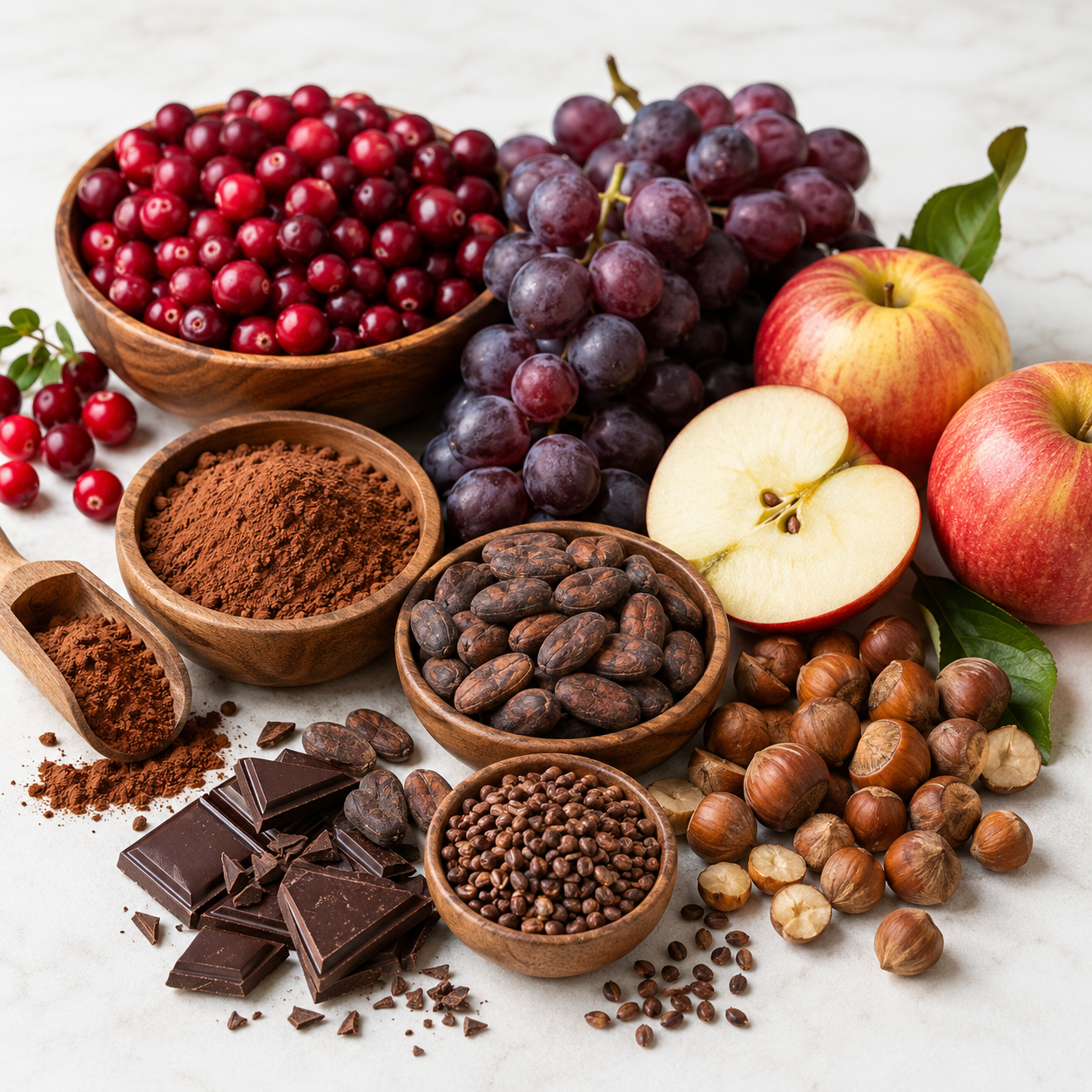
Common Foods High in Proanthocyanidins
| Food | Form | Proanthocyanidins per 100 g | Common Serving | Approx. per Serving | How to Read It |
|---|---|---|---|---|---|
| Cinnamon powder | Dried spice | About 8,084 mg | 2 g | About 162 mg | Extremely concentrated, but only a small amount is normally used at a time |
| Natural unsweetened cocoa powder | Non-alkalized dry powder | About 4,252 mg | 10 g | About 425 mg | Even 10 g provides a substantial amount; alkalization can reduce levels considerably |
| Aronia berries | Fresh raw fruit | About 1,330 mg | 100 g | About 1,330 mg | A high-content fresh fruit source, with a relatively large share of higher-polymer PACs |
| Cranberries | Fresh raw fruit | About 1,201 mg | 100 g | About 1,201 mg | Rich in PACs with distinctive A-type linkages |
| Hazelnuts | Nuts | About 491 mg | 25 g | About 123 mg | Also provide fat, fiber, and other polyphenols |
| Pecans | Nuts | About 477 mg | 25 g | About 119 mg | Easy to include in normal portions |
| Wild blueberries | Fresh raw fruit | About 325 mg | 100 g | About 325 mg | Also rich in anthocyanins and other polyphenols |
| Pistachios | Raw nuts | About 226 mg | 25 g | About 57 mg | Still a useful everyday source |
How should you read these numbers?
Per-100-g values are useful for comparing concentration; common servings are more useful for estimating real intake. Cinnamon may contain about 8,084 mg/100 g, but a typical use is only 1–3 g. Cocoa may contain about 4,252 mg/100 g, but a serving is often 5–15 g. A serving of hazelnuts is usually 20–30 g, while berries are much easier to eat in a 100 g portion. Do not judge practical value only by the per-100-g ranking.
How Much Can Food Provide in a Day?
Example 1
About 100 g blueberries + 25 g hazelnuts or pecans.
This combination provides proanthocyanidins from berries and nuts along with fiber, healthy fats, and other polyphenols.
Example 2
About 10 g non-alkalized unsweetened cocoa powder + a small amount of cinnamon, added to oats, yogurt, or milk.
Do not try to match supplement-study milligrams. Food intake is not the same as a standardized grape-seed extract research setting.
Cooking and storage tips
Choose non-alkalized cocoa when possible: alkalization can substantially reduce measured proanthocyanidins.
Use actual serving size for spices: cinnamon is highly concentrated, but the amount used at one time is small.
Keep fresh fruit and dried fruit separate: dehydration, added sugar, and processing change values per unit weight, so fresh-fruit numbers should not be reused.
No need to chase one very high dose: use a variety of plant foods to build a long-term dietary source.
Whole foods vs supplements
Whole Foods
- Also provide fiber, vitamins, minerals, and multiple plant bioactives
- Contain a complex mixture, not only oligomeric proanthocyanidins
- Suitable as a long-term dietary source
- Composition varies with variety and processing
- No need to match supplement-study doses
Supplements
- Concentrated target ingredients
- Can be standardized to OPCs or other proanthocyanidin measures
- Easier to match to a specific study
- Testing methods and label definitions vary substantially
- Long-term high-dose use requires additional safety consideration
Dosage
Different products may report total extract weight, OPCs, or total polyphenols. These numbers mean different things and should not be compared directly by milligrams.
Official Dose Status, Regulatory References & Human Research
Health Canada safety reference
This applies only to a specific regulatory context and specific grape-seed specification. It is not a recommended intake, a formal UL, or a safety ceiling for all proanthocyanidin products.
Human-Study References
Formulations, populations, and standardization percentages differ, so the research cannot be combined into a single recommended dose of 200–2,500 mg.
Core principle:Specific goal + specific product + actual active ingredient + matching human research.
Important Note
There is currently no RNI, RDA, AI, formal UL, or universally recommended daily dose. Health Canada’s 100 mg OPC/day figure is a regulatory condition for a specific grape-seed extract, not a universal intake recommendation.
Human studies have used roughly 200–400 mg proanthocyanidins/day, but that is not a default recommendation for healthy adults. Multi-gram grape-seed extract doses mainly come from short-term safety studies.
Total grape-seed extract weight is not the same as the actual OPC dose. When comparing products, first check whether the label clearly states OPCs, proanthocyanidins, or another standardized component.
Dose Utilization
Proanthocyanidins are not all absorbed intact. More highly polymerized forms largely reach the colon, where gut microbes convert them into smaller phenolic metabolites that may then be partly absorbed. Monomers and lower oligomers are generally more bioavailable.
Therefore, consuming 100 mg of proanthocyanidins does not mean 100 mg of intact proanthocyanidins enters the bloodstream. Raw-material composition, degree of polymerization, and delivery system all affect human exposure.
How to Read Common Product Doses
The number on the front label is not necessarily the actual OPC dose. Total Polyphenols, equivalent raw-material amounts, and special complex weights need to be interpreted separately.
| Product | Package / Label Number | Dose That Is Actually Comparable | Formulation | How to Read It |
|---|---|---|---|---|
| GNC HumanN Cardiovascular Health DailyOfficial product link | 150 mg Enovita® grape-seed extract/serving | 127.5 mg oligomeric proanthocyanidins (OPCs)/serving | 85% oligomeric proanthocyanidins Enovita® grape-seed extract; 95% Total Polyphenols |
150 mg × 85% = 127.5 mg OPCs; other blended ingredients should not be added to this number. |
| NOW Foods Grape Seed 100 mgOfficial product link | 100 mg grape-seed extract/capsule | 90 mg Total Polyphenols; OPC content cannot be reliably calculated | ≥90% Total Polyphenols The label refers to Total Polyphenols, not 90% OPCs |
You can confirm ≥90 mg total polyphenols, but you cannot rewrite this as 90 mg OPCs. |
| Solgar Grape Seed Extract 100 mgOfficial product link | 100 mg grape-seed extract/capsule | 90 mg Total Polyphenols; OPC content cannot be reliably calculated | 90% Total Polyphenols Not defined as oligomeric proanthocyanidins (OPCs) |
The label provides 90 mg total polyphenols; it cannot be rewritten as 90 mg OPCs. |
| Blackmores Bilberry Eye Support AdvancedOfficial product link | 150 mg extract; equivalent to 18 g dried grape seed | 142.5 mg procyanidins/tablet | 95% procyanidins Label standardized to Procyanidins; also contains bilberry |
The 18 g figure is an equivalent dry raw-material amount, not 18 g of proanthocyanidins. Compare the 142.5 mg procyanidins instead. |
| Swisse Beauty Grape SeedOfficial product link | 118.75 mg grape-seed extract/tablet; equivalent to 14.25 g dried grape seed/tablet | 95 mg procyanidins/tablet | About 80% procyanidins Calculated from the official label: 237.5 mg grape-seed extract and 190 mg procyanidins per 2 tablets; also contains vitamin C. |
The 14.25 g figure is equivalent dry grape-seed raw material, not the actual extract weight. The relevant comparable procyanidin dose is 95 mg/tablet. |
| Jamieson ResveratrolOfficial product link | 100 mg Leucoselect Phytosome® complex | 8.25 mg oligomeric proanthocyanidins (OPCs)/capsule | OPC phospholipid complex Leucoselect Phytosome® |
The 100 mg figure is the entire complex; it provides only 8.25 mg OPCs. |
| NOW Foods Pine Bark Extract 240 mgOfficial product link | 240 mg pine-bark extract/capsule | ≥216 mg proanthocyanidins/capsule | ≥90% proanthocyanidins Pine-bark extract (Pinus massoniana) |
You can calculate at least 216 mg pine-bark proanthocyanidins, but this should not be treated as equivalent to 216 mg grape-seed OPCs. |
GNC HumanN Cardiovascular Health Daily
Official product link- Package / Label Number
- 150 mg Enovita® grape-seed extract/serving
- Dose That Is Actually Comparable
- 127.5 mg oligomeric proanthocyanidins (OPCs)/serving
- Formulation
- 85% oligomeric proanthocyanidins
Enovita® grape-seed extract; 95% Total Polyphenols
- How to Read It
- 150 mg × 85% = 127.5 mg OPCs; other blended ingredients should not be added to this number.
NOW Foods Grape Seed 100 mg
Official product link- Package / Label Number
- 100 mg grape-seed extract/capsule
- Dose That Is Actually Comparable
- 90 mg Total Polyphenols; OPC content cannot be reliably calculated
- Formulation
- ≥90% Total Polyphenols
The label refers to Total Polyphenols, not 90% OPCs
- How to Read It
- You can confirm ≥90 mg total polyphenols, but you cannot rewrite this as 90 mg OPCs.
Solgar Grape Seed Extract 100 mg
Official product link- Package / Label Number
- 100 mg grape-seed extract/capsule
- Dose That Is Actually Comparable
- 90 mg Total Polyphenols; OPC content cannot be reliably calculated
- Formulation
- 90% Total Polyphenols
Not defined as oligomeric proanthocyanidins (OPCs)
- How to Read It
- The label provides 90 mg total polyphenols; it cannot be rewritten as 90 mg OPCs.
Blackmores Bilberry Eye Support Advanced
Official product link- Package / Label Number
- 150 mg extract; equivalent to 18 g dried grape seed
- Dose That Is Actually Comparable
- 142.5 mg procyanidins/tablet
- Formulation
- 95% procyanidins
Label standardized to Procyanidins; also contains bilberry
- How to Read It
- The 18 g figure is an equivalent dry raw-material amount, not 18 g of proanthocyanidins. Compare the 142.5 mg procyanidins instead.
Swisse Beauty Grape Seed
Official product link- Package / Label Number
- 118.75 mg grape-seed extract/tablet; equivalent to 14.25 g dried grape seed/tablet
- Dose That Is Actually Comparable
- 95 mg procyanidins/tablet
- Formulation
- About 80% procyanidins
Calculated from the official label: 237.5 mg grape-seed extract and 190 mg procyanidins per 2 tablets; also contains vitamin C.
- How to Read It
- The 14.25 g figure is equivalent dry grape-seed raw material, not the actual extract weight. The relevant comparable procyanidin dose is 95 mg/tablet.
Jamieson Resveratrol
Official product link- Package / Label Number
- 100 mg Leucoselect Phytosome® complex
- Dose That Is Actually Comparable
- 8.25 mg oligomeric proanthocyanidins (OPCs)/capsule
- Formulation
- OPC phospholipid complex
Leucoselect Phytosome®
- How to Read It
- The 100 mg figure is the entire complex; it provides only 8.25 mg OPCs.
NOW Foods Pine Bark Extract 240 mg
Official product link- Package / Label Number
- 240 mg pine-bark extract/capsule
- Dose That Is Actually Comparable
- ≥216 mg proanthocyanidins/capsule
- Formulation
- ≥90% proanthocyanidins
Pine-bark extract (Pinus massoniana)
- How to Read It
- You can calculate at least 216 mg pine-bark proanthocyanidins, but this should not be treated as equivalent to 216 mg grape-seed OPCs.
Health Effects
Blood Pressure
Systematic reviews suggest grape-seed extract may slightly lower diastolic blood pressure, while effects on systolic pressure are inconsistent and trials vary substantially. People with elevated blood pressure or metabolic risk may be more likely to show changes, but supplementation does not replace antihypertensive medication or lifestyle treatment.
View Meta-analysis
Blood Lipids
Some trials and meta-analyses suggest LDL cholesterol and triglycerides may decrease, but total cholesterol and HDL have not improved consistently. Samples are small and formulations vary, so this is not a certain lipid-lowering effect.
View Meta-analysis
Glucose & Metabolic Health
Meta-analysis has found a small reduction in fasting glucose, but HbA1c, body weight, and other longer-term or more clinically meaningful outcomes have not improved consistently. It should not replace standard management or be marketed as preventing diabetes.
View Meta-analysis
Oxidative Stress
200–400 mg/day of grape-seed proanthocyanidins for 12 weeks reduced some MDA-modified LDL measures. This cannot be extrapolated to fewer cardiovascular events, disease prevention, or slower aging.
View Randomized Controlled Trial
Inflammatory Markers
Some studies report a small average decrease in CRP, but populations, products, doses, and durations vary considerably. A lower CRP does not automatically mean less perceived inflammation, better joints, or faster recovery.
View Meta-analysis
Healthy Aging
Evidence is concentrated on blood pressure, blood lipids, and biomarkers. Reliable research does not show that long-term use in healthy adults reverses aging, slows overall functional decline, or extends lifespan.
View Official Resource
Product Selection
Botanical source, actual extract weight, and the clearly stated OPC or other proanthocyanidin content matter most.
Check these four things when buying
What is the active ingredient?
First identify the source—Grape Seed Extract, pine bark, or another botanical—and then identify what is standardized: OPCs, Procyanidins / Proanthocyanidins, total proanthocyanidins, or Total Polyphenols. These measures are not interchangeable milligram for milligram.
How much do you actually get per serving?
Check the extract milligrams first, then look for a standardization percentage. You can calculate a target ingredient only when the label clearly states the target, such as OPCs or Procyanidins / Proanthocyanidins, and the standardization percentage. Total Polyphenols cannot automatically be converted to OPCs, and an “equivalent to 14 g grape seed” statement does not mean 14 g of OPCs.
Are there unnecessary added ingredients?
Vitamin C, resveratrol, bilberry, green tea, other polyphenols, and phospholipid carriers should be interpreted separately and should not be added to OPCs to create a larger “total proanthocyanidin” number.
Does it have reliable quality control?
Check the botanical source and plant part, extract weight, standardized component and percentage, active amount per serving, batch information, contaminant or heavy-metal testing, and any verifiable third-party quality documentation.
How to Read the LabelExample: 150 mg grape-seed extract standardized to 85% oligomeric proanthocyanidins (OPCs)
Total extract weight is not the same as the actual OPC dose.
Total Polyphenols or other blended ingredients should be evaluated separately
Calculate from the actual OPC amount per serving
Source | Standardization | Lot | Testing
150 mg × 85% = 127.5 mg OPCs. The 150 mg figure is total grape-seed extract weight, not 150 mg of OPCs.
Confirm the botanical source
First confirm that the raw material is Grape Seed Extract. Do not confuse the botanical raw-material name with the active-ingredient name.
Check total extract weight
In this example, each capsule contains 150 mg grape-seed extract. The 150 mg figure is total extract weight, not 150 mg of OPCs.
Find the standardization percentage
The label states standardized to 85% OPCs. That percentage is what allows you to calculate the actual OPC dose.
Calculate the actual active dose
150 mg × 85% = 127.5 mg, so each capsule can be confirmed to provide 127.5 mg of OPCs.
Do not combine Total Polyphenols with OPCs
If the label separately reports Total Polyphenols, treat it as a different measure. Do not automatically convert a “total polyphenol percentage” into the same percentage of OPCs.
Confirm serving size and daily servings
Here, one serving is 1 capsule. To calculate daily intake, also check how many servings the label recommends each day. Example: 127.5 mg OPC/capsule × 1 capsule/day = 127.5 mg OPC/day.
How to Choose Among Common Forms(Different sources and formulations are not interchangeable by milligrams)
Standardized Grape-Seed OPCs
Key Features
The OPC or Procyanidin percentage is clearly stated, making the actual dose easier to calculate and the product easier to compare with grape-seed research.
Site Guidance
For a matching goal, prioritize products with clearly stated actual OPC content and standardization rather than the largest extract milligram number.
Grape-seed extract labeled only for Total Polyphenols
Key Features
Total Polyphenols is a broader measure than OPCs and cannot be used to infer the OPC percentage.
Site Guidance
Not necessarily an inferior product, but for precise comparison with research, prefer products that clearly state OPCs or Procyanidins.
OPC Phospholipid Complex
Key Features
The total complex weight may be far higher than the OPC amount, and human exposure may also differ.
Site Guidance
Confirm the actual OPC content. Do not compare by the milligrams of the entire complex or convert it directly to an equal dose of conventional extract.
Pine-Bark Proanthocyanidins
Key Features
Rich in proanthocyanidins, but the source, composition, and research material differ from grape-seed extract.
Site Guidance
If you are using grape-seed research as the reference, choose grape seed rather than substituting the same milligram amount from pine bark.
Cranberry A-Type Proanthocyanidins
Key Features
A-type linkages are distinctive and differ from the B-type proanthocyanidins commonly found in grape seed.
Site Guidance
For cranberry-specific goals, choose a product that clearly states cranberry proanthocyanidin content rather than replacing it milligram for milligram with grape-seed OPCs.
How to Take
Use the actual OPC or other proanthocyanidin content, and set a defined trial period for a specific goal.
Default plan (healthy adults)
Official recommended dose: No universal official recommended dose has been established
Frequency: Follow the specific product label
Gastrointestinal tolerance: Take with food if it causes stomach discomfort
With food?: Most products can be taken with or after a meal
Split doses?: Higher daily amounts can be divided according to the product label
Long-term use?: Set an observation period first, then decide whether to continue
Missed dose: If you occasionally miss a dose, simply skip it
Frequently asked questions
With food or on an empty stomach?
There is no evidence that it must be taken on an empty stomach. If you are prone to stomach discomfort, take it with food and follow the label.
Morning or evening?
There is no clearly preferred time of day. Choose a time that is easy to maintain and well tolerated.
Can I take it with iron?
Polyphenols may reduce absorption of non-heme iron when taken at the same time. If your iron stores are low or you take an iron supplement, it is more reasonable to separate concentrated grape-seed polyphenols from iron.
Do I need to split the dose?
There is no universal rule. If the daily dose is relatively high or the label recommends twice-daily use, divide it according to the label.
How long should I take it?
Most studies last about 6–12 weeks. Set an observation period and reassess if there is no benefit.
How do I know if it is working?
Track a preselected outcome such as home blood pressure or blood lipids. Do not use “antioxidant” marketing claims as proof that it is working.
Risks & Precautions
Common Side Effects
- Headache or dizziness: occasionally reported and usually mild
- Nausea or stomach discomfort: relatively common mild reactions
- Diarrhea: reported in a small number of participants in high-dose studies
- Constipation: occasionally reported in short-term high-dose studies
- Mild reactions such as skin itching: occasionally reported
- For mild stomach discomfort, reduce the dose or take it with food; stop if symptoms persist or recur.
High-Dose Risks
- No formal UL does not mean the dose can be increased without limit
- 100 mg/day is not a universal supplement UL; it applies only to a specific regulatory context involving 70%–90% OPCs
- The highest 2,500 mg/day grape-seed extract data lasted only 4 weeks and came from a small sample
- Long-term chronic-use, reproductive/developmental, and very-high-intake data are limited
- General safety data should not be applied automatically to special high-absorption formulations
- Liver: unlike EGCG or curcumin, current evidence does not justify a prominent liver warning for grape-seed extract. A reliable causal link with clinically apparent liver injury has not been established. Combination products still require separate review of their other ingredients.
People Who Need More Caution
- Pregnancy or breastfeeding
- Children and adolescents
- Low iron stores or tendency toward iron deficiency
- Currently taking an iron supplement
- Long-term high-dose use
- Use of special delivery systems
- Iron absorption should not be overstated: short-term use in healthy adults has not consistently shown a meaningful decline in iron status. People with iron deficiency, those taking iron, or those at higher risk are better off separating concentrated grape-seed polyphenols from iron supplements or high-iron meals.
Medications & Special Situations
- Regular medication use: check for potential interactions before starting
- Anticoagulant/antiplatelet drugs: in-vitro data suggest possible platelet effects, but human evidence is limited, so this remains a potential risk
- Other prescription drugs: in-vitro work suggests effects on some CYP450 enzymes, but clinical relevance is uncertain; an in-vitro effect does not prove a clinically important interaction
- Iron supplements: when correcting iron deficiency, avoid taking concentrated grape-seed polyphenols at the same time
- Surgery/invasive procedures: tell your clinician you use the supplement; do not invent one universal number of days to stop
- Do not claim that taking it 2 hours apart from anticoagulants solves the issue; potential platelet or metabolism-related risks cannot be guaranteed away by simple timing separation.
Stop and consult
Stop and speak with a clinician or pharmacist if persistent nausea, diarrhea, constipation, headache, marked dizziness, or recurrent skin discomfort occurs.
Seek Medical Care Promptly
Seek prompt medical care for difficulty breathing, swelling of the face or lips, fainting, persistent severe vomiting, or unexplained significant bleeding.
Sources
Sources support PAC definitions, food content, grape-seed OPC regulation, absorption, iron-related issues, human evidence, and product labels. Supplement evidence is concentrated on grape-seed extract/OPCs and should not be generalized to all sources.
Background, Food Sources & Overall Safety
Definitions, polymerization categories, and food content.
Health Effects & Human Evidence
Dose & Safety References
Mainstream Product Labels & Dose Examples
Data Boundaries
Grape-seed extract weight ≠ OPCs; Total Polyphenols ≠ OPCs or total PACs; equivalent dry grape seed ≠ PACs; OPCs are only the oligomeric fraction; grape seed, pine bark, and cranberry are not interchangeable by milligrams; ordinary regulatory figures do not apply automatically to special formulations; short-term high-dose studies do not establish long-term recommendations or a UL; food databases do not set personal intake targets.
Last updated: August 12, 2026