Ground Flaxseed
Ground Flaxseed / Milled Flaxseed / Ground Linseed / Flaxseed Meal
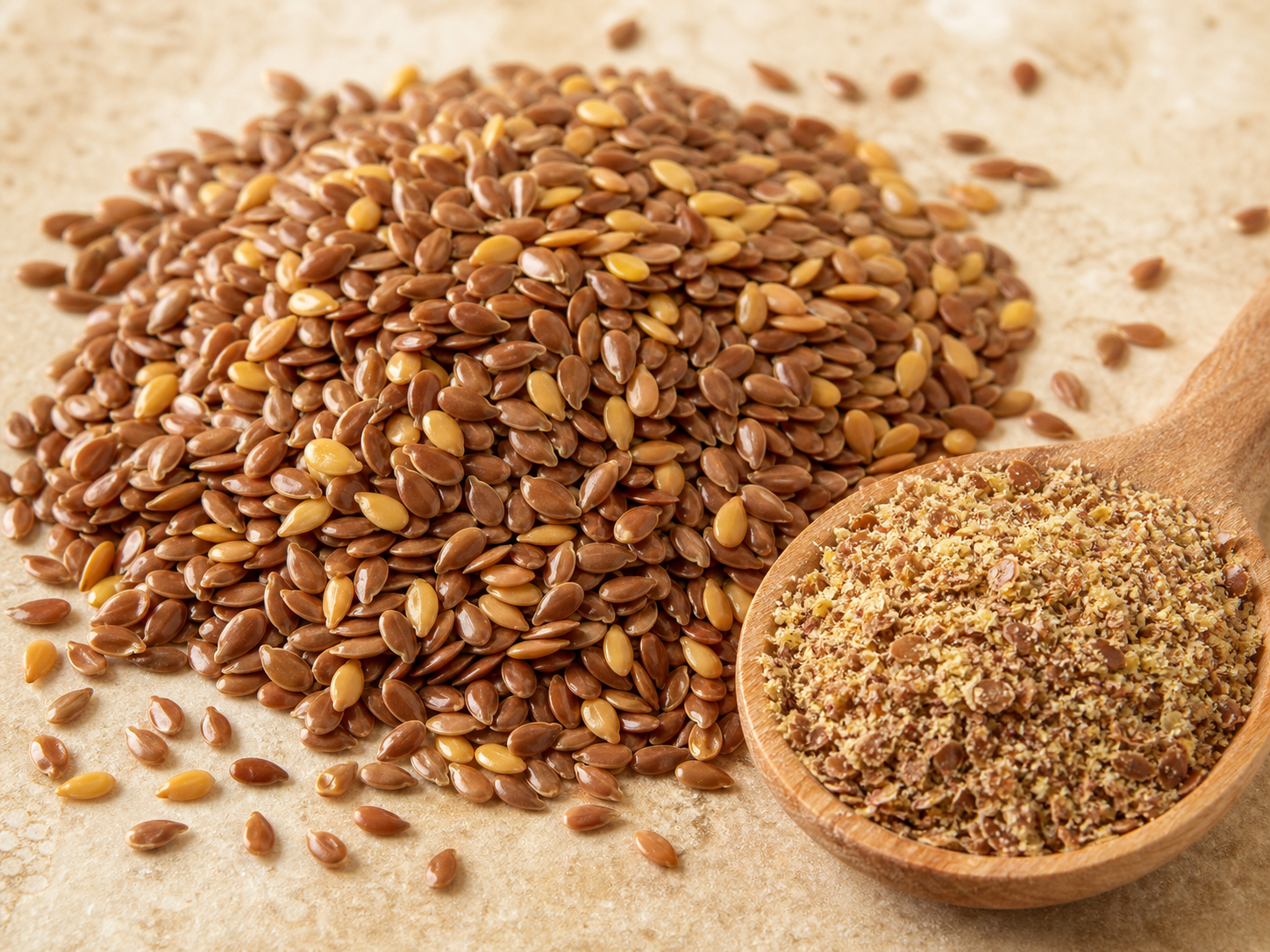
Ground flaxseed is made by milling mature seeds of flax (Linum usitatissimum). It provides plant-based omega-3 alpha-linolenic acid (ALA), dietary fiber, and lignans such as SDG. It is an ordinary food, not a supplement that humans must consume separately. Whole-ground flaxseed, partially defatted flax meal, flaxseed oil, and lignan extracts differ in fat, ALA, fiber, and human-study outcomes.
30-second check: which situation fits you best?
You Want More Plant-Based Omega-3 and Dietary Fiber
Ground flaxseed provides ALA, dietary fiber, and lignans and is easy to add to breakfast or baked foods. It is not a “superfood” that everyone needs to add, and ALA should not be treated as equivalent to EPA and DHA from fish oil.
You Have a Specific Goal: Blood Lipids, Blood Pressure, or Glucose
Human evidence for flaxseed is relatively stronger for blood lipids and blood pressure, and some glucose markers also show improvement. Effects from whole or ground flaxseed are not the same as those from flaxseed oil. The clearest improvements often occur in people who already have higher metabolic risk.
You Already Eat Ground Flaxseed Every Day
If you already use it long term, confirm whether the product is whole-ground or defatted meal and how much ALA, dietary fiber, and lignans each serving actually provides. Also consider total daily amount, fluid intake, storage, and whether the product is tested for food-safety issues such as cadmium.
Basic Overview
What is it?
Ground flaxseed is a food powder made by milling mature seeds of flax (Linum usitatissimum). Flaxseed is naturally rich in fat, especially the plant-based omega-3 fatty acid ALA, and also provides dietary fiber, protein, and lignans.
It is an ordinary food, not a supplement that humans must consume separately.
Why do people use it?
How does it relate to healthy aging?
The more reasonable long-term health links for flaxseed come from blood lipids, blood pressure, glucose regulation, dietary fiber, and plant unsaturated fat intake. These are all relevant to long-term cardiometabolic health, but there is no clinical evidence that ground flaxseed directly slows human aging or extends lifespan.
A more accurate description is: a nutrient-dense seed food that may provide limited support for some cardiometabolic markers, not an anti-aging supplement.
Supplement Assessment
First decide whether you simply want to enrich your intake of seeds and fiber or have a specific goal that matches human evidence.
Low Priority for Routine Supplementation
- You want to eat large fixed amounts mainly because of omega-3, anti-inflammatory, superfood, or anti-aging marketing.
- Your usual diet already includes nuts, seeds, whole grains, vegetables, and other high-fiber foods.
- You want to turn clinical-study doses directly into everyday intake.
- There are more important improvements to make in your overall diet.
Your next step:
Look at your overall diet first. If you simply want more seeds, fiber, and plant-based ALA, ground flaxseed can be one option rather than something to increase continuously for “anti-inflammatory” purposes.
A specific goal may justify a trial
- You already have elevated LDL or elevated blood pressure.
- You have prediabetes, type 2 diabetes, or insulin resistance.
- You have overweight, obesity, or other cardiovascular risk.
- You are willing to distinguish whole-ground flaxseed, flaxseed oil, and lignan extracts.
Your next step:
Define the main goal first, then review the corresponding human evidence in Section 05. Also confirm the product form used in the study and whether the research dose is appropriate for comparison.
Ask a Professional First in Special Situations
- Difficulty swallowing or a risk of esophageal or intestinal narrowing/obstruction
- Severe gastrointestinal problems
- Pregnancy or breastfeeding
- Current anticoagulant or antiplatelet therapy
- Plans for long-term, high daily intake
Your next step:
Confirm product form, actual daily intake, whether fluid intake is adequate, and current medications. Do not increase flaxseed on your own if you have swallowing difficulty or gastrointestinal-obstruction risk.
Quick Self-Check
Am I buying whole-ground flaxseed or defatted flax meal?
Is my main goal ALA, dietary fiber, or lignans?
Am I applying flaxseed-oil research to ground flaxseed?
How much do I actually eat each day?
Am I drinking enough fluid?
Products & Everyday Use
First distinguish whole-ground from partially defatted meal, then compare fat, ALA, lignans, dietary fiber, packaging, and testing.
Why Compare Real Products?
Ground Flaxseed, Milled Flaxseed, and Flaxseed Meal may sound very similar, but market products can be whole-milled seed powder or partially defatted meal left after oil pressing.
The fat and ALA content can differ substantially, so the product name alone is not enough.
The products below are included only to illustrate real market differences, not as brand recommendations or rankings.Same Label: Flaxseed Meal
Can differ substantially
Common Market Product Comparison
For ground flaxseed, compare in this order: whole-ground vs partially defatted → fat → ALA → lignans → dietary fiber → packaging and testing.
| Product | Package / Label Information | What Is Actually Comparable | Product Features | How to Read It |
|---|---|---|---|---|
| Bob's Red Mill Organic Brown Flaxseed MealOfficial product link | Organic Whole Flaxseed;13 g/serving;ALA 1700 mg;Fiber 3 g | Whole-Ground|ALA|Fat|Fiber | Brown|Whole-Ground Organic whole flaxseed |
Although the product name says “Meal,” the ingredient is whole flaxseed rather than a defatted by-product after oil pressing. |
| Bob's Red Mill Organic Golden Flaxseed MealOfficial product link | Organic Whole Golden Flaxseed;13 g/serving;ALA about 1800 mg;Fiber 3 g | Golden Seed|Whole-Ground|ALA | Golden|Whole-Ground Whole golden flaxseed |
The main differences from the brown version are color and flavor; golden flaxseed should not automatically be considered nutritionally superior. |
| Carrington Farms Organic Milled Flax SeedsOfficial product link | 2 Tbsp;Omega-3 2800 mg;Fiber 3 g;Lignans 90 mg;Cold-Milled | ALA|Lignans|Fiber|Processing | More Transparent Lignan Data Whole-ground |
One of the few products that directly states a lignan amount, but 90 mg is still a brand label value rather than an independent current-batch laboratory result. |
| Linwoods Milled FlaxseedOfficial product link | 100% Organic Flaxseed;20 g/serving;ALA 4 g;Fiber 4.1 g | ALA|Fiber|Serving Weight | Whole-Ground|Clear Information 100% organic flaxseed |
It directly shows how much ALA and fiber a 20 g serving provides, which is more informative than a “High Omega-3” claim alone. |
| Manitoba Milling Premium Powder / Whole-Milled FlaxseedOfficial product link | Whole-Milled Golden Flaxseed;whole seed milled | Whole-Ground Status|Whether Fat Is Retained | Whole-Seed Milled Whole-Milled |
The manufacturer explicitly states that it is not a defatted by-product after oil extraction, which helps clarify what Whole-Milled means. |
| Flax Farm Organic Fat-Reduced Ground FlaxseedOfficial product link | Partially Defatted;about 75% lower fat;Fat 9.9 g/100 g;Fiber 43.1 g/100 g | Degree of Defatting|Fat|Fiber | Partially Defatted|High-Fiber Type Partially Defatted |
This differs substantially from whole-ground flaxseed: fiber is proportionally higher, but fat and ALA are much lower. The name “Flaxseed Meal” alone is not enough for comparison. |
Bob's Red Mill Organic Brown Flaxseed Meal
Official product link- Package / Label Information
- Organic Whole Flaxseed;13 g/serving;ALA 1700 mg;Fiber 3 g
- What Is Actually Comparable
- Whole-Ground|ALA|Fat|Fiber
- Product Features
- Brown|Whole-Ground
Organic whole flaxseed
- How to Read It
- Although the product name says “Meal,” the ingredient is whole flaxseed rather than a defatted by-product after oil pressing.
Bob's Red Mill Organic Golden Flaxseed Meal
Official product link- Package / Label Information
- Organic Whole Golden Flaxseed;13 g/serving;ALA about 1800 mg;Fiber 3 g
- What Is Actually Comparable
- Golden Seed|Whole-Ground|ALA
- Product Features
- Golden|Whole-Ground
Whole golden flaxseed
- How to Read It
- The main differences from the brown version are color and flavor; golden flaxseed should not automatically be considered nutritionally superior.
Carrington Farms Organic Milled Flax Seeds
Official product link- Package / Label Information
- 2 Tbsp;Omega-3 2800 mg;Fiber 3 g;Lignans 90 mg;Cold-Milled
- What Is Actually Comparable
- ALA|Lignans|Fiber|Processing
- Product Features
- More Transparent Lignan Data
Whole-ground
- How to Read It
- One of the few products that directly states a lignan amount, but 90 mg is still a brand label value rather than an independent current-batch laboratory result.
Linwoods Milled Flaxseed
Official product link- Package / Label Information
- 100% Organic Flaxseed;20 g/serving;ALA 4 g;Fiber 4.1 g
- What Is Actually Comparable
- ALA|Fiber|Serving Weight
- Product Features
- Whole-Ground|Clear Information
100% organic flaxseed
- How to Read It
- It directly shows how much ALA and fiber a 20 g serving provides, which is more informative than a “High Omega-3” claim alone.
Manitoba Milling Premium Powder / Whole-Milled Flaxseed
Official product link- Package / Label Information
- Whole-Milled Golden Flaxseed;whole seed milled
- What Is Actually Comparable
- Whole-Ground Status|Whether Fat Is Retained
- Product Features
- Whole-Seed Milled
Whole-Milled
- How to Read It
- The manufacturer explicitly states that it is not a defatted by-product after oil extraction, which helps clarify what Whole-Milled means.
Flax Farm Organic Fat-Reduced Ground Flaxseed
Official product link- Package / Label Information
- Partially Defatted;about 75% lower fat;Fat 9.9 g/100 g;Fiber 43.1 g/100 g
- What Is Actually Comparable
- Degree of Defatting|Fat|Fiber
- Product Features
- Partially Defatted|High-Fiber Type
Partially Defatted
- How to Read It
- This differs substantially from whole-ground flaxseed: fiber is proportionally higher, but fat and ALA are much lower. The name “Flaxseed Meal” alone is not enough for comparison.
Golden vs Brown Flaxseed: Which to Choose?
Brown Flaxseed and Golden Flaxseed are both common on the market, but seed color itself is not the most important nutrition criterion.
Most users should focus more on whether the product is whole-ground and whether key nutrient data are clear rather than assuming Golden is inherently better than Brown.
Everyday Ways to Use It
Oatmeal & Breakfast
Mix directly into oatmeal, cereal, or other breakfast foods. The nutty flavor is mild and works well with other seeds.
Yogurt
Stir into plain yogurt or unsweetened plant yogurt and let it sit briefly; flaxseed absorbs water and thickens the texture.
Shakes & Smoothies
Add a small amount to fruit or vegetable smoothies if you do not enjoy eating seed particles directly.
Salads & Cooked Foods
Sprinkle onto salads, grain bowls, soups, or cooked vegetables. There is no need to insist on eating it raw for “activity.”
Baking
Suitable for bread, muffins, cookies, and similar foods. Heating can reduce hydrogen-cyanide risk related to cyanogenic glycosides in flaxseed.
Flax Egg
A common method is 1 tablespoon ground flaxseed + about 3 tablespoons water, rested for several minutes to form a gel that can replace egg in some baking recipes.
Things to Keep in Mind
Milling improves availability
Milling substantially improves bioavailability of lignan metabolites and raises plasma ALA more effectively than intact seeds.
There is no need to insist on eating it raw
Heating is not simply “destroying nutrients”; cooking and baking can also reduce hydrogen-cyanide-related risk.
Higher amounts need enough fluid
Flaxseed fiber absorbs substantial water and swells. Eating large amounts without enough fluid may increase swallowing and gastrointestinal problems.
Store according to the product directions
Once milled, the fat is more exposed to air, so packaging and storage matter more. Some brands recommend refrigeration after opening while others allow room-temperature storage; there is no single rule.
Dosage
There is no universal recommended daily gram amount or formal UL. ALA nutrition reference values, human-study doses, and food-safety guidance for raw ground flaxseed must be kept separate.
Ground Flaxseed Human-Study Reference
Human Study Amounts by Population and Goal
These numbers show the scale used in studies. They are not daily recommendations for generally healthy adults.
Key reminder:Study dose ≠ recommended dose; ALA AI ≠ recommended flaxseed-powder amount; raw powder ≠ baked flaxseed; ground flaxseed ≠ flaxseed oil; whole-ground powder ≠ partially defatted meal; higher dose ≠ stronger effect.
Important Note
Ground flaxseed itself has no established RNI, RDA, AI, universal daily gram recommendation, or formal UL for generally healthy adults.
The adult AI for ALA is 1.6 g/day for men and 1.1 g/day for women, 1.4 g/day during pregnancy, and 1.3 g/day during breastfeeding. These are nutrition reference values for ALA, not recommended amounts of ground flaxseed.
Studies of whole or ground flaxseed commonly use about 20–40 g/day, with 30 g/day appearing often, but this is a research range.
Research Doses & Safety Reference
In 2026, Germany’s BfR advised adults to keep raw ground flaxseed to about 15–20 g/day, not more than 20 g, mainly because milling can release hydrogen cyanide from cyanogenic glycosides and because of cadmium exposure.
Hydrogen cyanide is volatile during heating and the relevant enzymes are inactivated by heat, so 30 g of flaxseed in baked foods ≠ 30 g of raw ground flaxseed eaten directly.
Whole seeds, ground powder, flaxseed oil, and partially defatted meal also cannot be compared by gram amount alone.
Practical Use Reference
Everyday food use: There is no need to chase the 20–40 g amounts used in research.
Raw ground flaxseed every day: The more conservative current food-safety reference is no more than about 20 g/day for adults.
When increasing intake for the first time: Start with a smaller amount, increase gradually, and pay attention to fluid intake and gastrointestinal tolerance.
Specific blood-lipid, blood-pressure, or glucose goal: First confirm the product form and study population before deciding whether the research dose is useful for comparison.
Health Effects
Blood Lipids
62 RCTs|3,772 participants
A meta-analysis found that flaxseed interventions reduced total cholesterol by about 5.4 mg/dL, triglycerides by about 9.4 mg/dL, and LDL by about 4.2 mg/dL on average, with no clear change in HDL. Another analysis of 31 RCTs and 1,698 participants found greater improvements in TC, LDL, and TG with whole flaxseed, while flaxseed oil did not show the same lipid-lowering effect.
How to interpret this
Flaxseed has a relatively consistent but overall modest effect on blood lipids. It is more relevant for people with abnormal lipids, and whole-ground flaxseed cannot simply be replaced by flaxseed oil.
View Meta-analysis of 62 RCTs
Blood Pressure
33 trials|2,427 participants
A meta-analysis found average reductions of about 3.19 mmHg in systolic blood pressure and 2.61 mmHg in diastolic blood pressure with flaxseed interventions. Improvements were greater in studies lasting >20 weeks, using ≥30 g/day, and in people who already had hypertension. Heterogeneity was very high, however, so the average effect cannot predict an individual response.
How to interpret this
Flaxseed shows a relatively consistent signal for a small reduction in blood pressure, potentially larger in people with hypertension. The 30 g research amount should not be turned directly into everyday raw-intake advice.
View Meta-analysis of 33 Trials
Blood Glucose & Insulin Regulation
Updated meta-analysis|47 RCTs
Updated evidence found overall reductions in fasting glucose, insulin, and insulin-resistance measures with flaxseed interventions, while HbA1c did not show a stable significant overall change. Improvements were most evident with whole flaxseed. An earlier analysis of 25 randomized clinical trials similarly found that flaxseed oil and lignan extracts did not reproduce all the effects of whole flaxseed.
How to interpret this
The findings are more relevant to people with prediabetes, type 2 diabetes, or insulin resistance. They do not mean people with normal glucose must eat flaxseed every day for glucose control.
View Updated Meta-analysis
Body Weight & Waist Circumference
64 trials|72 intervention groups
A 2024 meta-analysis found average reductions of about 0.63 kg in body weight, 0.24 kg/m² in BMI, and 1.43 cm in waist circumference with flaxseed interventions. Improvements were more evident in people with higher BMI and in studies lasting 10–20 weeks, but between-study differences were substantial.
How to interpret this
Flaxseed may produce small improvements in body weight and waist circumference, but the average effect is modest. It should not be positioned as a weight-loss powder and cannot replace overall diet and energy management.
View 2024 Meta-analysis
Inflammatory markers
54 RCTs|3,000 participants
A 2024 GRADE meta-analysis found that flaxseed interventions reduced C-reactive protein (CRP) and interleukin-6 (IL-6), while TNF-α did not change significantly. Heterogeneity was high for CRP, IL-6, and related outcomes.
How to interpret this
It is reasonable to say some inflammatory markers may improve, but this should not be rewritten as flaxseed “eliminating chronic inflammation” or proving an anti-aging effect.
View Meta-analysis of 54 RCTs / 3,000 Participants
Product Selection
First confirm whether the product is whole-ground, then compare ALA, fat, dietary fiber, lignans, food-safety testing, and packaging.
Which type fits your needs?Different goals call for different comparison points
Everyday Whole-Nutrition Type
Add to oatmeal, yogurt, smoothies, or baking while getting ALA, fiber, and lignansPrioritize Whole-Milled, 100% Flaxseed, ALA, and Dietary Fiber. This is the most straightforward option for most everyday users; there is no need to pay a large premium simply for labels such as Golden or Cold-Milled.
High-Fiber / Lower-Fat Type
Your main goal is more fiber and protein rather than ALAPrioritize Partially Defatted, Fat-Reduced, Dietary Fiber, and Fat. Defatted meal can have a higher fiber percentage but much less ALA, so it should not be treated as the same product as whole-ground flaxseed.
High-Transparency Products
You use it every day and care especially about composition and food safetyPrioritize ALA, Lignans / SDG, Dietary Fiber, Cadmium, Batch Testing, and COA. Specific composition and safety data are more worth paying for than claims such as High Omega-3, Superfood, or Cold-Milled.
100% flaxseed + clear product form + simple ingredients + reliable food safety should be the baseline. Golden color, organic certification, cold milling, origin, and measured key compounds answer different questions and cannot substitute for one another.
Check These Six Things
01 Ingredient & Origin
Confirm flax (Linum usitatissimum), brown or golden seed, and whether the source is traceable. Seed color itself does not need to be treated as a nutrition grade; whether the whole seed is milled is more important.
02 Processing Method
Distinguish Whole-Milled / Ground Whole Flaxseed, Partially Defatted, and Cold-Milled. “Cold-Milled” by itself does not prove higher ALA, lignans, or stronger human effects.
03 Ingredients & Purity
For a single-ingredient everyday flaxseed powder, prefer Ingredients: Flaxseed or Organic Flaxseed. Watch for Added Sugar, Maltodextrin, Starch, Flavoring, Sweetener, and Chia / Seed Blend.
04 Key Compounds & Content
The most useful values to compare are alpha-linolenic acid (ALA), Lignans / SDG, and Dietary Fiber. Also check whether the serving is 13 g, 20 g, or 30 g of powder.
05 Certification & Testing
For long-term daily use, focus on cadmium, lead, pesticide residues, and microbiological testing, and when relevant cyanogenic glycoside / hydrogen cyanide testing. Price, color, and an organic label do not reliably predict cadmium content.
06 Packaging & Storage
Whole-ground flaxseed contains substantial unsaturated fat. Prefer resealable, moisture-protective, light-protective packaging in a size you can finish at a reasonable pace; follow the specific storage directions after opening.
Data TransparencySpecific values and batch evidence are more useful than marketing language
🟢 More Complete Measured Information
ALA: × g/serving|Lignans / SDG: × mg/serving|Dietary Fiber: × g/serving|Cadmium: × mg/kg|Batch / Laboratory / Date. Highest reference value.
🟡 Key Nutrition Data Are Clear
ALA + fat + fiber are stated, but no current-batch report is public. Suitable for ordinary everyday comparison.
🟠 Only Partial Brand-Labeled Data
For example, Omega-3 2800 mg without a testing method or batch information. Useful as label information, but not the same as an independent laboratory measurement.
⚪ Marketing Claims Only
High Omega-3|Rich in Lignans|Superfood|Premium Flax. Without specific numbers, actual content cannot be compared.
Data priority: Current-batch measured data + laboratory/date > clear key nutrition data > partial brand-labeled data > marketing language only
How to Read the LabelCheck in this order
Ingredients:100% Flaxseed
Plant:Linum usitatissimum
Product Form:Ground Whole Flaxseed
Seed Color:Brown / Golden
Serving Size:Specific g
Key Nutrients & Natural Compounds
Check serving weight and testing basis(Do not rely only on “High Omega-3”)
Cadmium:Cadmium × mg/kg
Laboratory:Laboratory
Batch:Batch
Report:COA / Test Report
The nutrition reference value for ALA is not a recommended ground-flaxseed amount. Label values are for product comparison and do not necessarily represent independent testing of the current batch.
Start with the ingredient list
Confirm whether it is 100% Flaxseed. Multi-seed blends cannot be estimated using nutrition data for single-ingredient flaxseed powder.
Confirm the product form
Look for Whole-Milled, Ground Whole Flaxseed, or Partially Defatted. The word “Meal” alone does not tell you whether the product is defatted.
Compare ALA, fat, and fiber
Check the specific values and serving grams; whole-ground and partially defatted products can differ substantially.
Then check lignans
If Lignans / SDG matter to you, look for mg/serving. “Rich in Lignans” cannot be compared without a number.
Verify safety testing
Focus on Cadmium, Lead, Pesticide Residues, and Microbiological Testing, and whether the report matches the batch.
Check packaging and storage
Choose sealed, moisture-protective, light-protective packaging in a size that matches your use rate, and follow the product instructions on refrigeration.
Which Features Are Worth Paying More For?First meet the product-form, ingredient, and food-safety basics; then decide which differences match your goal.
Transparent Key-Nutrient Data
Worth It
Worth paying for when the product clearly provides ALA + dietary fiber + lignans, especially with a reliable testing basis.
Not Necessary
Not worth paying extra for when it only says High Omega-3 / Rich in Lignans without specific numbers.
Food-Safety Testing Such as Cadmium
Worth It
If you plan to eat it every day long term, current-batch heavy-metal testing has practical value.
Not Necessary
“Third-Party Tested” without knowing what was tested is not enough to establish a low cadmium level.
Organic Certification
Worth It
If organic agriculture, pesticide management, and a certifiable supply chain matter to you, organic certification can be a buying criterion.
What It Does Not Mean
It does not mean higher ALA, more lignans, or necessarily lower cadmium.
Golden / Cold-Milled and Similar Features
Worth It
Choose them if you prefer the golden appearance, milder flavor, or a particular powder texture.
Not Necessary
If your main goal is ALA + fiber + lignans, these labels alone do not prove meaningfully stronger nutritional effects.
How to Use
Ordinary food use does not require clinical-study amounts. When eating raw ground flaxseed, keep the conservative ~20 g/day safety reference, increase gradually, and drink enough fluid.
Frequently asked questions
How much should I use?
Ground flaxseed has no universal gram recommendation for healthy adults. For ordinary food use, there is no need to chase the 20–40 g amounts used in clinical studies. For raw ground flaxseed, the current more conservative BfR safety reference is no more than about 20 g/day for adults.
How should I start the first time?
Start with a smaller amount, then adjust gradually according to bowel habits, bloating, and the rest of your diet. Avoid suddenly adding a large amount of fiber at once.
Do I need to drink more water?
If you use it regularly as a high-fiber food, especially for bowel regularity, make sure fluid intake is adequate.
Whole seeds or ground?
If your main goal is ALA and lignans, ground flaxseed is more appropriate. Human studies show milling substantially improves availability of lignan metabolites and ALA exposure.
Can it be heated?
Yes. Normal baking or cooking does not mean flaxseed becomes ineffective, and heating can also substantially reduce hydrogen-cyanide-related risk.
Does it have to be refrigerated?
Not always. Follow the specific package directions; stability differs with milling and packaging methods.
Can it replace fish oil?
Not directly. Flaxseed provides ALA, while fish and fish oil mainly provide EPA + DHA. Human conversion of ALA to EPA and DHA is limited.
Brown or golden: which is better?
There is no need to treat color as a primary nutrition grade. Whole-ground status, ALA, fiber, lignans, and safety testing are more useful comparison points.
Risks & Precautions
Gastrointestinal Discomfort
- A sudden increase may cause bloating, fullness, more gas, or diarrhea.
- Higher flaxseed amounts are more likely to cause gastrointestinal discomfort, so increasing gradually is more appropriate than taking a large amount all at once.
Cyanogenic Glycosides & Cadmium
- Raw flaxseed naturally contains cyanogenic glycosides, which can release hydrogen cyanide after milling or chewing. Flaxseed can also accumulate cadmium.
- In 2026, BfR advised adults to keep raw ground flaxseed to 15–20 g/day and not exceed 20 g. Cooking and baking can substantially reduce hydrogen-cyanide-related risk.
People Who Need More Caution
- People with swallowing difficulty, esophageal problems, or a risk of intestinal narrowing or obstruction should not self-prescribe large amounts of water-absorbing flaxseed.
- Young children in particular should not be given raw ground flaxseed on their own. Safety data are also limited for large or supplement-like amounts during pregnancy and breastfeeding.
Medications & Special Situations
- Because flaxseed absorbs water and swells, it may affect absorption of other oral medications. EMA guidance for medicinal constipation doses advises separating it from other medicines by about 0.5–1 hour.
- If you take glucose-lowering, blood-pressure-lowering, anticoagulant, antiplatelet, or other oral medicines requiring precise absorption and plan long-term daily use of larger flaxseed amounts, check with a clinician or pharmacist.
Stop and ask for advice
Persistent, significant bloating or abdominal pain
Difficulty swallowing
Severe constipation or possible bowel-obstruction symptoms
Significant diarrhea
Allergic reaction
Suspected change in medication effect after starting flaxseed
Sources
The sources on this page support the nutrition positioning, food safety, human health effects, effects of milling on availability, research doses, market products, and buying guidance for ground flaxseed.
01|Basic Information & Nutrition Standards
02|2026 Food Safety
03|Blood Lipids
04|Blood Pressure
05|Glucose Control
06|Body Weight & Waist Circumference
07|Inflammatory Markers
08|Milling & Absorption
09|Market Product Information
Last updated: September 19, 2026