Ginger Powder
Ginger Powder / Ground Ginger / Ginger Root Powder / Zingiber officinale / Spice Powder
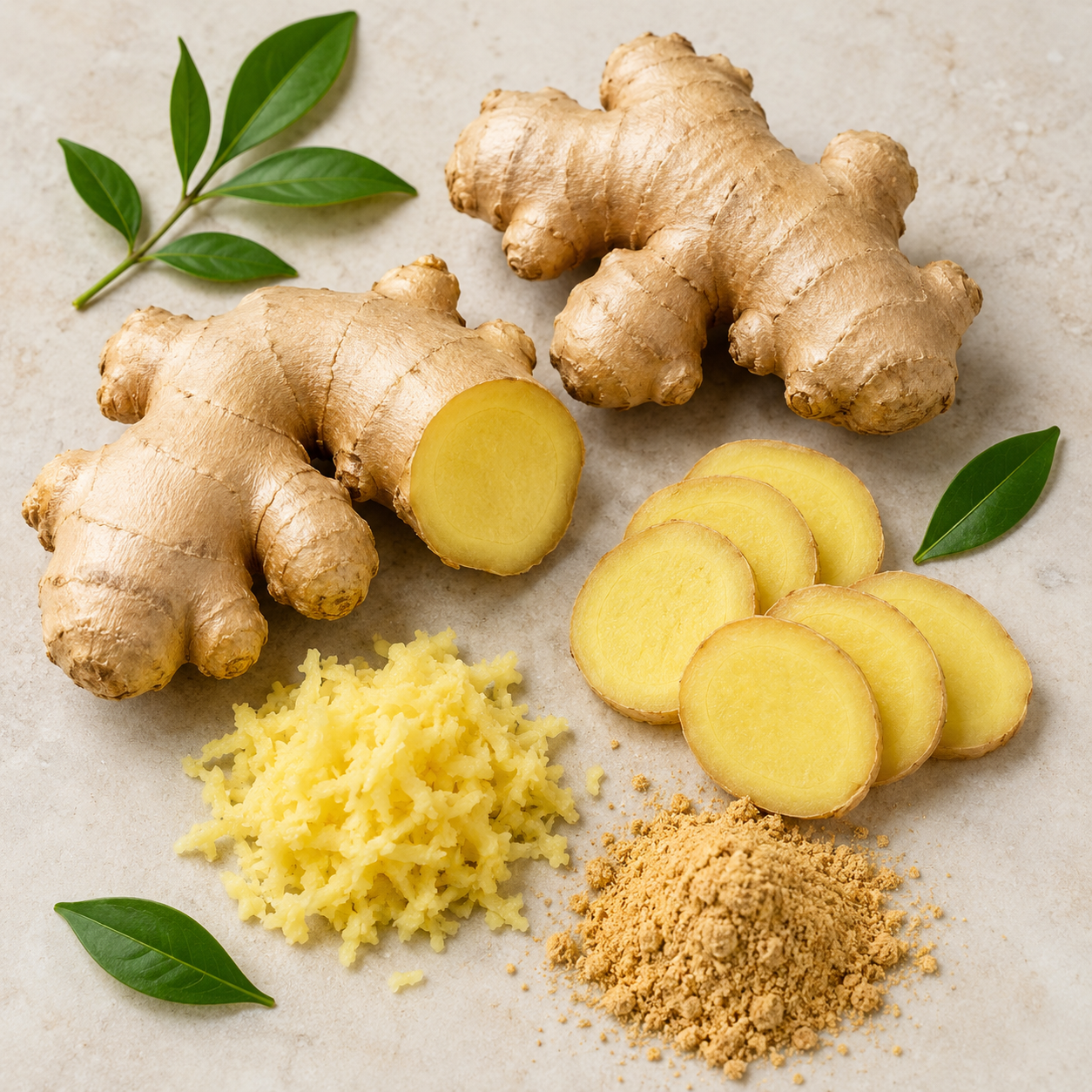
Ginger powder is a spice made by drying and grinding ginger rhizome. Its main bioactive compounds include gingerols and shogaols. Fresh ginger, dried ginger powder, and concentrated extracts differ in water content, processing, and active-compound profile, so they are not directly interchangeable.
30-second check: which situation fits you best?
Using it for everyday anti-inflammatory eating
Ginger powder can be used as an everyday spice and provides plant compounds such as gingerols and shogaols. Human studies support improvements in some inflammatory and oxidative-stress markers, but healthy people do not need to eat a fixed amount every day.
You have a specific goal: menstrual pain or metabolic health
Human evidence is relatively clearer for primary dysmenorrhea. There are also signals for blood glucose, lipids, and blood pressure, but metabolic studies mainly involve people with diabetes, obesity, or other elevated metabolic risk.
You already use ginger powder every day
First confirm that the product is 100% ginger rhizome powder, then check your actual daily amount, ingredients, and product source. Gingerol and shogaol content can vary between powders, and regular long-term use also requires attention to GI tolerance and medications.
Basic Overview
What it is
Ginger powder is a spice made by drying and grinding the underground rhizome of ginger (Zingiber officinale). It can be used in cooking, drinks, or capsules. It is a food powder, not an essential nutrient that people need to supplement. Fresh ginger, dried ginger powder, and concentrated extracts come from the same plant but differ in water content, processing, and proportions of active compounds.
Key bioactive compounds
Why it is worth attention
Human research on ginger currently focuses on inflammation and oxidative stress, primary dysmenorrhea, nausea during pregnancy, and some blood-glucose, lipid, and blood-pressure outcomes.
Dysmenorrhea and nausea during pregnancy are relatively specific targets. Metabolic signals also exist, but participants often already have diabetes, obesity, or elevated cardiometabolic risk.
Supplement Assessment
First distinguish everyday culinary use from a specific health goal and situations that need professional guidance.
Low priority for supplementation
- You only want to use it regularly because of anti-inflammatory, antioxidant, or anti-aging claims
- You do not have a specific symptom or metabolic goal
- Diet, exercise, and sleep still have obvious room for improvement
- You hope ginger powder can offset other lifestyle problems
Your next step:
Use it normally according to taste. If basic habits still have clear room for improvement, ginger powder does not need to be a high-priority health intervention.
A specific goal may justify a trial
- Short-term use for primary dysmenorrhea
- Nausea during pregnancy after checking with a healthcare professional
- Existing blood-glucose, lipid, or blood-pressure concerns
- You are willing to judge the evidence by population, formulation, dose, and duration
Your next step:
Choose one main goal first, then check what form, dose, population, and duration were used in the relevant studies.
Consult a professional first
- Pregnancy with plans to use supplement-level amounts
- Use of glucose-lowering, blood-pressure, anticoagulant, or antiplatelet medication
- Frequent heartburn, reflux, or stomach discomfort
- Sulfite sensitivity
- Plans for long-term amounts clearly above normal culinary use
Your next step:
Review the ingredient list, your actual daily amount, and current medications together. If you only use ordinary culinary amounts, there is usually no need to overcomplicate it.
Products & Everyday Use
Compare real products first, then decide how ginger powder fits into your everyday diet.
Why compare real products here?
Products that all look like “ginger powder” can differ in raw-material source, plant part, certifications, pathogen-control methods, added sulfites, and packaging.
Ordinary products usually do not disclose specific gingerol levels. The first priority is therefore not finding the “highest gingerol” product, but understanding what the product actually contains.
The examples below are for understanding market differences only; they are not brand recommendations or rankings.
Even when the label says Ground Ginger, ingredients, processing information, and data transparency can still differ.Not all ginger powders are identical
May not be the same
Common Market Products
These examples compare single-ingredient status, certifications, processing details, and sulfite labeling. Ordinary products generally do not provide batch-level quantitative data for 6-gingerol, total gingerols, or 6-shogaol.
| Product | Label Information | Main Difference | Product Features | How to Interpret It |
|---|---|---|---|---|
| Simply Organic Ginger Root, GroundOfficial product link | Organic Ginger; Zingiber officinale; Non-ETO; Non-Irradiated | Single ingredient | Organic | Relatively clear processing information | Single Ingredient Ingredients: Organic Ginger only |
A useful example of a pure ginger-powder product, but the manufacturer does not disclose a specific gingerol content. |
| Frontier Co-op Ginger, GroundOfficial product link | Organic Ginger; Zingiber officinale; Non-ETO; Non-Irradiated; Fair Trade | Single ingredient | Multiple certifications | Certification-Rich Regenerative organic, Fair Trade, and relatively complete processing information |
Certifications help describe production practices, but they do not prove higher gingerol content or stronger effects in humans. |
| McCormick Ground GingerOfficial product link | Ginger + Sulfiting Agent | Contains sulfites | Added Ingredient Includes a sulfiting agent to help preserve color |
Even when the front says Ground Ginger, check the ingredient list. This matters especially for people sensitive to sulfites. |
| The Spice House Ground GingerOfficial product link | Ginger + Sulfur Dioxide; sourced from China | Origin disclosed | Contains sulfites | Contains Sulfites Manufacturer states Contains Sulfites |
Origin transparency and single-ingredient status are separate issues. People sensitive to sulfites should not overlook the ingredient statement. |
Simply Organic Ginger Root, Ground
Official product link- Label Information
- Organic Ginger; Zingiber officinale; Non-ETO; Non-Irradiated
- Main Difference
- Single ingredient | Organic | Relatively clear processing information
- Product Features
- Single Ingredient
Ingredients: Organic Ginger only
- How to Interpret It
- A useful example of a pure ginger-powder product, but the manufacturer does not disclose a specific gingerol content.
Frontier Co-op Ginger, Ground
Official product link- Label Information
- Organic Ginger; Zingiber officinale; Non-ETO; Non-Irradiated; Fair Trade
- Main Difference
- Single ingredient | Multiple certifications
- Product Features
- Certification-Rich
Regenerative organic, Fair Trade, and relatively complete processing information
- How to Interpret It
- Certifications help describe production practices, but they do not prove higher gingerol content or stronger effects in humans.
McCormick Ground Ginger
Official product link- Label Information
- Ginger + Sulfiting Agent
- Main Difference
- Contains sulfites
- Product Features
- Added Ingredient
Includes a sulfiting agent to help preserve color
- How to Interpret It
- Even when the front says Ground Ginger, check the ingredient list. This matters especially for people sensitive to sulfites.
The Spice House Ground Ginger
Official product link- Label Information
- Ginger + Sulfur Dioxide; sourced from China
- Main Difference
- Origin disclosed | Contains sulfites
- Product Features
- Contains Sulfites
Manufacturer states Contains Sulfites
- How to Interpret It
- Origin transparency and single-ingredient status are separate issues. People sensitive to sulfites should not overlook the ingredient statement.
Everyday ways to use it
Seasoning meals
Works well in curries, stews, soups, meat, fish, and stir-fries. The flavor is more concentrated than fresh ginger, so a small amount is often enough.
Breakfasts & drinks
A small amount can be added to oats, yogurt, milk, unsweetened plant milk, or hot drinks. Ordinary ginger powder does not fully dissolve, so sediment is normal.
Baking
Can be used in gingerbread, baked oats, or apple- and pumpkin-based sweet dishes. In these uses it mainly functions as a spice.
Things to keep in mind
Normal heating is fine
Heating changes the proportions of gingerols, shogaols, and volatile compounds, but this does not simply mean the ginger becomes “inactive.”
No mandatory pairing
There is no need to force a black-pepper pairing or add large amounts of extra oil.
Check for sulfites
If the ingredient list says Sulfiting Agent, Sulfur Dioxide, or Contains Sulfites, people with sulfite sensitivity should pay particular attention.
Store it properly
Keep sealed, dry, protected from light, and away from heat. Discard if it develops a moldy odor, insect contamination, or obvious moisture damage.
Dosage
No unified RNI, RDA, AI, UL, or health-use recommended intake has been established for ordinary healthy adults; research doses are not everyday recommendations.
Dose References From Human Ginger Studies
Human study doses by research goal
These figures only show amounts used in studies. They are not a universal recommended intake for ginger powder.
How to interpret research doses
The same grams of ginger powder can still provide different amounts of active compounds.
Key reminder:Research dose ≠ everyday recommendation; grams of ginger powder ≠ gingerol dose; ordinary ginger powder ≠ standardized ginger extract.
No official recommended intake
Ginger powder is a spice, not an essential nutrient with a daily intake target.
There is no standard telling healthy adults how much ginger powder they “must” eat each day.
No UL does not mean unlimited intake. Moving from small culinary amounts to several grams every day approaches the intervention doses used in many clinical studies.
Grams of ginger powder are not the same as gingerol dose
Cultivar, drying time, temperature, and processing can change gingerol, shogaol, and volatile-oil content.
The same 2 g of ginger powder can provide different amounts of gingerols. Without batch testing, a fixed active-compound content should not be assumed.
Practical use
Everyday cooking | Use to taste. There is no need to chase gram-level doses from clinical studies.
Specific health goal | Check the study form first. Confirm whether the research used ginger powder, capsules, or extract, and whether the population and duration resemble your situation.
Regular long-term use | Watch tolerance and medications. If heartburn, diarrhea, or stomach discomfort develops, there is no need to force continued use.
Health Effects
Inflammation & Oxidative Stress
A 2025 GRADE systematic review of 29 randomized controlled trials found that ginger supplementation lowered CRP by about 0.86 mg/L, TNF-α by about 1.90 pg/mL, and IL-6 by about 1.15 pg/mL on average, while improving some antioxidant markers. This does not prove that ginger can “eliminate chronic inflammation” or slow aging.
View the 29-RCT systematic review
Primary Dysmenorrhea
A 2024 systematic review included 24 studies, with 12 entered into meta-analysis. Compared with placebo, ginger reduced pain intensity and shortened pain duration, but heterogeneity was high and safety data were not fully reported in every trial.
View the dysmenorrhea meta-analysis
Nausea During Pregnancy
A meta-analysis of 13 studies involving 1174 pregnant participants found that ginger improved overall nausea-and-vomiting symptom scores and reduced nausea severity. Vomiting alone did not show a consistently significant improvement, and ginger did not show a clear advantage over vitamin B6.
View the pregnancy-nausea meta-analysis
Blood Glucose & Insulin Regulation
A 2026 meta-analysis in people with type 2 diabetes found that ginger supplementation lowered fasting blood glucose by about 16.3 mg/dL and HbA1c by about 0.41 percentage points on average. HOMA-IR and BMI did not improve consistently, heterogeneity was high, and these results do not show that daily ginger powder prevents diabetes in healthy people.
View the type 2 diabetes meta-analysis
Blood Lipids
A meta-analysis of 12 trials involving 586 participants found that ginger lowered triglycerides by about 17.6 mg/dL and LDL by about 4.9 mg/dL on average. Improvement signals mainly came from people with dyslipidemia, diabetes, obesity, or other higher metabolic risk; additional benefit in healthy adults remains uncertain.
View the lipid meta-analysis
Blood Pressure
A 2026 GRADE systematic review of 12 randomized controlled trials found that ginger supplementation lowered systolic blood pressure by about 5.03 mmHg and diastolic pressure by about 2.03 mmHg on average. Larger signals appeared in subgroups with higher baseline blood pressure, obesity, or doses ≥2 g/day, but overall certainty remained low.
View the blood-pressure GRADE review
Product Selection
Start with why you are buying it, then compare raw material, processing, ingredients, active-compound data, food safety, and packaging.
Which type fits you?Different goals call for different product information
Everyday seasoning
For cooking, baking, or hot drinksPrioritize products that contain only ginger, taste fresh, and come in a package size you can use before quality declines. There is no need to pay a large premium just for gingerol testing.
Active-data focused
For a specific research-based goalLook for total gingerols, 6-gingerol, or 6-shogaol reported in mg/g or per serving, and favor data tied to a stated testing method and batch.
Traceability focused
For people who care more about cultivation, origin, and processingCheck the botanical name, country of origin, drying information, and pathogen-control details. Organic, Non-ETO, or Non-Irradiated claims do not replace active-compound or food-safety testing.
Whichever type you choose, first confirm that it is actual ginger rhizome powder and check for sulfites, sugar, maltodextrin, flavors, or other unnecessary added ingredients.
Check these seven things in order
01 Raw Material & Origin
Confirm ginger root/rhizome and the botanical name Zingiber officinale. Country of origin helps traceability, but origin alone cannot tell you which product has more gingerols.
02 Processing
Look for drying method, Non-Irradiated, Non-ETO, or other pathogen-control information. Processing labels alone do not prove stronger effects in humans.
03 Ingredients & Purity
Prefer products listing only Ginger or Organic Ginger. Check for sulfites, sugar, maltodextrin, flavorings, and other added ingredients.
04 Active Compounds
For everyday seasoning, testing is not essential. For a specific goal, compare actual values and units for total gingerols, 6-gingerol, or 6-shogaol.
05 Quality & Safety
Look for microbiological testing, Salmonella control, heavy metals, and pesticide residues. Reliable manufacturing and testing matter more than “superfood” marketing.
06 Flavor & Use
Pungent, warming, and slightly citrus-like notes are common, but a hotter taste does not prove higher gingerol content. Choose based on the foods you actually make.
07 Packaging & Cost
Choose packaging that is sealed, moisture-resistant, light-protective, and appropriately sized for your use rate. There is no need to pay a large premium just for organic status, origin stories, or numerous certifications.
How to Read the Package LabelCheck in this order
Product Name:Ginger Powder
Botanical Identity:Zingiber officinale
Plant Part:Rhizome
Ingredients:100% Ginger
Country of Origin:Check country and traceable growing region
Processing:Check drying, milling, and pathogen-control information
Active-compound information, if disclosed
Prefer mg/g or amount per serving(and verify the testing method and batch)
Batch Information:Batch No. / Lot No.
Production & Best-Before:Check dates and storage after opening
Test Report:Confirm it matches the current product or batch
Storage:Keep sealed, dry, protected from light, and in a cool place
Ordinary ginger powder usually does not list gingerol content. Missing a number does not make a product unacceptable, but marketing language cannot substitute for comparable test data.
Start with the ingredient list
Prefer 100% ginger. Check for Sulfiting Agent, Sulfur Dioxide, sugar, maltodextrin, flavorings, and other added ingredients.
Confirm the raw material
Look for Zingiber officinale rhizome and verify the country of origin or traceable source.
Understand the processing
Drying and heating change the proportions of gingerols, shogaols, and volatile oils. Non-ETO or Non-Irradiated claims answer specific processing questions only.
Judge active data by level of transparency
Specific values with units, testing methods, and batch information are most transparent; a standardization percentage alone is less informative, and claims such as High Gingerol are least useful.
Check food safety
Look for microbiological, Salmonella, heavy-metal, and pesticide-residue testing, and confirm that reports correspond to the product or batch.
Which product features are worth paying more for?Meet basic purity and safety requirements first, then decide whether extra information serves your goal.
Batch testing of active compounds
When it may be worth choosing
If you have a specific research goal and want to know how much total gingerol, 6-gingerol, or 6-shogaol each gram provides, specific values, testing methods, and batch reports are genuinely useful.
When it may not be worth paying extra
For everyday seasoning, you do not need to pay a large premium for active-compound testing; taste and how often you use it may matter more.
Organic & processing certifications
When it may be worth choosing
If the relevant cultivation or processing practices matter to you, legitimate organic, Non-ETO, or Non-Irradiated information can be useful additional filters.
When it may not be worth paying extra
These labels do not prove more gingerol or stronger human effects, and they do not replace microbiological or heavy-metal testing.
Origin & traceability
When it may be worth choosing
Clear country, region, batch, and supply-chain information makes it easier to trace raw materials and quality issues.
When it may not be worth paying extra
Stories such as “highland,” “traditional,” or “premium origin” without specific sourcing or testing evidence are not enough to show the product is better overall.
How to Take
The simplest approach is to treat it as a spice and use it with meals according to taste.
Default plan (healthy adults)
How much for everyday use: Use to taste. Gram-level amounts mainly come from human studies and are not recommended intakes for healthy adults.
Do I need it every day?: No. Use it regularly or occasionally according to your diet and preferences.
With food or on an empty stomach?: Ordinary food amounts can be used either way; if you are prone to heartburn, reflux, or stomach discomfort, taking it with food is more practical.
Can it be heated?: Yes. It can be added normally to soups, curries, stews, or baked foods. Heating changes compound proportions but does not make it inactive.
Do I need extra fat?: No. There is no need to add large amounts of fat just to improve absorption.
Do I need black pepper?: No. Pair it according to flavor in normal cooking.
Can fresh ginger be substituted?: For cooking, substitute by taste. Research doses cannot be converted directly gram-for-gram.
Frequently asked questions
Is 2 g the best amount?
No. 2 g is simply an amount used in some human trials. There is no established optimal daily ginger-powder dose for healthy adults.
Can I mix it directly into water?
Yes, but ordinary ginger powder does not fully dissolve, so sediment is normal. Mixing it with water offers no special health advantage.
Can I use it with cinnamon or turmeric?
Normal food amounts can generally be combined. The more ingredients you stack, the more important total intake and GI tolerance become.
How long should I keep using it?
Everyday dietary use has no defined course. For a specific health goal, refer to the population, formulation, and duration used in the relevant research.
Should I continue if I do not notice anything?
If you are forcing yourself to take it every day only for anti-inflammatory or anti-aging reasons and have no clear goal, it is reasonable to reassess.
More questions about use (click to expand)
Can ginger powder and ginger extract be converted by dose?
No. Extracts may standardize or concentrate specific compounds. Even at the same labeled milligrams, gingerol, shogaol, and total human exposure can differ substantially.
Risks & Precautions
Common adverse effects
- Abdominal discomfort, heartburn, or reflux
- Diarrhea
- Mouth or throat irritation
- There is no need to force continued use if you stay noticeably uncomfortable for the sake of supposed anti-inflammatory benefits
Higher amounts & long-term use
- No formal health-use UL does not mean intake can increase without limit
- Moving from small culinary amounts to several grams per day approaches intervention levels used in many clinical studies
- Focus on your actual goal, GI response, and duration rather than continually chasing a higher dose
People who should be more cautious
- Pregnancy at supplement-level amounts or breastfeeding
- Frequent heartburn or acid reflux
- Sulfite sensitivity
- Plans for long-term amounts clearly above normal culinary use
Medications & special situations
- Use of glucose-lowering or blood-pressure medication
- Use of anticoagulant or antiplatelet medication
- Plans to increase from culinary amounts to several grams per day or use a concentrated extract
- Do not use ginger to replace or adjust prescribed treatment on your own
Stop and ask for advice
If regular use causes persistent significant heartburn, diarrhea, abdominal pain, or unusual dizziness, or if you plan long-term higher-dose use while taking medication.
Seek prompt medical care
For a severe allergic reaction, fainting, persistent significant bleeding, or other acute severe symptoms.
Sources
These sources support the page’s definition of ginger powder, compound and processing differences, research doses, human health effects, product evaluation, and safety boundaries.
Authoritative Institutions & Basic Safety
Used for: basic ginger information, nausea during pregnancy, dysmenorrhea, common adverse effects, and pregnancy/breastfeeding safety.
Used for: Zingiber officinale rhizome definition and European herbal assessment information.
Used for: microbiological, pathogen, and food-safety control considerations for spices.
Compounds, Doses & Major Human Research
Market Product Label References
Last updated: September 19, 2026