Quercetin
Quercetin / Quercetin / Flavonol
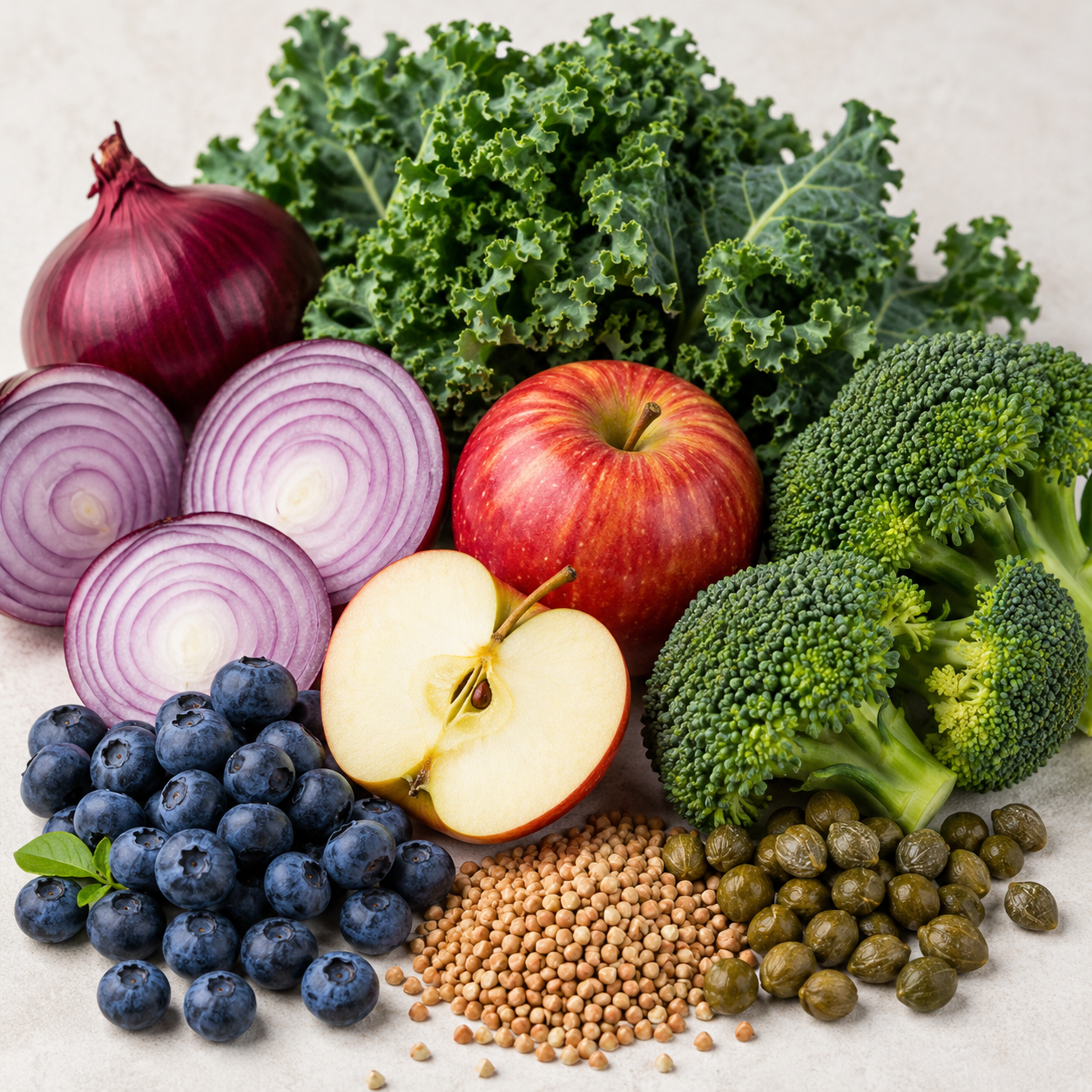
Quercetin is a naturally occurring flavonol found in onions, capers, herbs, apples, berries, and other plants. It is not an essential nutrient and has no RNI, RDA, AI, or formal UL. Human evidence is relatively more consistent for small reductions in blood pressure, improvement in some inflammatory markers, and support for recovery after strenuous exercise. Extra benefits for general antioxidant use, blood lipids, glucose, immune support in healthy adults, or healthy aging are less consistent. Healthy adults do not need to take quercetin long term simply because it is marketed as an “antioxidant.”
30-second check: which situation fits you best?
I just want everyday anti-inflammatory or antioxidant support
Quercetin has clear antioxidant and anti-inflammatory activity in laboratory models, but in human trials, even 500–1,000 mg/day that substantially raises blood quercetin levels has not consistently improved multiple systemic oxidative-stress markers.
I have one clear goal I want to improve
If your goal is blood pressure, selected inflammatory markers, or recovery after strenuous exercise, there are human research signals for quercetin. But study populations, doses, formulations, and durations vary widely by goal.
I am planning to use it or already taking it
Standard quercetin, quercetin dihydrate, phospholipid complexes, and other enhanced-absorption formulations can produce very different systemic exposure. Equal-looking milligram amounts are not necessarily directly comparable.
Basic Overview
What it is
Quercetin is a flavonol naturally found in plants, including onions, capers, apples, berries, and many herbs. It is not an essential vitamin or mineral and there is no required daily intake. Supplements commonly use standard quercetin, quercetin dihydrate, or complexes designed to improve absorption.
Why people use it
- Try it for cardiovascular markers such as blood pressure
- Support muscle soreness and recovery after exercise
- Short-term trial for selected inflammatory markers
- Obtain standardized doses that are difficult to reach from food
- Use a clearly dosed product that is easy to evaluate
- Use as an optional optimization, not to fill an essential nutrient gap
How it relates to healthy aging
Quercetin is linked mechanistically with oxidative stress, inflammation, and vascular function, but human studies mainly examine specific endpoints such as blood pressure, inflammatory markers, and exercise recovery.
Current evidence does not show that quercetin reverses aging, makes the body “younger,” or extends human lifespan. Higher doses have also not been shown to produce proportionally greater long-term health benefits.
Supplement Assessment
There is no deficiency test or routine blood target for quercetin in healthy people. Whether it is worth using depends on having a specific goal and relevant human evidence.
Low supplementation priority
- You are interested mainly because it is marketed as a “natural antioxidant”
- You do not have a specific marker or outcome you want to improve
- You mainly want general “anti-inflammatory” or “anti-aging” support
- Diet, exercise, and sleep still have obvious room for improvement
- You plan to use it long term without a defined goal or stop point
Your next step:
First clarify whether you actually care about blood pressure, exercise recovery, or another specific outcome. If the goal is simply to be “healthier overall,” prioritize whole plant foods.
Clear goal: a trial may be reasonable
- You are focused on blood-pressure-related markers
- You are focused on post-exercise muscle soreness and recovery
- You want a short-term trial for selected inflammatory markers such as CRP
- Your basic lifestyle habits are already stable
- You are willing to set a defined trial period and stopping criteria
Your next step:
Match the study population, actual quercetin dose, formulation, and duration instead of choosing the highest milligram dose or the strongest absorption claim.
Talk with a healthcare professional first
- You take prescription drugs with potential interactions
- You are taking blood-pressure medication
- You have impaired kidney function
- Pregnancy or breastfeeding
- You are receiving complex medical treatment
- You plan to use clearly high doses long term
- You take medication and are also considering a formulation with substantially enhanced bioavailability
Your next step:
Ask a doctor or pharmacist to review the specific medication, product form, and long-term risk. Do not rely on simply “separating them by two hours.”
Food Sources
Quercetin has no formal RNI, RDA, or AI, so this table does not show a percentage of an adult reference intake. Per-100-g values compare concentration, while typical servings show what you actually eat. Capers and dill can look very high per 100 g but are usually eaten in only a few grams; red onion can be eaten in much larger portions; apples are lower in concentration but easy to include regularly. Do not rank foods only by the per-100-g number.
Common Food Sources With Higher Quercetin Content
| Food | Form | Approx. Quercetin per 100 g | Typical Serving / Approx. per Serving | How to Interpret It |
|---|---|---|---|---|
| Pickled Capers | Canned | Approx. 172.55 mg | 10 g / approx. 17.3 mg | Very high concentration, but usually eaten only in small amounts as a condiment. |
| Radish Leaves | Raw | Approx. 70.37 mg | — / — | The edible leaves contain substantially more quercetin than many common vegetables. |
| Fresh Dill | Raw | Approx. 55.15 mg | 5 g / approx. 2.8 mg | Very high per 100 g, but a typical serving is only a few grams. |
| Cilantro Leaves | Raw | Approx. 52.90 mg | 10 g / approx. 5.3 mg | A high-concentration herb, but actual intake is limited by portion size. |
| Red Onion | Raw | Approx. 30.60–39.21 mg | — / — | A practical everyday source that combines a meaningful concentration with a normal serving size. |
| Cranberries | Raw | Approx. 14–15 mg | — / — | Lower in concentration than capers or onions, but easy to eat in a normal fruit portion. |
| Apple With Skin | Raw | Approx. 2.35–3.86 mg | — / — | Quercetin is concentrated mainly in the peel, with very little in the flesh. Washing and eating the skin preserves more. |
These values are only for understanding differences in quercetin content in foods; they do not establish a daily quercetin target.
How Much Can Food Provide in a Day?
Example 1
Also provides fiber, vitamins, and other plant polyphenols. This is not a daily target; it only illustrates the order of magnitude obtainable from food.
Example 2
Capers and cilantro are very concentrated per 100 g but are eaten in small amounts. Do not try to match 500–1,000 mg supplement-study doses by eating excessive amounts of one food.
Cooking and storage tips
Avoid prolonged heating: Long cooking may reduce some quercetin and quercetin glycosides in onions.
Boiling can cause losses into water: Some onion quercetin glycosides move into the cooking water rather than being completely destroyed.
Keep the cooking liquid when practical: In soups and stews, retaining the liquid reduces loss of quercetin that leaches into water.
Do not over-trim edible outer layers: The outer edible layers of onion often contain more quercetin, so excessive trimming lowers intake.
Eat apples with the skin when practical: Most apple quercetin is in the peel, so peeling can substantially reduce intake.
Whole foods vs supplements
Whole Foods
- Provides multiple plant polyphenols at the same time
- Also provides fiber, vitamins, and minerals
- Fits better into a long-term healthy diet
- Quercetin doses are usually spread across foods
- Normal diets rarely reach supplement doses of several hundred milligrams
Supplements
- Quercetin is more concentrated
- Dose per serving is easier to standardize
- Can reach human-study doses that are difficult to obtain from food
- Systemic exposure varies substantially by formulation
- Requires more attention to high doses and drug interactions
Dosage
Quercetin has no RNI, RDA, AI, formal UL, or universal daily recommended dose. Regulatory food-use conditions and human-study doses are not official supplement recommendations.
Official Dose Status, Regulatory References, and Human Research
FDA regulatory safety reference
The 500 mg/serving figure in FDA GRAS Notice No. 341 is a proposed use level for specific foods. It is not a quercetin supplement RDA, recommendation, UL, or a recommendation to take 500 mg every day.
Human-Study References by Research Context
These are human-study doses, not recommended intakes for generally healthy adults.
Longer-term safety data
There are relatively more short-term human tolerability data for about 1,000 mg/day for up to roughly 12 weeks. Evidence supporting safety becomes much thinner as dose and duration increase beyond that.
Dose–Benefit Relationship
There is no reliable evidence that more quercetin consistently produces better effects.
Who These Numbers Apply To:This section is written for generally healthy adults. Pregnancy, breastfeeding, children and adolescents, impaired kidney function, long-term medication use, or complex medical treatment require individual review rather than simply applying these numbers.
Important Note
Quercetin has no established RNI, RDA, AI, formal UL, or universal daily recommended dose; it is not an essential nutrient.
Lower-dose studies use around 150 mg/day, standard-quercetin studies commonly use 500–1,000 mg/day, and many exercise-recovery studies use about 1,000 mg/day. These are research doses, not recommended intakes for healthy adults.
The FDA's 500 mg/serving figure comes from specific food-use GRAS conditions and belongs to that regulatory food-safety context, not to supplement dose recommendations.
There are relatively more short-term human data for about 1,000 mg/day for up to 12 weeks, but 1,000 mg is not a formal UL. Safety data are much more limited for higher doses or longer use.
Phytosome and other delivery systems can substantially change systemic exposure, so tens of milligrams of a high-absorption quercetin formulation cannot be compared with standard quercetin by label milligrams alone.
How Formulation Affects Exposure
Overall absorption of standard quercetin is low and varies widely between people, so the milligrams swallowed do not directly equal the amount reaching the bloodstream.
Quercetin glycosides, phospholipid complexes, cyclodextrins, and other delivery systems can differ by several-fold or more in human absorption and blood exposure.
In human pharmacokinetic studies of a specific Phytosome formulation, systemic exposure was much higher than with standard quercetin. Therefore, 80 mg of an enhanced-absorption formulation should not simply be interpreted as one-sixth of 500 mg standard quercetin.
Fat and other food-matrix factors may also affect utilization. Higher absorption does not mean clinical effects increase in the same proportion.
How to Read Common Product Doses: Package Numbers ≠ Actual Target Ingredient Dose
The number on the front may be actual quercetin or the weight of an entire delivery complex. First confirm the actual quercetin amount, then distinguish standard, enhanced-absorption, and combination products.
| Product | Package / Label Number | Dose That Is Actually Comparable | Formulation | How to Interpret It |
|---|---|---|---|---|
| NOW Foods Quercetin 500 mgOfficial product link | 500 mg per capsule | 500 mg quercetin per capsule | Standard quercetin Single-ingredient standard quercetin |
The label is straightforward: 500 mg means 500 mg quercetin per capsule and can be compared with studies using standard quercetin. |
| Jarrow Quercetin 500 mgOfficial product link | 500 mg per capsule | 500 mg quercetin per capsule | Standard aglycone Quercetin aglycone |
Clearly provides 500 mg free quercetin and is not a delivery system specifically designed to enhance absorption. |
| Life Extension Quercetin 500 mgOfficial product link | 500 mg per capsule | 500 mg quercetin per capsule | Standard single-ingredient Single-ingredient quercetin formula |
The 500 mg on the label is the actual quercetin dose per capsule; there is no complex-weight conversion. |
| Life Extension Optimized QuercetinOfficial product link | 250 mg per capsule | 250 mg quercetin per capsule | Combination formula Quercetin + vitamin C and other ingredients |
The 250 mg is the quercetin amount. Vitamin C and other plant ingredients should be counted separately rather than added to quercetin. |
| NOW Quercetin PhytosomeOfficial product link | 250 mg complex per capsule | 80 mg quercetin per capsule | Phospholipid complex Enhanced-absorption formulation |
The 250 mg is the weight of the entire phospholipid complex, while actual quercetin is only 80 mg. Do not compare the 80 mg directly with standard quercetin by milligrams alone. |
| Life Extension Bio-QuercetinOfficial product link | 30 mg proprietary complex per capsule | 10 mg quercetin per capsule | Enhanced-absorption formulation Quercetin + galactomannan complex |
The 30 mg is the weight of the proprietary complex, not the actual quercetin dose. It provides 10 mg quercetin. |
| NOW Quercetin + BromelainOfficial product link | 800 mg quercetin / 2 capsules | 800 mg quercetin / 2 capsules | Combination formula Quercetin + bromelain |
Also contains 165 mg bromelain. The two ingredients should be counted separately and should not be added together as 965 mg quercetin. |
NOW Foods Quercetin 500 mg
Official product link- Package / Label Number
- 500 mg per capsule
- Dose That Is Actually Comparable
- 500 mg quercetin per capsule
- Formulation
- Standard quercetin
Single-ingredient standard quercetin
- How to Interpret It
- The label is straightforward: 500 mg means 500 mg quercetin per capsule and can be compared with studies using standard quercetin.
Jarrow Quercetin 500 mg
Official product link- Package / Label Number
- 500 mg per capsule
- Dose That Is Actually Comparable
- 500 mg quercetin per capsule
- Formulation
- Standard aglycone
Quercetin aglycone
- How to Interpret It
- Clearly provides 500 mg free quercetin and is not a delivery system specifically designed to enhance absorption.
Life Extension Quercetin 500 mg
Official product link- Package / Label Number
- 500 mg per capsule
- Dose That Is Actually Comparable
- 500 mg quercetin per capsule
- Formulation
- Standard single-ingredient
Single-ingredient quercetin formula
- How to Interpret It
- The 500 mg on the label is the actual quercetin dose per capsule; there is no complex-weight conversion.
Life Extension Optimized Quercetin
Official product link- Package / Label Number
- 250 mg per capsule
- Dose That Is Actually Comparable
- 250 mg quercetin per capsule
- Formulation
- Combination formula
Quercetin + vitamin C and other ingredients
- How to Interpret It
- The 250 mg is the quercetin amount. Vitamin C and other plant ingredients should be counted separately rather than added to quercetin.
NOW Quercetin Phytosome
Official product link- Package / Label Number
- 250 mg complex per capsule
- Dose That Is Actually Comparable
- 80 mg quercetin per capsule
- Formulation
- Phospholipid complex
Enhanced-absorption formulation
- How to Interpret It
- The 250 mg is the weight of the entire phospholipid complex, while actual quercetin is only 80 mg. Do not compare the 80 mg directly with standard quercetin by milligrams alone.
Life Extension Bio-Quercetin
Official product link- Package / Label Number
- 30 mg proprietary complex per capsule
- Dose That Is Actually Comparable
- 10 mg quercetin per capsule
- Formulation
- Enhanced-absorption formulation
Quercetin + galactomannan complex
- How to Interpret It
- The 30 mg is the weight of the proprietary complex, not the actual quercetin dose. It provides 10 mg quercetin.
NOW Quercetin + Bromelain
Official product link- Package / Label Number
- 800 mg quercetin / 2 capsules
- Dose That Is Actually Comparable
- 800 mg quercetin / 2 capsules
- Formulation
- Combination formula
Quercetin + bromelain
- How to Interpret It
- Also contains 165 mg bromelain. The two ingredients should be counted separately and should not be added together as 965 mg quercetin.
Health Effects
Blood Pressure & Cardiovascular Markers
A meta-analysis of 17 trials involving 896 participants found average reductions of about 3.09 mmHg in systolic and 2.86 mmHg in diastolic blood pressure. These are small improvements in a marker, and some studies involved people with elevated blood pressure or metabolic risk. Quercetin does not replace lifestyle changes or necessary treatment.
View meta-analysis
Inflammatory Markers
A meta-analysis of randomized trials found an average CRP reduction of about 0.33 mg/L with quercetin supplementation. Results varied between studies and there is no evidence that higher doses consistently improve the effect. A change in CRP should not be described as a clearly noticeable reduction in “body inflammation.”
View meta-analysis
Post-Exercise Muscle Recovery
Meta-analysis of exercise studies suggests quercetin may reduce muscle soreness, CK elevation, and some strength loss after strenuous exercise. However, the total number of participants is small, most participants were young men, and nearly all studies used about 1,000 mg/day, so the findings should not be generalized to all adults.
View systematic review
Antioxidant Defense
Quercetin has clear antioxidant-related activity, but in a large human trial, 500 or 1,000 mg/day for 12 weeks substantially increased plasma quercetin without improving F2-isoprostanes, oxidized LDL, glutathione, or several measures of overall antioxidant capacity.
View randomized controlled trial
Blood Lipids & Glucose
Meta-analysis of randomized trials found no consistent, significant improvement in fasting glucose or overall lipid profiles with quercetin. Some subgroups showed changes in triglycerides or HDL, but this is not enough to support routine long-term use in healthy adults for “glucose control” or “lowering cholesterol.”
View meta-analysis
Immune Function & Upper Respiratory Infections
In 1,002 adults taking 500 or 1,000 mg/day for 12 weeks, overall rates, duration, and symptoms of upper respiratory infections did not improve significantly. Some signals appeared only in specific age or fitness subgroups, so quercetin should not be broadly promoted as an “immune booster.”
View randomized controlled trial
Product Selection
First confirm whether the package number is actual quercetin, then distinguish standard, enhanced-absorption, and combination formulations.
Check These Four Things
What is the active ingredient?
First locate Quercetin on the label, then determine whether it is standard free quercetin, quercetin dihydrate, plant-derived quercetin, or a delivery system such as Phytosome. If the label only gives the weight of a botanical extract or proprietary complex, do not assume the entire amount is quercetin.
How much do you actually get per serving?
Confirm how much quercetin itself is provided per capsule or serving, then account for the number of capsules per serving. For example, a Phytosome product may list 250 mg of complex but provide only 80 mg quercetin.
Are there unnecessary added ingredients?
Vitamin C, zinc, bromelain, and other botanicals should be evaluated separately for whether they match your goal and whether they add duplication, interaction risk, or unnecessary cost.
Is quality control credible?
Prefer products with a clearly identified manufacturer, lot number, expiration date, actual quercetin dose, source material, and quality documentation. For enhanced-absorption ingredients, confirm the actual quercetin content rather than relying on absorption claims alone.
How to Read the LabelTotal complex weight is not the same as actual quercetin dose
The largest milligram number on the package may only be the total weight of the delivery complex. Find how much quercetin the complex actually provides.
Phospholipid carrier and other combination ingredients should be checked separately on the actual product label.
For example, 2 capsules/day provide 160 mg quercetin/day. This is only a label calculation, not a site recommendation.
Actual Quercetin | Total Complex Weight | Formulation | Lot Number | Third-Party Testing
Illustrative label. The 250 mg refers to the full Quercetin Phytosome Complex, which provides 80 mg quercetin. The number to compare is 80 mg, not 250 mg of complex.
Find the target ingredient first
Find Quercetin first; do not begin by comparing the total weight of a botanical extract, Phytosome Complex, or Proprietary Blend.
Read the ingredient form and actual dose
Quercetin Phytosome 250 mg providing 80 mg Quercetin: the relevant amount to compare is 80 mg quercetin.
Calculate the actual daily intake
80 mg quercetin/capsule × 2 capsules/day = 160 mg quercetin/day. This is only a label calculation, not a site recommendation.
Evaluate added active ingredients separately
800 mg quercetin + 165 mg bromelain does not equal 965 mg quercetin. Vitamin C, zinc, phospholipids, and other ingredients should also be counted separately.
Then check formulation and quality
Confirm whether the product uses standard free quercetin, dihydrate, phospholipid complex, glycoside, or another enhanced-absorption system, and check raw material, lot number, and verifiable quality documentation.
How to Choose Among Common FormsDifferent forms should not be compared by milligrams alone
Standard Quercetin / Quercetin Aglycone
Main features
The most common form in traditional supplements and human studies. Labels usually state the actual quercetin milligrams directly, making comparison with conventional research straightforward. Oral bioavailability is generally low.
Site guidance
A reasonable default if you want a simple, affordable product with transparent dosing that can be compared directly with conventional human studies. There is no need to assume a more expensive patented delivery system is better.
Quercetin Dihydrate
Main features
A common raw-material form. Many products label the actual quercetin amount directly. It is still a conventional form, not a delivery technology designed specifically to enhance absorption.
Site guidance
If the label clearly states actual quercetin, it can be interpreted similarly to standard quercetin. A more complex-sounding “dihydrate” name does not automatically mean better absorption or stronger effects.
Quercetin Phospholipid Complex / Phytosome
Main features
Combines quercetin with a phospholipid delivery system. Human pharmacokinetic studies of specific formulations show substantially greater systemic exposure; labels often lead with the total complex weight.
Site guidance
You must identify the actual quercetin amount. Higher absorption does not automatically mean clinical benefits rise proportionally, so do not buy based on an absorption multiplier alone.
High-Absorption Glycosides / Other Delivery Systems
Main features
Some glycosides, cyclodextrin systems, self-emulsifying systems, and other delivery technologies can produce much higher absorption than free quercetin. Differences between technologies can be large.
Site guidance
Consider paying extra only when the raw material and actual quercetin amount are clear and the human research for your goal used the same or a closely related formulation. Do not compare marketing absorption multiples across products as if they were equivalent.
Quercetin + Bromelain and Other Combination Formulas
Main features
Combines quercetin with bromelain, vitamin C, zinc, or other ingredients. Each ingredient has its own dose and safety limits; this is not a new chemical form of quercetin.
Site guidance
Consider it only if you also need the other ingredients. Do not assume bromelain automatically improves quercetin absorption; direct human pharmacokinetic evidence is limited.
How to Take
Standard quercetin can be taken with food. The important issues are formulation, actual daily dose, your goal, and the evaluation period.
Default plan (healthy adults)
With food or on an empty stomach: Standard quercetin can be taken with food. Some food matrices and dietary fat may increase exposure, and taking it with food may also reduce gastrointestinal discomfort. If the specific product gives different instructions, follow the label.
How many times per day: There is no universal rule. Standard 500 mg products are commonly taken once daily or divided. Do not assume that because a study used 1,000 mg/day, 1,000 mg should be taken as a single dose.
Morning or evening: There is no reliable human evidence of a meaningful morning-versus-evening difference. Choose the time that is easiest to follow consistently.
How long to use it: For a goal-specific supplement, set an initial evaluation period of about 6–12 weeks. If there is no observable benefit, do not continue indefinitely just because of an “antioxidant” rationale.
Spacing from other supplements: There is no universal need to separate quercetin from standard vitamins or minerals. If you use multiple botanical extracts, check for duplicate quercetin or similar active compounds.
Missed dose: If you occasionally forget a dose, skip it and resume your usual amount next time. Do not double the dose.
Frequently asked questions
With food or on an empty stomach?
Standard quercetin can be taken with food. Some food matrices and dietary fat may raise exposure, and eating with it may also reduce gastrointestinal discomfort in some people.
Do I need to divide the daily dose?
There is no universal rule. Interpret the product label and the relevant study; do not turn a 1,000 mg research dose into a default daily recommendation.
Morning or evening?
There is no clear morning-versus-evening advantage. Choose the schedule that is easiest to maintain.
Is separating it from medication by two hours enough?
Not necessarily. Some interactions involve metabolic enzymes and drug transporters and may not be prevented by a two-hour gap. People on long-term medication should have a doctor or pharmacist review the combination.
More questions about use (click to expand)
How should I evaluate it initially?
Define the goal and outcome measure first, then reassess after about 6–12 weeks. If there is no meaningful improvement, do not continue long term based only on mechanistic claims.
Can I use the same dose for an enhanced-absorption formulation?
No. Enhanced-absorption formulations can produce substantially different systemic exposure. Use human data for that specific formulation rather than converting directly from standard-quercetin milligrams.
What if I miss a dose?
Skip it and resume the usual amount next time. Do not double the dose.
Risks & Precautions
Common Side Effects
- Stomach or abdominal discomfort
- Nausea
- Headache
- Mild tingling in the hands or feet
- Rates are low in many studies and in some cases similar to placebo. If symptoms remain clearly bothersome after lowering the dose, stop use and reassess.
Higher-Dose Risks
- There are relatively more human safety data for 500–1,000 mg/day for about 12 weeks or less
- Safety data are clearly limited for ≥1,000 mg/day used for longer than 12 weeks
- This does not mean 1,000 mg has been proven toxic, and it is not a formal UL
- People with impaired kidney function need extra caution
- No UL does not mean the dose can be increased without limit
People Who Need More Caution
- Impaired kidney function
- Pregnancy and breastfeeding
- Children and adolescents
- People receiving complex treatment for cancer, transplantation, kidney disease, or other serious conditions
- Anyone planning long-term use of clearly high doses
Medications & Special Situations
- Cyclosporine and other immunosuppressants: exposure may be affected through CYP3A4 or drug-transport pathways; ask a doctor or pharmacist first.
- Pravastatin, fexofenadine, and others: pharmacokinetic data suggest quercetin may alter absorption or systemic exposure. Simply separating doses by two hours may not solve the issue.
- Blood-pressure medication: quercetin's small blood-pressure-lowering effect may add to medication effects, so monitor blood pressure and have the combination reviewed professionally.
- Anticoagulant or antiplatelet therapy, or planned surgery: direct clinical evidence is limited, but higher-risk users should consult a professional first.
Stop and Ask for Advice
If you develop persistent nausea, stomach upset, headache, tingling in the hands or feet, or another symptom clearly different from usual, stop use and consult a doctor or pharmacist.
Seek Medical Care Promptly
Seek prompt medical care for difficulty breathing, marked swelling of the lips, face, or tongue, fainting, or another severe acute reaction.
Sources
Sources on this page support quercetin identity, food data, dose and safety, human health effects, bioavailability, cooking effects, and product-label examples.
Nutrition Standards & Basic Data
Use: quercetin content in foods and comparison of flavonol levels across foods.
Use: chemical classification, basic structure, and properties.
Use: human absorption, short-term safety, and drug interactions; not used as evidence of COVID treatment.
Dose & Safety
Use: specific food-use conditions and regulatory safety context; not a supplement RDA or UL.
Use: long-term high-dose data, limited evidence beyond ≥1,000 mg/day, and potential interactions.
Health Effects & Scientific Evidence
Use: 500 or 1,000 mg/day for 12 weeks and evidence boundaries for antioxidant effects.
Bioavailability & Formulation
Food, Processing & Cooking
Mainstream Product Pages
Last updated: August 11, 2026