NMN (β-Nicotinamide Mononucleotide)
Nicotinamide Mononucleotide / NMN / β-NMN / β-Nicotinamide Mononucleotide / Nicotinamide Mononucleotide / Nicotinamide Ribonucleotide
NAD⁺ is an essential coenzyme that cells use for energy metabolism, stress responses, and many maintenance functions. NMN is one intermediate the body uses to make NAD⁺.
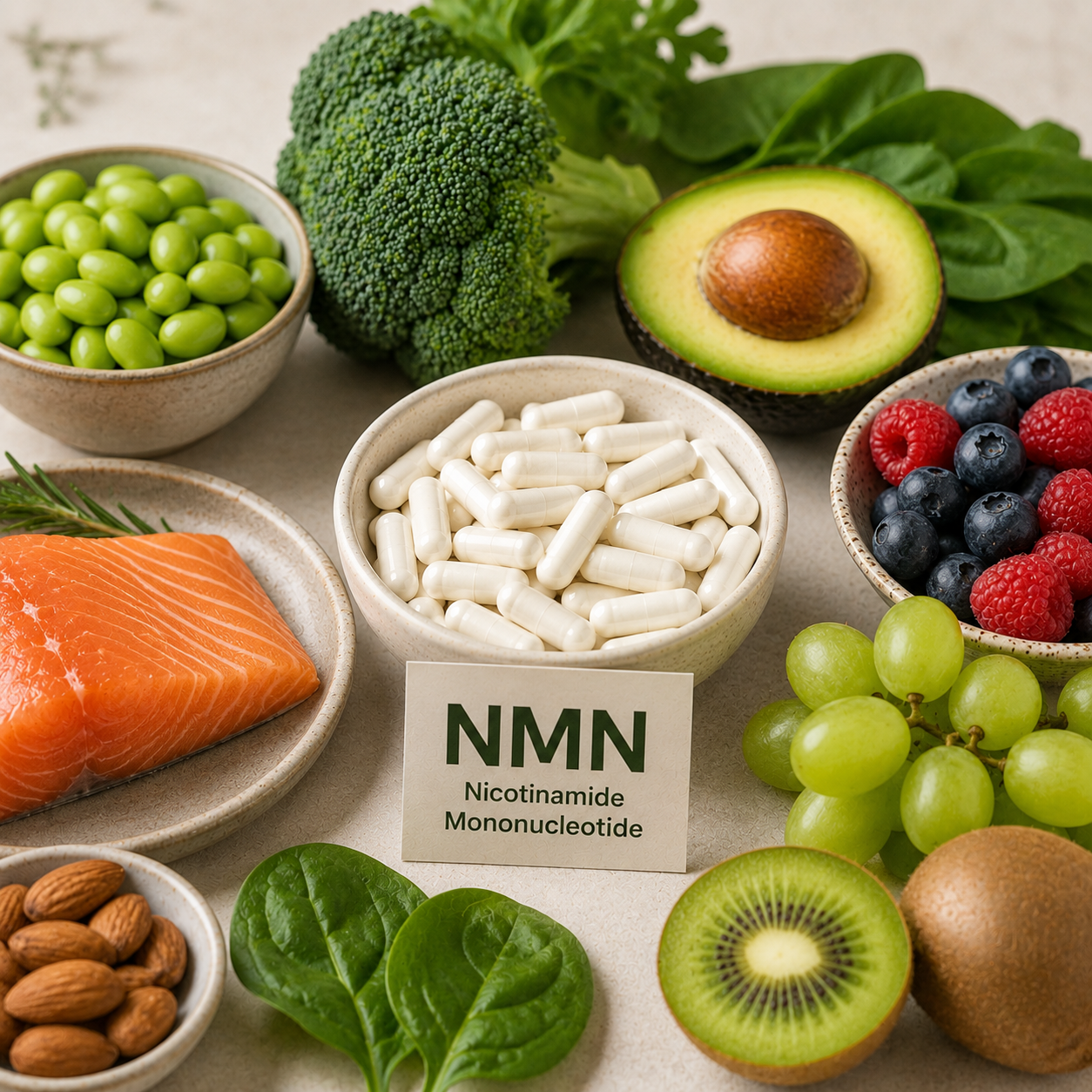
30-second check: which situation fits you best?
I feel well and am mainly interested in anti-aging
Your energy, sleep, and overall physical condition are generally normal, but you have heard that NMN can raise NAD⁺, support mitochondria, repair cells, or slow aging and are considering it as a long-term wellness supplement.
I have a specific outcome I want to improve
You are mainly interested in age-related physical function, fatigue, daytime energy, sleep, or skin and want to know whether NMN is likely to produce a meaningful real-world change.
I am planning to use it or already taking it
You accept that NMN benefits remain uncertain and are ready to try it or already use it. The practical questions are the product form, actual dose per serving, whether the amount is high, and when you will reassess whether it is worth continuing.
Basic Overview
What It Is
NMN is a substance the body naturally produces and mainly uses in the pathway that makes NAD⁺. NAD⁺ is an essential coenzyme for cellular energy metabolism, mitochondrial function, and selected stress-response pathways. Because the body can make both, NMN is not a basic nutrient that must be obtained from food every day, and there is no deficiency-based replacement standard.
What Does NAD⁺ Actually Do?
NAD⁺ helps cells carry out normal energy conversion.
How NMN, NR & NAD⁺ Relate
NMN and NR are both NAD⁺ precursors, while direct NAD⁺ products are a separate category. Their absorption and metabolism differ, so package milligrams cannot be converted with a fixed ratio.
Why People Consider It
- Maintain strength and day-to-day physical function with age
- Address frequent fatigue or low daytime energy
- Explore possible changes in sleep quality and next-day recovery
- Support skin-related or age-related goals
- Support mitochondrial and cellular energy metabolism
- Use as an optional healthy-aging experiment
How It Relates to Healthy Aging
NMN is closely tied to healthy-aging research because NAD⁺ is involved in energy metabolism, mitochondrial function, inflammatory regulation, and cellular maintenance—not because NMN has been proven to be an anti-aging drug.
A more accurate description is “an NAD⁺ precursor studied in healthy aging,” not “a proven longevity supplement.”
Supplement Assessment
Separate the goal of raising NAD⁺ from goals involving physical function, fatigue, sleep, skin, or healthy aging.
Lower Supplement Priority
- You feel well and are interested mainly because of NAD⁺ or anti-aging concepts
- You do not have a fatigue, sleep, physical-function, or skin goal
- You treat a higher NAD⁺ level as the final health outcome
- You expect supplementation to make the whole body younger or extend lifespan
Your next step:
Turn the broad idea of “anti-aging” into an observable goal such as fatigue, sleep, physical function, or skin condition first.
Clear goal: worth a closer look
- You want to maintain strength and everyday physical function with age
- You often feel fatigued and want to track daytime energy
- Your sleep is suboptimal and you want to observe sleep and next-day recovery
- You are focused on skin elasticity, fine lines, or other age-related skin changes
- You understand that evidence strength differs greatly by outcome
- You are willing to use it for a defined period and continue only if there is a meaningful benefit
Your next step:
Choose one main goal, then review the matching human evidence, study dose, and observation period. Physical-function evidence is broader but inconsistent; fatigue and sleep are still small-study signals; human skin evidence is weaker.
Consult a professional first
- Children and adolescents
- Significant liver or kidney dysfunction
- Current cancer treatment
- Complex chronic-disease treatment
- Long-term use of multiple prescription medications
- Planning continuous use for years
- Planning long-term higher-dose use, especially clearly above 300 mg/day
Your next step:
Ask a doctor or pharmacist to review your health status, medical conditions, medications, other supplements, and planned dose first. The 300 mg/day figure is a regulatory safety-assessment reference for a specific β-NMN ingredient, not a formal NMN UL.
Quick Self-Check
Do I have a specific, observable physical goal?
Do I understand that raising NAD⁺ is only the first step?
Am I comfortable with the possibility of little or no noticeable benefit?
Can I track changes in fatigue, sleep, or physical function?
Can I document skin goals under consistent conditions?
Am I pregnant or breastfeeding, undergoing cancer treatment, managing complex disease, or taking multiple medications?
Do I Need Testing?
Generally healthy adults do not usually need NAD⁺ testing before deciding whether to try NMN.
- There is no diagnostic threshold for NAD⁺ deficiency or agreed “optimal NAD⁺ range.”
- There is no clinical standard saying NMN must be used below a certain value or that a specific NAD⁺ level is healthiest.
- One blood NAD⁺ measurement cannot be used to set an NMN dose; whole-blood NAD⁺ also has not shown a consistent age-related decline.
The decision to try NMN should be based more on a clear goal, evidence boundaries, product dose, and personal risk.
Food Sources
NMN has no established RNI, RDA, or AI, and there is no dietary target for how much NMN must be obtained from food each day.
Relatively Higher Natural Sources in Available Data
| Food | Form | Approx. NMN per 100 g | How to Read It |
|---|---|---|---|
| Edamame | Fresh | About 0.47–1.88 mg | Relatively higher, but still under 2 mg per 100 g |
| Avocado | Fresh | About 0.36–1.60 mg | Measured values vary substantially among samples |
| Broccoli | Fresh | About 0.25–1.12 mg | A normal serving still provides only a small amount |
Using about 1.88 mg NMN per 100 g of edamame, reaching 300 mg would theoretically require roughly 16 kg. This only illustrates the order-of-magnitude gap between food and supplements. It is not a reason to eat excessive amounts, and low food content does not mean the body is NMN-deficient.
How Food Can Provide NMN Naturally
Example 1
A normal serving of edamame with vegetables such as broccoli can provide a small amount of NMN along with protein, fiber, folate, and potassium. There is no need to increase one food dramatically just for NMN.
Example 2
Avocado, tomatoes, and some animal foods also provide small amounts of NMN or other NAD⁺ precursors. The dietary goal is to support overall metabolism, not to reach supplement-level NMN doses.
Whole foods vs supplements
Whole Foods
- Naturally contain small amounts of NMN
- Normal servings usually provide milligram amounts or less
- Also provide multiple essential nutrients
- No daily food target for NMN exists
- No need to match supplement doses
Supplements
- Commonly provide about 250–1,000 mg
- Far above normal dietary exposure
- Can change NAD⁺-related biomarkers
- Require attention to identity, purity, and actual dose
- Real-world health benefits still need to be evaluated outcome by outcome
Dosage
NMN has no established RNI, RDA, AI, formal NMN-specific UL, DV, or universal daily recommended dose. Human-study doses, product strengths, and regulatory assessments should not be rewritten as recommended intakes.
Regulatory Safety Assessment, Human-Study Doses & Use Boundaries
EFSA 2026: Proposed Maximum Use for a Specific β-NMN Ingredient
The EFSA scientific opinion is not itself a final EU market authorization, recommended intake, or UL.
Human-Study Doses by Goal
Small studies show what was tested; they do not by themselves establish the effects listed in Section 05.
Dose Levels & Longer-Term Safety Data
Important Note
NMN has no established RNI, RDA, AI, formal NMN-specific UL, or universal daily recommended dose.
EFSA’s 300 mg/day figure is the highest proposed use in the safety assessment of a specific β-NMN ingredient. It does not mean the body requires 300 mg/day.
The most consistent human effect of NMN is an increase in selected blood NAD⁺-related biomarkers. Sleep, fatigue, and physical-function findings remain preliminary, while reliable human doses for skin anti-aging, overall anti-aging, or lifespan extension have not been established.
NMN is the general name for nicotinamide mononucleotide. β-NMN is the principal form used in human NAD⁺ metabolism and in most current human research.
Dose Utilization
Oral NMN enters the human NAD⁺ metabolic network and changes circulating NAD⁺ and related metabolites.
The process is not simply that swallowed NMN enters every cell intact and is immediately converted to NAD⁺; multiple conversions can occur in the gut and tissues.
A reliable fixed oral absorption percentage for ordinary users has not been established.
There are not enough large head-to-head studies to rank liposomal, sublingual, enteric-coated, and conventional capsules by clinical effect or assign fixed conversion ratios.
How to Read Common Product Doses
Focus on the actual NMN amount, not “NAD⁺ Booster” marketing.
| Product | Package / Label Number | Dose That Is Actually Comparable | Formulation | How to Read It |
|---|---|---|---|---|
| ProHealth NMN Pro™ 500 - Uthever® NMNOfficial product link | 500 mg Uthever® β-NMN | 500 mg β-nicotinamide mononucleotide (β-NMN)/capsule | Conventional capsule Branded ingredient |
Serving size is 1 capsule. Uthever® is the branded β-NMN ingredient, not an additional 500 mg ingredient. |
| Renue By Science NMN Pure PowderOfficial product link | 500 mg NMN/scoop | 500 mg nicotinamide mononucleotide (NMN)/serving | Powder Conventional single ingredient |
The powder format changes convenience, not proven clinical effectiveness. |
| Renue By Science NMN Liposomal CapsulesOfficial product link | 500 mg β-NMN/2 capsules | 500 mg β-NMN/serving (about 250 mg/capsule) | Liposomal Special delivery |
Two capsules provide 500 mg total. Do not rewrite this as 500 mg per capsule, and there is no reliable fixed absorption multiplier. |
| DoNotAge Pure NMN SupplementOfficial product link | 500 mg NMN/capsule or scoop | 500 mg NMN/serving | Conventional single ingredient Capsule or powder |
A 500 mg product strength is not automatically an optimal dose. Manufacturer directions and regulatory references should be interpreted separately. |
| MAAC10 NMN 250MG NAD+ SupportOfficial product link | 250 mg NMN | 250 mg nicotinamide mononucleotide (NMN)/capsule | Conventional capsule Conventional single ingredient |
Being below 300 mg does not automatically make the product equivalent to the specific ingredient assessed by EFSA. |
| OMRE NMN + ResveratrolOfficial product link | 500 mg NMN + 500 mg trans-resveratrol + 5 mg BioPerine® | 500 mg NMN/2 capsules | Combination formula Resveratrol combination |
The NMN dose is still 500 mg. The combination ingredients should not be added together and described as 1,005 mg NMN. |
ProHealth NMN Pro™ 500 - Uthever® NMN
Official product link- Package / Label Number
- 500 mg Uthever® β-NMN
- Dose That Is Actually Comparable
- 500 mg β-nicotinamide mononucleotide (β-NMN)/capsule
- Formulation
- Conventional capsule
Branded ingredient
- How to Read It
- Serving size is 1 capsule. Uthever® is the branded β-NMN ingredient, not an additional 500 mg ingredient.
Renue By Science NMN Pure Powder
Official product link- Package / Label Number
- 500 mg NMN/scoop
- Dose That Is Actually Comparable
- 500 mg nicotinamide mononucleotide (NMN)/serving
- Formulation
- Powder
Conventional single ingredient
- How to Read It
- The powder format changes convenience, not proven clinical effectiveness.
Renue By Science NMN Liposomal Capsules
Official product link- Package / Label Number
- 500 mg β-NMN/2 capsules
- Dose That Is Actually Comparable
- 500 mg β-NMN/serving (about 250 mg/capsule)
- Formulation
- Liposomal
Special delivery
- How to Read It
- Two capsules provide 500 mg total. Do not rewrite this as 500 mg per capsule, and there is no reliable fixed absorption multiplier.
DoNotAge Pure NMN Supplement
Official product link- Package / Label Number
- 500 mg NMN/capsule or scoop
- Dose That Is Actually Comparable
- 500 mg NMN/serving
- Formulation
- Conventional single ingredient
Capsule or powder
- How to Read It
- A 500 mg product strength is not automatically an optimal dose. Manufacturer directions and regulatory references should be interpreted separately.
MAAC10 NMN 250MG NAD+ Support
Official product link- Package / Label Number
- 250 mg NMN
- Dose That Is Actually Comparable
- 250 mg nicotinamide mononucleotide (NMN)/capsule
- Formulation
- Conventional capsule
Conventional single ingredient
- How to Read It
- Being below 300 mg does not automatically make the product equivalent to the specific ingredient assessed by EFSA.
OMRE NMN + Resveratrol
Official product link- Package / Label Number
- 500 mg NMN + 500 mg trans-resveratrol + 5 mg BioPerine®
- Dose That Is Actually Comparable
- 500 mg NMN/2 capsules
- Formulation
- Combination formula
Resveratrol combination
- How to Read It
- The NMN dose is still 500 mg. The combination ingredients should not be added together and described as 1,005 mg NMN.
Health Effects
NAD⁺ Levels & Cellular Energy
A meta-analysis of 12 studies with 513 participants found that NMN significantly increased blood NAD⁺, with an effect size of SMD 1.79. NAD⁺ is involved in mitochondrial energy conversion and redox reactions, making this NMN’s most reliable biological effect. Most clinical outcomes, however, did not improve in parallel, so a higher NAD⁺ level should not be interpreted directly as “more energy.”
View meta-analysis
Physical Function & Healthy Aging
One meta-analysis of 412 participants reported improvement in selected outcomes such as walking speed, but a 2025 systematic review and meta-analysis found no significant improvement in muscle mass, grip strength, walking speed, 5-times sit-to-stand, or knee-extension strength. Because pooled results conflict, NMN may have signals in selected populations or outcomes, but it cannot yet be described as reliably preserving muscle strength or physical function.
View meta-analysis 1 · View meta-analysis 2
Healthy Aging & Lifespan
NAD⁺ is linked to mitochondrial function, genomic stability, inflammation, and cellular stress, giving NAD⁺ precursors a strong biological rationale in aging research. A 2026 systematic review of 33 human interventions, however, found healthspan-related outcomes scattered and inconsistent. There is currently no evidence that NMN lowers mortality, extends human lifespan, or reverses overall biological aging.
View systematic review
Fatigue & Daytime Vitality
NAD⁺ directly participates in converting nutrients into usable cellular energy, which provides a clear rationale for studying NMN in fatigue, sleepiness, and daytime vitality. Direct fatigue studies remain small, however, and fatigue is strongly influenced by sleep, exercise, and stress. Current evidence does not show that healthy adults will reliably feel less fatigued or clearly more energetic after taking NMN.
View randomized controlled trial
Sleep Quality
NAD⁺ metabolism interacts with circadian regulation, so NMN may plausibly influence sleep–wake rhythms through NAD⁺-related pathways. Human studies, however, have not produced consistent results, and some trials summarized in reviews found no clear improvement in overall sleep quality or fatigue scores versus control. NMN should not currently be positioned as a supplement for falling asleep faster, sleeping longer, or increasing deep sleep.
View randomized controlled trial
Skin Condition & Skin Aging
A 2025 study in human skin fibroblasts found that NMN increased cellular NAD⁺ and affected mitochondria, autophagy, cellular senescence, and extracellular matrix pathways. Other experiments have reported more type I collagen, and animal photoaging studies have shown changes in wrinkles, elasticity, and barrier function. Reliable human clinical evidence is still lacking for oral or topical NMN improving wrinkles, elasticity, hydration, or skin tone.
View skin-cell study
Product Selection
Buying order: confirm NMN / β-NMN → actual mg per serving → daily total → special delivery → combination ingredients → identity and quality testing.
Check These Four Things
What is the active ingredient?
Prefer labels that clearly state β-nicotinamide mononucleotide (β-Nicotinamide Mononucleotide / β-NMN) or clearly identified NMN, not just “NAD⁺ Booster.”
How much do you actually get per serving?
Check the Serving Size carefully. 500 mg per 2 capsules means 500 mg per serving and 250 mg per capsule.
Are there unnecessary added ingredients?
Evaluate TMG, trans-resveratrol, and black-pepper extract separately. They should not be added to the NMN dose, and a single-ingredient product is easier to evaluate.
Is quality control credible?
Look for NMN identity, purity, amount per serving, batch testing, heavy-metal and microbial testing, and a finished-product certificate of analysis (COA).
How to Read the Label5 steps to read an NMN label
Target ingredient → Serving Size → per capsule & daily total → brand not double-counted → combinations separate
TMG, trans-resveratrol, and black-pepper extract are listed separately
Manufacturer directions are not site-recommended dosing.
NMN identity | Purity | Batch potency | COA | Heavy metals | Microbial testing
Uthever® β-NMN 500 mg means 500 mg of the branded β-NMN ingredient, not 500 mg Uthever® plus another 500 mg NMN.
Find the target ingredient first
Confirm β-NMN or clearly identified NMN, not only “NAD⁺ Booster.”
Confirm the serving size
Serving Size may be 1 capsule, 2 capsules, or 1 scoop.
Calculate per-capsule and daily intake
500 mg per 2 capsules = 250 mg per capsule. Daily intake depends on the number of servings used.
Do not double-count branded ingredients
Uthever® is a branded β-NMN ingredient, not a second ingredient.
Count combination ingredients separately
500 mg NMN + 500 mg resveratrol + 5 mg black-pepper extract still provides only 500 mg NMN.
How to Choose Among Common FormsThere is no reliable clinical ranking or fixed conversion for higher-absorption formats
Conventional β-NMN Capsules
Main features
The dose is easiest to verify and compare with conventional oral human studies.
Site guidance
A practical first choice. Ingredient identity, actual dose, and testing usually matter more than special delivery claims.
NMN Powder
Main features
Flexible to measure, but requires accurate portioning.
Site guidance
There is no evidence that powder produces better clinical outcomes than capsules.
Liposomal NMN
Main features
Uses phospholipids to alter delivery, but independent head-to-head human evidence is limited.
Site guidance
Do not automatically pay a premium or convert the dose against conventional NMN with a fixed ratio.
Sublingual NMN
Main features
Changes how the product is administered through dissolution in the mouth; comparative clinical data are limited.
Site guidance
Choose based on preference if desired, but do not assume a lower milligram dose is necessarily more potent.
NMN Combination Formulas
Main features
Often combine NMN with resveratrol, TMG, or other ingredients, each with its own dose and evidence.
Site guidance
Choose a combination only if you have a separate reason to use the other ingredient as well.
How to Take
NMN has no established best time of day, and there is no evidence that it must be taken in the morning, at night, fasting, with food, with fat, with TMG, or with resveratrol.
Default plan (healthy adults)
Official recommended dose: No official NMN recommended intake has been established
Frequency: Human studies commonly use once-daily or divided dosing
With food or fasting?: There is no evidence that one is clearly superior
Morning or evening?: No generally accepted best time has been established
Split doses?: There is no universal requirement to divide the dose
Long-term use?: Set an observation period before deciding whether to continue
Missed dose: If you occasionally miss a dose, skip it rather than doubling the next dose
Frequently asked questions
Do I have to take it in the morning?
No reliable evidence shows that morning use is required. Choose the time that is easiest to maintain and does not interfere with sleep or stomach comfort.
Should I take it at night for sleep?
That cannot be concluded from current evidence. Small trials are not enough to define evening dosing as better for sleep.
Do I have to take it fasting?
There is no evidence that fasting produces better health outcomes. If it causes discomfort, there is no reason to force fasting use.
Do I need TMG with it?
No clinical guideline requires all NMN users to add TMG. It is a separate supplement.
Do I need to combine it with resveratrol?
No. They are separate ingredients, and there is no evidence that everyone benefits more from using them together.
Which is best: liposomal, sublingual, or conventional capsules?
There are not enough adequately powered head-to-head studies to rank them reliably or assign fixed absorption conversions.
More questions about use (click to expand)
How should I reassess after about 8–12 weeks?
Choose one main outcome—daytime vitality, physical function, sleep, or skin—and keep lifestyle factors reasonably stable. If there is no meaningful benefit after 8–12 weeks, do not continue indefinitely simply because “NAD⁺ probably increased.”
How do I know whether it is working?
Track daytime fatigue, activity, and recovery; use repeatable walking, stair, sit-to-stand, or training measures; record sleep onset, awakenings, sleep duration, and next-day sleepiness; use standardized lighting and angles for skin photos. There is no home metric that proves overall aging has slowed, and blood NAD⁺ alone does not prove meaningful benefit.
Risks & Precautions
Common Side Effects
- There is currently no stable, well-quantified pattern of common NMN-specific side effects
- A 2026 meta-analysis found no significant increase in overall adverse events, serious events, withdrawals, or liver-enzyme abnormalities
- Nausea, diarrhea, and headache should not be presented as established common NMN side effects
- If a new symptom is persistent or repeatedly returns, stop and seek advice
Higher-Dose Risks
- Higher-dose human trials are generally short, so multi-year high-dose safety is unknown
- Animal toxicology findings cannot be converted directly into a human safe dose
- Short-term tolerability does not mean the dose can be increased without limit
- No formal UL does not mean unlimited dosing is safe
People Who Need More Caution
- Pregnant and breastfeeding women are outside EFSA’s assessed target population
- Children and adolescents
- Significant liver or kidney dysfunction
- Current treatment for complex disease or cancer
- Long-term use of multiple medications or plans for multi-year high-dose use
Medications & Special Situations
- There is no mature list of classic NMN drug interactions
- Do not invent claims that NMN definitely interacts with anticoagulants, glucose-lowering drugs, or blood-pressure medication
- People taking complex medication regimens should consult a doctor or pharmacist before long-term use
- There is no evidence that NMN causes cancer, but long-term safety of deliberately increasing NAD⁺ during cancer treatment has not been established, so self-starting is not advised
Stop and Ask for Advice
Stop and seek advice if persistent gastrointestinal, sleep-related, or other clearly new symptoms develop or recur after stopping and restarting.
Seek Medical Care Promptly
Seek prompt medical care for difficulty breathing, marked swelling of the face, lips, or tongue, persistent severe vomiting, or another acute severe reaction.
Sources
Priority is given to official regulatory sources, systematic reviews, meta-analyses, and human studies. Small fatigue, sleep, and skin studies are used only to show research direction and dose context.
NAD⁺ Biology & NMN Positioning
Healthy Aging & Overall NAD⁺ Evidence
Physical-Function Evidence
Fatigue & Sleep Evidence
Skin & Skin-Aging Evidence
Safety & Dosage
EU Regulatory Status
Mainstream Product Dose Examples
Last updated: August 15, 2026