EGCG
Epigallocatechin Gallate / EGCG / Epigallocatechin-3-gallate / EGCg / Epigallocatechin Gallate / Green Tea Extract
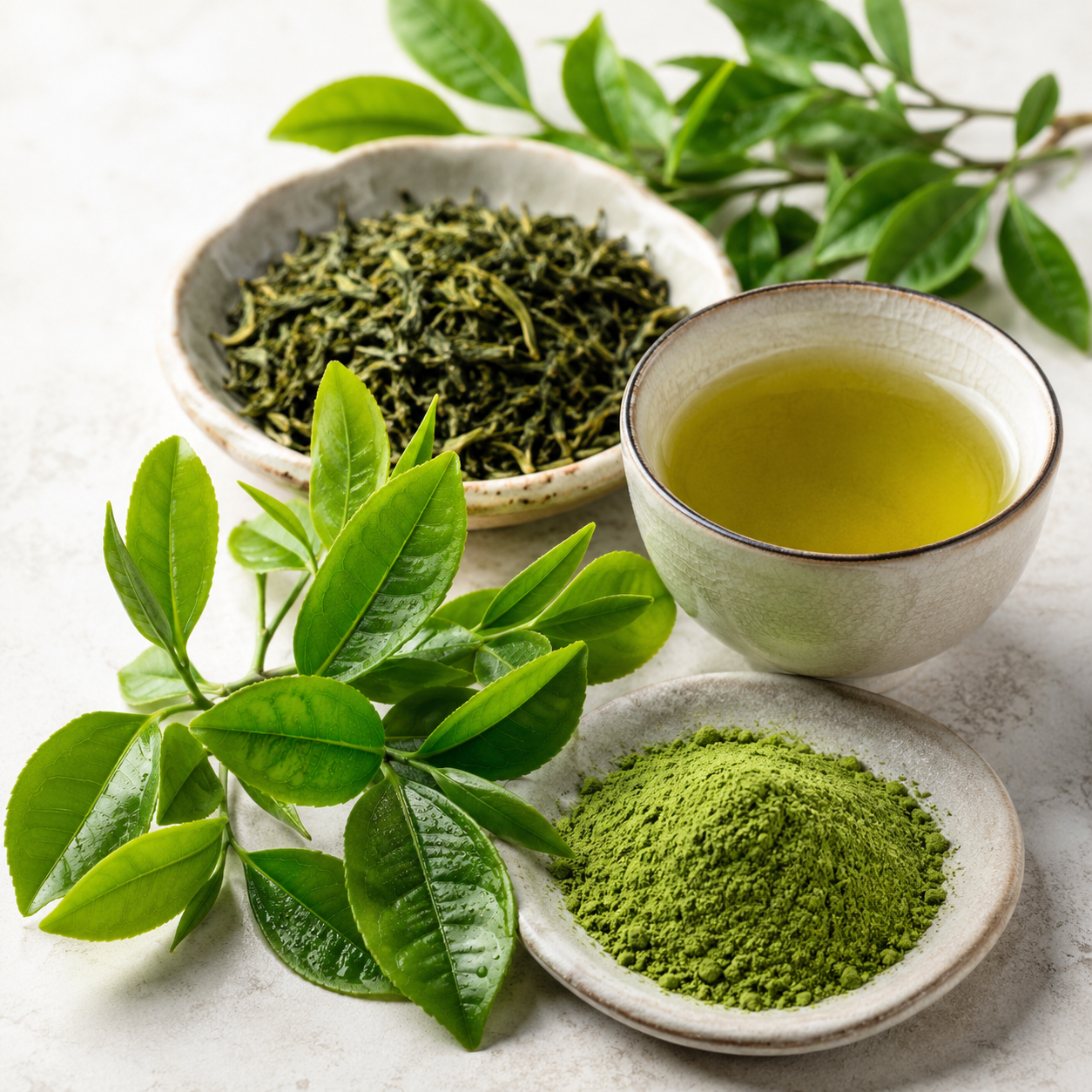
EGCG is one of the most studied catechins in green tea. It is not an essential nutrient. Regular tea can provide EGCG, while supplements usually use standardized concentrated green tea extract or high-purity EGCG.
30-second check: which situation fits you best?
I mainly want everyday anti-inflammatory or antioxidant support
If you are considering long-term EGCG mainly because of “antioxidant” or “healthy aging” claims, there is no evidence that healthy adults need concentrated EGCG supplements to maintain health.
I have a specific goal
If your main goal is blood lipids, glucose, blood pressure, or oxidative stress, review the human evidence carefully. Green tea, green tea extract, and isolated EGCG are not interchangeable.
I am planning to use it or already take it
The key number is not how much Green Tea Extract is printed on the front, but how much EGCG you actually get per day, whether the product contains caffeine, whether you take it with food, and whether you also use other green-tea extracts.
Basic Overview
What it is
EGCG is a catechin found in Camellia sinensis and one of the most studied polyphenols in green tea. It is not an essential nutrient, and the body has no required daily EGCG intake. Regular tea can provide EGCG, while supplements usually use standardized concentrated green tea extract or high-purity EGCG.
Why people use it
- Increase everyday tea-polyphenol intake
- Support antioxidant defenses and oxidative-stress status
- Help improve blood-lipid markers
- Support glucose and metabolic health
- Support weight-management goals
- Use because of “anti-inflammatory” or “healthy aging” claims
How it relates to healthy aging
EGCG can affect redox, metabolic, and cell-signaling pathways, and some human studies report small changes in oxidative-stress, lipid, or glucose markers.
However, there is no direct human evidence that EGCG supplementation reverses aging or extends lifespan. Higher doses have also not shown a consistent pattern of stronger antioxidant effects or greater health benefits.
Supplement Assessment
EGCG is not a basic nutrient, so there is no question of “getting enough” or being “deficient.” Whether it is worth using depends on having a clear goal, whether the evidence applies to you, and whether you can evaluate it over a defined period.
Lower priority
- You do not have a specific marker or goal to improve
- You mainly want long-term use for “anti-inflammatory” or “antioxidant” purposes
- You already drink green tea regularly
- Diet, exercise, and sleep still have obvious room for improvement
- You are hoping for a vague “anti-aging” benefit
Your next step:
In this situation, concentrated EGCG is usually not a priority supplement.
A targeted trial may be reasonable
- You want to improve mildly abnormal blood lipids
- You want to track glucose or insulin-resistance markers
- You want more tea polyphenols but do not regularly drink tea
- You have a specific measurable goal and are willing to set a limited trial period
Your next step:
Some favorable evidence comes from green tea or standardized green tea extract, so it should not be assumed that isolated EGCG has proven the same effects.
Talk with a professional first
- Current or previous liver problems
- Iron deficiency or treatment for iron deficiency
- You take prescription medication
- Pregnancy or breastfeeding
- You are considering a high-concentration, high-dose EGCG product
- You plan to use it continuously for more than about 3 months
Your next step:
These situations should not use a generic healthy-adult plan. Ask a doctor or pharmacist to review safety, drug interactions, and an appropriate duration.
Quick Self-Check
What exactly am I trying to improve: blood lipids, glucose, blood pressure, or oxidative stress?
Does the evidence come from green tea, green tea extract, or isolated EGCG?
Does the label clearly state the actual EGCG amount?
Will I also get caffeine from tea, coffee, or other products?
Can I take it consistently with food rather than on an empty stomach?
Do I have liver, iron-deficiency, or prescription-drug risks?
Food Sources
EGCG has no formal RNI, RDA, or AI, so this table does not show a percentage of an adult reference intake.
Common Higher-EGCG Food Sources
| Food | Form | Approx. EGCG per 100 g | Typical Serving | Approx. EGCG per Serving | How to Read It |
|---|---|---|---|---|---|
| Matcha Powder | Tea powder | Approx. 1,100–5,900 mg | 2 g | Approx. 22–118 mg | Because the whole tea powder is consumed, EGCG is relatively concentrated. Levels vary widely by matcha variety and grade. |
| Green Tea | Brewed | Average about 70 mg | 240 mL | Average about 168 mg | The main everyday source. Measured values range roughly from 2–203 mg/100 g, and brewing method has a large effect. |
| White Tea | Brewed | Approx. 39–46 mg | 240 mL | Approx. 93–110 mg | Can also provide substantial EGCG, but the available database sample is small, so the values should not be treated as fixed. |
| Oolong Tea | Brewed | Approx. 7–71 mg | 240 mL | Approx. 18–170 mg | Partial oxidation still leaves some EGCG, but tea type and processing create large differences. |
| Decaffeinated Green Tea | Brewed | Approx. 25–27 mg | 240 mL | Approx. 60–65 mg | Most caffeine is removed while some EGCG remains; actual levels depend on the decaffeination process. |
How to read these numbers
Do not simply assume that matcha always provides more EGCG than brewed green tea. Matcha looks very concentrated per 100 g, but a typical serving is only about 2 g. A 240 mL cup of stronger green tea can also provide a meaningful amount. Compare the amount you actually consume and the EGCG that serving provides, not just the per-100-g figure. Black tea, bottled ready-to-drink green tea, fruits, and nuts usually contain much less EGCG, so they are not shown here as representative high-EGCG sources.
How to Get EGCG From Food in a Day
Example 1 | Everyday brewed tea
One cup of green tea, about 240 mL. Using the database average, this may provide roughly 170 mg EGCG.
Values vary widely by tea and brewing method, so 170 mg should not be treated as a fixed amount per cup.
Example 2 | Matcha
About 2 g of matcha powder may provide roughly 20–120 mg EGCG.
It also provides caffeine and other tea polyphenols. There is no need to keep increasing matcha powder just to raise EGCG intake.
Cooking and storage tips
Control brewing conditions: Tea amount, water temperature, and steeping time can all substantially change EGCG concentration.
Freshly brewed is easier to interpret: Processing and storage make EGCG levels in bottled tea less predictable.
Watch the total amount of matcha: More matcha powder also means more caffeine and other tea polyphenols.
No need to over-steep: Longer steeping does not mean health benefits will rise in proportion to EGCG.
Whole foods vs supplements
Tea & Matcha
- EGCG dose: Spread out and highly dependent on the tea and brewing method
- Also provides: Multiple catechins and tea polyphenols; some products contain caffeine
- Human exposure: Usually distributed across the diet
- Best role: Preferred everyday natural source
- Main risk: Generally low, although strong tea can increase caffeine intake
EGCG Supplements
- EGCG dose: More concentrated and easier to quantify from the label
- Also provides: May be highly concentrated in EGCG and may also contain caffeine
- Human exposure: Higher single doses, so fasting and high-dose use matter more
- Best role: Consider only for a specific goal and a defined trial period
- Main risk: High-dose concentrated extracts require more attention to liver safety
Dosage
EGCG has no RNI, RDA, AI, formal UL, or universal daily recommended dose. This section shows regulatory references, human-study doses, and risk signals without turning them into recommendations.
Official Dose Status, Regulatory References & Human Studies
Health Canada safety reference
These figures apply to specific regulatory product conditions. They are not an RDA, RNI, AI, UL, or ideal effective dose.
European regulatory conditions
Ordinary green tea extracts and ≥90% high-purity EGCG use different regulatory frameworks and should not be compared by milligrams alone.
Human-Study References by Goal and Context
Research doses are not recommendations for healthy adults.
Who this section applies to:This section is written for generally healthy adults. Pregnancy, breastfeeding, age under 18, current or previous liver problems, iron deficiency, prescription medication, or plans to use high-purity or high-absorption formulations require individual review rather than simply applying these numbers.
Key Notes
EGCG has no established RNI, RDA, AI, formal UL, or universal daily recommended dose.
Health Canada's 300 mg/day is a regulatory safety reference under specific conditions; the EU's <800 mg/day is a regulatory restriction. Neither is a UL.
EGCG Novel Food refers to highly purified green-tea EGCG extract, typically at least about 90% pure, far above the EGCG proportion in ordinary green tea extract. Ordinary green tea extract and ≥90% high-purity EGCG fall under different regulatory conditions.
For generally healthy adults who choose to try concentrated EGCG, a conservative product-screening approach is to favor products providing no more than about 300 mg EGCG/day and intended to be taken with food.
Dose & Absorption
Oral EGCG absorption is limited, but fasting can substantially increase exposure. Regulatory safety guidance, however, is to take it with food and not on an empty stomach. Do not fast simply to increase absorption.
In human pharmacokinetic studies, fasting AUC was about 2.7-fold and 3.9-fold higher than under some fed conditions. That is not a reason to take EGCG fasting. Health Canada requires use with food, and EU conditions say not to take it on an empty stomach.
Higher absorption ≠ safer ≠ better results.
How to Read Common Product Doses: Package Numbers ≠ Actual EGCG
Numbers such as 400 mg, 500 mg, 725 mg, or 1,000 mg on green-tea-extract products usually refer to total extract weight. What matters is the actual EGCG per day, the standardization percentage, caffeine, and whether the product uses a high-purity or special delivery system.
| Product | Prominent Package Number | Actual EGCG to Compare | Other Ingredients / Formulation Features | How to Interpret It |
|---|---|---|---|---|
| NOW Foods EGCg Green Tea ExtractOfficial product link | 400 mg green tea extract | 200 mg EGCG per capsule | Standardized extract ≥80% catechins; 50% EGCG; plus 50 mg decaffeinated green tea; naturally occurring caffeine ≤4 mg |
The 400 mg refers to green tea extract weight; the capsule actually provides 200 mg EGCG. It also contains other catechins and 50 mg decaffeinated green tea, with caffeine ≤4 mg, making it closer to a standardized low-caffeine EGCG product. |
| GNC Herbal Plus Green Tea ComplexOfficial product link | 500 mg | Clearly standardized portion provides 125 mg EGCG per capsule | Blend of extracts Made from two 250 mg green tea extracts; one portion standardized to 50% EGCG |
Each capsule contains 500 mg total green-tea-leaf extract. The label clearly lists about 222.5 mg polyphenols and 125 mg EGCG. The “500 mg” on the front refers to total green tea extract, not EGCG. |
| NatureWise Green Tea ExtractOfficial product link | 1,000 mg / 2 capsules | Approx. 500 mg EGCG per serving | Contains caffeine 50% EGCG; about 30 mg caffeine |
The 1,000 mg refers to total green tea extract, providing about 500 mg EGCG per serving. It also contains about 30 mg caffeine, which may increase stimulation but also raises the chance of caffeine-related effects. This is closer to a high-dose, caffeinated EGCG product. |
| Life Extension Decaffeinated Mega Green Tea ExtractOfficial product link | 725 mg | Approx. 326 mg EGCG per capsule | Manufacturer directions conflict with conservative safety guidance 98% polyphenols; 45% EGCG; caffeine ≤3.6 mg |
The 725 mg refers to green tea extract weight; the capsule provides about 326 mg EGCG. It also contains 98% total polyphenols with caffeine ≤3.6 mg, making it closer to a high-polyphenol, low-caffeine EGCG product. |
| Pure Encapsulations TeavigoOfficial product link | 150 mg extract | Approx. 141 mg EGCG per capsule | High-purity EGCG Standardized to 94% EGCG; caffeine-free; 1–2 capsules provide about 141–282 mg EGCG/day |
This is a high-purity EGCG product and should not be compared with ordinary green tea extract by milligrams alone. |
NOW Foods EGCg Green Tea Extract
Official product link- Prominent Package Number
- 400 mg green tea extract
- Actual EGCG to Compare
- 200 mg EGCG per capsule
- Other Ingredients / Formulation Features
- Standardized extract
≥80% catechins; 50% EGCG; plus 50 mg decaffeinated green tea; naturally occurring caffeine ≤4 mg
- How to Interpret It
- The 400 mg refers to green tea extract weight; the capsule actually provides 200 mg EGCG. It also contains other catechins and 50 mg decaffeinated green tea, with caffeine ≤4 mg, making it closer to a standardized low-caffeine EGCG product.
GNC Herbal Plus Green Tea Complex
Official product link- Prominent Package Number
- 500 mg
- Actual EGCG to Compare
- Clearly standardized portion provides 125 mg EGCG per capsule
- Other Ingredients / Formulation Features
- Blend of extracts
Made from two 250 mg green tea extracts; one portion standardized to 50% EGCG
- How to Interpret It
- Each capsule contains 500 mg total green-tea-leaf extract. The label clearly lists about 222.5 mg polyphenols and 125 mg EGCG. The “500 mg” on the front refers to total green tea extract, not EGCG.
NatureWise Green Tea Extract
Official product link- Prominent Package Number
- 1,000 mg / 2 capsules
- Actual EGCG to Compare
- Approx. 500 mg EGCG per serving
- Other Ingredients / Formulation Features
- Contains caffeine
50% EGCG; about 30 mg caffeine
- How to Interpret It
- The 1,000 mg refers to total green tea extract, providing about 500 mg EGCG per serving. It also contains about 30 mg caffeine, which may increase stimulation but also raises the chance of caffeine-related effects. This is closer to a high-dose, caffeinated EGCG product.
Life Extension Decaffeinated Mega Green Tea Extract
Official product link- Prominent Package Number
- 725 mg
- Actual EGCG to Compare
- Approx. 326 mg EGCG per capsule
- Other Ingredients / Formulation Features
- Manufacturer directions conflict with conservative safety guidance
98% polyphenols; 45% EGCG; caffeine ≤3.6 mg
- How to Interpret It
- The 725 mg refers to green tea extract weight; the capsule provides about 326 mg EGCG. It also contains 98% total polyphenols with caffeine ≤3.6 mg, making it closer to a high-polyphenol, low-caffeine EGCG product.
Pure Encapsulations Teavigo
Official product link- Prominent Package Number
- 150 mg extract
- Actual EGCG to Compare
- Approx. 141 mg EGCG per capsule
- Other Ingredients / Formulation Features
- High-purity EGCG
Standardized to 94% EGCG; caffeine-free; 1–2 capsules provide about 141–282 mg EGCG/day
- How to Interpret It
- This is a high-purity EGCG product and should not be compared with ordinary green tea extract by milligrams alone.
Health Effects
Antioxidant Status
In human studies of green tea and green tea extract, MDA decreased while markers such as TAC, SOD, and GPx improved, suggesting tea polyphenols may influence oxidative-stress status. However, most studies did not use isolated EGCG, and changes in biomarkers do not mean users will feel more energetic or that human aging is slowed.
View meta-analysis
Systemic Inflammation
Although EGCG has clear anti-inflammatory activity in cell and animal models, human trials have not consistently improved common systemic inflammatory markers. In a recent meta-analysis, CRP, IL-6, and TNF-α were not significantly changed overall; only some markers such as IL-1β improved. EGCG should not be described as a proven, potent anti-inflammatory supplement.
View meta-analysis
Blood Lipids
Meta-analyses of randomized green-tea trials show average reductions of about 4–5 mg/dL in total cholesterol and LDL, with no consistent improvement in HDL or triglycerides. The effects are generally small, and many studies used green tea or mixed green-tea extracts, so the findings cannot all be attributed to isolated EGCG.
View meta-analysis
Blood Pressure
Meta-analysis of randomized green-tea supplementation trials found average reductions of about 1 mmHg in systolic and diastolic blood pressure. This is a small effect, study heterogeneity was high, and there was no clear dose-response relationship. At most, it may be a modest adjunct to lifestyle measures and should not replace weight management, exercise, or standard blood-pressure treatment.
View meta-analysis
Glucose & Metabolic Health
An EGCG-focused meta-analysis of 41 randomized trials found small improvements in fasting glucose, HbA1c, and HOMA-IR. HbA1c fell by about 0.18 percentage points on average, while fasting insulin did not change significantly. Participants included people with metabolic abnormalities and disease, so the same benefit cannot be assumed in healthy adults.
View meta-analysis
Weight & Healthy Aging
EGCG is often marketed for “fat burning” and “anti-aging,” but high-dose research has not consistently supported those claims. For example, 843 mg/day for one year did not clearly improve BMI or body fat. Canada's permitted weight-management use also requires calorie control, exercise, and a specific caffeine-containing formula.
View long-term randomized trial
Product Selection
What should I look for on the label?
Check these four things
What is the active ingredient?
Look for a product that clearly lists EGCG / Epigallocatechin Gallate and the green tea extract's standardization. If the label only says Green Tea Extract 500 mg without stating EGCG, it is difficult to compare with research or other products.
How much do you actually get per serving?
Green tea extract weight × EGCG standardization = actual EGCG. For example, 500 mg × 50% = 250 mg EGCG. Also check how many capsules are in a serving and how many servings are taken per day.
Are there unnecessary added ingredients?
Check for large amounts of added caffeine, stimulating botanicals, sugar, sweeteners, or complex “fat-burning” blends. Caffeine is not EGCG and should be counted separately.
Is quality control clear?
Prefer products that clearly list EGCG, caffeine, manufacturer, lot number, and storage conditions. Heavy-metal, pesticide-residue, identity/purity testing, and verifiable third-party quality certification are useful additional signals.
How to Read the LabelFind the EGCG first, then calculate the actual daily intake
The largest milligram number on the package may only be the total weight of a botanical extract or blend, not the EGCG dose.
Caffeine and other tea polyphenols: check the specific product label separately.
Use as directed on the product label; this page follows a conservative safety approach of taking it with food / not on an empty stomach.
Standardization | Caffeine | Lot number | Third-party testing
Illustrative label. The 500 mg refers to total green tea extract. If standardized to 50% EGCG, it provides about 250 mg EGCG. When comparing products, focus on 250 mg rather than 500 mg.
Find the target ingredient first
Look for “EGCG / Epigallocatechin Gallate” before comparing total Green Tea Extract weight.
Separate extract weight from actual dose
500 mg green tea extract does not equal 500 mg EGCG. At 50% standardization, it provides about 250 mg EGCG.
Calculate the actual daily total
Check capsules per serving and servings per day, then calculate total daily EGCG. Example: 1 capsule/serving × 1 serving/day × 250 mg = 250 mg EGCG/day.
Count caffeine and other blend ingredients separately
Caffeine, other catechins, and added blend ingredients should be calculated separately rather than added together as “total EGCG.”
Then check formulation and quality
Confirm the standardization, caffeine content, whether the product is high-purity or uses a special high-absorption system, plus lot information and verifiable quality documentation.
How to Choose Among Common FormsOrdinary extracts, high-purity EGCG, and high-absorption systems should not be compared by milligrams alone
Standard Green Tea Extract
Key Feature
Contains EGCG plus other catechins such as EGC, ECG, and EC. EGCG percentage can vary widely with raw material, processing, and extraction.
Site Guidance
Focus on actual EGCG per serving rather than only “Green Tea Extract XXX mg” or total extract weight.
Standardized EGCG Extract
Key Feature
Clearly states EGCG and total catechin percentages, making the actual dose easier to calculate. Some products also control or clearly state caffeine content.
Site Guidance
Compare EGCG per serving, total catechins, and caffeine, then account for how many servings are used each day.
≥90% High-Purity EGCG
Key Feature
EGCG makes up most of the extract, with much less of the other catechins. In the EU, ≥90% EGCG highly purified green tea extract has separate Novel Food authorization conditions.
Site Guidance
Do not compare high-purity EGCG with ordinary green tea extract by milligrams alone. Use the regulatory conditions and label for that specific high-purity ingredient.
High-Absorption / Special Delivery System
Key Feature
Special systems such as phospholipid complexes can substantially change EGCG absorption and systemic exposure, so equal label milligrams may not produce equal exposure.
Site Guidance
Do not compare directly with standard EGCG by milligrams alone. Safety references for ordinary green tea extract also cannot automatically be applied to high-absorption systems; prioritize human data for the specific formulation.
Important: higher absorption is not automatically better
When Canada established its 300 mg safety reference for standardized green tea extract, specially formulated delivery systems that substantially alter bioavailability were not directly covered.
Standard EGCG 300 mg ≠ high-absorption EGCG 300 mg. Without formulation-specific human exposure and safety data, higher absorption alone is not a reason to choose a product.
How to Take
When should I take it, and how can I use it more safely?
Default plan (healthy adults)
Dose: There is no universal recommended amount. For product screening, a conservative approach is to favor products providing no more than about 300 mg EGCG/day.
Product stacking: Use only one main EGCG / green tea extract product per day and account for tea intake as well.
Frequency: Follow the product directions. If a dose is meant to be divided, do not combine the full daily amount into one dose on your own.
Stomach tolerance: Take with food. Do not use an empty stomach simply to increase absorption.
Products containing caffeine: Count caffeine from tea, coffee, and other supplements together. If caffeine affects sleep, use the product earlier in the day.
Long-term use: Consider an 8–12 week evaluation period. Consult a healthcare professional before continuing beyond 12 weeks.
Missed dose: If you occasionally miss a dose, skip it and resume the usual amount next time. Do not double the dose.
Frequently asked questions
With food or on an empty stomach?
With food. Fasting can markedly increase systemic exposure, but Health Canada requires use with food and EU conditions say not to take it on an empty stomach. Do not fast just to improve absorption.
Can I use multiple green tea products together?
Not recommended. Avoid stacking multiple major EGCG or green tea extract products on the same day, and also account for tea intake.
When should I take a product that contains caffeine?
Earlier in the day is usually better. Count caffeine from tea, coffee, and other supplements together.
How long should I use it?
Set an 8–12 week evaluation period with a specific outcome in mind. Consult a professional before continuing beyond 12 weeks.
How do I know whether it is helping?
Evaluate the specific blood-lipid, glucose, blood-pressure, or oxidative-stress goal you chose in advance. Do not continue indefinitely just because the label says “antioxidant.”
More questions about use (click to expand)
Is high-absorption EGCG better?
Not necessarily. Higher absorption can change systemic exposure, and safety references for standard formulations may not apply directly. Greater absorption does not automatically mean greater safety or better results.
Does Green Tea Extract 500 mg mean 500 mg EGCG?
No. You need the standardization and actual EGCG amount. For example, 500 mg extract standardized to 50% EGCG provides 250 mg EGCG.
Can I improve absorption by taking it on an empty stomach?
Not recommended. Higher fasting exposure may also increase risk, so this site follows the conservative regulatory guidance of taking EGCG with food / not on an empty stomach.
Risks & Precautions
Common Side Effects
- Nausea
- Stomach upset
- Vomiting
- Headache or general discomfort
- Some skin reactions
- For mild stomach upset, first check whether you took it fasting or used a large single dose. If symptoms persist or recur, stop use.
High-Dose Risks
- High-dose concentrated green tea extract is associated with liver-enzyme elevations
- Clear human safety signals appear around approximately 800 mg/day
- 843 mg/day long term significantly increased abnormal ALT
- Fasting can substantially increase systemic EGCG exposure
- Long-term safety data for high-absorption formulations cannot simply be borrowed from standard products
People Who Need More Caution
- Current or previous liver disease
- Iron deficiency or low iron stores
- Pregnancy
- Breastfeeding
- Under age 18
- Chronic gastrointestinal sensitivity
- Anyone planning long-term use of a high-concentration product
Medication & Special Situations
- Nadolol: EGCG / green tea can substantially reduce nadolol exposure. People taking nadolol should not add concentrated EGCG on their own.
- Rosuvastatin: EGCG or green tea extract may reduce rosuvastatin exposure. Ask a doctor or pharmacist to review your specific medication.
- Iron: Higher-dose EGCG can reduce non-heme iron absorption. If you have iron deficiency or take iron supplements, do not take concentrated EGCG at the same time; have a professional advise on timing.
- Surgery or complex treatment: Tell your healthcare team you are using EGCG and let them decide whether it should be stopped and for how long. Do not rely on a generic “2-hour gap” or fixed number of preoperative days.
Stop Use and Ask for Advice
If persistent nausea, vomiting, stomach upset, marked loss of appetite, or unusual fatigue develops, stop EGCG and consult a doctor or pharmacist.
Seek Medical Care Promptly
Stop use and seek medical care if you develop warning signs of liver injury such as jaundice, dark urine, persistent significant abdominal pain, or severe vomiting.
Sources
This page uses sources to support EGCG regulatory dose boundaries, health effects, safety and use, and representative mainstream product-label examples.
Nutrition Standards & Basic Data
Use: EGCG dose, eligible population, use with food, 12-week limit, and liver/iron-deficiency warnings.
Use: 300 mg/day RMDI, safety-assessment logic, and the applicability boundary for high-bioavailability formulations.
Use: ordinary green tea extract <800 mg EGCG/day and warnings about fasting, pregnancy/breastfeeding, and age under 18.
Use: highly purified EGCG extract conditions such as 150 mg/serving and ≤300 mg extract/day.
Use: EGCG and other flavonoid content in tea and foods.
Health Effects & Scientific Evidence
Use: antioxidant and inflammatory biomarkers.
Use: blood pressure.
Use: total cholesterol, LDL, and related outcomes.
Use: fasting glucose, HbA1c, HOMA-IR, and human-study dose range.
Use: 843 mg/day for one year did not clearly improve BMI or body fat.
Safety & Use
Use: concentrated green tea extract and rare liver-injury risk.
Use: long-term high-dose liver-enzyme risk, nausea, and skin adverse events.
Use: fasting exposure approximately 2.7- and 3.9-fold higher than under some fed conditions.
Use: repeated 200, 400, and 800 mg dosing and nonlinear exposure around 800 mg.
Use: drug interaction.
Use: changes in rosuvastatin exposure.
Use: iron-deficiency and iron-absorption caution.
Mainstream Product Dose Examples
Use: label example showing 400 mg extract and 200 mg EGCG per capsule.
Use: label example showing two extracts with total weight and a clearly stated 125 mg EGCG portion.
Use: 500 mg extract and 250 mg EGCG per capsule; this is a retailer page, not an independent manufacturer site.
Use: 1,000 mg/2 capsules, about 500 mg EGCG per serving, and caffeine labeling.
Use: 725 mg extract, about 326 mg EGCG, and the conflict between manufacturer fasting directions and conservative regulatory guidance.
Use: 150 mg extract, 94% EGCG, about 141 mg EGCG per capsule, and a high-purity formulation example.
Last updated: August 10, 2026