Curcumin
Curcumin / Curcuminoids / Turmeric Extract / Turmeric Curcumin
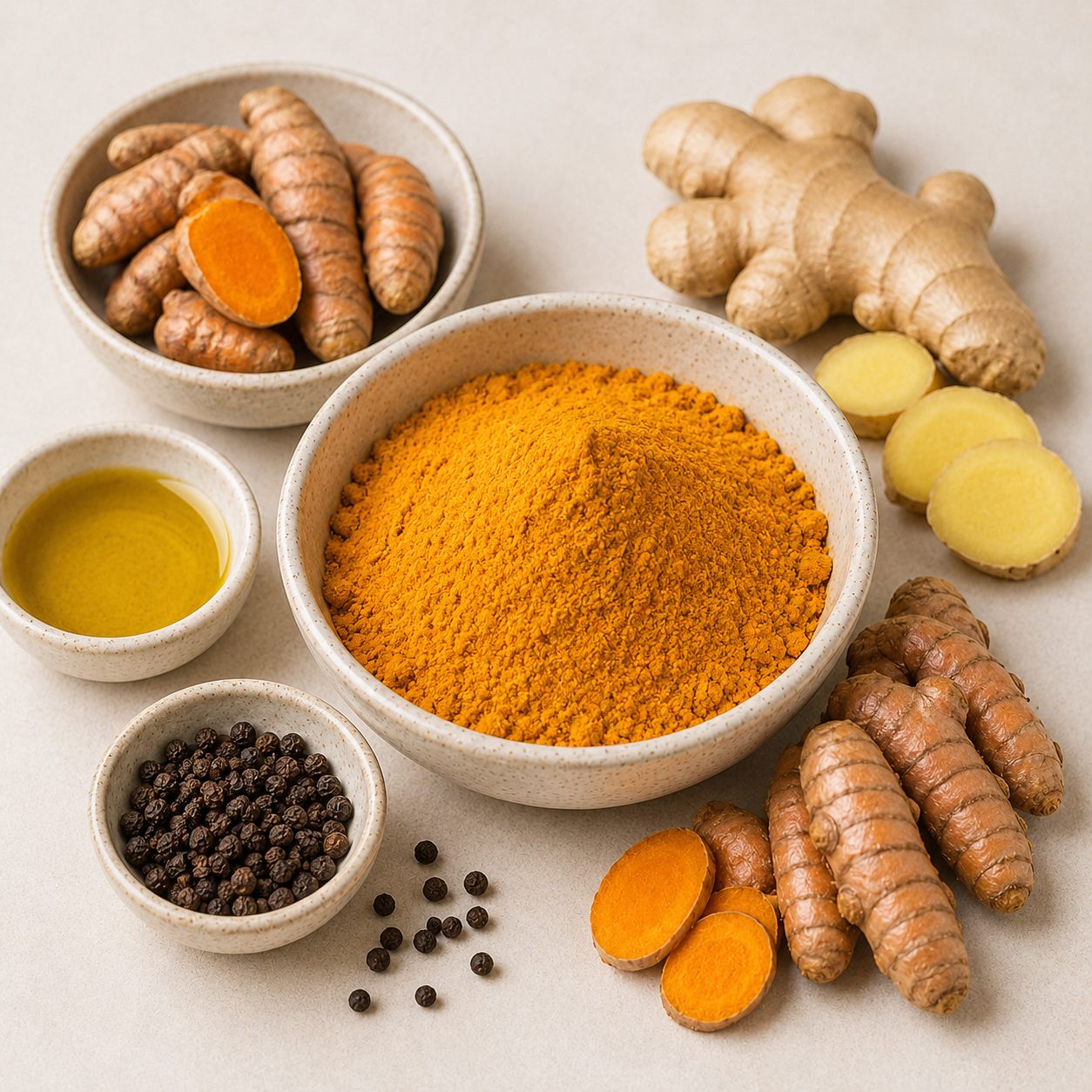
Curcumin is one of the main curcuminoids in the rhizome of turmeric (Curcuma longa). In supplements, “curcuminoids” usually include curcumin, demethoxycurcumin, and bisdemethoxycurcumin. It is not an essential nutrient and is mainly used as a plant bioactive for specific goals such as inflammation, joint symptoms, and exercise recovery.
30-second check: which situation fits you best?
I just want everyday anti-inflammatory or antioxidant support
You are interested in curcumin’s anti-inflammatory and antioxidant activity and are considering it as a long-term wellness supplement, but you do not have a specific symptom, condition, or measurable goal you want to improve.
I have one clear goal I want to improve
If your main goal is post-exercise muscle soreness and recovery, a specific joint problem, or another clearly defined outcome, look for human research that matches your population, formulation, and goal.
I am planning to use it or already taking it
If you have already bought curcumin or plan to use it, the key is not finding the “highest dose.” First determine whether the label refers to turmeric powder, curcuminoids, or a higher-bioavailability formulation.
Basic Overview
What it is
Curcumin is a naturally occurring plant bioactive in turmeric rhizome and one of the compounds responsible for turmeric’s yellow color. Supplemental curcumin usually comes from concentrated turmeric extract. It is not an essential vitamin or mineral, and there is no established daily requirement. People generally use curcumin supplements for specific goals such as inflammation, exercise recovery, or joint comfort.
Why people use it
- A goal-directed trial for inflammation-related concerns
- Post-exercise soreness and recovery
- Joint comfort and physical function
- A standardized curcuminoid dose
- Further evaluation of selected metabolic markers
- An optional optimization, not basic nutrient replacement
How it relates to healthy aging
Experimental research links curcumin with several pathways related to aging, including inflammatory signaling and oxidative stress, and some human studies report changes in inflammatory or oxidative markers.
These changes are mainly biomarkers. They do not prove that curcumin slows human aging, extends lifespan, or makes the body broadly “younger.”
Supplement Assessment
Curcumin is not something you need to “get enough of” every day. Whether it is worth using depends more on whether you have a clear goal, whether relevant human evidence applies to you, whether your product matches the studied formulation, and whether you notice a meaningful reason to continue.
Low priority right now
- No clear goal to improve
- Interested mainly because of “natural anti-inflammatory” marketing
- Wanting antioxidant or anti-aging benefits
- Hoping to prevent all chronic diseases
- Diet, exercise, sleep, or other basics still have substantial room for improvement
- Planning to take it indefinitely
Your next step:
Prioritize diet, exercise, and sleep first. If you still want to try curcumin, turn the vague idea of “reducing inflammation” into a specific goal rather than chasing a laboratory mechanism.
Clear goal: worth a closer look
- A specific exercise-recovery goal
- A specific joint-comfort goal
- Wanting to evaluate a particular inflammation-related marker
- Willing to reassess after about 6–12 weeks
- Able to use an extract reasonably similar to the one studied
- Accepting that benefits may be small or not noticeable
Your next step:
First find human research that matches your goal, population, and product form. Then choose the product and trial period. Evidence for one curcumin extract does not automatically prove that another higher-bioavailability formula works the same way.
Talk with a healthcare professional first
- Current or previous liver problems
- Gallstones, bile-duct obstruction, cholangitis, or other biliary disease
- Taking aspirin, clopidogrel, warfarin, or other anticoagulant or antiplatelet drugs
- Using anticancer drugs or immunosuppressants such as tacrolimus
- A bleeding disorder, or an upcoming surgery or invasive procedure
- Active gastrointestinal ulcer, GI bleeding, gastrointestinal perforation, or recent GI surgery
- Pregnancy or breastfeeding
Your next step:
These situations should not be managed with the same approach used for generally healthy adults. Ask a doctor or pharmacist to review risks and interactions before using curcumin.
Quick self-check
What exactly am I trying to improve?
Is there human research in people like me?
Is the product turmeric powder, a conventional extract, or a higher-bioavailability formula?
Does the label state the total curcuminoid content?
How long will I take it, and what will I use to decide whether it is worth continuing?
Am I taking medications or dealing with liver or biliary problems?
Food Sources
Curcumin has no established RNI, RDA, or AI, so this table does not show a percentage of an adult reference intake. Food values are included to show the scale of natural dietary exposure, not to imply a daily target.
Common Food Sources With Higher Curcumin Content
| Food | Representative Origin / Type | Approx. Curcumin per 100 g | Common Serving | Approx. per Serving | How to Interpret It |
|---|---|---|---|---|---|
| Lakadong turmeric powder | Jaintia Hills, Meghalaya, India | About 7,000–10,000 mg | About 3 g | About 210–300 mg | A representative high-curcumin type. Many commercial products list about 7%–10%, and some research samples have exceeded 12.5%, so individual batches can still vary substantially. |
| Alleppey turmeric powder | Kerala, India | About 4,000–7,000 mg | About 3 g | About 120–210 mg | A relatively high-curcumin type. Indian processing references give a representative range of about 4%–7%, and the IISR Alleppey Supreme variety is around 6%. |
| Nizamabad Finger turmeric powder | Telangana, India | About 4,000–5,000 mg | About 3 g | About 120–150 mg | Commercial export material is often specified at about 4%–5%. This is useful for understanding the rough level of local products, but it does not mean every variety or batch is fixed at that level. |
| Salem / Erode turmeric powder | Tamil Nadu, India | About 3,000–4,000 mg | About 3 g | About 90–120 mg | Commercial export material is often specified at about 3%–4%; actual content also varies with cultivar, maturity, and processing. |
| Typical commercial turmeric powder | No specific origin / variety | Average about 3,140 mg | About 3 g | Average about 94 mg | In one analysis of commercial products, pure turmeric powder averaged about 3.14% curcumin. Actual products can be substantially higher or lower, so this is only a rough reference. |
How to read these numbers
1 Origin is not the only factor
Curcumin content is influenced by cultivar, genetics, climate, soil, maturity, and processing. Even within India, powders from the same region can differ by variety, year, or batch.
2 Lakadong is a high-content example, not a fixed value
Lakadong turmeric is known for higher curcumin. Commercial products often list about 7%–10%, but studies and batches can measure lower or higher. The name “Lakadong” suggests a rough range; it does not replace batch-specific testing.
3 Typical turmeric powder cannot be calculated precisely
If a label simply says “turmeric powder” without a cultivar, standardization percentage, or laboratory result, do not assume it contains exactly 3.14% curcumin. About 3,140 mg/100 g is only an average from commercial samples.
4 Distinguish “curcumin” from “total curcuminoids”
This table primarily compares curcumin itself. Some references report total curcuminoids, which also include demethoxycurcumin and bisdemethoxycurcumin. These are not identical measures.
How Much Can Food Provide in a Day?
Example 1 | Add ordinary turmeric powder to meals
Add about 3 g of ordinary turmeric powder to curry, eggs, stews, or soup.
Using the rough commercial average of about 3.14% curcumin: 3 g turmeric powder ≈ 94 mg curcumin.
Actual content varies by product and batch, so this example is only meant to show the order of magnitude.
Example 2 | A higher-curcumin variety
If a product is clearly labeled Lakadong and testing shows about 7%–10% curcumin, then 3 g provides roughly 210–300 mg curcumin.
That is substantially more than typical turmeric powder, so two products cannot be assumed equivalent just because both are “3 g of turmeric powder.”
Cooking and storage tips
Turmeric powder can be used as a spice in meals or added to dairy or plant milk for golden milk.
After opening, keep turmeric powder sealed and away from heat and light to limit quality loss over time.
Piperine in black pepper can increase curcumin absorption and bioavailability; only a small amount is needed.
Whole foods vs supplements
Turmeric Powder
- Provides curcuminoids, volatile oils, and other plant compounds
- Can be used directly in curry, stews, eggs, golden milk, and other foods
- Curcumin content can differ several-fold by variety and batch
- Typical products are usually not standardized for curcumin content
- Better suited to natural dietary intake than precise milligram dosing
Curcumin Supplements
- Provide a more concentrated amount of curcuminoids
- Can state the actual curcuminoid amount per capsule or serving
- Make it easier to match standardized doses used in human studies
- Conventional and higher-bioavailability formulations can produce very different human exposure
- Require more attention to dose, formulation, drug interactions, and liver safety
Dosage
Curcumin has no established RNI, RDA, AI, formal UL, or universal daily recommended dose. Regulatory references and research doses should not be presented as official recommendations.
Official Dose Status, Regulatory References, and Human Research
Regulatory Safety References
EFSA’s ADI applies to curcumin used as the food additive E100. It is not an RNI, RDA, AI, supplement recommendation, or supplement UL. The ANSES reference applies only to conventional curcumin formulations.
Human Research References by Formulation and Use Case
These are study doses, not universal daily recommendations. Different formulations cannot be converted directly based on label milligrams.
Who These Numbers Apply To:This section is written for generally healthy adults. Do not directly apply these numbers to pregnancy, breastfeeding, children or adolescents, current or previous liver problems, long-term medication use, or plans to use a higher-bioavailability or piperine-containing formula.
Important Note
Curcumin currently has no established RNI, RDA, or AI, no formal UL, and no universal daily recommended dose.
EFSA’s 3 mg/kg body weight/day figure is the ADI for curcumin as food additive E100. It is not a supplement recommendation or supplement UL.
ANSES’s <153 mg/day figure is a regulatory safety reference for a 60 kg adult using conventional formulations. It does not apply to higher-bioavailability formulations.
Theracurmin in human studies is a patented higher-absorption curcumin formulation that uses submicron-particle dispersion to improve water dispersibility and human exposure. It cannot be directly compared with “500 mg/day of a conventional 95% curcumin extract.”
Dose interpretation must account for the actual formulation. Conventional products, piperine combinations, phospholipid complexes, micelles, and other delivery systems cannot be compared by milligrams alone.
How Formulation Affects Exposure
Conventional curcumin is poorly water soluble, and its absorption and metabolism leave very low levels of free curcumin in the blood. This is why many formulations are designed to increase bioavailability.
Piperine, phospholipid complexes, micelles, and similar systems can substantially increase human exposure, so the same 500 mg label dose does not necessarily produce the same curcumin exposure.
In a classic small pharmacokinetic study, 2 g curcumin plus 20 mg piperine increased measured bioavailability by about 2,000% compared with curcumin alone.
How to Read Common Product Doses: Front-Label Number ≠ Curcuminoid Dose
The 2,250 mg, 750 mg, 550 mg, 500 mg, or 665 mg printed on turmeric products may refer to turmeric root, turmeric extract, or actual curcuminoid content.
| Product | Front-Label Number | Dose That Is Actually Comparable | Formulation | How to Read It |
|---|---|---|---|---|
| NatureWise Turmeric CurcuminOfficial product link | 2250 mg | 500 mg curcuminoids/day | Absorption enhanced 95% standardized extract + BioPerine; 3 capsules/day |
The 2,250 mg on the label refers to the total amount of organic turmeric ingredients. Actual curcuminoids are about 500 mg/day. BioPerine® black pepper extract (piperine) makes this a piperine-enhanced curcumin formula. |
| Doppelherz aktiv Curcuma 750Official product link | 750 mg | 35 mg curcuminoids/capsule | Piperine formula 750 mg turmeric-root extract (35 mg curcumin), plus 2 mg piperine + 25 μg vitamin D3 |
Most of the 750 mg figure is turmeric-root extract. Actual curcumin is only 35 mg, and piperine is included, so absorption is intentionally altered. |
| Jamieson Curcumin Turmeric 550 mgOfficial product link | 550 mg | About 60–90 mg curcuminoids | Turmeric root + standardized extract 500 mg turmeric root + 50 mg 50:1 turmeric extract; extract standardized to 95% |
The 50 mg turmeric extract is standardized to 95% curcuminoids, so that portion clearly provides 47.5 mg curcuminoids. Using a common literature estimate of roughly 3%–8% curcumin in turmeric material, 500 mg root may contribute another ~15–40 mg, giving a rough total of about 60–90 mg curcuminoids. |
| Jarrow Curcumin 95Official product link | 500 mg | 475 mg total curcuminoids/capsule | Conventional standardized 500 mg turmeric extract; standardized to 95%; no piperine or other absorption enhancer listed |
This is a conventional standardized turmeric extract. The total curcuminoid dose is easy to interpret: compare the 475 mg total curcuminoids, not the 500 mg extract weight. |
| NOW Turmeric CurcuminOfficial product link | 665 mg | 630 mg total curcuminoids/capsule | Conventional standardized 665 mg turmeric-root extract; at least 95% curcuminoids; no piperine or other absorption enhancer listed |
For dose comparisons, focus on the 630 mg total curcuminoids rather than the 665 mg extract weight shown on the package. |
NatureWise Turmeric Curcumin
Official product link- Front-Label Number
- 2250 mg
- Dose That Is Actually Comparable
- 500 mg curcuminoids/day
- Formulation
- Absorption enhanced
95% standardized extract + BioPerine; 3 capsules/day
- How to Read It
- The 2,250 mg on the label refers to the total amount of organic turmeric ingredients. Actual curcuminoids are about 500 mg/day. BioPerine® black pepper extract (piperine) makes this a piperine-enhanced curcumin formula.
Doppelherz aktiv Curcuma 750
Official product link- Front-Label Number
- 750 mg
- Dose That Is Actually Comparable
- 35 mg curcuminoids/capsule
- Formulation
- Piperine formula
750 mg turmeric-root extract (35 mg curcumin), plus 2 mg piperine + 25 μg vitamin D3
- How to Read It
- Most of the 750 mg figure is turmeric-root extract. Actual curcumin is only 35 mg, and piperine is included, so absorption is intentionally altered.
Jamieson Curcumin Turmeric 550 mg
Official product link- Front-Label Number
- 550 mg
- Dose That Is Actually Comparable
- About 60–90 mg curcuminoids
- Formulation
- Turmeric root + standardized extract
500 mg turmeric root + 50 mg 50:1 turmeric extract; extract standardized to 95%
- How to Read It
- The 50 mg turmeric extract is standardized to 95% curcuminoids, so that portion clearly provides 47.5 mg curcuminoids. Using a common literature estimate of roughly 3%–8% curcumin in turmeric material, 500 mg root may contribute another ~15–40 mg, giving a rough total of about 60–90 mg curcuminoids.
Jarrow Curcumin 95
Official product link- Front-Label Number
- 500 mg
- Dose That Is Actually Comparable
- 475 mg total curcuminoids/capsule
- Formulation
- Conventional standardized
500 mg turmeric extract; standardized to 95%; no piperine or other absorption enhancer listed
- How to Read It
- This is a conventional standardized turmeric extract. The total curcuminoid dose is easy to interpret: compare the 475 mg total curcuminoids, not the 500 mg extract weight.
NOW Turmeric Curcumin
Official product link- Front-Label Number
- 665 mg
- Dose That Is Actually Comparable
- 630 mg total curcuminoids/capsule
- Formulation
- Conventional standardized
665 mg turmeric-root extract; at least 95% curcuminoids; no piperine or other absorption enhancer listed
- How to Read It
- For dose comparisons, focus on the 630 mg total curcuminoids rather than the 665 mg extract weight shown on the package.
Health Effects
Inflammatory Markers
Pooled randomized trials suggest curcumin may reduce some inflammatory markers such as CRP, IL-6, and TNF-α, but results vary substantially by population, product, and dose, and some meta-analyses are inconsistent. In generally healthy adults, a lower marker does not necessarily mean you will feel that “inflammation is lower.”
View meta-analysis
Antioxidant Status
Some pooled randomized trials suggest curcumin may reduce oxidative-stress markers such as MDA and improve selected antioxidant markers. These are mainly blood or laboratory measurements; they do not yet show that healthy adults experience a clearly noticeable benefit, and they should not be interpreted as proof of slower aging.
View meta-analysis
Joint Comfort
In knee osteoarthritis studies, some curcumin formulations may reduce pain and stiffness and improve function. However, a recent umbrella review found substantial differences among extracts, along with methodological and heterogeneity concerns. Most results come from people with osteoarthritis and should not be generalized to healthy adults without joint problems.
View network meta-analysis
Post-Exercise Recovery
Some exercise studies report less soreness or lower muscle-damage markers with curcumin, but recent reviews find inconsistent results across inflammation, soreness, muscle damage, and performance, with overall low certainty. Curcumin is therefore better viewed as a goal-directed short-term trial than an essential sports supplement.
View systematic review
Blood Glucose & Metabolism
Recent meta-analyses suggest curcumin may modestly improve blood glucose and some lipid measures in people with diabetes or prediabetes. These findings come mainly from people who already have hyperglycemia or metabolic abnormalities and cannot be assumed to apply equally to healthy adults with normal glucose regulation.
View meta-analysis
Cognition & Healthy Aging
Two 2025 meta-analyses, including about 501 and 531 participants respectively, reached different conclusions. One suggested a possible improvement in overall cognition; the other found no clear overall benefit, with signals only in selected abilities such as working memory and processing speed. At this stage, it is more accurate to say curcumin may help some cognitive domains than to describe it as a reliably effective brain-health or anti-aging supplement.
View meta-analysis 1 · View meta-analysis 2
Product Selection
If I buy curcumin, what should I look for on the label?
Check These Four Things
What is the active ingredient?
First distinguish turmeric-root powder, turmeric extract, and standardized curcuminoid extract. If you want a product that resembles human curcumin research, look for the plant source, extract weight, and a statement such as “total curcuminoids xx%,” rather than relying on the front-label “Turmeric” milligrams.
How much do you actually get per serving?
Calculate the actual milligrams of total curcuminoids. For example, “500 mg turmeric extract, standardized to 95% curcuminoids” provides about 475 mg total curcuminoids. Do not treat 500 mg of raw extract weight and 475 mg of standardized active content as the same number.
Are there unnecessary added ingredients?
Check for sugar, flavorings, colors, and unrelated herbal blends. Piperine is not simply an “inactive add-on”; it is included specifically to alter curcumin absorption and should be evaluated separately. People taking medications should be especially careful not to treat it as an ordinary black-pepper excipient.
Is quality control credible?
Prefer products that clearly state the botanical source, standardization, active amount per serving, lot number, and manufacturing information, ideally with third-party testing or verifiable quality certification. For turmeric extracts, actual curcuminoid content, heavy metals, and ingredient authenticity matter more than vague “natural” or “high purity” claims.
How to Read the LabelFind the total curcuminoids first, then calculate the actual daily amount
The largest mg number on the package may be the total weight of a plant extract or complex, not the total curcuminoid dose.
Piperine / Black Pepper Extract, etc. Check the actual product label separately.
Use directions should follow the actual manufacturer label; they are not converted here into a site-recommended dose.
Turmeric source | Standardization | Total curcuminoids | Lot number | Third-party testing
Illustrative label. A 500 mg figure refers to total turmeric-extract weight; at 95% standardization it provides about 475 mg total curcuminoids. When comparing conventional standardized products, focus on 475 mg rather than the 500 mg extract weight.
Find the target ingredient first
Distinguish turmeric-root powder, turmeric extract, and standardized curcuminoid extract. If you are comparing with human curcumin research, focus on the actual total curcuminoid content.
Separate extract weight from active dose
500 mg turmeric extract is not the same as 500 mg curcuminoids. At 95% standardization, it provides about 475 mg total curcuminoids.
Calculate the actual daily intake
Check how many capsules make one serving and how many servings are taken per day, then calculate daily total curcuminoids. Example: 1 capsule/serving × 1 serving/day × 475 mg = 475 mg total curcuminoids/day. This is label math, not a site-recommended dose.
Evaluate absorption enhancers separately
Piperine, phospholipid complexes, micelles, and similar systems change human exposure. They should not simply be added to the curcuminoid amount, and they cannot be compared with conventional formulations by milligrams alone.
Then check formulation and quality
Confirm turmeric source, standardization, actual total curcuminoids, whether it is a special higher-bioavailability formulation, and whether lot and quality information can be verified.
How to Choose Among Common Forms(Different forms cannot be compared by milligrams alone)
Turmeric Powder
Main features
Whole turmeric material. The USP monograph requires dried turmeric rhizome to contain at least 3% total curcuminoids. Actual content varies with variety, origin, and batch and is far lower than concentrated extracts.
Site guidance
Best understood as a spice or food source. Do not treat “500 mg turmeric powder” as “500 mg curcuminoids,” and do not convert it one-for-one to clinical supplement doses.
High-Concentration Standardized Curcuminoid Extract
Main features
Concentrates total curcuminoids and standardizes them to a high proportion, commonly around 93%–95%. Active content is clearer, although oral bioavailability of conventional formulations is still generally limited.
Site guidance
If you want to compare with traditional human curcumin studies, prioritize labels that clearly state the milligrams of total curcuminoids per serving, not just total turmeric-extract weight.
Curcumin + Piperine
Main features
Piperine can inhibit some metabolic processes and markedly increase curcumin exposure. A classic small pharmacokinetic study found a large increase in exposure, but that does not mean health effects rise proportionally.
Site guidance
Treat it as an absorption-enhanced formula rather than ordinary curcumin. People taking medications should be more cautious because piperine may affect drug metabolism and transport.
Phospholipid Complex / Micelle / Cyclodextrin, etc.
Main features
Phospholipid complexes, micelles, cyclodextrins, and similar delivery technologies can substantially change curcumin solubility and absorption. The increase varies widely by system, so products cannot be ranked by milligrams alone.
Site guidance
These formulations are most informative when the exact delivery system has its own human pharmacokinetic or clinical data. Interpret the dose using studies of that formulation rather than converting it directly to a conventional high-concentration extract.
Do not compare delivery systems by curcuminoid milligrams alone
For example, a conventional 95% extract may list more curcuminoids per capsule than a phytosome product, but that does not automatically make it the “stronger” or more appropriate option.
Conventional extracts, piperine combinations, phytosomes, micelles, and cyclodextrin systems differ in absorption and pharmacokinetics. When possible, look for human research that matches the product form and your goal.
Higher-absorption formulations should not be treated only as a selling point. Rare liver injury has been reported with some curcumin products, so safety also matters.
How to Take
When should I take it, and what is the most practical way to use it?
Default plan (healthy adults)
Official recommended dose: Not established. Conventional standardized extracts and higher-bioavailability formulations cannot be directly interchanged by milligrams.
Common product amounts: Market examples of conventional 93%–95% extracts provide about 372–1,425 mg/day total curcuminoids (market-label examples only, not an official recommendation).
Frequency: Usually 1–2 times daily, depending on the specific product and study.
GI tolerance: Prefer taking it with a meal. Several conventional standardized products also direct users to take it with food or at mealtime.
Mild discomfort: Lower the amount per dose or split the dose. If symptoms persist, stop and seek advice.
Long-term use?: Do not assume indefinite use. For a goal-directed trial, consider an initial 6–12 week observation period and then reassess. This is a practical site strategy, not an official treatment course.
Missed dose: If you occasionally miss a dose, skip it and resume your usual plan next time. Do not double the dose.
Frequently asked questions
With food or on an empty stomach?
Prefer taking it with food. Several conventional standardized product labels also recommend use with meals, especially for people with a sensitive stomach.
Do I need black pepper?
Piperine in black pepper can increase curcumin absorption. If the product already contains BioPerine or another absorption enhancer, there is no need to add more simply to chase higher absorption.
Morning or evening?
There is no required time. Choose a regular mealtime that is easy to maintain and well tolerated.
How long should I take it?
For a goal-directed trial, you can start with about 6–12 weeks and define what you will track in advance. If there is no meaningful benefit, do not continue indefinitely just because curcumin is described as “anti-inflammatory.”
How do I know whether it is working?
For joint or exercise-recovery goals, track outcomes you can actually feel or measure, such as soreness, mobility, or recovery time. Do not assume it is working simply because the label says “antioxidant.”
More questions about use (click to expand)
Is a higher-bioavailability formulation always better?
Not necessarily. Higher-bioavailability curcumin formulations can increase blood exposure, but an independent 2025 pharmacokinetic study further showed that higher exposure cannot simply be translated into a proportional clinical effect. NCCIH and the TGA also note rare reports of liver injury with higher-bioavailability formulations; people with a history of liver disease should not use them on their own.
Can a piperine formula and a conventional extract be compared by milligrams?
No. In an older small human study, 2 g curcumin plus 20 mg piperine markedly increased measured curcumin bioavailability. That was a pharmacokinetic result under specific study conditions; it does not mean “health effects increased 20-fold,” and it does not allow direct milligram comparisons with other products.
Is “500 mg turmeric powder” the same as “500 mg extract”?
No. USP turmeric powder standards require at least about 3% curcuminoids, whereas standardized curcuminoid ingredients may contain at least 95%. “500 mg turmeric extract” and “500 mg turmeric powder” are different dose concepts and should not be compared directly.
Risks & Precautions
Common Side Effects
- Nausea or stomach discomfort: take with food and consider lowering the amount per dose
- Reflux: avoid taking it on an empty stomach or taking a large amount at once
- Diarrhea or constipation: reduce the dose; stop if it persists
- Vomiting: repeated vomiting is a reason to stop self-directed use
- These are among the common oral side effects listed by NCCIH; not everyone experiences them
Higher-Dose Risks
- No formal UL has been established for curcumin supplements. The absence of a UL does not mean the dose can be increased without limit.
- Conventional turmeric or curcumin that is not specifically formulated for enhanced absorption is generally considered reasonably safe for about 2–3 months when used at recommended amounts.
- Rare but potentially serious liver injury has been reported with turmeric/curcumin supplements.
- Recent TGA and EMA assessments indicate that higher doses and higher-bioavailability formulations may warrant greater caution.
People Who Need More Caution
- Current or previous liver problems: do not self-start turmeric or curcumin supplements, especially higher-bioavailability formulations, which may increase the risk of rare but serious liver injury.
- Gallstones or biliary disease: people with gallstones, bile-duct obstruction, cholangitis, or other biliary disorders should not self-use these products because turmeric may promote bile flow and gallbladder contraction.
- Pregnancy or breastfeeding: do not self-start curcumin supplements during pregnancy. Safety data for amounts above ordinary food use during breastfeeding are insufficient, so seek advice first.
- Active serious gastrointestinal disease: people with GI bleeding, active ulcers, gastrointestinal perforation, or recent GI surgery should not self-use curcumin without medical assessment.
Medications & Special Situations
- Anticoagulant or antiplatelet drugs: if you take aspirin, warfarin, or other anticoagulant or antiplatelet medication, ask a doctor or pharmacist to review possible interactions first.
- Cancer or immunosuppressive treatment: do not add curcumin on your own if you are receiving anticancer therapy or using immunosuppressants such as tacrolimus.
- Recurrent calcium-oxalate kidney stones or hyperoxaluria: avoid large amounts of turmeric powder and first consider the ingredient form used in the curcumin product.
- Upcoming surgery or invasive procedure: tell your healthcare team that you use curcumin and follow their instructions on whether and when to stop it.
- During menstruation, women are advised not to use curcumin or turmeric powder. In traditional Chinese medicine, turmeric is described as promoting blood movement and qi circulation, which is said to potentially increase bleeding.
Stop and Ask for Advice
Persistent nauseaPersistent diarrheaRepeated refluxSignificant stomach painPersistent vomitingRash, hives, or another possible allergic reaction
Seek Medical Care Promptly
Yellowing of the skin or whites of the eyesDark urineMarked unusual fatiguePersistent nausea and vomitingUnexplained significant bleedingAbdominal pain
Sources
This page uses sources covering the overall evidence and safety of curcumin, human evidence in healthy adults, joint-related evidence, absorption and formulation, food sources, and examples of mainstream product labels.
Basic Information, Overall Evidence & Safety
Human Evidence in Healthy Adults
Joint Evidence
Absorption & Formulation
Food Sources
Mainstream Product Label Examples
Last updated: August 9, 2026