Resveratrol
Resveratrol / trans-Resveratrol / Resveratrol / trans-Resveratrol
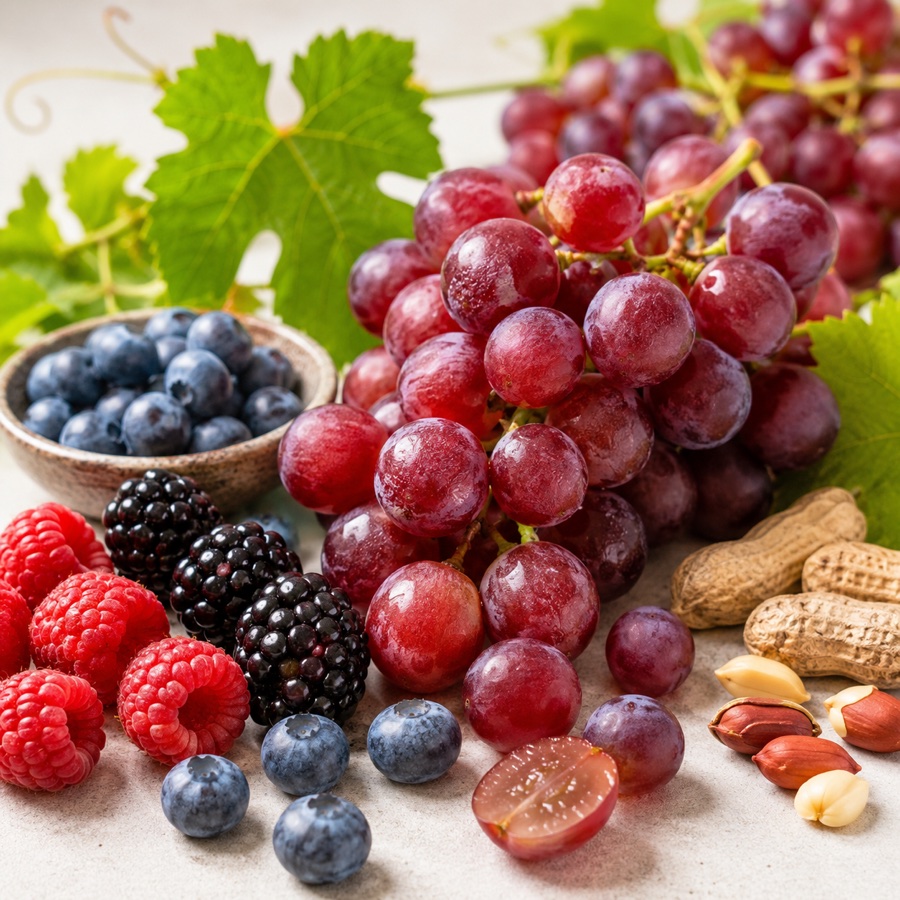
Resveratrol is a natural polyphenol found in grapes, peanuts, and other plants and belongs to the stilbene family. It is not an essential nutrient, and there is no defined resveratrol-deficiency state. Whole foods provide only small amounts, while supplements usually use concentrated extracts from Japanese knotweed or grapes. When comparing products, focus on the actual trans-resveratrol content.
30-second check: which situation fits you best?
I just want everyday anti-inflammatory or antioxidant support
If you are considering long-term use mainly because of “antioxidant,” “anti-inflammatory,” or “healthy aging” claims, evidence for meaningful extra benefit in generally healthy adults is not strong. Resveratrol has many biological activities, but in-vitro antioxidant findings cannot be directly translated into human outcomes.
I have one clear goal I want to improve
If your goal is glucose, blood pressure, lipids, vascular function, or cognition during a specific life stage, review the relevant human research and confirm whether the study population resembles you. Findings from disease populations should not be applied directly to healthy adults.
I am planning to use it or already taking it
The key questions are how much trans-resveratrol the product actually provides, whether a research dose can be applied to your situation, whether the product uses a special high-absorption formulation, and whether your medications affect safety.
Basic Overview
What it is
Resveratrol is a natural plant polyphenol found mainly in grape skins, peanut skins, and some other plants. It is not an essential nutrient and there is no required daily intake. Supplements commonly use extracts from Japanese knotweed root or grapes, with the biologically better-characterized trans-resveratrol form being the main focus.
Why people use it
- Support selected metabolic markers
- Support vascular and cardiovascular health
- Seek additional antioxidant support
- Focus on inflammation-related markers
- Focus on cognition and cerebral blood flow
- Interest in healthy-aging research
How it relates to healthy aging
Resveratrol affects pathways related to oxidative stress, inflammation, energy metabolism, vascular function, and cell signaling, which is why it has long been studied in healthy aging.
However, many famous mechanisms come from cell or animal research, and free resveratrol concentrations in human blood are very low after oral intake. Current human evidence does not show that resveratrol reverses aging, makes the whole body “younger,” or extends lifespan in healthy adults.
Supplement Assessment
Resveratrol is not a basic nutrient and there is no deficiency-testing logic. Whether it is worth trying depends on having a specific goal, whether the human evidence applies to you, and whether you can reassess after a defined period.
Low supplementation priority
- No specific outcome you want to improve
- Mainly attracted by antioxidant or anti-aging marketing
- Hoping one supplement will make the whole body healthier
- Diet, exercise, and sleep still have obvious room for improvement
- Planning to take it indefinitely
Your next step:
Prioritize diet, exercise, and sleep first. If you still want to try it, convert a vague “antioxidant” or “healthy-aging” goal into a specific outcome that can be evaluated.
Clear goal: a trial may be reasonable
- Adults with overweight and elevated total cholesterol
- Postmenopausal women aged 45–85 who are focused on cognition and cerebrovascular function
- You have a specific goal rather than a vague desire for “antioxidant support”
- You can choose a trans-resveratrol product similar to that used in the relevant research
- You are willing to set a trial period and evaluate the actual result
Your next step:
Find human evidence that matches your goal, population, dose, and product form. A positive study does not mean every resveratrol product is equally effective.
Talk with a healthcare professional first
- You take anticoagulant or antiplatelet medication
- You take multiple long-term medications
- You have a higher bleeding risk
- You have a history of an estrogen-sensitive condition
- Pregnancy or breastfeeding
- You are receiving complex medical treatment
- You plan to use a high-dose product on your own
Your next step:
Ask a doctor or pharmacist to review your condition, medications, and potential interactions before deciding whether to use it and at what dose.
Quick self-check
Can I clearly state the specific outcome I want to improve?
Is there direct human research for that outcome?
Does the study population broadly resemble me?
Does the product clearly state trans-resveratrol and the actual daily dose?
Am I willing to set a defined trial period and stop if there is no benefit?
Am I currently taking medication?
Food Sources
Resveratrol has no RNI, RDA, or AI, so no percentage of adult reference intake is shown.
Representative Natural Sources
| Food Form | Approx. Resveratrol per 100 g | How to Interpret It |
|---|---|---|
| Red / Purple Grapes With Skin | Approx. 0.40–0.68 mg | Resveratrol is concentrated mainly in grape skin, and levels vary substantially by variety and growing conditions. |
| Boiled Peanuts With Skin | Approx. 0.51 mg | Relatively higher levels have been measured after boiling; the peanut skin itself is an important site of concentration. |
| Strawberries | Up to about 0.30 mg | A representative fruit source, but amounts vary considerably by variety and sample. |
| Pistachios | Approx. 0.01–0.17 mg | Some varieties are relatively higher, but overall they remain a sub-milligram source. |
Why peanut skin matters
Resveratrol is much more concentrated in peanut skin, the thin seed coat, than in the peeled kernel. A more accurate way to think about it is that peanut skin is a relatively enriched part of the food, so peanuts eaten with the skin are more representative than peeled peanuts. The skin weighs very little, however, so a normal serving still provides only a small amount of resveratrol. Low-value sources such as blueberries, dark chocolate, cocoa powder, and peanut butter are not included in this table.
How to Get Resveratrol From Food in a Day
Example 1
100 g red/purple grapes + 25 g peanuts with skin
Provides a small amount of resveratrol naturally while also supplying other polyphenols, unsaturated fats, fiber, and micronutrients.
Example 2
100 g strawberries + 25 g pistachios + other plant foods
There is no need to calculate an exact daily milligram intake. The more useful goal is to include these foods within a varied plant-rich diet.
Cooking and storage tips
Eat grapes with the skin when practical: Resveratrol is concentrated mainly in the grape skin, so peeling lowers intake.
Keep peanut skins when practical: Resveratrol is much more concentrated in the peanut skin than in the peeled kernel.
No need to count every milligram: Variety, origin, and processing can cause large differences in content.
Do not use alcohol as a resveratrol source: Red wine contains some resveratrol, but that is not a reason to start drinking.
Whole foods vs supplements
Whole Foods
- Resveratrol dose is low
- Also provides fiber, multiple polyphenols, vitamins, minerals, and other plant bioactives
- Better suited as part of a long-term dietary pattern
Resveratrol Supplements
- Can provide tens to hundreds of milligrams per serving, a very different exposure level from food
- Dose is more concentrated and standardized
- Requires more attention to actual trans-resveratrol content, drug interactions, and high-dose tolerability
Dosage
Resveratrol has no RNI, RDA, AI, formal UL, or universal long-term recommended dose. Regulatory references and human-study doses should not be rewritten as recommendations for generally healthy adults.
Official Status, Regulatory Safety References & Human Studies
Regulatory Safety References
Regulatory figures must be interpreted together with the specific ingredient and conditions of use; they cannot be combined into one global safety boundary.
Human-Study References by Population and Context
Research doses are not recommendations for generally healthy adults; disease-study doses are not everyday doses for healthy people.
Higher-Dose Risk Signal
Around ≥1,000 mg/day is not a UL, toxicity threshold, or absolute safety ceiling.
Who These Numbers Apply To:This section is mainly written for generally healthy adults. Doses and outcomes in disease or metabolic-abnormality populations should not be applied directly. People taking medication, those who are pregnant or breastfeeding, people at increased bleeding risk, or anyone considering high doses should first consult a doctor or pharmacist.
Important Note
There is no established RNI, RDA, AI, or formal UL.
Regulatory numbers ≠ recommended dose. The EU 150 mg figure and Canada's 1,000 mg figure come from different regulatory systems and conditions; neither is a daily recommendation for healthy adults.
High disease-study doses ≠ healthy-adult dosing. Studies using 1,000–2,000 mg/day generally involve special populations or disease research and should not be copied by healthy adults.
Higher dose ≠ greater benefit. There is no stable evidence that benefits increase in proportion to dose; gastrointestinal intolerance becomes more relevant around 1 g/day and above.
How Formulation Affects Exposure
A substantial portion of oral resveratrol is absorbed from the gut, but it is rapidly metabolized through glucuronidation and sulfation after entering the body.
Relatively high absorption does not mean high bioavailability of free resveratrol. Unmetabolized free resveratrol concentrations in blood are usually very low, with most circulating material present as metabolites.
Taking 10× more does not mean free resveratrol rises 10× or that health effects rise 10×. Product effectiveness cannot be judged from the package milligram number alone.
How to Read Common Product Doses: Package Number ≠ Actual trans-Resveratrol Dose
Japanese knotweed extract, grape-vine extract, Resveratrol Complex, total resveratrol, and trans-resveratrol are not the same thing. The most useful comparison is the actual trans-resveratrol amount per day.
| Product | Package / Label Number | Dose That Is Actually Comparable | Formulation | How to Interpret It |
|---|---|---|---|---|
| NOW Foods Resveratrol 200 mgOfficial product link | 400 mg Japanese knotweed extract complex | 200 mg trans-resveratrol per capsule | Standardized extract Standardized Japanese knotweed extract + grape-seed extract |
The 400 mg is the total weight of the Japanese knotweed root/rhizome extract complex; it clearly provides 200 mg trans-resveratrol. |
| Jamieson ResveratrolOfficial product link | 50 mg grape-vine extract | 3 mg trans-resveratrol per capsule | Grape-derived combination Grape-vine extract + grape-seed OPC |
The 50 mg refers to Resveravine® grape-vine extract, which clearly provides only 3 mg trans-resveratrol. The product also adds 100 mg grape-seed OPC-phospholipid complex, making it closer to a “low-dose resveratrol + grape-seed polyphenol” combination product. |
| Jarrow Resveratrol 100 mgOfficial product link | 100 mg resveratrol | ≥90 mg trans-resveratrol per capsule | Japanese knotweed source Japanese knotweed extract + vitamin C |
The 100 mg is total resveratrol; the manufacturer states that at least 90 mg is the trans form. |
| Solgar Resveratrol 100 mgOfficial product link | 100 mg | 100 mg trans-resveratrol per capsule | Clearly stated trans content Explicitly labeled trans-resveratrol |
This label is easy to interpret: each capsule directly provides 100 mg trans-resveratrol. |
| Life Extension Resveratrol EliteOfficial product link | 167 mg proprietary blend | 30 mg trans-resveratrol per serving | Enhanced-absorption formulation Enhanced-absorption combination |
The 167 mg is the weight of the entire proprietary blend; only 18% is trans-resveratrol, equal to 30 mg. |
| Doctor's Best Trans-Resveratrol 600Official product link | 600 mg | 600 mg trans-resveratrol per serving | High-purity trans form High-purity trans-resveratrol |
The 600 mg is the actual trans-resveratrol per capsule, not the total weight of a Japanese knotweed extract. “98% purity” describes the raw material and does not need another conversion. |
NOW Foods Resveratrol 200 mg
Official product link- Package / Label Number
- 400 mg Japanese knotweed extract complex
- Dose That Is Actually Comparable
- 200 mg trans-resveratrol per capsule
- Formulation
- Standardized extract
Standardized Japanese knotweed extract + grape-seed extract
- How to Interpret It
- The 400 mg is the total weight of the Japanese knotweed root/rhizome extract complex; it clearly provides 200 mg trans-resveratrol.
Jamieson Resveratrol
Official product link- Package / Label Number
- 50 mg grape-vine extract
- Dose That Is Actually Comparable
- 3 mg trans-resveratrol per capsule
- Formulation
- Grape-derived combination
Grape-vine extract + grape-seed OPC
- How to Interpret It
- The 50 mg refers to Resveravine® grape-vine extract, which clearly provides only 3 mg trans-resveratrol. The product also adds 100 mg grape-seed OPC-phospholipid complex, making it closer to a “low-dose resveratrol + grape-seed polyphenol” combination product.
Jarrow Resveratrol 100 mg
Official product link- Package / Label Number
- 100 mg resveratrol
- Dose That Is Actually Comparable
- ≥90 mg trans-resveratrol per capsule
- Formulation
- Japanese knotweed source
Japanese knotweed extract + vitamin C
- How to Interpret It
- The 100 mg is total resveratrol; the manufacturer states that at least 90 mg is the trans form.
Solgar Resveratrol 100 mg
Official product link- Package / Label Number
- 100 mg
- Dose That Is Actually Comparable
- 100 mg trans-resveratrol per capsule
- Formulation
- Clearly stated trans content
Explicitly labeled trans-resveratrol
- How to Interpret It
- This label is easy to interpret: each capsule directly provides 100 mg trans-resveratrol.
Life Extension Resveratrol Elite
Official product link- Package / Label Number
- 167 mg proprietary blend
- Dose That Is Actually Comparable
- 30 mg trans-resveratrol per serving
- Formulation
- Enhanced-absorption formulation
Enhanced-absorption combination
- How to Interpret It
- The 167 mg is the weight of the entire proprietary blend; only 18% is trans-resveratrol, equal to 30 mg.
Doctor's Best Trans-Resveratrol 600
Official product link- Package / Label Number
- 600 mg
- Dose That Is Actually Comparable
- 600 mg trans-resveratrol per serving
- Formulation
- High-purity trans form
High-purity trans-resveratrol
- How to Interpret It
- The 600 mg is the actual trans-resveratrol per capsule, not the total weight of a Japanese knotweed extract. “98% purity” describes the raw material and does not need another conversion.
Health Effects
Glucose & Insulin Sensitivity
Some meta-analyses suggest resveratrol may improve glucose, insulin, or insulin-resistance markers in people with type 2 diabetes, while results are inconsistent in people without diabetes. It is better viewed as a research option in selected metabolically abnormal populations than as a general glucose-control supplement for healthy adults.
View meta-analysis
Blood Pressure & Vascular Function
Some human evidence and meta-analyses suggest resveratrol may improve blood pressure or endothelial function in selected metabolically abnormal populations. In 2026 umbrella evidence, blood-pressure improvement in people with type 2 diabetes was among the more reliable findings, but whether healthy adults get the same benefit remains unclear.
View umbrella review
Blood Lipids & Waist Circumference
The latest 2026 umbrella evidence suggests resveratrol may produce small reductions in total cholesterol and waist circumference in adults with overweight. Average changes are modest, and participants were mainly overweight or metabolically abnormal, so this should not be interpreted as meaningful fat loss or a substitute for diet and exercise.
View umbrella review
Inflammation & Oxidative Stress
Some studies report reductions in CRP, while results for IL-6, TNF-α, and other markers are less consistent. Resveratrol has strong antioxidant activity in laboratory systems, but free resveratrol concentrations in humans are low, so it should not be described as entering the body and directly “scavenging large amounts of free radicals.”
View meta-analysis
Cognition & Cerebrovascular Function
A study in postmenopausal women used 150 mg/day for 12 months and observed improvements in some cognitive and cerebrovascular measures. Broader human research remains mixed, so the evidence is better described as a positive signal in a specific population rather than proof that resveratrol is an established brain-health supplement for all adults.
View randomized controlled trial · View systematic review
Healthy Aging & Exercise
Resveratrol is often promoted as an anti-aging ingredient because of mechanisms involving SIRT and AMPK, but there is no human evidence that it extends lifespan or makes the whole body younger. Exercise findings are also inconsistent; some studies in healthy older men even suggest resveratrol may blunt certain training adaptations.
View umbrella review
Product Selection
What should I prioritize when buying?
Check These Four Things
What is the active ingredient?
Prefer products that clearly state trans-Resveratrol / trans-resveratrol, then check the botanical source and standardization. If the label only says Japanese knotweed, grape extract, or Resveratrol Complex, do not assume the whole amount is the target active ingredient.
How much do you actually get per serving?
Confirm trans-resveratrol per capsule, capsules per serving, and recommended daily servings, then calculate the actual daily intake. Do not treat total botanical-extract or proprietary-complex weight as trans-resveratrol dose.
Are there unnecessary added ingredients?
Check whether the formula adds large amounts of unrelated botanicals, sugar, sweeteners, flavors, or other ingredients. Grape-seed OPC, quercetin, vitamin C, and similar ingredients should be evaluated separately for whether they match your goal.
Is quality control credible?
Prefer products that clearly identify the manufacturer, manufacturing location, lot number, expiration date, trans-resveratrol amount, and raw-material source. Verifiable third-party testing adds useful confirmation of consistency.
How to Read the LabelFind trans-resveratrol first, then calculate the actual daily intake
The largest milligram number on the package may only be total botanical extract or blend weight, not the trans-resveratrol dose.
Grape Seed Extract 10 mg
Take 1 capsule daily. Determine use based on the product label and individual circumstances.
Raw Material | Standardization | Lot Number | Third-Party Testing
Illustrative label. The 400 mg refers to total Japanese knotweed extract weight, which provides 200 mg trans-resveratrol. When comparing products, focus on 200 mg rather than 400 mg.
Find the target ingredient first
Find “trans-resveratrol” first rather than comparing the total weight of Japanese knotweed, grape extract, or a resveratrol complex.
Read the ingredient form and actual dose
400 mg Japanese knotweed extract does not equal 400 mg resveratrol. If the label says it provides 200 mg trans-resveratrol, compare products using 200 mg.
Calculate the actual daily intake
First check capsules per serving and recommended servings per day, then calculate actual daily trans-resveratrol. Example: 1 capsule/serving × 1 serving/day × 200 mg = 200 mg trans-resveratrol/day.
Evaluate added active ingredients separately
Grape-seed OPC, quercetin, vitamin C, and similar ingredients are separate actives. Do not add them to trans-resveratrol to create a “total active dose.”
Then check formulation and quality
Check the botanical source, standardization, whether it uses an absorption-enhancing formulation, and quality information such as lot number and third-party testing. High-absorption products should not be compared with standard products by milligrams alone.
Common Label FormsDo not compare only the largest milligram number on the package
Standardized Japanese Knotweed Extract
Main features
Made from Japanese knotweed root or rhizome. The extract may contain other plant compounds, so total extract weight is not the same as actual trans-resveratrol. For example, 400 mg extract may provide only 200 mg trans-resveratrol.
Site guidance
Prioritize labels that clearly state how much trans-resveratrol the extract provides. Compare products mainly by actual trans-resveratrol milligrams, not total Japanese knotweed extract weight.
Grape-Derived Combination Extract
Main features
These products may provide small amounts of trans-resveratrol along with grape-seed OPCs or other grape polyphenols. For example, some 50 mg grape-vine extracts provide only a small amount of trans-resveratrol.
Site guidance
Calculate trans-resveratrol and grape-seed OPCs separately. A large grape-extract number is not the same as a large resveratrol dose and should not be compared directly with a high-purity single-ingredient product.
Explicitly labeled trans-resveratrol
Main features
The label directly states trans-resveratrol per capsule or serving, making the target active ingredient easy to identify without estimating from total botanical-extract weight.
Site guidance
This is the easiest label format for checking the actual dose. Still confirm capsules per serving and daily frequency before calculating total daily trans-resveratrol. A clear label does not mean a higher dose is better.
Enhanced-Absorption Formulation
Main features
Uses dispersion technology, hydrogels, micelles, or other systems that alter absorption and systemic exposure. The pharmacokinetic change varies substantially between technologies.
Site guidance
Do not compare with standard products by label milligrams alone, and do not convert it into an assumed “equivalent standard-resveratrol dose.” Higher absorption or blood exposure does not prove that clinical health effects increase by the same proportion.
Higher absorption does not automatically mean stronger health effects
Oral absorption is not the main limitation of resveratrol; rapid metabolism after absorption is a defining feature. Special delivery systems may change pharmacokinetics, but that does not automatically prove better real-world health outcomes.
How to Take
When should I take it, and how should I use it?
Default plan (healthy adults)
Recommended Dose: There is no universal recommended dose for generally healthy adults. Interpret dosing according to the specific goal, human evidence, and the actual trans-resveratrol amount in the product.
Frequency: There is no universal requirement. Some studies dose once daily, while others divide the total into two doses.
With food or on an empty stomach: There is no evidence that everyone must take it fasting or with food. If you are prone to gastrointestinal discomfort, taking it with food is reasonable.
Does it need a high-fat meal?: No. There is no need to deliberately pair it with a high-fat meal just to increase absorption.
Morning or evening: There is no reliable evidence that morning or evening is clearly superior.
Long-term use?: It is better used for a defined goal, for a limited period, followed by reassessment. If there is no meaningful benefit, do not default to continuing indefinitely.
Missed dose: If you miss a dose occasionally, skip it and resume the usual amount next time. Do not double the dose.
Frequently asked questions
With food or on an empty stomach?
There is no universal requirement. People with sensitive digestion can take it with a normal meal, but there is no need to use a high-fat meal for absorption.
Does the dose need to be divided?
There is no universal requirement. Some high-dose clinical studies use divided doses, but healthy adults should not assume they need to copy that schedule.
What time of day should I take it?
There is no reliable evidence that morning or evening produces meaningfully different effects. Choose a time that is easy to follow and does not conflict with medications.
Do I need to separate it from medication?
Potential platelet and CYP-enzyme interactions are not necessarily prevented by separating doses by a few hours. Ask a doctor or pharmacist to review the combination.
More questions about use (click to expand)
How long should I take it?
There is no universal treatment course. For a specific goal, use a defined trial period and reassess the target outcome, tolerability, and cost rather than defaulting to long-term use.
How do I know whether it is working?
Define the real outcome in advance, such as waist circumference or an existing lipid or glucose marker. Do not judge it by whether you “feel younger” or “more antioxidant.”
Is a higher dose more effective?
No. Research has not established a stable dose-response showing that higher doses produce stronger health effects. Gastrointestinal side effects become more relevant around 1 g/day and above.
Risks & Precautions
Common Side Effects
- Nausea
- Stomach or abdominal discomfort
- Bloating and gas
- Diarrhea
- Occasional headache or other mild discomfort
- For mild gastrointestinal symptoms, try taking it with food, reducing the single dose, or lowering the total amount. If symptoms persist or recur, stop use.
Higher-Dose Risks
- Gastrointestinal adverse effects are more common around 1 g/day and above
- Higher doses have not consistently produced proportionally greater health benefits
- Multi-gram doses mainly come from special clinical studies and are not ordinary daily-use amounts
- Long-term human safety data at high doses remain limited
- The absence of a formal UL does not mean the dose can increase without limit
People Who Need More Caution
- Pregnancy or breastfeeding
- Children and adolescents
- People at increased bleeding risk
- People with a history of estrogen-sensitive conditions
- People with complex chronic disease
- Anyone planning to use a clearly high dose without supervision
Medications & Special Situations
- Anticoagulant and antiplatelet drugs: People taking warfarin, heparin, clopidogrel, or similar drugs should not add high-dose resveratrol on their own.
- Some NSAIDs: If you also use aspirin or another drug that may increase bleeding risk, consult a doctor or pharmacist first.
- CYP-related medications: Resveratrol may affect CYP3A4 and may also involve CYP2C9, CYP2D6, and related pathways. People taking multiple long-term medications should not self-prescribe high doses.
- Surgery or invasive procedures: Tell your healthcare team you use resveratrol and let them decide whether it should be stopped and for how long; do not rely on a fixed number of days before surgery.
Stop and Ask for Advice
If you develop persistent diarrhea, nausea, abdominal pain, unusual bruising, bleeding, or similar problems, stop use and consult a doctor or pharmacist.
Seek Medical Care Promptly
Seek prompt medical care for difficulty breathing, swelling of the face, lips, or throat, persistent significant bleeding, or another severe acute symptom.
Sources
Sources on this page support resveratrol regulation and safety, health effects, absorption and dosing, natural food sources, and representative mainstream product labels.
Regulation, Safety & Basic Information
Use: Novel Food safety assessment of a specific-purity trans-resveratrol at 150 mg/day and gastrointestinal tolerability at higher doses.
Use: EU conditions for trans-resveratrol in adult supplements and the label requirement for medical supervision in people taking medication.
Use: resveratrol dose information within Canada's natural-health-product regulatory framework.
Use: ingredient identity, food sources, pharmacokinetics, safety, and drug interactions.
Health Effects & Scientific Evidence
Use: synthesis of 45 systematic reviews and meta-analyses to assess certainty across health outcomes.
Use: differences in glucose and insulin-sensitivity outcomes between people with and without diabetes.
Use: inflammatory markers including CRP, IL-6, and TNF-α.
Use: cognition and cerebrovascular outcomes in postmenopausal women taking 150 mg/day for 12 months.
Use: overall cognitive evidence remains limited and inconsistent.
Absorption & Dose
Use: oral absorption is relatively high, but systemic bioavailability of free resveratrol is very low.
Use: tolerability of moderate and high doses and gastrointestinal adverse effects.
Use: disease-study dosing that escalated from 500 mg to 2,000 mg/day.
Food-Source Data
Use: differences among boiled peanuts, roasted peanuts, and peanut products.
Use: higher concentrations in peanut skins than in peeled kernels.
Use: resveratrol levels in red/purple grapes and grape skin.
Use: pistachio resveratrol levels and varietal differences.
Mainstream Product Dose Examples
Data Boundaries
Primary population: generally healthy adults. Resveratrol has no RNI, RDA, AI, or formal UL; the EU 150 mg/day figure is a specific Novel Food condition, not a recommended intake; findings from disease and metabolically abnormal populations cannot be directly generalized; market product examples are for label education only.
Last updated: August 10, 2026