Vitamin C
Vitamin C / L-Ascorbic Acid / Ascorbic Acid
Vitamin C is an essential water-soluble vitamin that the body cannot make, so it must be obtained regularly from food or supplements. It supports collagen synthesis, antioxidant defense, immune function, and absorption of non-heme iron from plant foods.
30-second check: which situation fits you best?
Vegetable and fruit intake is consistent
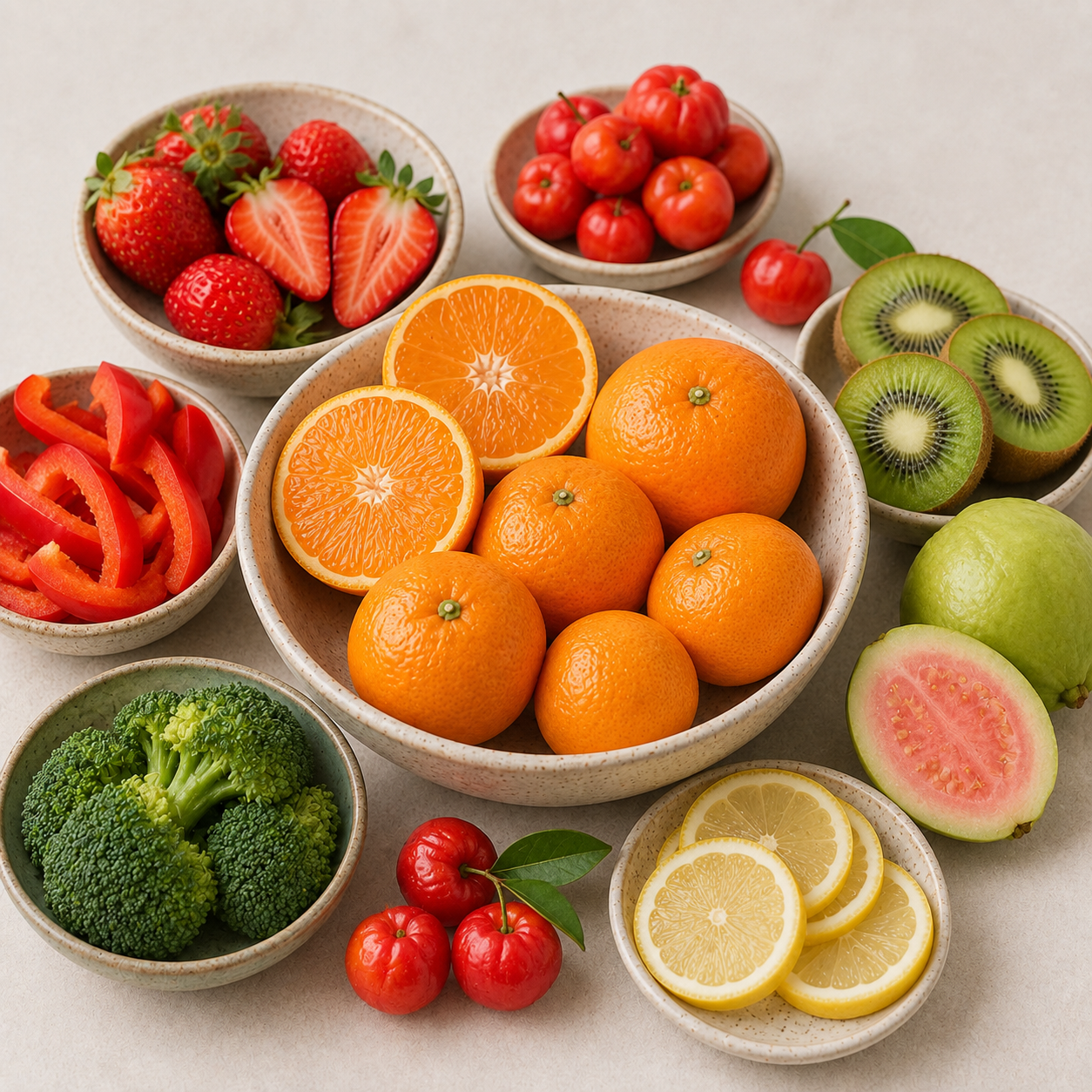
If you eat plenty of fresh vegetables and fruit each day—such as bell peppers, kiwi, broccoli, strawberries, and citrus—and your diet is varied, you can usually meet basic vitamin C needs. There is no need to add high-dose vitamin C solely for “more antioxidants,” “better immunity,” or “staying young.”
Vegetable and fruit intake is often low or inconsistent
Frequent takeout, little fresh produce, a narrow diet, or restrictive eating can make vitamin C intake unreliable. Smokers also need special attention: the U.S. RDA adds 35 mg/day above the usual adult requirement.
Diet is already good; the goal is skin, recovery, or antioxidant support
If your diet already meets vitamin C needs, supplementation is an optional add-on rather than gap-filling. Vitamin C has clear physiological roles, but in healthy adults with adequate intake, additional benefits for skin appearance, exercise recovery, inflammation, or healthy aging are generally limited or uncertain.
Basic Overview
What it is
Vitamin C, also called ascorbic acid, is an essential water-soluble vitamin. The body cannot make it and must obtain it regularly from vegetables, fruit, or supplements. Vitamin C levels are tightly regulated, and excess unused amounts are mainly excreted in urine.
Why people use it
- Fill gaps caused by low vegetable and fruit intake
- Maintain a steady intake when eating patterns are irregular
- Use a convenient, easy-to-track supplemental dose
- Evaluate a specific goal such as skin, antioxidant status, or exercise recovery
How it relates to healthy aging
Vitamin C supports collagen formation and the body’s antioxidant system, so it is important for normal skin, connective tissue, and tissue maintenance. Correcting deficiency matters, but in people who already meet their needs, there is not enough evidence that high-dose oral vitamin C reverses skin aging, extends lifespan, or makes the body “younger.”
Do not overinterpret this: supporting antioxidant defense does not mean higher doses provide stronger antioxidant or healthy-aging effects.
Supplement Assessment
Do I need a supplement? Start with the group that fits you best
Usually no dedicated supplement is needed
- You consistently eat a variety of fresh vegetables and fruit
- You regularly eat sources such as bell peppers, kiwi, citrus, strawberries, and broccoli
- Your diet is fairly varied
- You already use a multinutrient product containing vitamin C
- You only want 500–1,000 mg high-dose vitamin C for extra antioxidant, beauty, or healthy-aging benefits
Your next step:
Keep your current diet; there is no need to raise the dose for “stronger antioxidant” effects.
You may have an intake gap
- You rarely eat fresh fruit over the long term
- Your vegetable intake is also low
- You rely on takeout, are a selective eater, or have a narrow diet
- A restrictive diet substantially limits vegetables and fruit
- Work or travel makes your diet consistently irregular
- You smoke
- You have a clear absorption problem or another special situation
Your next step:
Restore consistent vegetable and fruit intake first. If that is genuinely difficult, consider a low-dose supplement.
Check with a health professional first
- Kidney dysfunction or hyperoxaluria
- Recurrent kidney stones
- Hereditary hemochromatosis or known iron overload
- Currently receiving chemotherapy or radiation therapy
- Using a medication regimen where antioxidant supplements require special consideration
- Planning long-term vitamin C intake well above everyday needs
- Pregnancy, breastfeeding, children, or a confirmed nutritional deficiency
Your next step:
Do not apply a healthy-adult supplementation plan directly. Ask a physician, pharmacist, or registered nutrition professional whether supplementation is appropriate and what dose fits your situation.
Quick self-check
Have you eaten vegetables and fruit on most days over the past week?
Do you rarely eat fresh fruit over the long term?
Do you have selective eating, a restrictive diet, or long-term reliance on takeout?
Do you smoke or have ongoing secondhand-smoke exposure?
Do you have kidney stones, iron overload, or a clear absorption problem?
Are you receiving complex treatment or taking relevant medications long term?
Food Sources
Values per 100 g are calculated from USDA reference weights and vitamin C data; common-serving values use the NIH ODS food table. Variety, ripeness, and storage time can change the actual amount.
Representative food sources
| Food / State | Approx. per 100 g | Common Serving | Approx. per Serving | % of China Adult RNI |
|---|---|---|---|---|
| Raw red bell pepper | About 127.7 mg | 1/2 cup | About 95 mg | About 95% |
| Raw kiwi | About 92.7 mg | 1 medium | About 64 mg | About 64% |
| Raw broccoli | About 89.2 mg | 1/2 cup | About 39 mg | About 39% |
| Raw green bell pepper | About 80.4 mg | 1/2 cup | About 60 mg | About 60% |
| Fresh strawberries | About 58.8 mg | 1/2 cup sliced | About 49 mg | About 49% |
| Raw orange | About 53.2 mg | 1 medium | About 70 mg | About 70% |
| Raw cauliflower | About 48.2 mg | 1/2 cup | About 26 mg | About 26% |
| Raw grapefruit | About 34.4 mg | 1/2 medium | About 39 mg | About 39% |
Variety, ripeness, and storage time can change these values; prolonged storage and cooking reduce vitamin C content.
How to get it from food in a day
Example One
Half a cup of raw red bell pepper provides about 95 mg of vitamin C, close to the China adult RNI of 100 mg/day. Adding some vegetables or fruit during the day will usually bring intake to the basic reference level.
Example Two
One medium orange provides about 70 mg, and half a cup of raw broccoli adds about 39 mg, for roughly 109 mg total—about 109% of the China adult RNI.
Cooking and storage tips
Avoid storing vegetables and fruit for long periods before eating them
Use shorter cooking times for vegetables when practical
Steaming or microwaving generally preserves more vitamin C than prolonged boiling
Whole foods vs supplements
Whole Foods
- Provide fiber, potassium, folate, and many plant compounds in addition to vitamin C
- Better suited as a long-term foundation
- Vitamin C is spread across foods and servings
- Usually unlikely to produce very high intakes
Supplements
- Provide a consistent, convenient, easy-to-track dose
- Useful for filling gaps when daily produce intake is genuinely unreliable
- Do not replace a balanced diet
- High doses can increase gastrointestinal side effects and other risks
Dosage
How much is appropriate each day, and what is the long-term upper limit?
China & U.S. Adult Reference Intakes
The scale shows the China adult RNI (100 mg/day), U.S. adult RDA (75 mg/day for women and 90 mg/day for men), and the adult UL in both China and the U.S. (2,000 mg/day). The UL is a long-term safety boundary for total daily intake, not a target.
Special populations:Data for children, pregnancy, and breastfeeding are not shown on this page. With a confirmed deficiency, medical condition, or other special situation, intake should be based on test results and professional guidance.
China & U.S. Reference Standards
China RNI
100 mg/day
UL (Tolerable Upper Intake Level)
2,000 mg/day
U.S. RDA
75–90 mg/day
UL (Tolerable Upper Intake Level)
2,000 mg/day
U.S. guidance also adds 35 mg/day for smokers above the RDA for their age and sex. The adult UL is 2,000 mg/day in both China and the U.S.
Dose & Absorption
- About 30–180 mg/day: absorption is typically about 70%–90%
- Above 1 g/day, the proportion absorbed may fall below 50%
- Large further increases in intake do not produce proportional increases in body vitamin C levels
Health Effects
Collagen Synthesis & Skin
Vitamin C is a required cofactor for normal collagen synthesis and is important for maintaining skin and connective tissue. This basic role does not mean that high-dose vitamin C in healthy adults will noticeably reduce wrinkles or make skin look younger.
View Review
Antioxidant Defense
Vitamin C is an important physiological antioxidant and also helps regenerate other antioxidants. However, the body tightly regulates vitamin C levels, so raising the dose after intake is already adequate does not proportionally increase antioxidant protection.
View Official Resource
Immune Function & the Common Cold
Vitamin C supports normal immune function, but in the general population, regular intake of ≥200 mg/day does not meaningfully reduce how often colds occur. Regular supplementation may shorten cold duration in adults by about 8% on average; starting vitamin C only after symptoms begin has not shown consistent benefit.
View Systematic Review
Exercise Recovery
A 2026 meta-analysis found no consistent improvement in post-exercise IL-6 or MDA. The CRP reduction came from only a few small trials and was rated low-certainty evidence. Earlier studies also did not show clear improvements in muscle soreness or strength recovery.
View Meta-analysis
Inflammatory Markers
A meta-analysis of clinical trials found a possible modest reduction in CRP, but heterogeneity was very high and hs-CRP did not improve significantly overall. A change in one inflammatory marker should not be interpreted as “clearly less inflammation” or an anti-aging effect.
View Meta-analysis
Non-Heme Iron Absorption
Vitamin C improves absorption of non-heme iron from plant foods, so having it with iron-containing foods such as legumes, whole grains, and vegetables has clear nutritional value. This does not mean healthy adults need high-dose vitamin C supplements.
View Official Resource
Product Selection
What should I look for on the label?
Check These Four Things
What is the active ingredient?
Check the vitamin C source on the label. Standard L-ascorbic acid meets most supplementation needs; sodium ascorbate and calcium ascorbate also provide vitamin C. Do not pay extra solely for “natural” or “high-absorption” marketing.
How much is actually in each serving?
First check how many milligrams of vitamin C are in each tablet, capsule, or serving, then how many servings are suggested per day. For filling a dietary gap, 100–200 mg/day is usually an easy-to-adjust low-dose range; there is no need to default to 500–1,000 mg products.
Are there unnecessary added ingredients?
Tablets and capsules often have simpler formulas. For gummies, effervescent tablets, drink mixes, and beverages, also check added sugar, sweeteners, flavors, colors, and sodium. Small amounts of ordinary excipients such as cellulose or gelatin are not automatically a problem.
Is quality control reliable?
Prefer products that clearly list the manufacturer, lot number, expiration date, amount per serving, and storage conditions. Verifiable third-party testing or certification is a plus. Quality certification mainly supports ingredient and manufacturing control; it does not prove stronger health effects.
How to Read the LabelExample: a low-dose vitamin C product
Take 1 capsule daily, with or without food.
Vegetable capsule, rice flour, silica.
Third-Party Tested
Lot: VC260807
Best By: 2028/08
*100 mg vitamin C per serving is suitable for filling a routine produce-intake gap; standard L-ascorbic acid already has good bioavailability.
Product Form
Tablets, capsules, powders, effervescent tablets, gummies, and more. First confirm the vitamin C source; standard L-ascorbic acid meets most supplementation needs.
Amount per Capsule or Serving
Focus on the milligrams listed for “Vitamin C / Ascorbic Acid,” not the total tablet weight or total weight of a blend. For filling a routine gap, 100–200 mg/day is usually an easy-to-adjust low-dose range.
Servings per Day
Read the Serving Size in Supplement Facts together with the suggested use to calculate actual daily intake. FDA labeling requires the serving size and the amount of each dietary ingredient per serving.
Other Ingredients
Separate other nutrients such as vitamins and minerals from food additives such as sugar, flavors, colors, and sweeteners. Gummies, effervescent tablets, drink mixes, and beverages deserve extra attention for added sugar, sweeteners, flavors, colors, and sodium.
Quality Information
Check the lot number, expiration date, storage requirements, manufacturer, and whether credible third-party testing or verifiable certification is available.
Choosing a Common FormDifferences, whether the premium is worth it, and who may prefer each form
Standard L-Ascorbic Acid
Key Difference
The simplest and most common form, with good bioavailability.
Worth Paying More?
A sensible first choice for most healthy adults; usually no need to pay more.
Best Fit
A practical first choice for filling everyday produce-intake gaps.
Sodium Ascorbate / Calcium Ascorbate
Key Difference
Mineral ascorbate salts with lower acidity.
Worth Paying More?
There is no reliable evidence that they provide better real-world health outcomes than standard ascorbic acid in generally healthy adults.
Best Fit
Consider them if standard ascorbic acid causes stomach discomfort, while accounting for the added sodium or calcium.
Liposomal, Sustained-Release, or Other High-Absorption Forms
Key Difference
Some human pharmacokinetic studies show that liposomal vitamin C can produce higher blood levels.
Worth Paying More?
That does not prove better skin, immune, recovery, or long-term health outcomes. Most people do not need to pay a large premium for “higher absorption.”
Best Fit
Basic supplementation of 100–200 mg/day usually does not require these forms.
How to Take
When and how should I take it?
Default plan (healthy adults)
Practical Dose: About 100–200 mg/day when diet is insufficient
Frequency: Usually 1 time daily is enough
Stomach Tolerance: With or without food; take with food if sensitive
If Mild Discomfort Occurs: Lower the single dose or split it
Long-Term Use: Depends on whether the dietary gap persists
Missed Dose: Skip it; do not double the next dose
Frequently asked questions
With food or on an empty stomach?
Either is fine. Vitamin C does not need to be taken with fat. If it irritates your stomach when taken without food, take it with a meal. Taking it with a meal rich in plant iron can also improve non-heme iron absorption.
Do I need to split the dose?
At 100–200 mg/day, splitting the dose is usually unnecessary. At higher doses or with poor gastrointestinal tolerance, lowering the single dose or splitting it is more practical than taking a large amount at once. The proportion absorbed decreases as vitamin C doses rise.
What time of day?
Morning, midday, or evening are all fine. There is no evidence that routine supplementation needs a specific time of day. Choose a time you can follow consistently.
Do I need to separate it from other supplements?
There is no general rule requiring vitamin C to be separated by several hours from most ordinary supplements. It can be taken with iron-containing foods or iron supplements to improve non-heme iron absorption. For medications, follow the precautions in Section 08.
More questions about use (click to expand)
How long should I take it?
Vitamin C has no standard “course.” If you supplement because vegetable and fruit intake is chronically low, use it while the gap persists and reduce or stop once the diet becomes consistent. If your diet is already adequate and the goal is antioxidant support, skin, or recovery, do not default to indefinite high-dose use for “maintenance.”
How do I know if it is working?
If you are filling a dietary gap, the goal is more consistent total intake, not an immediate sensation. When diet is already adequate, vitamin C usually does not produce a clearly noticeable change in skin, energy, or recovery, so “I do not feel anything” is not a reason to keep increasing the dose.
Do I need to separate it from medications?
There is no universal “separate by 2 hours” rule that resolves every drug interaction. If you take long-term medications or are receiving treatments such as chemotherapy or radiation therapy, ask a physician or pharmacist about the specific drug rather than trying to manage risk by timing alone.
Risks & Precautions
Common Side Effects
- Diarrhea: unabsorbed high-dose vitamin C can increase the intestinal osmotic load. Reduce the dose or split it.
- Nausea or stomach upset: this can be more noticeable after higher doses on an empty stomach. Take it with food and lower the single dose.
- Abdominal cramping: more common with higher intakes. Stop increasing the dose and reduce it to see whether symptoms improve.
- NIH notes that the most common adverse effects of high-dose vitamin C are diarrhea, nausea, abdominal cramps, and other gastrointestinal symptoms.
High-Dose Risks
- More gastrointestinal effects: above normal nutritional needs, absorption efficiency falls as the dose rises. Above 1 g/day, absorption may drop below 50% while gastrointestinal side effects become more likely.
- Kidney-stone risk needs context: high-dose vitamin C may increase urinary oxalate and uric acid excretion, but findings in generally healthy adults are inconsistent. Concern is greater in people with kidney disease or hyperoxaluria.
- Iron overload: vitamin C increases non-heme iron absorption. This is usually not a safety problem for healthy adults, but long-term high-dose use may add to iron burden in people with hereditary hemochromatosis or other iron-overload disorders.
Use High Doses With Extra Caution
- People with impaired kidney function
- People with hyperoxaluria or recurrent kidney stones
- People with hereditary hemochromatosis or other confirmed iron overload
- People receiving cancer treatment
- People who are pregnant or breastfeeding and considering self-directed high-dose use
- Children and adolescents
- People planning long-term intake of 500–2,000 mg or more
- “Use with caution” does not mean these groups cannot consume vitamin C; it means a standard healthy-adult supplementation plan should not be applied automatically.
Special Situations
- Chemotherapy and radiation therapy: whether antioxidant supplements can affect some cancer treatments remains debated. People receiving chemotherapy or radiation therapy should not start high-dose vitamin C on their own and should first check with their oncology team.
- Lipid-lowering therapy: a combination of vitamin C with other antioxidants may affect HDL changes during niacin plus simvastatin treatment. If you use related medications long term, ask a physician or pharmacist to review the combination.
Stop and Seek Advice
Persistent diarrheaPersistent nauseaSignificant stomach painRepeated stomach upsetSuspected allergic reaction
Seek Prompt Medical Care
Blood in the urineSevere flank or abdominal painDifficulty breathingSwelling of the face or throatSevere rash
Sources
Nutrition Standards & Basic Data
Health Effects & Scientific Evidence
Cochrane Database of Systematic Reviews.
Clinical Nutrition ESPEN. (DOI: 10.1016/j.clnesp.2026.102962)
European Journal of Nutrition. (DOI: 10.1007/s00394-020-02215-2)
Nutrients. (DOI: 10.3390/nu9080866)
Safety, Product & Use References
Last updated: August 7, 2026