Psyllium Husk
Psyllium Husk / Psyllium Husk / Psyllium Seed Husk / Plantago ovata Husk / Ispaghula Husk
Psyllium husk is a concentrated, gel-forming dietary fiber from the outer husk of Plantago ovata seeds. Its strongest uses are bowel regularity and LDL-cholesterol reduction; it is not a typical prebiotic and is not a “detox” product.
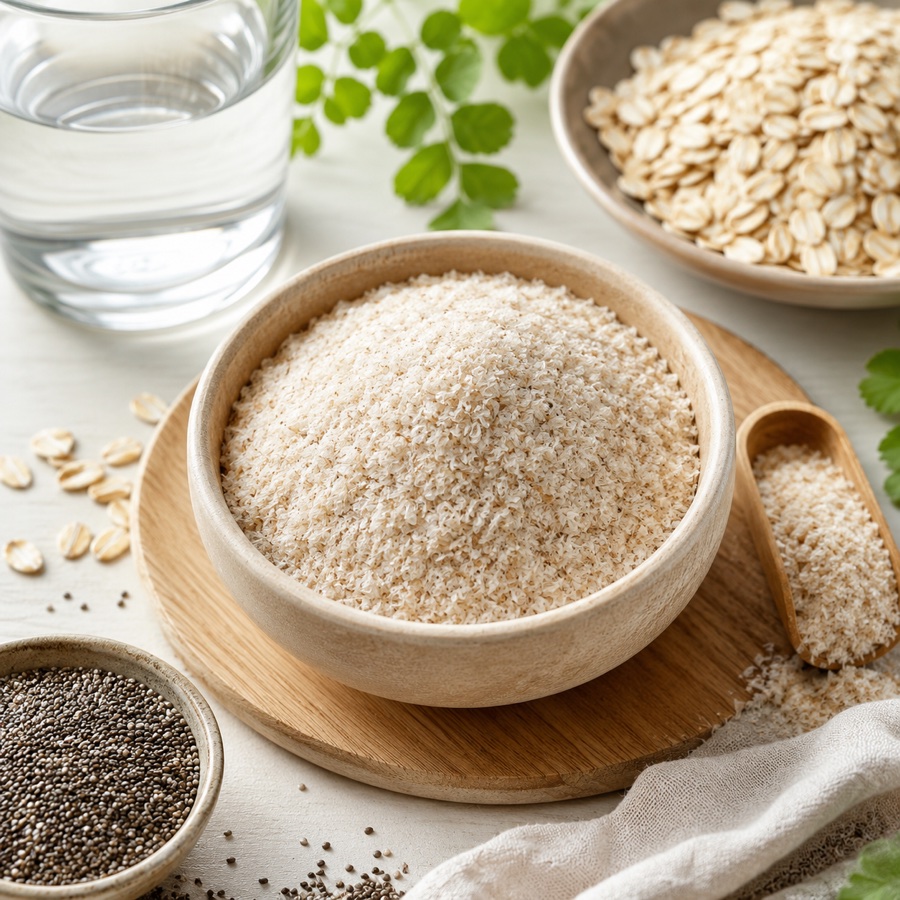
30-second check: which situation fits you best?
You just want general gut support
Your usual diet already includes plenty of plant foods and bowel habits are regular, and you are considering psyllium mainly because of “microbiome,” “cleanse,” or “detox” marketing.
You have a clear bowel or cholesterol goal
Bowel movements are infrequent, stools tend to be hard, or you want additional cholesterol management on top of diet.
You already use or plan to use it
You have bought a powder, whole husk, capsules, or a flavored fiber product.
Basic Overview
What it is
Psyllium husk is the outermost husk of Plantago ovata seeds and is composed mainly of dietary fiber. In the digestive tract, it absorbs substantial water and forms a soft, viscous gel. This increases stool water content and bulk and can also affect the movement of bile acids and nutrients through the intestine.
Why people use it
How it relates to healthy aging
Regular bowel function, adequate dietary fiber, and healthy lipid and glucose profiles are relevant to long-term metabolic and cardiovascular health. There is no evidence that psyllium directly slows aging or extends lifespan; its more appropriate role is improving fiber intake and selected risk factors.
Supplement Assessment
Define the goal first, then check fluid intake, dose, medication spacing, and obstruction risk.
Low priority for supplementation
- You eat plenty of vegetables, fruit, legumes, and whole grains
- Bowel habits have been consistently regular and stool form is normal
- You do not have a specific lipid or metabolic-management goal
- You are considering it only because of “cleanse,” “detox,” or microbiome marketing
- There is still plenty of room to improve dietary fiber from food
Your next step:
Increase whole plant foods first. If a clear bowel or fiber problem remains after dietary changes, then consider psyllium.
A clear goal may justify a trial
- Usual dietary fiber intake is low
- Bowel movements are relatively infrequent
- Stools are persistently hard
- You want to improve bowel regularity
- You want to increase soluble fiber intake
- You want to support cholesterol management alongside diet
- You have abnormal glucose regulation and want additional support for post-meal fluctuations
Your next step:
Decide whether the main goal is bowel function, lipids, or fiber intake, then choose the relevant dose and outcome to track instead of chasing every possible effect at once.
Talk with a professional first
- Difficulty swallowing
- Frequent unexplained abdominal pain or vomiting
- Possible intestinal narrowing or obstruction
- A sudden major change in bowel habits that persists
- Unexplained blood in the stool
- Regular use of multiple oral medications
- Difficult-to-control blood glucose or use of glucose-lowering medication
Your next step:
Rule out swallowing and obstruction risks first and check medication spacing. Do not assume warning symptoms are simply a lack of fiber and self-treat them.
Quick self-check
Is the goal bowel function, lipids, or simply adding fiber?
Can you take every serving with at least one large glass of fluid?
Do you know the actual psyllium and dietary-fiber grams per serving?
Do you know how to separate it from oral medications?
Are you willing to start lower and increase gradually?
Are there no signs of swallowing difficulty or obstruction risk?
Food Sources
Psyllium husk comes from the outer seed coat of Plantago ovata and is not widely present across ordinary foods.
Where it comes from
Plantago ovata seed: psyllium is the outer seed coat of Plantago ovata and is separated from the rest of the seed during processing.
Whole husk: retains more intact husk flakes and swells markedly when mixed with water.
Psyllium husk powder: is milled more finely, disperses faster, and has a more uniform texture. It is common in supplements and high-fiber foods.
Reference-intake context
Psyllium husk has no separate RNI, RDA, or AI. The Chinese adequate intake for total dietary fiber in adults is 25–30 g/day. This refers to all dietary fiber from the entire day and does not mean adults should eat 25–30 g of psyllium husk.
How to get fiber from the diet
Example One | Prioritize whole foods
Have oats and fruit at breakfast and include legumes, whole grains, and vegetables at lunch and dinner. This provides dietary fiber from several plant foods and may remove the need for extra psyllium.
Example Two | Use psyllium as a fiber supplement
If fiber from whole foods remains low over time, a small amount of psyllium can be mixed into water or another beverage as part of total daily fiber, rather than replacing vegetables, fruit, or whole grains.
Use and storage notes
Always take it with enough fluid. Dry swallowing or inadequate fluid can increase swallowing and obstruction risk.
Drink it soon after mixing. The longer it sits, the thicker it becomes and the harder it is to drink.
Start small. A sudden large increase is more likely to cause bloating and changes in bowel habits.
Store it dry. Reseal after opening and keep in a cool, dry place.
Whole foods vs supplements
Whole foods
- Provide several different types of dietary fiber
- Also provide vitamins, minerals, and plant bioactives
- Better support a varied plant-rich diet
- Different foods provide different fermentable substrates
Psyllium husk
- Provides dietary fiber in a concentrated form
- Has strong water-holding and gel-forming properties
- Makes daily intake easier to quantify
- Has relatively direct human evidence for bowel function and LDL cholesterol
Dosage
There is no separate RNI, RDA, AI, formal UL, or one dose that fits every goal. The raw-material weight of a product may also differ from its actual dietary-fiber content.
Understand human studies and regulatory information by goal
Goal-specific dose references
These are study or regulatory amounts for specific goals, not daily recommendations for everyone.
Important note
25–30 g of dietary fiber does not mean 25–30 g of psyllium husk. The former is the total from all foods and supplements across the day.
Different goals should not share one dose. Bowel regularity, lipid management, and simply adding fiber are different use cases.
No UL does not mean unlimited intake. At higher amounts, inadequate fluid makes swallowing and obstruction risk more important.
Even when two products both list 9 g of psyllium husk, the actual dietary fiber and soluble fiber still need to be read from the label.
How dose works
The key effect is not absorption into the bloodstream but water absorption and formation of a viscous gel within the intestinal lumen.
A larger amount usually produces more water-holding and viscosity, but health benefits do not increase without limit.
Compared with highly fermentable fibers such as inulin, psyllium relies more on physical water-holding, moisture retention, and gel formation.
How to read common product doses
Powder, whole husk, and capsules may all say Psyllium Husk, but the actual dietary fiber provided per serving can differ substantially.
| Product | Package or label number | Dose that is actually comparable | Formulation | How to interpret |
|---|---|---|---|---|
| NOW Foods Psyllium Husk PowderOfficial product link | 9 g per serving | 7 g dietary fiber, including 6 g soluble fiber | Powder Psyllium Seed Husk |
9 g is the weight of the psyllium raw material. When comparing fiber intake, use the approximately 7 g of dietary fiber. |
| NOW Foods Psyllium Husks WholeOfficial product link | 10 g per serving | 7 g dietary fiber, including 6 g soluble fiber | Whole husk More intact husk particles |
10 g of whole husk is not 10 g of dietary fiber; the label shows about 7 g. |
| Swanson Psyllium Husk Powder - Certified OrganicOfficial product link | 5 g per serving | 4 g dietary fiber | Powder Organic psyllium husk powder |
5 g of raw material provides about 4 g of dietary fiber. |
| NOW Foods Psyllium Husk Caps 500 mgOfficial product link | 500 mg/capsule | 3 capsules = 1.5 g psyllium husk, about 1.1 g dietary fiber | Capsule Lower amount per capsule |
Reaching gram-level psyllium doses generally requires several capsules at a time. |
| Solgar Psyllium Husks Fiber 500 mg Vegetable CapsulesOfficial product link | 500 mg/capsule | 2 capsules = 1 g psyllium husk, about 1 g dietary fiber | Capsule Convenient to carry |
Fiber per serving is much lower than with most powders. |
| Metamucil 4-in-1 Real Sugar Smooth Fiber PowderOfficial product link | Contains psyllium-derived fiber per serving | 2.4 g psyllium soluble fiber/serving | Flavored powder Contains sugar and flavoring ingredients |
For a cholesterol goal, look at psyllium-derived soluble fiber rather than the total weight of one scoop. |
NOW Foods Psyllium Husk Powder
Official product link- Package or label number
- 9 g per serving
- Dose that is actually comparable
- 7 g dietary fiber, including 6 g soluble fiber
- Formulation
- Powder
Psyllium Seed Husk
- How to interpret
- 9 g is the weight of the psyllium raw material. When comparing fiber intake, use the approximately 7 g of dietary fiber.
NOW Foods Psyllium Husks Whole
Official product link- Package or label number
- 10 g per serving
- Dose that is actually comparable
- 7 g dietary fiber, including 6 g soluble fiber
- Formulation
- Whole husk
More intact husk particles
- How to interpret
- 10 g of whole husk is not 10 g of dietary fiber; the label shows about 7 g.
Swanson Psyllium Husk Powder - Certified Organic
Official product link- Package or label number
- 5 g per serving
- Dose that is actually comparable
- 4 g dietary fiber
- Formulation
- Powder
Organic psyllium husk powder
- How to interpret
- 5 g of raw material provides about 4 g of dietary fiber.
NOW Foods Psyllium Husk Caps 500 mg
Official product link- Package or label number
- 500 mg/capsule
- Dose that is actually comparable
- 3 capsules = 1.5 g psyllium husk, about 1.1 g dietary fiber
- Formulation
- Capsule
Lower amount per capsule
- How to interpret
- Reaching gram-level psyllium doses generally requires several capsules at a time.
Solgar Psyllium Husks Fiber 500 mg Vegetable Capsules
Official product link- Package or label number
- 500 mg/capsule
- Dose that is actually comparable
- 2 capsules = 1 g psyllium husk, about 1 g dietary fiber
- Formulation
- Capsule
Convenient to carry
- How to interpret
- Fiber per serving is much lower than with most powders.
Metamucil 4-in-1 Real Sugar Smooth Fiber Powder
Official product link- Package or label number
- Contains psyllium-derived fiber per serving
- Dose that is actually comparable
- 2.4 g psyllium soluble fiber/serving
- Formulation
- Flavored powder
Contains sugar and flavoring ingredients
- How to interpret
- For a cholesterol goal, look at psyllium-derived soluble fiber rather than the total weight of one scoop.
Health Effects
Bowel regularity
A 2022 systematic review and meta-analysis found that fiber supplementation increased bowel-movement frequency and improved stool characteristics, with psyllium among the more consistently effective fiber types. Overall effects were clearer at higher doses and with at least 4 weeks of use.
View Systematic Review & Meta-analysis
Stool consistency
Psyllium absorbs water and forms a gel, increasing stool water content and bulk. This can make hard stools easier to pass and can also help very loose stools become more formed. The effect comes mainly from water-holding and gel formation rather than extensive fermentation.
View Fiber-Mechanism Review
Lower LDL cholesterol
A meta-analysis of 41 randomized controlled trials with 2049 participants found that psyllium lowered LDL cholesterol by an average of about 8.6 mg/dL and total cholesterol by about 9.1 mg/dL.
View Meta-analysis
Blood-glucose control
Meta-analysis shows that effects depend on starting glucose status: they are largest in people with diabetes, smaller in prediabetes, and minimal in people with normal glucose. Psyllium should not be presented as a general glucose-lowering supplement for healthy adults.
View Meta-analysis
Blood-pressure support
A meta-analysis of 14 randomized controlled trials with 802 adults found an average reduction of about 2.2 mmHg in systolic blood pressure, with no significant improvement in diastolic pressure. This does not replace antihypertensive treatment.
View Meta-analysis
Body weight and satiety
Gel formation may increase fullness, but a 2020 meta-analysis of 22 randomized trials found no significant reduction in body weight, BMI, or waist circumference. Psyllium should not be positioned as a reliable weight-loss supplement.
View Meta-analysis
Product Selection
Product selection should focus on psyllium per serving, actual dietary fiber, soluble fiber within that amount, ingredients, and quality.
Check these four things
What is the active ingredient?
Prefer products that clearly identify Psyllium Husk / Psyllium Seed Husk. A multi-fiber blend should not be compared with pure psyllium by total blend weight.
How much is actually in one serving?
Check psyllium weight, dietary fiber, and soluble fiber per serving. For example, 9 g of psyllium powder may provide only about 7 g of dietary fiber.
Are there unnecessary extras?
A plain powder may need only one ingredient. Flavored products may contain added sugar, sweeteners, flavors, and colors.
Is quality control reliable?
Check the manufacturer, lot number, expiration date, raw-material source, and verifiable testing, including contaminant and heavy-metal control.
How to read the labelGel-forming fiber product label
Psyllium raw material → grams per serving → dietary fiber → soluble fiber → fluid and medication spacing → ingredients and quality
If sugar, sweeteners, other fibers, or flavoring ingredients are present, list them separately
Mix each serving with at least about 240 mL of fluid and drink promptly. Separate from medications according to the label or professional advice.
Raw-material source | Fiber grams | Ingredients | Lot | Contaminant testing
9 g of psyllium husk powder is not 9 g of dietary fiber. In this example, the meaningful comparison is 7 g of dietary fiber, including 6 g soluble fiber.
Confirm the target ingredient
Find Psyllium Husk / Psyllium Seed Husk.
Check raw-material grams per serving
Confirm whether Serving Size is one scoop, several grams, or multiple capsules.
Find actual dietary fiber
Do not count the full weight of the powder or capsules as fiber.
Then check soluble fiber
For cholesterol goals, pay particular attention to psyllium-derived soluble fiber.
Confirm fluid and medication spacing
The label should include adequate-fluid instructions and relevant medication warnings.
Finally check ingredients and quality
Review sugar, sweeteners, lot information, and contaminant testing.
How to choose among common formsForm affects texture, thickening speed, and convenience, not a hierarchy of effectiveness
Whole Psyllium Husk
Main features
More intact husk flakes that swell markedly with water. Formulas are often simple, and one serving can provide several grams of fiber.
Site guidance
Suitable if you do not mind a more textured drink and want a simple formula. Long-term cost is usually lower than capsules.
Psyllium Husk Powder
Main features
More finely milled and easy to add to drinks or food, but it usually thickens faster once mixed with liquid.
Site guidance
For people aiming for gram-level doses, powder is often more practical for dose, cost, and convenience.
Psyllium Husk Capsules
Main features
Convenient and avoids the powder texture, but each capsule usually contains only about 0.5–0.7 g.
Site guidance
Useful for smaller amounts or for people who dislike powders. Higher target doses require multiple capsules.
Flavored fiber powders
Main features
Often easier to drink but may contain sugar, sweeteners, flavors, or other fibers.
Site guidance
Compare actual psyllium-derived soluble fiber and the ingredient list, not “high fiber” marketing or total scoop weight.
How to Take
Start with a smaller amount and increase gradually if tolerated. Take every serving with enough fluid and separate it from oral medications as directed.
Default plan (healthy adults)
How to start: Begin with a smaller amount and increase gradually after several days of good tolerance
How much fluid?: Use at least one large glass each time, about 240 mL or more
How soon after mixing?: Drink promptly after stirring rather than waiting for a thick gel to form
When to take it: Use timing that fits the goal and product directions; there is no universal morning/evening rule
Should it be divided?: Higher daily amounts can be divided to make fluid intake and tolerance easier to manage
What about medications?: Many products instruct users to separate psyllium from oral medications by at least about 2 hours before or after
Frequently asked questions
Can I swallow it dry and then drink water?
Not recommended. Mix it with enough liquid first, or follow the product's fluid instructions exactly.
Can I mix it into yogurt?
Yes, but still drink enough additional fluid. Do not count the moisture in yogurt as the entire fluid requirement.
Can I use it every day?
It can be used long term as dietary fiber, but whether you need it depends on diet, bowel habits, and your goal.
How long until bowel effects appear?
As a bulk-forming fiber, some product information indicates bowel effects may appear in about 12–72 hours.
More questions about use (click to expand)
Is more better?
No. Once the goal is met, there is no need to keep increasing the amount. Rapid increases are more likely to cause bloating and discomfort and raise risk when fluid intake is inadequate.
What if it does not work?
First check the actual fiber grams, fluid intake, duration of use, and the cause of the bowel problem. Do not simply keep increasing the dose; persistent symptoms should be evaluated.
Risks & Precautions
Common adverse effects
- Bloating
- Increased gas
- Abdominal discomfort
- Changes in bowel habits
- Reducing the amount per serving and increasing slowly is often easier to tolerate
Higher-dose risks
- No formal UL does not mean more is safer
- Large amounts with inadequate fluid can form a large-volume gel
- This may increase the risk of difficulty swallowing or esophageal/intestinal obstruction
- Do not keep increasing the amount simply because there is no UL
Who should be more cautious
- Difficulty swallowing
- Possible bowel obstruction or intestinal narrowing
- Persistent or unexplained abdominal pain
- Unexplained blood in the stool
- A sudden change in bowel habits lasting more than two weeks
Medications and special situations
- Psyllium may affect absorption of some oral medications
- People using regular medications should check the specific spacing interval
- People taking glucose-lowering medication should monitor glucose changes
- During pregnancy or breastfeeding, confirm the specific product before long-term supplementation
Stop and seek advice
Stop increasing the dose and seek advice for persistent abdominal pain, marked bloating, constipation lasting more than a week, a sudden major bowel-habit change, or unexplained blood in the stool.
Seek prompt medical care
Seek immediate care if use is followed by chest pain, persistent vomiting, marked difficulty swallowing, breathing difficulty, or a suspected severe allergic reaction.
Sources
Priority is given to regulatory agencies, official drug information, and original human research. Product pages are used only to explain labels and do not represent recommendations.
Regulatory & Official Information
Bowel Function & Fiber Mechanisms
Lipids & Blood Glucose
Blood Pressure & Body Weight
Product Information
Last updated: August 28, 2026