Natural Cocoa Powder
Natural Cocoa Powder / Non-Alkalized Cocoa Powder / Cacao Powder / Natural Cocoa Powder / 100% Cocoa Powder
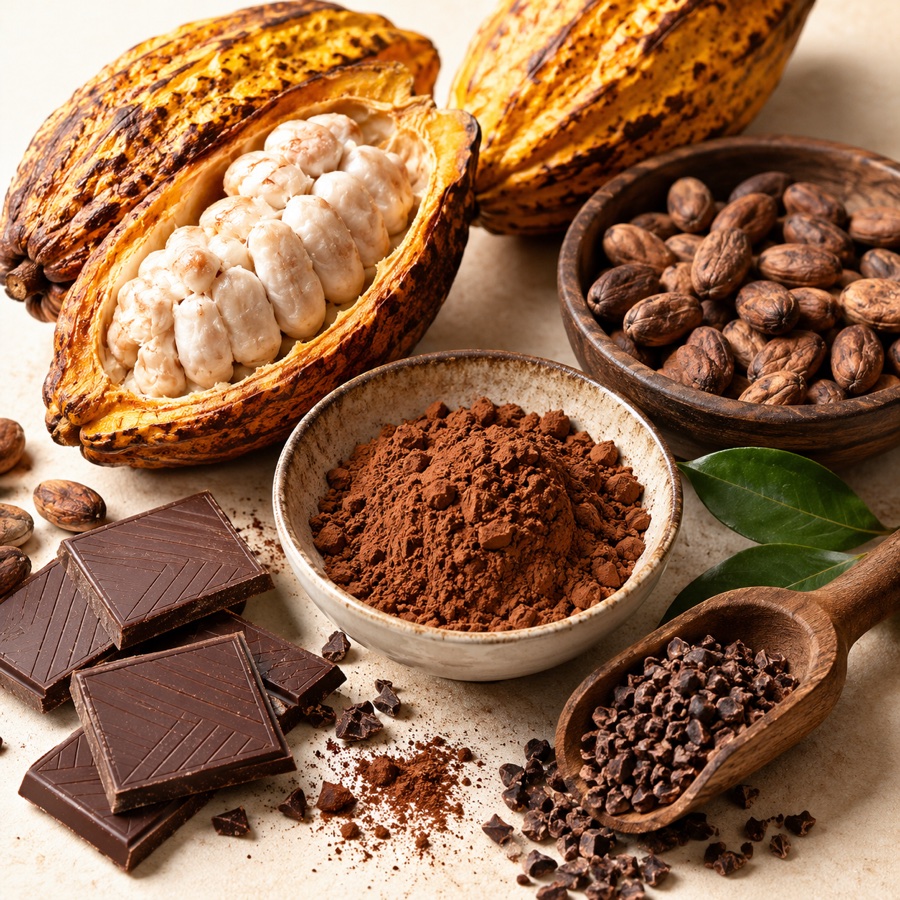
Natural, non-alkalized cocoa powder is cocoa powder that has not undergone alkalization (Dutch processing). Compared with alkalized cocoa, it generally retains more native cocoa flavanols, especially epicatechin. Actual levels can still vary substantially between products, so “non-alkalized” is only a first screening step and does not automatically mean “high flavanol.”
30-second check: which situation fits you best?
For everyday antioxidant-rich eating
100% natural cocoa powder can be added to milk, oats, yogurt, or baked foods as part of a plant-rich diet. There is no need to treat it as a functional food that must be consumed in a fixed daily amount just because it has high antioxidant capacity.
A specific goal: vascular function, blood pressure, or skin photoprotection
Human evidence for cocoa flavanols is relatively good for vascular endothelial function, and blood pressure and some metabolic markers may improve modestly. There is also some evidence for better skin tolerance to UV exposure. Most of these studies, however, used cocoa products with known high flavanol content rather than ordinary cocoa powder with unknown flavanol levels.
You already use natural cocoa powder every day
First confirm that the product is 100% cocoa and clearly non-alkalized. Then check your actual serving, any flavanol data, and testing for cadmium and other heavy metals. Without test data, 5 g or 10 g of powder does not tell you the actual flavanol intake.
Basic Overview
What it is
Natural cocoa powder is made from cocoa beans that are fermented, dried, roasted or otherwise processed, ground into cocoa liquor, partially defatted, and milled into powder without a later alkalization step. It is an ordinary food, not an essential nutrient that people need to supplement.
Cocoa naturally contains cocoa flavanols, epicatechin, catechin, procyanidins, dietary fiber, minerals such as magnesium, iron, and copper, theobromine, and a small amount of caffeine. From the perspective of human research, the most relevant components on this page are cocoa flavanols, especially epicatechin.
Why people use it
How it relates to healthy aging
The relationship between cocoa flavanols and healthy aging is mainly about supporting normal vascular relaxation, blood flow, and some metabolic functions, not simply “scavenging free radicals.”
Some studies also suggest greater skin tolerance to UV exposure, but improvements in wrinkles or elasticity are inconsistent. Large long-term studies have not shown that cocoa flavanols clearly prevent cardiovascular disease, improve cognition, or slow aging.
A more accurate interpretation is that cocoa flavanols may modestly support specific functions, not make the body broadly “younger.”
Why emphasize “non-alkalized”?
Alkalization, often called Dutch processing, is mainly used to reduce the acidity of natural cocoa and change its color, flavor, and processing characteristics. The trade-off is that alkalization can substantially reduce native flavanols.
An analysis of commercial cocoa powders found mean total flavanols of 34.6 ± 6.8 mg/g in natural, non-alkalized cocoa, 13.8 ± 7.3 mg/g after light alkalization, 7.8 ± 4.0 mg/g after medium alkalization, and 3.9 ± 1.8 mg/g after heavy alkalization. As final pH and degree of alkalization increased, total flavanols and flavanol monomers, oligomers, and polymers all fell substantially. (PubMed)
In other words, heavily alkalized cocoa retained only a fraction of the flavanols found in natural cocoa on average. But this does not mean every natural cocoa powder contains 34.6 mg/g. Raw material, fermentation, processing, and storage can all create substantial product-to-product differences.
Supplement Assessment
Whether long-term use is worthwhile should be judged around a specific vascular, metabolic, or skin goal—not around a nonexistent “cocoa flavanol deficiency.”
Low priority for supplementation
- You are mainly interested because of “antioxidant” or “anti-aging” claims
- You do not have a specific vascular, blood-pressure, or skin goal
- You already regularly eat fruit, drink tea, or consume other plant foods
- Diet, exercise, sleep, and sun protection still have obvious room for improvement
Your next step:
Without a specific goal you can assess, natural cocoa powder is usually better treated as a normal food than as a high-priority functional supplement.
A specific goal may justify a trial
- [Vascular function & blood pressure] You care about endothelial function or blood pressure and accept that the average effect is usually modest
- [Metabolic markers] You are interested in supportive changes in glucose or lipids but do not treat cocoa as a weight-loss or metabolic therapy
- [Skin photoaging & UV tolerance] You care about post-sun redness or photoprotection and already use routine sun protection
- You are willing to choose a cocoa product, flavanol dose, and duration closer to the relevant research
Your next step:
First decide whether your main goal is vascular, metabolic, or skin-related, then review the matching studies. Do not treat ordinary cocoa-powder grams as flavanol research doses.
Consult a professional first
- You are receiving antihypertensive treatment and already tend toward low blood pressure or dizziness
- You are highly sensitive to caffeine or theobromine and easily develop palpitations or sleep disruption
- You are actively treating iron deficiency and plan to use cocoa powder regularly with an iron supplement or iron-rich meal
- You have recurrent calcium oxalate stones and need to manage high-oxalate foods
- Pregnancy or breastfeeding with plans to substantially increase cocoa or high-flavanol product intake
Your next step:
First confirm whether you plan to use ordinary natural cocoa powder or a high-flavanol product, then judge it in the context of the actual dose, diet, and your health situation.
Products & Everyday Use
Understand differences between cocoa products, the key compounds, and practical ways to use them.
Why compare real products here?
Even among 100% cocoa powders (100% Cocoa / Cacao Powder), raw-material source, fermentation, roasting, alkalization, later processing, and storage can produce substantial differences in composition.
For natural cocoa powder, two questions should be kept separate: does the product clearly state that it is non-alkalized, and does it actually disclose measured Cocoa Flavanols? These are not the same thing.
The market products below are shown only to illustrate real label differences; they are not brand recommendations or rankings.Even among 100% cocoa powders
Actual flavanol content and quality can differ
Common Market Products
These real products illustrate label differences and are not brand recommendations or rankings. Most ordinary natural cocoa powders do not disclose measured flavanol content, so the key comparison is whether the product clearly states Non-Alkalized and whether it provides quantitative Cocoa Flavanols and Epicatechin data.
| Product | Package / Label Information | What You Should Actually Compare | Product Features | How to Interpret It |
|---|---|---|---|---|
| Navitas Organics Cacao PowderOfficial product link | 100% Cacao | Non-Alkalized | Lightly Roasted | 6 g per serving | Organic | Cocoa Flavanols: no specific mg/% found on current official page; Epicatechin: no specific value found | Non-Alkalized | Organic | Traceable 100% cacao powder with relatively complete sourcing and certification information |
“Non-Alkalized + Organic” describes processing and production systems, but still does not tell you how many flavanols each 6 g serving provides. |
| NOW Real Food Cocoa Powder, OrganicOfficial product link | No Sugar Added | Non-Alkalized | Organic Cocoa Powder | Flavanols and Epicatechin: no specific quantitative values found on current official page | Non-Alkalized | Single-Ingredient Cocoa | Organic Typical everyday natural cocoa powder |
This is a typical everyday natural cocoa powder, but Non-Alkalized alone does not tell you the flavanol dose. |
| NOW Real Food Cacao Powder, Raw & OrganicOfficial product link | Peru | Sun Dried | Not Roasted | Non-Alkalized | 2.5 g per serving | Flavanols: no specific mg value found; Epicatechin: no specific value found | Non-Alkalized | Unroasted | Organic Fine Raw Cacao powder with relatively clear processing information |
Useful for comparing processing methods, but Raw / unroasted still does not replace testing of flavanols in the finished product. |
| HERSHEY'S COCOA 100% Cacao Natural UnsweetenedOfficial product link | 100% Cacao | Natural Unsweetened Cocoa | 5 g per serving | No specific flavanol or epicatechin value found on official page | Natural Cocoa | Single Ingredient Mainstream natural unsweetened cocoa powder |
A 100% Cacao label does not let you convert 5 g of powder into a research-level flavanol dose. |
| Sunfood Cacao PowderOfficial product link | Organic | Never Roasted | Never Dutch-Processed | Official page emphasizes retention of natural flavanols but does not provide a specific mg/% value | Non-Alkalized | Unroasted | Organic Cacao Powder made with a raw-style process |
Processing information is clear, but actual quantitative testing is still needed to judge comparability with human studies. |
| CocoaDynamics™ High Flavanol Cocoa PowderOfficial product link | 100% Unsweetened | Non-Alkalized | 5 g per serving | No Extracts | Brand states about 7.5% flavanols (about 75 mg/g); says every batch is tested by an ISO-17025 laboratory and values may vary by batch | High Flavanol | Laboratory Tested | Non-Alkalized Quantified flavanol content, closer to a standardized-product approach |
The main difference from ordinary natural cocoa is not that it is “more natural,” but that the key compounds are quantified, making comparison with human research easier. |
Navitas Organics Cacao Powder
Official product link- Package / Label Information
- 100% Cacao | Non-Alkalized | Lightly Roasted | 6 g per serving | Organic
- What You Should Actually Compare
- Cocoa Flavanols: no specific mg/% found on current official page; Epicatechin: no specific value found
- Product Features
- Non-Alkalized | Organic | Traceable
100% cacao powder with relatively complete sourcing and certification information
- How to Interpret It
- “Non-Alkalized + Organic” describes processing and production systems, but still does not tell you how many flavanols each 6 g serving provides.
NOW Real Food Cocoa Powder, Organic
Official product link- Package / Label Information
- No Sugar Added | Non-Alkalized | Organic Cocoa Powder
- What You Should Actually Compare
- Flavanols and Epicatechin: no specific quantitative values found on current official page
- Product Features
- Non-Alkalized | Single-Ingredient Cocoa | Organic
Typical everyday natural cocoa powder
- How to Interpret It
- This is a typical everyday natural cocoa powder, but Non-Alkalized alone does not tell you the flavanol dose.
NOW Real Food Cacao Powder, Raw & Organic
Official product link- Package / Label Information
- Peru | Sun Dried | Not Roasted | Non-Alkalized | 2.5 g per serving
- What You Should Actually Compare
- Flavanols: no specific mg value found; Epicatechin: no specific value found
- Product Features
- Non-Alkalized | Unroasted | Organic
Fine Raw Cacao powder with relatively clear processing information
- How to Interpret It
- Useful for comparing processing methods, but Raw / unroasted still does not replace testing of flavanols in the finished product.
HERSHEY'S COCOA 100% Cacao Natural Unsweetened
Official product link- Package / Label Information
- 100% Cacao | Natural Unsweetened Cocoa | 5 g per serving
- What You Should Actually Compare
- No specific flavanol or epicatechin value found on official page
- Product Features
- Natural Cocoa | Single Ingredient
Mainstream natural unsweetened cocoa powder
- How to Interpret It
- A 100% Cacao label does not let you convert 5 g of powder into a research-level flavanol dose.
Sunfood Cacao Powder
Official product link- Package / Label Information
- Organic | Never Roasted | Never Dutch-Processed
- What You Should Actually Compare
- Official page emphasizes retention of natural flavanols but does not provide a specific mg/% value
- Product Features
- Non-Alkalized | Unroasted | Organic
Cacao Powder made with a raw-style process
- How to Interpret It
- Processing information is clear, but actual quantitative testing is still needed to judge comparability with human studies.
CocoaDynamics™ High Flavanol Cocoa Powder
Official product link- Package / Label Information
- 100% Unsweetened | Non-Alkalized | 5 g per serving | No Extracts
- What You Should Actually Compare
- Brand states about 7.5% flavanols (about 75 mg/g); says every batch is tested by an ISO-17025 laboratory and values may vary by batch
- Product Features
- High Flavanol | Laboratory Tested | Non-Alkalized
Quantified flavanol content, closer to a standardized-product approach
- How to Interpret It
- The main difference from ordinary natural cocoa is not that it is “more natural,” but that the key compounds are quantified, making comparison with human research easier.
What You Should Actually Compare
Do not compare only “natural” or “organic” claims. Check these five label items one by one.
01 Non-Alkalized
Look for Natural Cocoa, Non-Alkalized, Not Dutch-Processed, or Never Dutch-Processed. If the ingredient statement says Cocoa Processed With Alkali, the cocoa has been alkalized.
02 Cocoa Flavanols
If your main reason for buying cocoa relates to vascular or skin research, this is the most useful number to compare. Ideally look for mg/g, mg/serving, %, testing method, laboratory, and Batch information.
03 Epicatechin
Epicatechin is one cocoa flavanol worth tracking separately. If an ordinary product does not publish epicatechin, that does not make it a poor product; it simply limits precise comparison with research formulations.
04 Theobromine & Caffeine
Especially useful for people sensitive to stimulants. Actual levels vary with raw material and processing, so do not use database averages or another product to estimate the current product.
05 Sugar & Ingredients
For ordinary single-ingredient cocoa powder, prioritize 100% cocoa. For routine healthy use, there is no need for added sugar, maltodextrin, creamer, flavorings, or sweeteners.
Everyday Ways to Use It
Milk or plant milk
Mix into unsweetened milk, soy milk, or another plant milk for an unsweetened cocoa drink.
Oats & breakfast cereals
Add to oatmeal, overnight oats, or other breakfast cereals for cocoa flavor.
Yogurt
Stir a small amount into plain yogurt and pair with fruit or nuts.
Smoothies
Blend with banana, berries, milk, or plant milk.
Baking
Use in lower-sugar breads, muffins, cakes, or similar recipes.
Savory dishes
Use a small amount in chili, Mexican-style sauces, or selected stews.
Everyday Use Notes
No need to chase large amounts
When using it as a normal food ingredient, adjust the amount to taste and your overall diet.
Do not judge quality by color
A darker color does not mean more flavanols; alkalization itself can substantially change cocoa color.
Raw is not a flavanol test
Unroasted or lower-temperature processing describes the process, but does not prove that the finished product contains more flavanols.
Store it properly
Keep sealed, dry, and away from heat and strong light. Do not continue using it if mold, strong off-odors, or abnormal moisture develops.
Dosage
There is no unified RNI, RDA, AI, formal UL, or required daily gram intake for healthy adults. Human studies control cocoa flavanol dose, not the weight of cocoa powder.
Human Research References for Cocoa Powder and Cocoa Flavanols
Human research references by population and goal
These are cocoa flavanol doses used in human studies, not recommended intakes for ordinary natural cocoa powder.
How to interpret research doses
These numbers help describe the scale and duration of existing research; they are not a unified recommendation for healthy adults.
Key reminder:Research dose ≠ recommended dose; grams of cocoa powder ≠ grams of flavanols; ordinary natural cocoa powder ≠ standardized high-flavanol cocoa; higher dose ≠ stronger effect.
Important note
Ordinary natural cocoa powder has no unified RNI, RDA, AI, or formal UL, and there is no agreed daily gram intake that healthy adults must consume.
200 mg refers to cocoa flavanols, not 200 mg of cocoa powder or 200 mg of epicatechin.
Research amounts are not daily requirements. Human trial doses belong to specific products, populations, goals, and durations.
No UL does not mean unlimited intake. Long-term high intake also raises considerations around theobromine, caffeine, oxalate, and contaminant exposure.
Dose interpretation
The same 5 g of cocoa powder cannot be compared directly because final flavanol content depends on raw material, fermentation, roasting, alkalization, processing, and storage.
5 g ordinary natural cocoa powder ≠ 5 g high-flavanol cocoa powder ≠ 500 mg standardized cocoa extract.
The FDA qualified health claim defines high-flavanol cocoa powder as containing at least 4% naturally conserved cocoa flavanols and explicitly does not apply the claim to ordinary cocoa powder.
Practical use
Everyday food use | Use to taste; there is no need to chase human research doses.
Regular long-term use | Choose an amount you can comfortably maintain; there is no need to keep increasing the grams of powder.
Specific vascular or skin goal | First confirm the product’s actual flavanol content. Without that information, you cannot reliably compare your cocoa powder with studies using 200, 320, or 500 mg of flavanols.
Health Effects
Vascular Endothelial Function
A 2019 meta-analysis included 15 studies, 18 intervention groups, and about 730 participants. Intervention groups consumed 80–1248 mg more cocoa flavanols than controls, with a mean of about 704 mg; flow-mediated dilation improved by about 1.17 percentage points on average. The EU also recognizes 200 mg cocoa flavanols/day as supporting maintenance of normal vascular elasticity and blood flow.
This is best understood as support for normal endothelial function and blood flow—not treatment of atherosclerosis or proof of cardiovascular disease prevention.
View the endothelial-function meta-analysis
Blood Pressure
A Cochrane review of 35 trials involving 1804 mainly healthy adults found that flavanol-rich cocoa products lowered systolic blood pressure by about 1.76 mmHg and diastolic blood pressure by about 1.76 mmHg on average over 2–18 weeks. A 2024 meta-analysis of 31 RCTs and 1986 participants also found reductions of about 2.52 mmHg systolic and 1.58 mmHg diastolic.
This is better interpreted as a small supportive effect and does not replace regular exercise, weight management, sodium reduction, or prescribed blood-pressure treatment.
View the Cochrane review
Blood Glucose, Lipids & Metabolism
A 2016 meta-analysis of 19 RCTs and 1131 participants found improvement signals for some insulin-sensitivity and lipid outcomes, but not all cardiometabolic markers changed. A 2024 meta-analysis of 31 RCTs and 1986 participants found average reductions of about 8.35 mg/dL in total cholesterol, 9.47 mg/dL in LDL, and 4.91 mg/dL in fasting glucose, while body weight, BMI, waist circumference, triglycerides, HDL, and HbA1c did not improve significantly.
The evidence includes cocoa extracts and ≥70% dark chocolate and cannot be treated as direct evidence for ordinary natural cocoa powder.
View the 2024 meta-analysis
Skin Tolerance to UV Exposure
A 2025 systematic review and meta-analysis included 5 cocoa-flavanol studies with 191 participants; 4 studies with 167 participants assessed minimum erythema dose. Most flavanol-only studies used about 200–600 mg/day. Overall, flavanols increased minimum erythema dose, meaning more UV exposure was required to produce the minimum visible redness.
However, the evidence is heterogeneous and still limited. This is adjunctive photoprotection and does not replace sunscreen, shade, protective clothing, or reducing intense sun exposure.
View the 2025 skin-photoaging meta-analysis
Skin Photoaging & Elasticity
Some small human trials have reported favorable changes in skin photoaging-related outcomes, but the evidence is not fully consistent. In the 2025 meta-analysis, two studies that could be pooled for skin elasticity included 121 participants; about 320–600 mg flavanols/day for 12–24 weeks did not significantly improve overall skin elasticity versus low-flavanol or placebo groups.
It is therefore more accurate to say there are some signals for skin-photoaging outcomes, but no confirmed consistent improvement in elasticity or wrinkles. This should not be described as “reversing skin aging.”
View the skin-photoaging meta-analysis
Cardiovascular, Cognitive & Long-Term Health Outcomes
The large COSMOS randomized trial enrolled 21,442 people and used 500 mg cocoa flavanols/day, including 80 mg epicatechin. After a median 3.6 years, the primary composite cardiovascular endpoint was not significantly reduced. COSMOS-Mind enrolled 2262 participants, and 500 mg/day for 3 years did not clearly improve overall cognition, memory, or executive function.
Short-term changes in vascular dilation, blood pressure, metabolic markers, or skin measures therefore should not be promoted as proof that cocoa flavanols prevent cardiovascular disease, protect the brain, or slow aging.
View the COSMOS cardiovascular trial
View the COSMOS-Mind cognition trial
Product Selection
Start with your reason for buying it, then compare raw material and origin, processing, ingredients and purity, key compounds, certification/testing, and packaging.
Which type fits you?Different goals call for different comparison points, even within cocoa powder
Everyday-use type
For drinks, oats, yogurt, baking, or normal food usePrioritize 100% cocoa, non-alkalized processing, no added sugar, a single ingredient, and food-safety testing. For everyday use, there is no need to spend much more just to maximize flavanol content.
High-flavanol type
For people mainly interested in vascular function and actual flavanol intake, with closer comparability to human researchPrioritize Cocoa Flavanols, mg/g, mg/serving, %, Epicatechin, laboratory testing, and batch testing. The high-flavanol cocoa powder referenced in the FDA qualified health claim contains at least 4% naturally conserved cocoa flavanols, but this does not mean every consumer must choose a product at or above 4%.
Raw-material quality type
For people who care more about traceability, organic production, Fair Trade, and specific originPrioritize Origin, raw-material sourcing, organic certification, Fair Trade, traceability, roasting method, and fermentation method. Organic, Raw, and specific origin answer different questions and none replaces measured flavanol data.
Whichever type you choose, treat clear ingredients, transparent processing, and reliable food safety as baseline requirements. High flavanol, organic, specific origin, and Raw each answer different questions and cannot substitute for one another.
Check these six things in order
01 Ingredient & Origin
First confirm 100% Cocoa / Cacao Powder, then check Country of Origin, specific Region, and Traceability. A famous cocoa origin does not automatically mean more flavanols or fewer contaminants.
02 Processing Method
Prefer Natural Cocoa, Non-Alkalized, or Not Dutch-Processed. Processed With Alkali means the cocoa was alkalized. Commercial-product research shows that greater alkalization generally lowers cocoa flavanols, but do not turn that into Raw = highest flavanols or low-temperature = automatically healthier.
03 Ingredients & Purity
For an ordinary single-ingredient powder, prioritize 100% cocoa. Check for Added Sugar, Maltodextrin, Starch, Flavoring, Creamer, and Sweetener.
04 Key Compounds & Content
First priority: Cocoa Flavanols, ideally reported in mg/g, mg/serving, or %. Second: Epicatechin, which helps compare the product with research formulations. Third: Theobromine and Caffeine, especially for people sensitive to stimulants.
05 Certification & Testing
For natural cocoa powder, pay particular attention to Cadmium, Lead, other heavy metals, microbiological testing, and where relevant pesticide residues. The EU maximum cadmium level for cocoa powder sold directly to consumers is 0.60 mg/kg, which can serve as a regulatory reference when reading test reports. Key-compound testing ≠ food-safety testing.
06 Packaging & Storage
Prefer Resealable, moisture-protective, light-protective packaging sized for your use rate. Nitrogen flushing or light-protective packaging may help storage quality, but premium packaging does not mean the powder started with more flavanols.
How to Read the Package LabelCheck in this order
Product Name:100% Non-Alkalized Cocoa Powder
Ingredients:100% Cacao, no added sugar
Processing:Natural Cocoa / Non-Alkalized
Origin:As stated on product, e.g. Peru
Key compounds per 100 g, example
Converted value: about 75 mg/g(based on seller-stated data; verify the current batch report)
Batch Information:Batch No. (example; should match current product)
Testing Note:Seller-stated + laboratory testing (example); flavanol testing ≠ heavy-metal testing
Storage:Keep sealed, dry, protected from light, and in a cool place.
This example shows what a data-rich label can look like. It is not a recommendation for a specific brand or flavanol standard. A “high flavanol” claim should still be checked against the actual amount, testing basis, and batch.
Start with Ingredients
Confirm 100% Cocoa / Cacao. Check for added sugar, maltodextrin, creamer, flavorings, sweeteners, and other extras.
Check for alkalization
Look for Non-Alkalized, Natural Cocoa, Not Dutch-Processed, or Never Dutch-Processed. Processed With Alkali means alkalized cocoa.
Check the key compounds
Look for Cocoa Flavanols and Epicatechin. Specific numbers are more useful than claims such as High Flavanol or Rich in Antioxidants.
Confirm what the number represents
Determine whether it is a brand typical value, raw-material specification, finished-product test, or current-batch test. Data tied to a laboratory, batch number, and date are more useful.
Check food safety
Look for Cadmium, Lead, Heavy Metals, Batch, Laboratory, and Certificate of Analysis / COA. Flavanol testing does not prove heavy-metal compliance, and vice versa.
Which product features are worth paying more for?Meet the basics first, then decide which differences are actually worth the extra cost for your goal.
Measured flavanol content
When it may be worth choosing
If your goal is specifically tied to vascular function or other flavanol research, prioritize a product that reports an actual flavanol amount with credible testing. Ideally this includes a specific amount (mg/g, mg/serving, or %) plus testing method / laboratory / batch.
When it may not be worth paying extra
If you mainly use cocoa for everyday drinks, baking, or flavor, there is no need to chase the highest flavanol number. If the label only says “high flavanol,” check whether there is an actual amount and testing basis before paying more.
Current-batch food-safety testing
When it may be worth choosing
If you plan regular long-term use, transparent heavy-metal testing—especially for cadmium—has practical value. Do not stop at Third-Party Tested; check who tested it, what was tested, the result, and which batch it applies to.
When it may not be worth paying extra
For occasional small amounts, risk is generally lower, but ingredient and processing information should still be clear.
Organic certification
When it may be worth choosing
If you care about organic production, agricultural-input management, and certifiable production systems, legitimate organic certification can be an additional filter.
When it may not be worth paying extra
Organic certification does not prove more flavanols or epicatechin, lower cadmium, or stronger human effects. If compound data matter most, prioritize measured values rather than paying only for an organic label.
Raw / specific origin
When it may be worth choosing
Raw, unroasted, and specific-origin information can help you understand processing, flavor, and raw-material sourcing, especially when those claims are linked to test data.
When it may not be worth paying extra
Raw, Peru, Ecuador, or Superfood marketing alone is not enough to show that a product is more effective, higher in flavanols, or lower in contaminants.
How to Take
Use it as a normal food. There is no universal daily gram amount; timing depends on your diet and sensitivity to caffeine and theobromine.
Default plan (healthy adults)
When to use it: Use to taste; there is no need to chase research doses. It can be used regularly or intermittently.
Morning or evening: No universal rule. If you are sensitive to caffeine or theobromine, daytime use is more practical and large amounts close to bedtime are best avoided.
With food or separately: Either is fine; choose based on GI tolerance.
How to mix it: Make a smooth paste with a small amount of liquid first, then add the rest.
Can it be heated?: Yes. It can be used normally in hot drinks, cooking, or baking.
Must I use it every day?: No. It can be used regularly as a food, but there is no need to keep increasing intake for health effects.
Frequently asked questions
Can I drink it with milk?
Yes. For ordinary food use, there is no need to avoid milk just to supposedly “improve absorption.”
Morning or evening?
No universal rule. People sensitive to caffeine or theobromine may prefer daytime use.
Can I eat it every day?
It can be used regularly as a food, but there is no need to keep increasing the amount for health effects.
Can it be heated?
Yes. It can be used normally in hot drinks and baking. Final flavanol content after home cooking cannot be calculated precisely from the original powder label alone.
Can I combine it with other food powders?
Usually yes. If you also use matcha, coffee, or other caffeine-containing foods, consider your total daily stimulant intake.
Can I take it with iron?
Avoid routinely taking larger amounts of cocoa at the same time as an oral iron supplement or your main iron-rich meal. Human research shows that polyphenol-rich cocoa drinks can substantially reduce non-heme iron absorption from the same meal.
More questions about use (click to expand)
Can 200 mg of flavanols be converted into grams of cocoa powder?
Not reliably. The 200 mg refers to cocoa flavanols, not cocoa-powder weight. If an ordinary natural cocoa product does not disclose actual flavanol content, grams of powder cannot be reliably converted into the study dose.
Risks & Precautions
Common adverse effects
- Sleep disruption: cocoa naturally contains caffeine and theobromine, and larger evening amounts may affect sleep in sensitive people.
- Palpitations or stimulation: people sensitive to stimulants may notice a faster heartbeat or discomfort at higher intakes.
- Stomach discomfort: some people may develop stomach discomfort or reflux when using larger amounts or taking it on an empty stomach.
- Headache: people sensitive to caffeine or related compounds may develop headaches or other symptoms.
Risks of higher intake
- Caffeine and theobromine can add up across cocoa powder, coffee, tea, energy drinks, and dark chocolate.
- Oxalate: chocolate is one of the higher-oxalate foods. People with recurrent calcium oxalate stones should consider stone type and the overall diet, and pairing calcium-containing foods with oxalate-containing foods can be relevant.
- Long-term cadmium exposure: the EU maximum for cocoa powder sold directly to consumers is 0.60 mg/kg. For regular long-term use, reliable testing is more meaningful for food safety than simply seeking Organic, Raw, or a specific origin.
- Long-term high-flavanol safety data remain limited. No formal UL does not mean intake can increase without limit.
People who should be more cautious
- Highly sensitive to caffeine or theobromine, with palpitations, overstimulation, or sleep disruption
- Recurrent calcium oxalate stones, requiring consideration of urine testing, dietary oxalate, calcium, and fluid intake
- Active iron supplementation or treatment, because cocoa polyphenols can substantially reduce non-heme iron absorption from the same meal
- GERD or a sensitive GI tract with recurrent reflux or discomfort after cocoa
- Pregnancy or breastfeeding, where cocoa caffeine should be considered together with coffee, tea, chocolate, and other sources
Medications & special situations
- Oral iron: avoid routinely taking large amounts of cocoa with an oral iron supplement or your main iron-rich meal.
- Blood-pressure medication: if you are being treated for hypertension and plan to use a clearly high-flavanol product, stop increasing intake and seek advice if you develop dizziness, weakness, or unusually low blood pressure.
- Other stimulant sources: coffee, tea, energy drinks, and cocoa all contribute to total daily stimulant exposure. Reduce the total if sleep clearly worsens, palpitations occur, or symptoms persist.
Stop and ask for advice
If regular use causes persistent significant stomach discomfort, recurrent palpitations, clearly worse sleep, or dizziness.If you are actively treating iron deficiency or recurrent calcium oxalate stones, pause any plan to substantially increase cocoa intake and reassess first.
Seek prompt medical care
Seek prompt care for difficulty breathing, marked swelling of the face/lips/tongue, persistent severe palpitations, fainting, or other acute severe symptoms.
Sources
These sources support the page’s definition of natural cocoa powder, processing effects, research doses, human health effects, product evaluation, and safety boundaries.
Authoritative Institutions & Regulatory References
Used for: 200 mg cocoa flavanols/day and the health claim related to maintaining vascular elasticity and normal blood flow.
Used for: definition of high-flavanol cocoa powder, at least 4% naturally conserved cocoa flavanols, and exclusion of ordinary cocoa powder from the claim.
Used for: cadmium limits in cocoa and chocolate; maximum 0.60 mg/kg for cocoa powder sold to final consumers.
Used for: calcium oxalate stones, higher-oxalate foods, and pairing calcium-containing foods with meals.
Major Human Research
Processing, Product & Market References
Used for: 34.6 / 13.8 / 7.8 / 3.9 mg/g values for natural cocoa and increasing degrees of alkalization.
Used for: 100% Cacao, Non-Alkalized, Lightly Roasted, 6 g per serving.
Used for: No Sugar Added, Non-Alkalized, Organic Cocoa Powder.
Used for: Peru, Sun Dried, Not Roasted, Non-Alkalized, 2.5 g per serving.
Used for: 100% Cacao, Natural Unsweetened Cocoa, 5 g per serving.
Used for: example of alkalized cocoa listing Cocoa Processed With Alkali.
Used for: Organic, Never Roasted, Never Dutch-Processed.
Used for: Non-Alkalized, 100% Unsweetened, labeled flavanol content, and laboratory-testing information.
Last updated: September 6, 2026