Selenium
Selenium / Se / Elemental Selenium
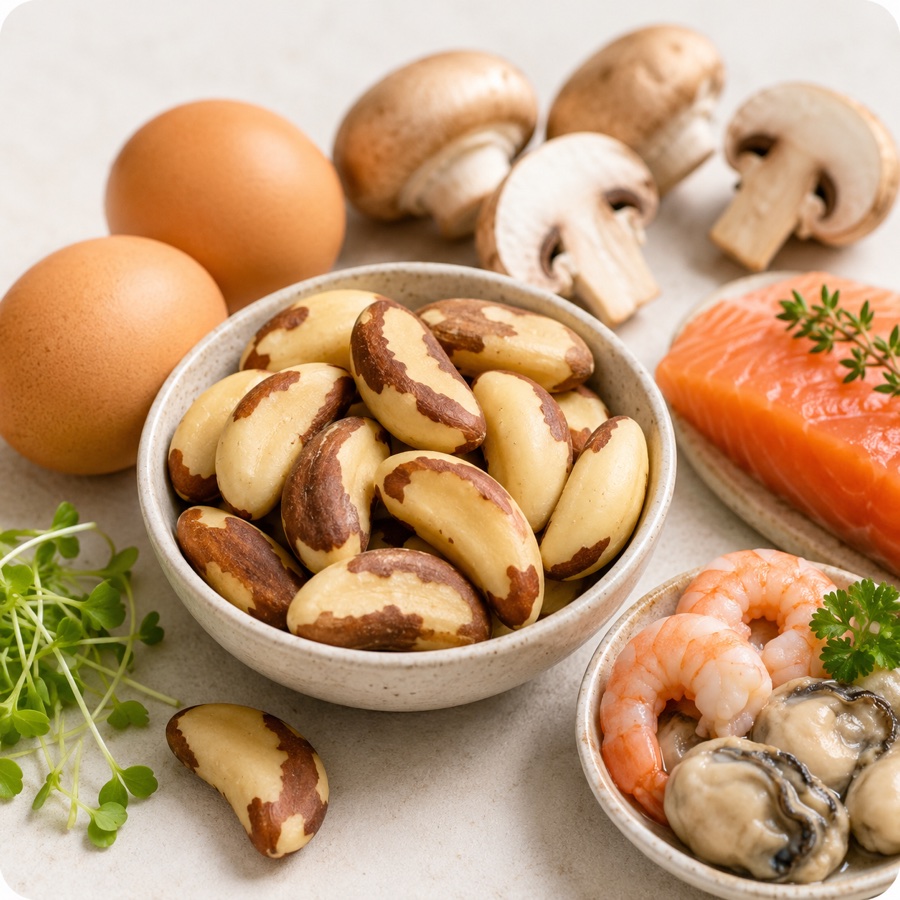
Selenium is an essential trace mineral that must be obtained from food. The body uses selenium to make selenoproteins involved in antioxidant defense, thyroid hormone metabolism, DNA synthesis, reproduction, and normal immune function. Selenium is found in seafood, meat, poultry, eggs, grains, and some nuts, while levels in plant foods can vary substantially with soil and growing location.
30-second check: which situation fits you best?
Your Food Sources Are Consistent
You regularly eat fish, seafood, meat, eggs, or grains, your diet is varied, and you do not chronically restrict major selenium sources, making adequate baseline intake more likely.
Your Selenium Sources Are Long-Term Low or Unstable
Long-term low intake of seafood, meat, and eggs, limited food variety, or heavy reliance on plant foods with highly variable selenium content can leave intake low.
Your Main Goal Is Antioxidant Support or Healthy Aging
Your diet is already stable, and you are considering extra selenium mainly for additional antioxidant effects, cardiovascular protection, cancer prevention, or slower aging. That is a question of added benefit, not basic adequacy.
Basic Overview
What it is
Selenium is an essential trace mineral that the body cannot make and must obtain from food. It is incorporated into several selenoproteins, including glutathione peroxidases, thioredoxin reductases, and thyroid hormone deiodinases. These proteins support normal antioxidant defense, thyroid hormone metabolism, DNA synthesis, reproduction, and immune function. Selenium requirements are small, and major sources include fish and seafood, meat, poultry, eggs, grains, and some nuts. Selenium in plant foods can vary greatly with soil and growing location.
Why people use it
- Fill a long-term dietary selenium gap
- Maintain baseline selenium intake during a restrictive diet
- Support the body's normal antioxidant defense system
- Support normal thyroid hormone metabolism
- Provide a basic mineral within a multivitamin
- Supplement when selenium status is clearly low
How it relates to healthy aging
Selenium contributes to the body's own antioxidant defense system, so meeting basic needs is important when selenium intake is clearly inadequate.
But “involved in antioxidant defense” does not mean “more selenium means more anti-aging.” Once selenium status is sufficient for selenoprotein synthesis, there is no reliable evidence that further increasing intake makes healthy adults younger overall, extends lifespan, or keeps increasing antioxidant capacity.
Supplement Assessment
Selenium is not usually difficult for healthy adults to obtain from food. Before considering a supplement, check whether your regular intake of seafood, meat, poultry, eggs, and grains is stable, then check whether current products such as multivitamins already contain selenium.
Usually No Dedicated Supplement Needed
- You regularly eat fish, seafood, meat, poultry, or eggs
- Grains and other everyday food sources are consistent
- Your diet is varied without long-term major food avoidance
- Your current multivitamin already provides selenium close to the daily reference amount
- You mainly want high-dose selenium for extra antioxidant effects
- You mainly want selenium for cancer prevention, cardiovascular protection, or healthy aging
Your next step:
Keep your diet varied and check how much selenium is already in your supplements. When baseline intake is stable, there is usually no reason to add a separate selenium product for “stronger antioxidant protection” or “anti-aging.”
You May Have an Intake Gap
- You rarely eat fish or seafood over the long term
- Your intake of meat, poultry, and eggs is also low
- Your diet has limited variety over the long term
- A restrictive diet substantially reduces major selenium sources
- You rely long term on a small number of plant foods with highly variable selenium content
- Your current diet and supplements still do not reliably reach the baseline reference intake
Your next step:
Increase natural food sources first. If you still cannot meet needs consistently, consider an adjustable low-dose supplement. The goal is to fill a basic gap, not to jump directly to 100–200 μg or more.
Talk to a Health Professional First
- Known selenium deficiency or a complex nutrition problem
- You are receiving kidney dialysis
- You have significant malabsorption
- You are receiving cancer treatment or another complex therapy
- You want to use selenium to treat a thyroid disorder
- You are on a treatment plan that may involve selenium metabolism
- You plan to take selenium well above daily reference intakes long term
- You already use several selenium-containing supplements
Your next step:
Ask a physician, pharmacist, or registered nutrition professional whether supplementation is appropriate, whether testing is needed, and whether your total daily selenium intake is reasonable.
Quick self-check
Over the past week, have you regularly eaten fish, seafood, meat, poultry, or eggs?
Are grains and other foods in your usual diet fairly varied?
Do you follow a long-term diet that substantially restricts animal foods?
Are you already taking a selenium-containing multivitamin?
Are you also using other mineral or antioxidant combination products?
Are you planning to take 100–200 μg or more of selenium every day long term?
Food Sources
Percentages of the China adult RNI are calculated using 60 μg/day. Selenium content varies with variety, origin, moisture, raw/cooked state, and processing, so table values are estimates for everyday intake. Selenium per Brazil nut is especially variable.
Representative food sources
| Food / Preparation | Approx. per 100 g | Common Serving | Approx. per Serving | % of China Adult RNI |
|---|---|---|---|---|
| Brazil nuts | about 1,919 μg | 1 nut | about 68–91 μg | about 113%–152% |
| Cooked yellowfin tuna | about 108 μg | 85 g | about 92 μg | about 153% |
| Oil-packed sardines, drained with bones | about 53 μg | 85 g | about 45 μg | about 75% |
| Cooked shrimp | about 49 μg | 85 g | about 42 μg | About 70% |
| Roasted pork chop | about 44 μg | 85 g | about 37 μg | about 62% |
| Roasted beef round | about 44 μg | 85 g | about 37 μg | about 62% |
| Pan-fried beef liver | about 33 μg | 85 g | about 28 μg | about 47% |
| Roasted turkey | about 31 μg | 85 g | about 26 μg | about 43% |
About Brazil nuts: they are unusually high in selenium. A single nut may provide about 68–91 μg, already meeting or exceeding the China adult RNI of 60 μg/day, and levels vary substantially by origin and batch. Therefore, “eat a fixed number of Brazil nuts every day” is not a precise selenium-dosing strategy.
How to get it from food in a day
Example One
About 153% of the China adult RNI. One serving of a selenium-rich fish can already cover the day's basic need, so there is no reason to add a high-dose selenium-only supplement just to “top up selenium.”
Example Two
This roughly reaches the China adult RNI of 60 μg/day.
Cooking and storage tips
For plant foods, origin matters: selenium content depends strongly on soil and growing region, so actual amounts can vary widely.
Avoid prolonged boiling: some grains and vegetables can lose selenium during long boiling, so extended cooking is unnecessary.
Cook fish normally: steamed, boiled, or pan-cooked fish generally retains substantial selenium, so raw fish is not needed for selenium intake.
Whole foods vs supplements
Whole Foods
- Also provides other nutrients
- Better suited as a long-term foundation
- Intake is usually spread across foods
- Less likely to produce a high-dose intake
Supplements
- Provides a stable, easy-to-calculate dose
- Useful for filling a gap when food sources are inconsistent
- Do not replace a balanced diet
- Makes duplicate or excessive intake easier
Dosage
Daily selenium needs are very small. For generally healthy adults, the goal is not to find a “high-dose effective range,” but to meet basic needs from food plus supplements while staying well below the 400 μg/day UL.
China & U.S. Adult Reference Intakes
The axis shows 3 points: the U.S. adult RDA of 55 μg/day, the China adult RNI of 60 μg/day, and the shared China/U.S. adult UL of 400 μg/day. The 400 μg/day UL is the safety boundary for total intake from food, beverages, and supplements—not a target to pursue.
Special populations:This section applies only to generally healthy adults. Children, pregnancy, breastfeeding, confirmed selenium deficiency, severe malabsorption, kidney dialysis, and people receiving medical treatment should not directly use these default values.
Chinese and U.S. Reference Standards
China RNI
60 μg/day
UL (Tolerable Upper Intake Level)
400 μg/day
U.S. RDA
55 μg/day
UL (Tolerable Upper Intake Level)
400 μg/day
Reference values differ slightly between countries; this does not mean 60 μg is inherently healthier than 55 μg.
The U.S. adult UL applies to total intake from food, beverages, and supplements.
Absorption & Use
Selenium is generally well absorbed. Common forms such as selenomethionine, selenium-enriched yeast, selenite, and selenate can all be absorbed by the body.
Selenoprotein-related functions tend to plateau once basic needs are met, so increasing intake further does not mean antioxidant capacity, thyroid function, or immune effects keep increasing with dose.
Excess selenium is eliminated mainly through urine and other routes, but chronic high intake can still cause toxicity. “It can be absorbed” does not mean “more is better.”
Health Effects
Antioxidant Defense
Selenium is part of selenoproteins such as glutathione peroxidases and thioredoxin reductases that contribute to the body's own antioxidant defenses. Repletion has clear value when selenium is deficient, but once baseline status is adequate, there is no reliable evidence that higher doses keep increasing overall antioxidant capacity or slow aging.
View official guidance
Thyroid Hormone Metabolism
Selenium-containing deiodinases participate in thyroid hormone metabolism and the conversion of T4 to T3, so selenium is needed for normal thyroid function. But in healthy adults, higher-dose supplementation has not been shown to further improve normal thyroid function even when blood selenium levels rise.
View official guidance
Immune Function
Selenoproteins contribute to normal immune regulation and host defense, so clearly inadequate intake can affect immune function. That does not mean more selenium produces stronger immunity. In healthy adults who already meet basic needs, human evidence does not support high-dose selenium as a reliable way to “boost immunity.”
View official guidance
Cardiovascular Health
Because selenium contributes to antioxidant and redox regulation, it has been studied for cardiovascular protection. Overall, randomized clinical trials have not shown that selenium supplementation reliably reduces cardiovascular disease or cardiovascular mortality. For people with adequate selenium intake, it should not be used routinely for cardiovascular protection.
View official guidance
Cognition & Healthy Aging
Some observational studies link lower selenium status with poorer cognitive performance, but association does not show that supplementation improves cognition. Current clinical evidence does not support raising selenium intake long term in healthy adults with adequate status to prevent cognitive decline or dementia or to slow overall aging.
View official guidance
Cancer Prevention
Early observational studies reported associations between selenium status and risk of some cancers, but later large randomized trials did not show that selenium supplementation reliably prevents prostate cancer or other cancers. Selenium is a basic nutrient, but it should not be used as a routine “cancer-prevention supplement” in healthy adults.
View official guidance
Product Selection
What Should I Look for on the Label?
Only Check These Four Things
What Is the Active Ingredient?
First identify the selenium source on the label. Common forms include L-selenomethionine, selenium-enriched yeast, selenium glycinate, sodium selenite, and sodium selenate. Forms differ in absorption and metabolism, but names such as “organic selenium,” “chelated selenium,” or “high absorption” do not prove better health effects.
How Much Is Actually in Each Serving?
Check how many micrograms of selenium each capsule or serving provides, how many capsules make one serving, and how many servings are suggested per day, then calculate the actual daily total. Also check multivitamins and other mineral products for selenium rather than counting only the selenium-only supplement.
Are There Unnecessary Additives?
A selenium-only supplement usually does not need large amounts of herbs, antioxidants, or other high-dose minerals. Combination formulas are not inherently bad, but extra ingredients are unnecessary when they do not match your goal, make dosing harder to adjust, or duplicate other supplements.
Is Quality Control Verifiable?
Check the manufacturer, country of manufacture, lot number, expiration date, selenium per serving, and storage instructions, and prefer products with verifiable quality information. Because selenium is used in microgram amounts, accurate content matters more than marketing terms such as “high absorption.”
How to Read the LabelExample: a low-dose selenium product
Take 1 capsule daily with a meal; the actual dose should be based on the selenium gap after accounting for diet and current supplements.
Vegetable capsule, rice flour, silica.
Third-Party Tested
Lot: SE260807
Expires: 2028-08
*This example provides 55 μg selenium as L-selenomethionine per serving: 55 μg ÷ the FDA Daily Value of 55 μg = 100%. Section 06 also lists common selenium-only products in 100 μg and 200 μg strengths. Choose based on the actual gap and calculate total daily intake; do not interpret this example label as a recommended dose. This is an educational example, not certification of an actual product label. %DV uses FDA Daily Values for adults and children aged 4 and older, excluding pregnancy and lactation; this adult example is not a child dosage recommendation. FDA Daily Values.
Product Form
Start with the selenium form: L-selenomethionine, selenium-enriched yeast, selenium glycinate, sodium selenite/selenate, or another form. Do not assume “organic,” “chelated,” or “high absorption” means better effects.
Amount per Capsule or Serving
Check how many micrograms of selenium each capsule or serving actually provides—such as 55 μg, 100 μg, or 200 μg in the examples—not the large marketing text on the front.
Servings per Day
Confirm how many capsules or servings are suggested each day to calculate the true daily total; do not confuse the per-capsule amount with the daily amount.
Other Nutrients
Check whether the product also contains vitamin E, zinc, iodine, or other minerals. Selenium from multivitamins and other mineral supplements must be counted in the total.
Quality Information
Check the manufacturer, lot number, expiration date, selenium per serving, and storage instructions, and favor verifiable testing or certification information.
How to Choose a FormDifferences, whether they are worth paying more for, and who they may suit
L-Selenomethionine
How It Differs
A common organic selenium form with relatively high absorption; some of its selenium can enter methionine-related body pools.
Worth Paying More?
A reasonable common form to prioritize, but there is no need to buy an expensive specialty brand just for “high absorption.”
Best For
Useful if you want a simple selenium-only product with more research and straightforward labeling.
Selenium-Enriched Yeast
How It Differs
Selenium-enriched yeast contains several selenium compounds, with a large proportion commonly present as organic forms such as selenomethionine.
Worth Paying More?
It is a reasonable option, but there is not enough evidence that it provides greater real-world health benefits than standard L-selenomethionine.
Best For
Suitable for people comfortable with a yeast-derived product who want a common organic selenium form.
Selenium Glycinate
How It Differs
Selenium glycinate is a selenium-glycine complex or chelated form. Small human studies show that it can provide bioavailable selenium and affect some selenium-related biomarkers.
Worth Paying More?
There are not enough direct comparative studies showing that selenium glycinate produces better real-world health effects than L-selenomethionine or selenium-enriched yeast, so paying a large premium just for the “chelated selenium” concept is not justified.
Best For
It can be chosen when the dose is sensible, quality is reliable, and price is similar to other forms, but there is no need to prioritize it over L-selenomethionine.
Sodium Selenite / Sodium Selenate
How It Differs
These are common inorganic selenium forms that can also be absorbed and used for selenoprotein synthesis, although their metabolism differs from organic forms such as selenomethionine.
Worth Paying More?
They are often less expensive, and the label “inorganic selenium” does not mean the product is necessarily lower quality or less effective.
Best For
When the dose is appropriate, labeling is clear, and quality is reliable, they can also be used to fill a basic selenium gap.
How to Interpret Selenium Glycinate Evidence
One small randomized human study gave healthy middle-aged men 200 μg/day of selenium glycinate for 6 weeks and observed changes in selenium-related markers, including plasma and red-blood-cell glutathione peroxidase activity.
But this study does not show that selenium glycinate is a “better selenium form” because the sample was small, the dose was relatively high at 200 μg/day, there was no direct comparison with L-selenomethionine or selenium-enriched yeast, outcomes were mainly biomarkers, and the study cannot show greater noticeable health benefits in healthy people.
The appropriate conclusion is that selenium glycinate is a usable selenium form, but there is currently insufficient evidence that it produces better real-world health outcomes than L-selenomethionine, selenium-enriched yeast, or standard inorganic selenium.
How to Take
When should you take it, and what is the most practical way to use it?
Default plan (healthy adults)
Suggested Dose: Base the amount on selenium already provided by food and current supplements so total daily intake approaches the baseline reference. Do not interpret China's 60 μg or the U.S. 55 μg as an amount everyone should add as a supplement.
Frequency: Usually once daily is enough.
Stomach Tolerance: There is usually no requirement to take selenium on an empty stomach. If fasting causes nausea or stomach upset, take it with food.
Adjust If You Feel Unwell: For mild discomfort, try taking it with food, lowering the dose, checking for other selenium-containing products, or switching to a simpler formula. If symptoms persist or are significant, stop self-directed use.
When to Take It: There is no reliable evidence that morning or evening selenium works differently. Choose a consistent time that is easy to maintain.
Long-Term Use?: If the dietary selenium gap continues, a reasonable low-dose supplement can continue. If the diet improves or another combined supplement already covers needs, reduce or stop the selenium-only product. Without a clear gap, high-dose selenium should not be treated as a default long-term antioxidant strategy.
Missed Dose: If you miss a dose, skip it and take your usual amount next time; do not double the dose.
Frequently asked questions
With Food or on an Empty Stomach?
Standard selenium supplements usually have no strict meal requirement. Take them with a meal if your stomach is sensitive.
Do I Need to Split the Dose?
Low doses usually do not need to be divided. If the product itself is high dose, reconsider whether that dose is necessary rather than simply splitting it into two doses.
What Time Should I Take It?
Morning or evening is fine. A suitable dose and avoiding duplicate intake matter more than a supposed “best time.”
Do I Need to Separate It From Other Supplements?
Most basic nutrition supplements do not need to be separated from selenium. But if you use a multivitamin, mineral product, thyroid-related formula, or antioxidant blend, first check whether it already contains selenium.
More questions about use (click to expand)
How Long Should I Take It?
There is no fixed course when the goal is simply to fill a dietary gap. Continue a reasonable amount while the diet remains insufficient, and reassess the need for a selenium-only product once food intake improves.
How Can I Tell Whether It Is Working?
Healthy people usually do not notice a dramatic subjective change after meeting selenium needs. Judge use by whether the intake gap has been filled appropriately, not by expecting rapid changes in energy, skin, or “anti-aging” status.
Do I Need to Separate It from Medications?
There is no single spacing rule that applies to every medication. If you are receiving complex treatment, chemotherapy, thyroid treatment, or long-term prescription therapy, ask a physician or pharmacist to review your regimen.
What Foods Can I Take It With?
No special pairing is usually needed. Take it with your normal diet; you do not need to add fat or a specific food just to improve absorption.
Risks & Precautions
Common Side Effects
- Nausea
- Stomach upset
- Diarrhea
- Abdominal discomfort
- An unusual metallic taste
- For mild symptoms, first check the dose and duplicate sources, then try taking it with food or lowering the supplement dose. If symptoms persist or are significant, stop self-directed use.
High-Dose Risks
- Long-term excess selenium can cause selenosis
- Typical signs include hair loss, brittle or lost nails, garlic-like breath, metallic taste, rash, nausea, diarrhea, fatigue, irritability, and neurologic abnormalities
- Severe excess can cause more pronounced systemic toxicity
- 400 μg/day is a UL, not a recommended dose; it is the long-term total-intake safety boundary, not a health target to pursue
- Do not check only a selenium-only capsule: also count selenium in multivitamins, other mineral formulas, selenium-only products, and food
Use Higher Doses with Extra Caution If You Are
- Severe kidney dysfunction or dialysis
- Significant malabsorption or nutrient-metabolism problems
- Currently receiving cancer treatment
- Possible signs of selenium excess are already present
- Using multiple selenium-containing supplements
- Relying on large amounts of Brazil nuts for selenium
- Planning to use a selenium-only product providing 100–200 μg or more long term
Special Situations
- Thyroid disease: selenium participates in normal thyroid hormone metabolism, but that does not justify self-treating thyroid disease with high-dose selenium. If you have a diagnosed thyroid problem, a physician should consider the specific condition, selenium status, and other treatments.
- Cancer treatment: do not add high-dose selenium during chemotherapy, radiotherapy, or other complex treatment simply because selenium has antioxidant roles.
- Brazil nuts: selenium content is extremely high and varies substantially by origin and batch. If you eat Brazil nuts while also taking a multivitamin and selenium supplement, calculate total intake carefully.
- Other supplements: multivitamins, mineral formulas, thyroid formulas, and “antioxidant blends” may already contain selenium. Check the label before adding more.
Stop and Seek Advice
Persistent nauseaPersistent diarrheaSignificant stomach upsetRepeated unusual metallic tasteMarked increase in unexplained hair lossNoticeable nail abnormalitiesSuspected excessive use of selenium-containing products
Seek Prompt Medical Care
Accidental ingestion of a large amount of selenium supplementSignificant neurologic abnormalitiesSevere vomitingDifficulty breathingAltered consciousness
Sources
This page supports the basic information, food sources, reference intakes, upper limit, health effects, product selection, use, and safety guidance for selenium. It is intended mainly for generally healthy adults and does not directly apply to children, pregnancy, breastfeeding, confirmed deficiency, dialysis, severe malabsorption, or people receiving medical treatment.
Nutrition Standards & Basic Data
Food Sources & Cooking
Health Effects & Scientific Evidence
Forms & Absorption
Safety, Product & Use References
Last updated: August 7, 2026