Coenzyme Q10
Coenzyme Q10 / CoQ10 / Ubiquinone / Ubidecarenone / Ubiquinol
Coenzyme Q10 (CoQ10) is an umbrella term. Ubiquinone (also called ubidecarenone) is the oxidized form, while ubiquinol is the reduced form. The body can convert between the two; even when ubiquinone is consumed, most circulating CoQ10 is present as ubiquinol.
30-second check: which situation fits you best?
I just want everyday antioxidant or healthy-aging support
You are interested in CoQ10 because it supports mitochondrial energy production and antioxidant defense and are considering it as a long-term wellness supplement, but you do not have a clear fatigue, recovery, or other measurable goal.
I have one clear goal I want to improve
If your main concern is persistent fatigue, post-exercise muscle recovery, or another specific outcome studied in CoQ10 trials, compare the study population, dose, and effects with your situation.
I am planning to use it or already taking it
If you have already bought or are taking CoQ10, the priority is not finding the “highest dose.” Confirm whether the product contains ubiquinone or ubiquinol, how much you actually take per day, and whether a special absorption formulation is used.
Basic Overview
What it is
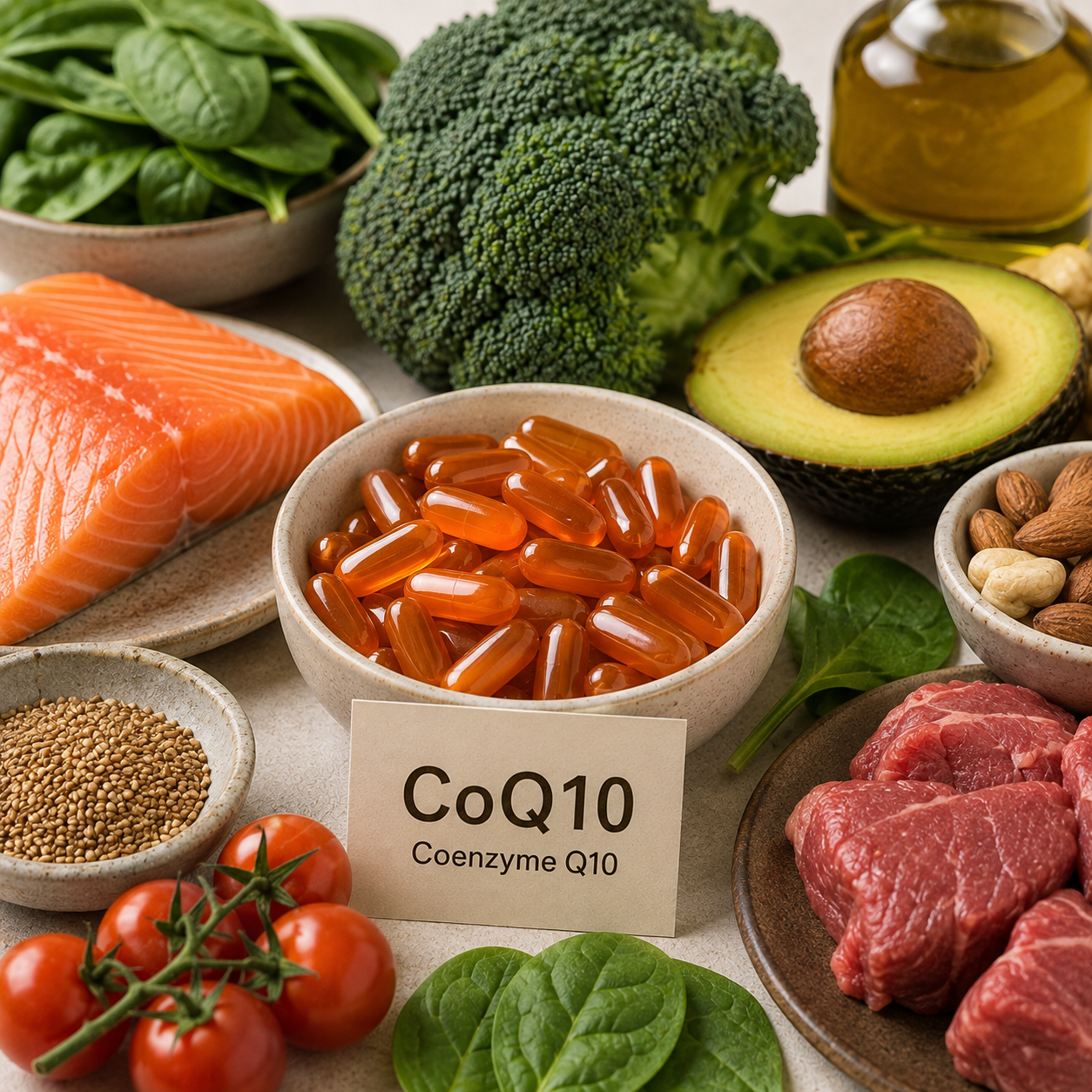
CoQ10 is a naturally occurring fat-soluble compound in human cells. It is especially involved in mitochondrial ATP production and also contributes to antioxidant defense in lipid membranes. The body can synthesize it and can also obtain small amounts from meat, fish, organ meats, nuts, and plant oils, so it is not a basic nutrient with an RDA in the way vitamin C is.
Why people use it
- Persistent subjective fatigue
- Post-exercise muscle recovery
- Muscle symptoms while taking a statin
- Adjunctive use for migraine prevention
- Goal-directed use related to cardiovascular health
- Interest driven by ideas such as “mitochondria,” “antioxidants,” or “healthy aging”
How it relates to healthy aging
Mechanistically relevant does not mean supplementation is anti-aging.
CoQ10 participates in mitochondrial energy metabolism and antioxidant defense, but clinical evidence does not currently show that supplementation in healthy adults extends lifespan, slows human aging, or reverses age-related changes.
Supplement Assessment
Start with your goal and medications, then decide whether a time-limited trial is worth considering.
Low supplementation priority
- Wanting long-term use only because of “mitochondria, antioxidants, or anti-aging”
- Energy, exercise recovery, and day-to-day physical condition are generally normal
- No specific, repeatable outcome such as fatigue level or recovery time to track
- Already using several wellness supplements and simply wanting to add another
- Wanting to use it indefinitely without knowing how you would decide whether it is helping
Your next step:
First define the problem you actually want to improve. If the goal can only be summarized as “antioxidant support, anti-aging, or general wellness,” supplementation is a low priority; focus first on diet, exercise, sleep, and weight management.
Clear goal: a trial may be reasonable
- Frequent fatigue and wanting to track changes in energy or tiredness
- Slow post-training recovery and wanting to track soreness or recovery time
- A physical outcome you can record repeatedly, rather than a vague goal of “more energy”
- Willing to use it consistently for a period of time rather than judging after only a few days
- Accepting that improvement may be limited and being willing to stop if no stable benefit appears
Your next step:
Define the outcome first—such as fatigue severity, recovery time, or post-exercise muscle discomfort—then decide whether a trial is worth it.
Talk with a healthcare professional first
- Using warfarin or another anticoagulant
- Receiving blood-pressure treatment or normally having low blood pressure
- Using insulin or other glucose-lowering treatment
- Receiving cancer treatment
- Pregnancy or breastfeeding
- Long-term use of multiple prescription medications
- Planning to use amounts far above typical product strengths
- Wanting to use CoQ10 for a specific disease-related goal such as migraine or heart failure
Your next step:
Tell your doctor or pharmacist the exact product, CoQ10 form, amount per capsule, planned daily intake, and current medications before deciding whether to start.
Do I need testing?
Generally healthy people do not usually need routine blood CoQ10 testing before deciding whether to supplement.
- Blood CoQ10 levels are influenced by lipoprotein levels, diet, supplements, and the testing method.
- Unlike 25-OH vitamin D, there is no mature healthy-adult pathway of “test for deficiency → supplement according to the result.”
The decision to try CoQ10 should be based more on a specific goal, the evidence, medications, and risk.
Food Sources
Common Food Sources With Higher CoQ10 Content
| Food | Approx. CoQ10 per 100 g | Common Serving | Approx. per Serving | How to Interpret It |
|---|---|---|---|---|
| Pork heart | About 11.8–28.2 mg | 100 g | About 11.8–28.2 mg | One of the richer natural sources, but organ meats are not a food to eat in large amounts every day. |
| Chicken liver | About 11.6–13.2 mg | 100 g | About 11.6–13.2 mg | Animal liver contains substantially more CoQ10 than ordinary poultry meat. |
| Beef heart | About 11.3 mg | 100 g | About 11.3 mg | Heart tissue is rich in mitochondria and contains more CoQ10 than ordinary beef. |
| Dark/red mackerel muscle | About 6.75 mg | 100 g | About 6.75 mg | Different muscle regions within the same fish can differ substantially. |
| Beef liver | About 3.9–5.1 mg | 100 g | About 3.9–5.1 mg | Still far below a typical 100 mg supplement. |
| Soybean oil | About 5.4–27.9 mg | 10 g | About 0.54–2.79 mg | A normal serving uses only a small amount, so per-serving intake matters more than the per-100-g value. |
Use the per-100-g column to compare food concentrations and the serving column to understand what you actually consume at one time. The large gap between food and supplement doses does not mean healthy adults need to supplement up to 100 mg.
How Much Can Food Provide in a Day?
Example 1
A 100 g serving of the darker/red portion of mackerel can provide about 6.8 mg. With ordinary meat, nuts, and plant oils, getting several milligrams per day from food is not difficult.
Example 2
A 100 g serving of beef heart provides about 11 mg, which is already a relatively high-food exposure. There is no need to eat large amounts of organ meat to chase supplement-level doses.
Cooking and storage tips
Avoid prolonged deep-frying: studies observed losses of about 14%–32%.
Boiling appears to cause less loss: early studies did not observe the same degree of loss seen with frying.
Fish muscle location matters: different muscle regions within the same fish can contain noticeably different amounts.
Whole foods vs supplements
Whole Foods
- Also provide protein, fat, vitamins, and minerals
- CoQ10 amounts are usually only a few milligrams
- Better suited to a long-term dietary pattern
- No need to chase supplement-level doses
- A normal diet is unlikely to reach ~100 mg/day
Supplements
- Provide a more concentrated and standardized amount
- Commonly about 50–200 mg per capsule
- Absorption can differ substantially by formulation
- Ubiquinone vs ubiquinol should not be judged by the name alone
- Dose, medications, and the reason for use matter more
Dosage
CoQ10 has no established RNI, RDA, AI, formal UL, or universal daily recommended dose.
Official Dose Status, Regulatory Monographs, and Human Research
Health Canada Regulatory Monographs
These are monograph doses for specific label uses, not an RDA or UL.
How much did studies use for specific goals?
Start with your goal, then look at doses used in similar human studies
Studies in healthy adults observed improvements in some measures of fatigue, sleepiness, and motivation. These are research doses, not recommendations for everyone.
CoQ10 can raise blood levels, but improvements in actual exercise performance are limited and inconsistent. There is no clear pattern showing that a higher dose works better.
These are disease-related targets and regulatory-monograph doses, not routine wellness doses for generally healthy adults.
How should generally healthy adults interpret dose?
Important Note
No RNI, RDA, AI, formal UL, or universal daily recommended dose has been established. The absence of a formal UL does not mean the dose can be increased without limit.
Health Canada monograph doses apply to specific intended uses and do not represent the daily requirement of generally healthy adults. 300 mg/day is not a UL.
100–200 mg/day is a common product and research dose range, not an official recommended intake.
1,200 mg/day is an Observed Safe Level (OSL), not a UL and not a routine self-use target.
Do not reinterpret product strengths, study doses, regulatory-monograph doses, or the OSL as an official recommended intake or UL.
How Formulation Affects Exposure
CoQ10 is highly fat soluble, and absorption from conventional oral formulations is generally limited.
Oil carriers, degree of solubilization, emulsification, and delivery technology can change human exposure at the same labeled milligram dose.
In a small crossover study, exposure from a water-soluble formulation was about 2.4 times that of a conventional ubiquinone capsule, and ubiquinol about 1.7 times; this does not support a fixed conversion such as 100 mg ubiquinol = 200 mg ubiquinone.
How to Read Common Product Doses: Same Milligrams ≠ Same Human Exposure
For standard single-ingredient CoQ10 products, the milligrams on the label usually are the actual CoQ10 dose. The main differences are ubiquinone vs ubiquinol, carrier, solubilization, and single-ingredient vs combination formulas.
| Product | Package / Label Number | Dose That Is Actually Comparable | Formulation | How to Read It |
|---|---|---|---|---|
| NOW Foods CoQ10 100 mg SoftgelsOfficial product link | 100 mg CoQ10 | 100 mg ubiquinone/capsule | Oil-based softgel Ubiquinone; olive-oil carrier |
100 mg is the actual CoQ10 amount per capsule; no standardization conversion is needed, and the oil is not counted toward the CoQ10 dose. |
| NOW Foods Ubiquinol 100 mgOfficial product link | 100 mg Ubiquinol | 100 mg ubiquinol/capsule | Ubiquinol form Ubiquinol; Kaneka ingredient; MCT oil |
Do not assume that 100 mg ubiquinol produces exactly the same human exposure as 100 mg conventional ubiquinone simply because the milligram number matches. |
| GNC CoQ-10 100 mgOfficial product link | 100 mg CoQ10 | 100 mg CoQ10/capsule | Oil-based softgel Conventional CoQ10 softgel |
The front-label number is the actual amount per capsule; manufacturer directions are not official dose recommendations. |
| Swisse Ultiboost Co-Enzyme Q10 150 mgOfficial product link | 150 mg CoQ10 | 150 mg ubiquinone/capsule | Ubiquinone form Ubiquinone (Ubidecarenone); single-ingredient capsule |
The actual dose is 150 mg. Unlike many plant extracts, no standardization percentage needs to be applied. |
| Blackmores CoQ10 150 mgOfficial product link | 150 mg CoQ10 | 150 mg ubiquinone/capsule | Ubiquinone form Ubiquinone (Ubidecarenone); single-ingredient capsule |
The package number is the dose of the target ingredient. |
| Jamieson CoQ10 120 mgOfficial product link | 120 mg CoQ10 | 120 mg CoQ10/capsule | Oil-based softgel Coenzyme Q10; oil-based carrier |
The number of capsules recommended on the label should not automatically become a default regimen for everyone. |
| NatureWise CoQ10 + Black PepperOfficial product link | 100 or 200 mg CoQ10 | 100 or 200 mg ubiquinone/capsule | Solubilized formula Ubiquinone + black pepper extract |
The weight of black pepper extract is not added to the CoQ10 dose. |
| Doppelherz Coenzyme Q10 + B VitaminsOfficial product link | 50 mg CoQ10 | 50 mg CoQ10/capsule | Combination formula CoQ10 + vitamins/minerals |
Only 50 mg is CoQ10; evaluate the other active ingredients separately. |
NOW Foods CoQ10 100 mg Softgels
Official product link- Package / Label Number
- 100 mg CoQ10
- Dose That Is Actually Comparable
- 100 mg ubiquinone/capsule
- Formulation
- Oil-based softgel
Ubiquinone; olive-oil carrier
- How to Read It
- 100 mg is the actual CoQ10 amount per capsule; no standardization conversion is needed, and the oil is not counted toward the CoQ10 dose.
NOW Foods Ubiquinol 100 mg
Official product link- Package / Label Number
- 100 mg Ubiquinol
- Dose That Is Actually Comparable
- 100 mg ubiquinol/capsule
- Formulation
- Ubiquinol form
Ubiquinol; Kaneka ingredient; MCT oil
- How to Read It
- Do not assume that 100 mg ubiquinol produces exactly the same human exposure as 100 mg conventional ubiquinone simply because the milligram number matches.
GNC CoQ-10 100 mg
Official product link- Package / Label Number
- 100 mg CoQ10
- Dose That Is Actually Comparable
- 100 mg CoQ10/capsule
- Formulation
- Oil-based softgel
Conventional CoQ10 softgel
- How to Read It
- The front-label number is the actual amount per capsule; manufacturer directions are not official dose recommendations.
Swisse Ultiboost Co-Enzyme Q10 150 mg
Official product link- Package / Label Number
- 150 mg CoQ10
- Dose That Is Actually Comparable
- 150 mg ubiquinone/capsule
- Formulation
- Ubiquinone form
Ubiquinone (Ubidecarenone); single-ingredient capsule
- How to Read It
- The actual dose is 150 mg. Unlike many plant extracts, no standardization percentage needs to be applied.
Blackmores CoQ10 150 mg
Official product link- Package / Label Number
- 150 mg CoQ10
- Dose That Is Actually Comparable
- 150 mg ubiquinone/capsule
- Formulation
- Ubiquinone form
Ubiquinone (Ubidecarenone); single-ingredient capsule
- How to Read It
- The package number is the dose of the target ingredient.
Jamieson CoQ10 120 mg
Official product link- Package / Label Number
- 120 mg CoQ10
- Dose That Is Actually Comparable
- 120 mg CoQ10/capsule
- Formulation
- Oil-based softgel
Coenzyme Q10; oil-based carrier
- How to Read It
- The number of capsules recommended on the label should not automatically become a default regimen for everyone.
NatureWise CoQ10 + Black Pepper
Official product link- Package / Label Number
- 100 or 200 mg CoQ10
- Dose That Is Actually Comparable
- 100 or 200 mg ubiquinone/capsule
- Formulation
- Solubilized formula
Ubiquinone + black pepper extract
- How to Read It
- The weight of black pepper extract is not added to the CoQ10 dose.
Doppelherz Coenzyme Q10 + B Vitamins
Official product link- Package / Label Number
- 50 mg CoQ10
- Dose That Is Actually Comparable
- 50 mg CoQ10/capsule
- Formulation
- Combination formula
CoQ10 + vitamins/minerals
- How to Read It
- Only 50 mg is CoQ10; evaluate the other active ingredients separately.
Health Effects
Mitochondrial Energy Production
CoQ10 is an important component of the electron transport chain and participates in ATP production. But the fact that the body needs CoQ10 does not mean supplementation will automatically improve energy or exercise performance in healthy people.
View official information
Subjective Fatigue
A 2022 meta-analysis of 13 randomized trials with 1,126 participants found a statistically significant improvement in fatigue scores, with an overall effect in the small-to-moderate range. Studies included both healthy people and patients with various conditions.
View meta-analysis
Exercise Recovery
A 2025 meta-analysis of 17 trials involving 440 exercising participants found reductions in some oxidative-stress and muscle-damage markers, but evidence quality was low. Lower biomarkers do not necessarily mean better performance or less soreness.
View meta-analysis
Migraine Prevention
Health Canada monographs allow this use and provide dose ranges and a treatment period of at least about 12 weeks. This is a disease-related goal and should not be generalized into an everyday wellness use for healthy adults.
View meta-analysis
Statin-Associated Muscle Symptoms
Some reviews have reported less muscle pain, but the overall evidence still requires caution. It is not appropriate to conclude that everyone taking a statin should also take CoQ10.
View meta-analysis
Cardiovascular Health
There is substantial research in patients with conditions such as heart failure, but that is not enough to show that long-term CoQ10 supplementation clearly prevents heart disease in generally healthy adults.
View official information
Product Selection
Start with the form and actual milligrams, then look at carrier, solubilization, added actives, and quality.
Check These Four Things
What is the active ingredient?
Confirm whether the product contains ubiquinone (Ubiquinone / Ubidecarenone) or ubiquinol. Do not assume all products labeled CoQ10 are equivalent.
How much do you actually get per serving?
Check milligrams per capsule, capsules per serving, and servings per day so you can calculate actual daily CoQ10 intake.
Are there unnecessary added ingredients?
Oils or phospholipids may help dispersion; combination vitamins, minerals, herbs, or black pepper should be evaluated separately to see whether you actually need them.
Is quality control credible?
Prefer products that clearly state the form, dose, manufacturer, lot number, and expiration date and provide GMP or third-party testing information.
How to Read the Label6 steps to read a CoQ10 label
Form → actual mg per capsule → daily total → formulation & carrier → added actives → quality
Plant-oil carrier; not counted toward the CoQ10 dose
1 capsule daily is only a product-label direction, not a site-recommended dose.
Form | Dose per capsule | Carrier | Lot number | Third-party testing
Coenzyme Q10 (Ubidecarenone) 150 mg means each capsule actually provides 150 mg of ubiquinone-form CoQ10; no standardization multiplier is needed.
Check the CoQ10 form first
Coenzyme Q10 / Ubiquinone / Ubidecarenone indicates ubiquinone; Ubiquinol indicates the reduced form.
Check actual milligrams per capsule
A label stating 150 mg usually means 150 mg actual CoQ10 per capsule; no standardization conversion is needed.
Calculate the actual daily intake
150 mg/capsule × 1 capsule/day = 150 mg/day. Label directions are not site recommendations.
Check the formulation and carrier
Look for conventional powder, oil-based softgels, MCT, water-soluble/solubilized, emulsified, or other delivery systems.
Evaluate added active ingredients separately
CoQ10 100 mg + black pepper extract still provides only 100 mg CoQ10.
Then verify quality
Check form, dose, serving size, carrier, combination ingredients, lot number, expiration date, manufacturer, and testing information.
How to Choose Among Common FormsForm and formulation affect human exposure
Ubiquinone
Main features
The classic form, with a long research history, many products, and usually lower cost. Absorption still depends on carrier and formulation.
Site guidance
For general supplementation, a clearly dosed oil-based softgel can be a practical choice. Do not assume a product is inferior simply because it is not ubiquinol.
Ubiquinol
Main features
The reduced form. Some studies suggest higher human exposure, and the body can convert between ubiquinone and ubiquinol.
Site guidance
It can be a reasonable option, but do not pay a large premium based on the word “ubiquinol” alone. Compare dose, formulation, and the relevant human data.
Oil-Based Softgel
Main features
Disperses fat-soluble CoQ10 in plant oil or MCT. Simple and common.
Site guidance
Practical for most users; focus on the dose per capsule and product quality.
Water-Soluble / Special Solubilized Formulations
Main features
Use emulsification, cyclodextrin, or other technologies to improve dispersion. Some pharmacokinetic studies show higher human exposure.
Site guidance
If the price is higher, look for human pharmacokinetic data on that specific formulation rather than relying on a marketing name.
How to Take
Because CoQ10 is strongly fat soluble, it is usually better taken with a meal. There is no universal rule that it must be taken in the morning or evening.
Default plan (healthy adults)
Official recommended dose: No universal official daily recommended dose has been established
How to interpret everyday doses: Many common products fall in the 100–200 mg range
Frequency: Most products are taken once daily; follow the specific label
With food?: Prefer taking it with a meal, especially a normal meal containing some fat
Split doses?: Higher daily amounts can be split according to the product directions
Long-term use?: If you have a clear goal, set an observation period before deciding whether to continue
Missed dose: If you occasionally miss a dose, skip it; do not double the next dose
Frequently asked questions
With food or on an empty stomach?
Prefer taking it with food to support dissolution and gastrointestinal tolerance.
Morning or evening?
No specific time is required. If evening use seems to affect sleep, move it to breakfast or lunch.
Is ubiquinol always better than ubiquinone?
Not necessarily. Carrier, solubilization, and delivery technology also matter, and there is no fixed conversion ratio.
Do I need to take extra oil with it?
A normal meal containing some fat is usually enough; there is no need to drink extra oil.
Do I need to split the dose?
For amounts around 100–200 mg/day, many labels use once-daily dosing. Higher doses depend on the product and goal.
How long before I judge whether it works?
For fatigue or recovery, set an observation period in advance. Migraine-related monographs typically use at least about 12 weeks.
Risks & Precautions
Common Side Effects
- Stomach upset or nausea
- Reflux, heartburn, or abdominal discomfort
- Headache or dizziness
- Sleep disturbance
- Rash in some people
- For mild symptoms, try taking it with food or lowering the dose; stop if symptoms persist
Higher-Dose Risks
- Tolerance of a high dose does not prove additional health benefit
- 1,200 mg/day is an Observed Safe Level, not a formal UL
- Doses in the thousands of milligrams mainly come from studies in specific patient populations
- No UL does not mean the dose can be increased without limit
People Who Need More Caution
- Pregnancy or breastfeeding
- Low blood pressure or use of antihypertensive treatment
- Diabetes treated with insulin
- Active cancer treatment
- Complex chronic disease or multiple medications
Medications & Special Situations
- Warfarin: CoQ10 may affect anticoagulant response; consult a doctor or pharmacist before starting or stopping it
- Blood-pressure medications: watch for additive blood-pressure lowering
- Insulin / glucose-lowering treatment: CoQ10 may affect control or treatment needs; do not adjust therapy on your own
- Cancer treatment: do not add CoQ10 simply because it is an antioxidant; let the oncology team assess it
Stop and Ask for Advice
Stop and seek advice if you develop persistent nausea, reflux, abdominal discomfort, significant insomnia, dizziness, or rash.
Seek Medical Care Promptly
Seek prompt medical care for a severe allergic reaction, significant unexplained bleeding, or abnormal bleeding while receiving anticoagulant treatment.
Sources
These sources support the basic information, overall evidence and safety, human evidence, food sources, absorption and formulation, and examples of mainstream product labels.
Basic Information, Overall Evidence & Safety
Health Effects & Human Evidence
Food Sources, Absorption & Formulation
Mainstream Product Label Examples
Last updated: August 13, 2026