Ginger Extract
Ginger Extract / Ginger Root Extract / Ginger / Ginger Extract / Ginger Root Extract / Zingiber officinale
30-second check: which situation fits you best?
Just looking for everyday anti-inflammatory or antioxidant support
Generally healthy adults do not need to use concentrated ginger extract long term solely because of anti-inflammatory or antioxidant marketing. Whole ginger already provides gingerols, shogaols, volatile oils, and other plant bioactives.
You have a specific goal you want to improve
Potential goals include motion-sickness-related nausea, gastric emptying and gastrointestinal motility, post-exercise muscle soreness, inflammatory or oxidative-stress markers, glucose and insulin, and blood lipids or blood pressure. The evidence, populations, and formulations differ across these goals.
You are planning to use it or already taking it
Do not look only at 500 mg or 1,000 mg on the front label. First determine whether the product is ginger root powder, ginger extract, or a complex, then look for standardization to Gingerols or to Gingerols + Shogaols.
Basic Overview
What it is
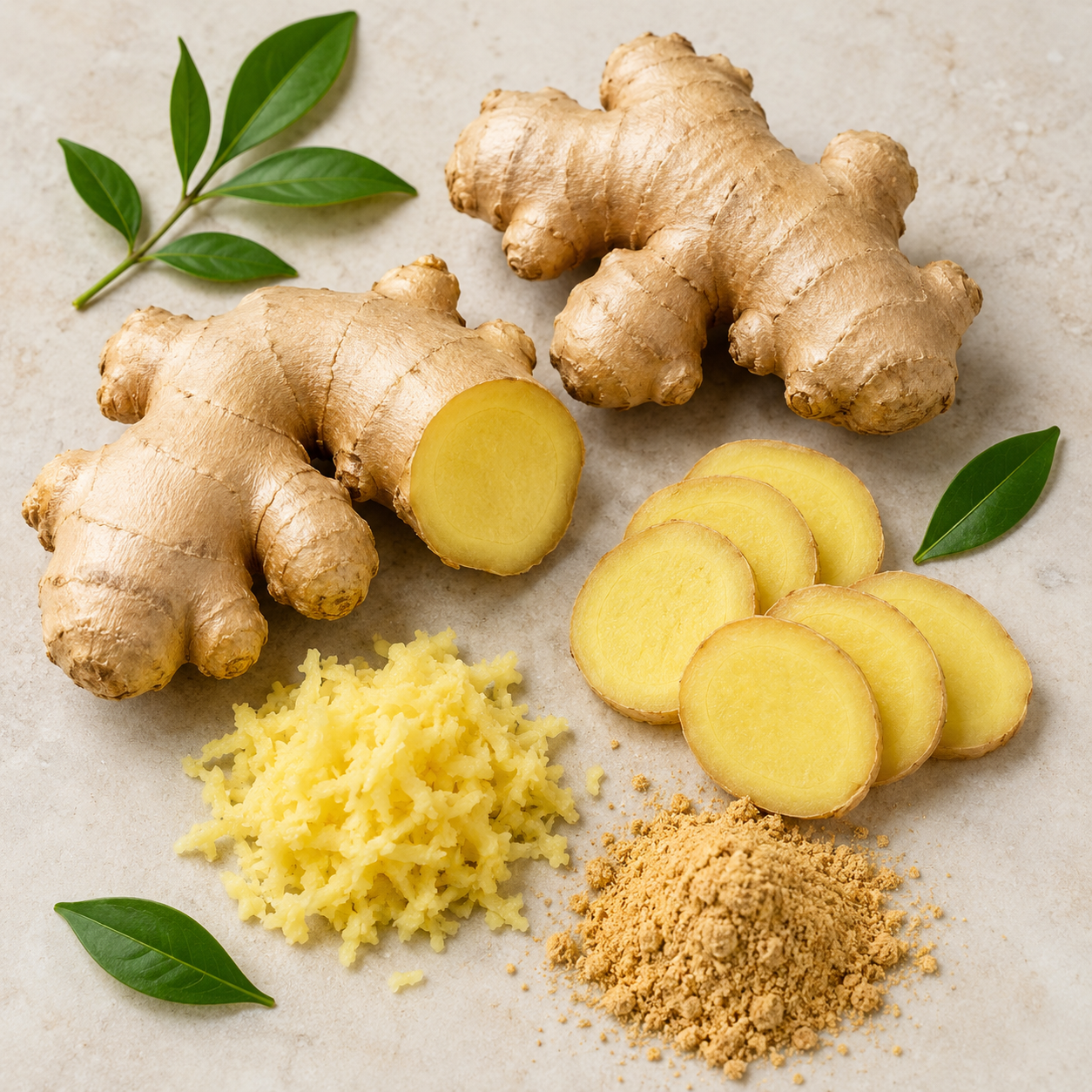
Ginger refers to the whole rhizome; Ginger Root Powder is dried rhizome ground into powder; Ginger Extract is a concentrated extract made from ginger. Gingerols are one of the main target bioactive groups, while Shogaols can form when some Gingerols are transformed during drying or heating. Ginger → extraction and concentration → Ginger Extract; Gingerols and Shogaols are major active constituents within that extract.
Why people use it
- Use in specific nausea or motion-sickness situations
- Target gastric emptying and gastrointestinal motility
- Try it to support recovery from post-exercise muscle soreness
- Target selected inflammatory or oxidative-stress markers
- Evaluate glucose, lipid, or blood-pressure research in people with metabolic abnormalities
- Use a standardized product to obtain a calculable Gingerol dose
How it relates to healthy aging
Gingerols and Shogaols can affect inflammatory, oxidative-stress, and metabolic signaling, which is why ginger is sometimes discussed in healthy-aging contexts.
These mechanisms and biomarker changes do not mean long-term supplementation in healthy adults reverses aging or extends lifespan. Additional benefit in generally healthy people remains uncertain.
Supplement Assessment
Define the goal → match the research formulation → verify standardized active ingredients → set an observation period.
Lower Supplement Priority
- No clear goal; only want everyday anti-inflammatory or antioxidant support
- Diet, exercise, and sleep still have obvious room for improvement
- Already use whole ginger regularly in the diet
- Product only lists “high concentration” or an equivalent milligram number without active-ingredient data
- Plan indefinite use without an outcome to track
Your next step:
Prioritize whole foods and basic lifestyle measures, and first turn a marketing goal into an observable problem.
Clear goal; reasonable to consider a trial
- Interested in motion-sickness-related nausea
- Interested in gastric emptying and gastrointestinal motility
- Interested in post-exercise muscle soreness
- Interested in specific inflammatory or oxidative-stress markers
- Interested in glucose, lipids, or blood pressure and can interpret evidence from people with abnormal baseline values correctly
- Willing to distinguish ginger powder, extract, and actual active ingredients
- Willing to set a fixed trial period and reassess
Your next step:
Prioritize a formulation, active dose, and duration that match the research rather than copying the package milligrams.
Consult a professional first
- Warfarin or other anticoagulant medication
- Multiple medications that may affect bleeding risk
- Currently using glucose-lowering medication
- Using multiple antihypertensive medications
- Significant gastroesophageal reflux or heartburn
- Gallstones or biliary disease
- Pregnancy or breastfeeding
- Complex disease treatment
- Planning clearly high-dose long-term use
Your next step:
Have a clinician or pharmacist evaluate your medications, symptoms, and exact formulation.
Quick Self-Check
What exactly am I trying to improve?
Is there relevant human research?
Did the study use ginger powder or a standardized extract?
Does the product state Gingerols or Shogaols?
What is my actual daily active dose?
Am I using long-term medication?
Am I willing to set a trial period?
Food Sources
Representative Ginger Sources
| Food | Active compounds per 100 g | Common Serving | Approx. per Serving | How to Read It |
|---|---|---|---|---|
| Fresh raw ginger | 6-Gingerol about 103–305 mg | 5 g | About 5–15 mg 6-Gingerol | Variety, batch, and processing method can all cause variation |
| Dried ginger / ginger powder | 6-Gingerol about 930 mg; 6-Shogaol about 230 mg | 1 g | About 9.3 mg 6-Gingerol + 2.3 mg 6-Shogaol | These values come from specific HPLC study samples and are not fixed values for every commercial ginger powder. |
How should you read these numbers?
Per-100-g values compare concentration, while common servings better reflect real intake. Drying changes the relative amounts of Gingerols and Shogaols; it is not simply water removal.
How Much Can Food Provide in a Day?
Example 1
About 5 g fresh ginger can provide roughly 5–15 mg 6-Gingerol.
It can be used in normal meals or drinks. Do not treat this quantity as a daily recommended intake.
Example 2
About 1 g ginger powder is more concentrated by weight, and the proportion of Shogaols may also be higher.
Values from research samples should not be treated as fixed content for every commercial ginger powder.
Cooking and storage tips
Fresh and dried ginger are different: their compound profiles differ and should not be converted simply by weight.
Heating changes the compound profile: some Gingerols can convert to Shogaols.
No need to insist on eating it raw: use ginger in a way that fits your diet and gastrointestinal tolerance.
Store ginger powder sealed: protect it from moisture and heat and follow package storage instructions.
Whole foods vs supplements
Whole Ginger or Ginger Powder
- Contains Gingerols, Shogaols, volatile oils, and other compounds together
- Closer to everyday food use
- Active content varies by variety and processing
- Usually not standardized
- Harder to match precisely to extract-based research
Standardized Ginger Extract
- Extraction concentrates active compounds
- Can specify actual Gingerols, or Gingerols + Shogaols
- Actual active dose is easier to calculate
- Products with the same extract milligrams can differ several-fold in active content
- Long-term safety data are limited for high-concentration products
Dosage
Ginger root powder, ordinary extracts, standardized extracts, and products with different Gingerol percentages cannot be placed on one universal recommended-dose axis.
Official Dose Status, Regulatory References & Human Research
EMA Medicinal Reference
These figures apply to medicinal preparations of Zingiber officinale rhizome, not to every dietary supplement.
Human Research Dose References
Human studies commonly use about 0.5–2 g total ginger preparation/day, with some around 0.4–2.5 g/day. These figures mix ginger powder, capsules, and different extracts and are not Gingerol doses.
How to Interpret Dose
No universal minimum effective dose, daily recommended dose, or high-dose risk threshold is established.
Core boundary:Total ginger or extract weight, Gingerols, and Gingerols + Shogaols are different dose metrics.
Important Note
There is currently no RNI, RDA, AI, formal UL, universal daily recommendation, or universal Gingerol recommendation.
The EMA’s 1–2 g figure is a medicinal dose of ginger rhizome powder in a specific motion-sickness setting. Human research using 0.5–2 g/day mixes ginger powder, capsules, and different extracts.
Two products containing 5% and 20% Gingerols can deliver fourfold different Gingerol amounts at the same extract weight. There is no evidence that a higher concentration automatically gives healthy adults greater anti-inflammatory or metabolic benefit.
Dose Utilization
6-Gingerol, 8-Gingerol, 10-Gingerol, and 6-Shogaol can be absorbed, but much of what circulates in blood is present as glucuronide and sulfate conjugates, while free Gingerol concentrations are relatively low.
Taking 25 mg Gingerols orally does not mean 25 mg of free Gingerols will appear in the bloodstream.
Extraction method, Gingerol-to-Shogaol ratio, raw-material processing, and formulation all affect actual human exposure.
How to Read Common Product Doses
The number on the package is not the actual Gingerol dose.
| Product | Package / Label Number | Dose That Is Actually Comparable | Formulation | How to Read It |
|---|---|---|---|---|
| NOW Foods Ginger Root Extract 250 mgOfficial product link | 250 mg Ginger Extract + 225 mg Ginger Powder/capsule | ≥12.5 mg Gingerols/capsule | Standardized to 5% Gingerols Standardized Ginger Extract + Whole Ginger Powder |
A 250 mg standardized Ginger Extract with at least 5% Gingerols provides ≥12.5 mg Gingerols: 250 mg × 5% = ≥12.5 mg. The additional 225 mg Ginger Powder naturally contains Gingerols too, but the manufacturer does not state the amount, so it should not be included in the confirmed dose. |
| Pure Encapsulations Ginger ExtractOfficial product link | 500 mg Ginger Extract/capsule | 25 mg Gingerols/capsule | 5% Gingerols Supercritical CO₂ Extract |
500 mg is the total extract weight; at 5% standardization, it provides 25 mg Gingerols. |
| Swanson Maximum Strength Ginger Root ExtractOfficial product link | 200 mg Ginger Extract/capsule | 40 mg Gingerols/capsule | 20% Gingerols High-percentage Gingerol standardization |
The total extract weight is lower, but at 20% it provides about 40 mg Gingerols. Do not compare only the total extract weight. |
| Swanson Ginger Root Standardized + Whole HerbOfficial product link | 250 mg extract + 250 mg dried Ginger Root/capsule | 12.5 mg Gingerols + Shogaols; active content of the dried ginger is unknown | 5% Gingerols + Shogaols Standardized Extract + Whole Ginger Root |
The 5% figure combines Gingerols and Shogaols. The additional 250 mg unstandardized dried Ginger Root cannot be converted precisely. |
NOW Foods Ginger Root Extract 250 mg
Official product link- Package / Label Number
- 250 mg Ginger Extract + 225 mg Ginger Powder/capsule
- Dose That Is Actually Comparable
- ≥12.5 mg Gingerols/capsule
- Formulation
- Standardized to 5% Gingerols
Standardized Ginger Extract + Whole Ginger Powder
- How to Read It
- A 250 mg standardized Ginger Extract with at least 5% Gingerols provides ≥12.5 mg Gingerols: 250 mg × 5% = ≥12.5 mg. The additional 225 mg Ginger Powder naturally contains Gingerols too, but the manufacturer does not state the amount, so it should not be included in the confirmed dose.
Pure Encapsulations Ginger Extract
Official product link- Package / Label Number
- 500 mg Ginger Extract/capsule
- Dose That Is Actually Comparable
- 25 mg Gingerols/capsule
- Formulation
- 5% Gingerols
Supercritical CO₂ Extract
- How to Read It
- 500 mg is the total extract weight; at 5% standardization, it provides 25 mg Gingerols.
Swanson Maximum Strength Ginger Root Extract
Official product link- Package / Label Number
- 200 mg Ginger Extract/capsule
- Dose That Is Actually Comparable
- 40 mg Gingerols/capsule
- Formulation
- 20% Gingerols
High-percentage Gingerol standardization
- How to Read It
- The total extract weight is lower, but at 20% it provides about 40 mg Gingerols. Do not compare only the total extract weight.
Swanson Ginger Root Standardized + Whole Herb
Official product link- Package / Label Number
- 250 mg extract + 250 mg dried Ginger Root/capsule
- Dose That Is Actually Comparable
- 12.5 mg Gingerols + Shogaols; active content of the dried ginger is unknown
- Formulation
- 5% Gingerols + Shogaols
Standardized Extract + Whole Ginger Root
- How to Read It
- The 5% figure combines Gingerols and Shogaols. The additional 250 mg unstandardized dried Ginger Root cannot be converted precisely.
Health Effects
Motion-Sickness-Related Nausea
The European Medicines Agency (EMA) still includes ginger rhizome powder for prevention of motion-sickness-related nausea and vomiting in its updated herbal monograph and lists 1–2 g for adults about 1 hour before travel. However, the EMA’s updated assessment also notes that supporting early studies were small and have methodological limitations by modern standards. This medicinal use can be described, but not as a consistently and definitively proven effect.
View Official Assessment
Gastric Emptying & Digestion
Systematic reviews and several small human studies suggest ginger may speed movement of food out of the stomach, but direct studies remain small, and faster gastric emptying does not necessarily make people feel better. In healthy adults and people with functional dyspepsia, gastric emptying accelerated but symptoms such as bloating and fullness did not improve consistently. This physiologic effect can be described, but not as “clearly improves digestion.”
View Systematic Review
Post-Exercise Muscle Soreness
Taking 2 g ginger daily for 11 days reduced pain 24 hours after eccentric exercise by about 23%–25%. Other studies have not consistently shown better exercise performance, so ginger is better framed as possible support for some recovery outcomes.
View Randomized Controlled Trial · View Systematic Review
Inflammation & Oxidative Stress
Randomized trials and meta-analyses have reported improvements in CRP, hs-CRP, and some oxidative-stress markers, often more clearly in people with existing health problems. Small biomarker changes do not mean healthy adults will feel a clear anti-inflammatory effect or that aging is slowed.
View Meta-analysis
Glucose, Blood Lipids & Blood Pressure
Evidence syntheses suggest fasting insulin, insulin resistance, triglycerides, total cholesterol, and some blood-pressure measures may improve. Many participants had diabetes or metabolic syndrome, so these findings should not become an everyday optimization plan for healthy adults.
View Umbrella Review
Weight & Body Fat
Meta-analyses show small changes in waist circumference or body-fat percentage, but body weight and BMI have not declined consistently. Ginger cannot replace energy balance, dietary control, and regular exercise.
View Meta-analysis
Product Selection
First separate ginger root powder from extract, then look at the standardized ingredient and actual daily active dose.
Check these four things when buying
What is the active ingredient?
Confirm that the product comes from Zingiber officinale rhizome and identify whether it is standardized to Gingerols, Gingerols + Shogaols, or only 6-Gingerol. An extract name without standardization data does not tell you the active dose.
How much do you actually get per serving?
Check the extract amount per capsule, standardization percentage, capsules per serving, and actual daily Gingerol amount. 500 mg × 5% = 25 mg; unstandardized Ginger Root Powder cannot be precisely converted on your own.
Are there unnecessary added ingredients?
Watch for sugar, syrup, flavorings, or irritating ingredients, as well as other actives such as Curcumin or Piperine. Combination ingredients should not be added to the Gingerol total.
Does it have reliable quality control?
Prefer products that clearly state the botanical name, rhizome part, extraction method, standardization percentage, and actual active amount, with documentation for raw-material identity, batch potency, heavy metals, microbiology, and residual solvents.
How to Read the LabelSix steps to read ginger root powder, extracts, and standardized ingredients
Look first for Zingiber officinale and Root/Rhizome, then calculate Gingerols.
Ginger Powder 225 mg: unstandardized; exact Gingerol content is unknown. Calculate combination ingredients separately.
Prioritize the actual amount of standardized active ingredient.
Source | Plant Part | Standardization | Batch Testing
250 mg standardized Ginger Extract × ≥5% = ≥12.5 mg Gingerols. The additional 225 mg ordinary Ginger Powder also naturally contains Gingerols, but the manufacturer does not state the amount, so it should not be included in the confirmed value.
Confirm the botanical source and plant part
Look for Zingiber officinale and Root/Rhizome. Black Ginger (Kaempferia parviflora) is a different plant.
Find the standardized target ingredient
Confirm whether the label lists Gingerols or Gingerols + Shogaols. Do not directly combine different standardization definitions.
Distinguish extract weight from active dose
250 mg Ginger Extract does not mean 250 mg Gingerols. At a minimum 5% standardization: 250 mg × ≥5% = ≥12.5 mg Gingerols.
Calculate ginger powder and extract separately
The additional 225 mg Ginger Powder naturally contains Gingerols but has no standardization data, so it cannot be converted precisely. Do not interpret 250 mg extract + 225 mg powder as 475 mg Gingerols.
Evaluate added active ingredients separately
Piperine, Black Pepper Extract, Curcuminoids, and other actives should be calculated separately and should not be added into a “total effective ginger dose.”
Then check extraction method and quality
Supercritical CO₂ Extract, Ethanol Extract, and Water Extract can produce different compound profiles, but the name of the extraction technology itself does not prove better clinical effects.
How to Choose Among Common Forms(Standardization definitions and intended goals differ)
Whole Ginger Root Powder
Key Features
Dried rhizome ground directly into powder. The profile is closer to whole ginger, but Gingerols and Shogaols are usually not standardized and batch-to-batch variation can be substantial.
Site Guidance
A convenient option if you simply want ginger powder. It is less useful than a standardized extract when you need to match a research dose precisely.
5% Gingerol-Standardized Extract
Key Features
A common standardized form. A 500 mg extract provides about 25 mg Gingerols, making the active dose easy to calculate.
Site Guidance
A reasonable first choice if you want a simple formula and transparent active amount. Do not assume another product is stronger just because its total milligrams are higher.
High-Percentage Gingerol Extract
Key Features
A 20% product can provide about 40 mg Gingerols from only 200 mg extract, clearly more concentrated than a 5% product.
Site Guidance
A higher percentage does not automatically mean a stronger clinical effect. Consider it only when the target study and actual dose are relevant.
Gingerols + Shogaols Standardized Extract
Key Features
Includes both Gingerols and Shogaols in the standardization measure and reflects part of the processed-ginger compound profile. Its percentage should not be compared directly with a Gingerols-only percentage.
Site Guidance
Match it to research using a similar ingredient and focus on actual dose and analytical definition.
Supercritical CO₂ Extract
Key Features
Can extract selected active compounds and be standardized while reducing use of traditional organic solvents.
Site Guidance
The benefit is in extraction method and standardization. The letters “CO₂” alone do not prove stronger effects in people.
Water or Ethanol Extract
Key Features
Different solvents and extraction ratios change the chemical profile, so “Ginger Extract” is not one uniform formulation.
Site Guidance
Choose a product that resembles the target research and clearly states Gingerol or Shogaol content rather than judging only by water vs ethanol extraction.
Ginger Root Powder + Standardized Extract
Key Features
Combines a broader whole-root profile with a consistent Gingerol dose, although usually only the extract portion has a precisely calculable active amount.
Site Guidance
A reasonable middle-ground format, but still prioritize how many Gingerols the standardized extract actually provides.
How to Take
Ginger Extract has no universal official recommended dose, and ginger powder and different standardized extracts cannot be converted directly by milligrams.
Default plan (healthy adults)
Official recommended dose: No universal supplement recommendation has been established
Frequency: Decide based on the specific product and goal
Gastrointestinal tolerance: If your stomach is sensitive, take it with food
With food?: It can generally be taken with normal meals
Split doses?: Higher daily amounts can be divided
Long-term use?: Set a goal-based trial period and reassess
Missed dose: If you occasionally miss a dose, skip it rather than doubling the next dose
Frequently asked questions
With food or on an empty stomach?
People prone to reflux or heartburn may tolerate it better with food. There is no need to force fasting for a supposed absorption advantage.
Morning or evening?
There is no reliable evidence requiring a fixed time of day. Choose a time that is easy to maintain and well tolerated.
Do I need to take it with fat?
No universal rule requires coadministration with fat, and there is no need to add large amounts of oil.
Can ginger powder and extract be converted directly?
No. Ginger powder varies with raw material, while standardized extracts may contain 5% or 20% Gingerols. Total weight alone is not comparable.
How long should I take it?
Motion sickness is a single-use situation; exercise-recovery studies can be as short as 11 days; metabolic studies usually last several weeks. Set duration according to the goal.
How do I know if it is working?
For nausea, track whether symptoms decrease; for exercise recovery, track soreness and recovery time. Without a defined goal, it is difficult to judge whether continued use is worthwhile.
Risks & Precautions
Common Side Effects
- Stomach upset
- Heartburn or acid reflux
- Belching
- Indigestion
- Nausea
- Diarrhea
- Mouth or throat irritation
- Rare allergic reactions
- If you are already prone to reflux or stomach sensitivity, adjust the dose or stop based on actual tolerance rather than pushing through symptoms to reach a target dose.
High-Dose Risks
- No UL does not mean the dose can be increased without limit
- There is currently no universal high-dose toxicity threshold for Gingerols
- Many clinical trials last only several days to about 12 weeks
- Multi-year safety data for highly standardized extracts are clearly limited
- Do not keep increasing Gingerol concentration or daily dose simply in pursuit of a stronger anti-inflammatory effect
People Who Need More Caution
- Significant gastroesophageal reflux or heartburn: symptoms may worsen
- Gallstones or biliary disease: consult before long-term use of concentrated extracts
- Pregnancy: ordinary dietary ginger and concentrated medicinal/supplement preparations are not the same exposure
- Breastfeeding: specific safety data for concentrated preparations are limited
Medications & Special Situations
- Warfarin and anticoagulant therapy: do not state that ginger definitely increases anticoagulant effects. Consult a clinician or pharmacist before using a concentrated extract.
- Glucose-lowering medication: metabolic studies report decreases in some glucose and insulin measures, so review the overall regimen before long-term supplementation.
- Antihypertensive medication: partial meta-analysis signals do not prove a definite interaction. People using multiple medications should consult first.
- Upcoming surgery: there is no reliable basis for a universal rule to stop ginger 7 or 14 days before surgery. If you use a concentrated extract, tell the surgical team.
Stop and consult
Stop use and speak with a clinician or pharmacist if persistent reflux, heartburn, nausea, diarrhea, or other significant gastrointestinal discomfort occurs, or if you develop symptoms clearly different from your usual state.
Seek Medical Care Promptly
Seek prompt medical care for difficulty breathing, swelling of the face, lips, or tongue, marked unexplained bleeding, severe persistent abdominal pain, or another rapidly worsening serious reaction.
Sources
Sources support regulatory and safety information, active compounds in food, human absorption and metabolism, health effects, and labels from six mainstream products.
1. Regulation, Safety & Background
2. Food & Active Compounds
3. Human Absorption & Metabolism
4. Health Effects
5. Mainstream Product Dose Examples
6. Data Boundaries
Generally healthy adults; no RNI, RDA, AI, formal UL, or universal recommendation for Gingerols or standardized Ginger Extract. Human studies often using about 0.5–2 g/day should not be applied directly to highly standardized extracts; EMA’s 1–2 g applies to a specific medicinal rhizome-powder context; long-term data beyond about 12 weeks are limited for standardized extracts.
Last updated: August 12, 2026