Omega-3 Fatty Acids
Omega-3 Fatty Acids / n-3 Polyunsaturated Fatty Acids / n-3 PUFAs / Omega 3 / Omega3 / Fish Oil / EPA / DHA / ALA / n-3 PUFA
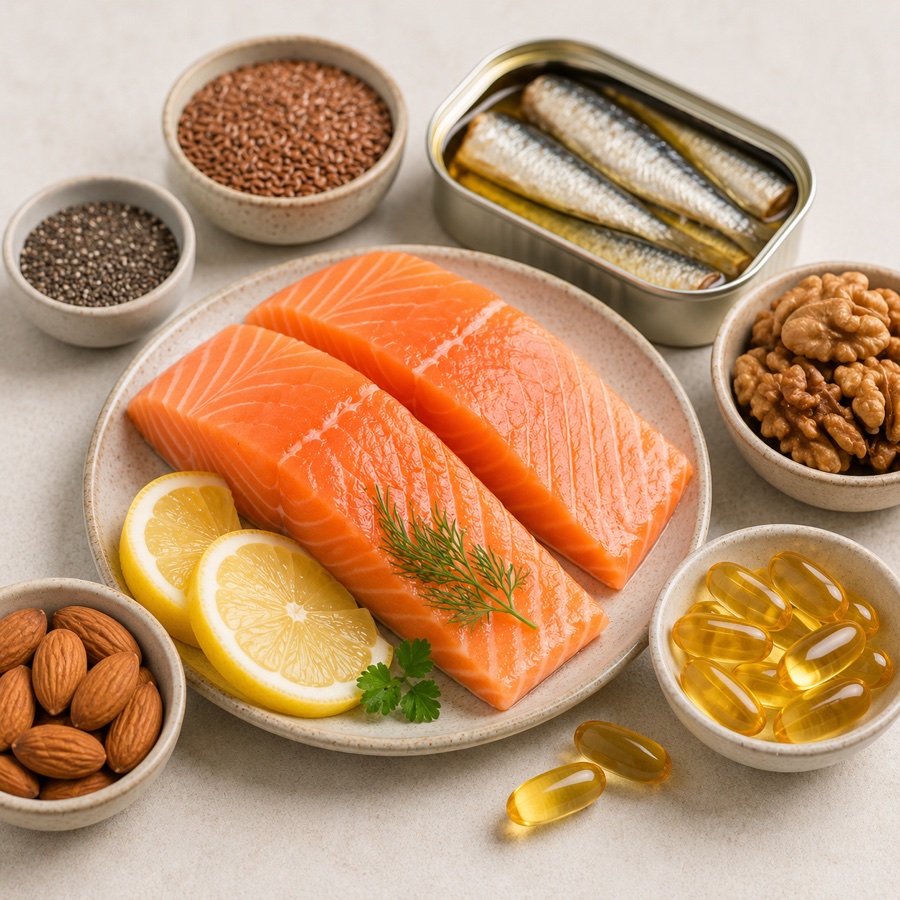
Omega-3 fatty acids are a group of polyunsaturated fats. ALA is essential and must come from the diet, while small amounts of EPA and DHA can be made from ALA, but conversion is limited. ALA mainly comes from certain plant oils, seeds, and nuts; EPA and DHA mainly come from fatty fish, seafood, and algae.
30-second check: which situation fits you best?
Fatty Fish and Other Sources Are Consistent
You regularly eat fish—about 2 servings of fish or seafood per week—and also include nuts, seeds, and plant oils, giving you relatively stable sources of EPA, DHA, and ALA.
You Rarely Eat Fish or Your Sources Are Inconsistent
You rarely eat fatty fish or seafood, follow a long-term vegetarian or fish-free diet, or have an inconsistent diet due to work, takeout, or travel, so direct sources of EPA and DHA may remain low.
Your Basics Are Good; You Want Extra Anti-Inflammatory or Optimization Benefits
Your diet, exercise, and sleep are already in good shape and fish intake is stable, but you still hope omega-3 will improve inflammation, cognition, exercise recovery, or long-term health.
Basic Overview
What it is
Omega-3 is a group of polyunsaturated fatty acids. ALA (alpha-linolenic acid) is essential and must come from food. EPA (eicosapentaenoic acid) and DHA (docosahexaenoic acid) are long-chain omega-3s that can be made from ALA in small amounts, but overall conversion is very limited; studies cited by NIH generally report less than 15%. ALA mainly comes from plant foods such as flaxseed, chia seeds, walnuts, flaxseed oil, and canola oil. EPA and DHA mainly come from fatty fish and seafood such as salmon, herring, sardines, mackerel, and trout, as well as supplements such as fish oil and algal oil.
Why people use it
- Supplement EPA and DHA if you rarely eat fatty fish long term
- Make omega-3 intake more consistent when your diet is irregular
- Use algal oil as an EPA/DHA source if you do not eat fish
- Provide baseline support for cardiovascular and brain health
- Evaluate it further for inflammation or exercise-recovery goals
- Use a more convenient and clearly dosed source than food
How it relates to healthy aging
EPA and DHA contribute to cell-membrane structure and signaling molecules, and DHA is especially abundant in the brain and retina. Adequate intake therefore supports long-term cardiovascular, nervous-system, and visual function.
That does not mean higher intake makes the brain, blood vessels, or body “younger” in healthy adults. Benefits seen in supplement studies depend strongly on baseline fish intake, health status, dose, and the outcome being studied.
Supplement Assessment
Whether omega-3 supplementation is worthwhile is not mainly about spotting “omega-3 deficiency symptoms.” The key questions are whether EPA+DHA sources such as fatty fish are consistently available, whether ALA intake is adequate, and whether other supplements already provide EPA and DHA.
Usually No Dedicated Supplement Needed
- You regularly eat about 2 servings of fish or seafood per week
- You often choose fatty fish such as salmon, sardines, mackerel, or herring
- You also regularly consume ALA sources such as nuts, seeds, and plant oils
- Your current supplements already provide EPA and DHA
- Your main goal is simply to use high-dose fish oil for “powerful anti-inflammatory” effects
- Your goal is simply brain enhancement, anti-aging, or prevention of all cardiovascular disease
Your next step:
Keep your current diet. Evidence for fish as part of an overall healthy diet is more consistent for cardiovascular health than treating fish oil as a preventive supplement for every healthy adult.
A Reasonable Supplement May Be Considered
- You rarely or never eat fish or seafood long term
- You rarely eat fatty fish such as salmon, sardines, or mackerel
- A vegetarian or other dietary pattern excludes fish
- Work or travel makes fish intake inconsistent over the long term
- You want direct DHA or EPA+DHA from algal oil
- You have improved your diet but still cannot maintain EPA+DHA sources consistently
Your next step:
Increase natural food sources first. If you cannot eat fish consistently long term, consider fish oil or algal oil. When choosing a supplement, calculate the actual EPA+DHA content—not the total ingredient weight such as “1,000 mg fish oil.”
Talk to a Health Professional First
- You are taking an anticoagulant such as warfarin
- You are taking an antiplatelet medication
- You have a bleeding disorder or significant bleeding risk
- You have a history of atrial fibrillation or significant arrhythmia
- You plan to use gram-level EPA+DHA long term
- You plan to use high-dose omega-3 to lower triglycerides
- You are preparing for surgery or an invasive procedure
- Receiving treatment for a complex medical condition
Your next step:
Do not automatically use the range intended for generally healthy adults. Confirm your medications, goal, and actual EPA/DHA dose, then ask a physician or pharmacist whether use is appropriate.
Quick self-check
Over the past month, how many times per week have you eaten fish on average?
How many of those servings were fatty fish such as salmon, mackerel, sardines, or herring?
Do you regularly consume nuts, seeds, and plant oils?
Do any products you currently take already contain EPA, DHA, or fish oil?
When buying a product, did you look only at “Fish Oil 1,000 mg” without checking EPA+DHA?
Are you taking an anticoagulant or antiplatelet medication?
Food Sources
The EPA+DHA values below come from USDA data listed by NIH ODS. The original source uses a 3-ounce serving (about 85 g); per-100-g values are approximate proportional conversions. Values vary with fish species, feed, season, and origin.
Representative food sources
| Food / Preparation | EPA+DHA per 100 g | Common Serving | Approx. per Serving |
|---|---|---|---|
| Cooked farmed Atlantic salmon | about 2,150 mg | 85 g | about 1,830 mg |
| Cooked Atlantic herring | about 2,010 mg | 85 g | about 1,710 mg |
| Cooked wild Atlantic salmon | about 1,850 mg | 85 g | about 1,570 mg |
| Canned sardines in tomato sauce, drained | about 1,400 mg | 85 g | about 1,190 mg |
| Cooked Atlantic mackerel | about 1,200 mg | 85 g | about 1,020 mg |
| Cooked wild rainbow trout | about 990 mg | 85 g | about 840 mg |
| Cooked sea bass | about 765 mg | 85 g | about 650 mg |
| Cooked eastern oysters | about 625 mg | 85 g | about 530 mg |
This table does not show “% of adult reference intake.” EPA+DHA standards differ by country: the U.S. has no formal RDA/AI for EPA or DHA, while China uses an AMDR range of 0.25–2.0 g/day rather than a single recommended value.
How to get it from food in a day
Example One | Direct EPA+DHA
One serving of cooked farmed Atlantic salmon provides about 1.83 g EPA+DHA. You do not need to eat the same fish every day; rotate salmon, mackerel, herring, and sardines across the week.
Example Two | Plant-Based ALA
ALA is also an important omega-3, but conversion to EPA and DHA is limited, so 2.57 g of ALA should not be interpreted as producing 2.57 g EPA+DHA.
ALA Source Examples
ALA comes from plant foods, while EPA+DHA comes mainly from fatty fish and algae. ALA cannot replace EPA+DHA milligram for milligram.
Cooking and storage tips
Prefer steaming or baking: these methods generally retain omega-3 better than deep frying.
Refrigerate promptly: keeping fish warm for long periods increases EPA and DHA loss.
Protect fish oil from heat and light: after opening, store it sealed as directed on the label to reduce oxidation over time.
Whole foods vs supplements
Whole Foods
- Fatty fish provides high-quality protein, selenium, vitamin B12, and, in some species, vitamin D in addition to EPA and DHA
- Fits well into a long-term overall diet
Supplements
- Fish oil or algal oil can provide a consistent, clearly dosed amount of EPA and DHA in a small volume
- Useful for people who rarely eat fish long term
- Requires more attention to actual content, oxidation, contaminants, and duplicate intake
Dosage
Omega-3 reference values need to be separated: ALA and EPA+DHA are different pathways, and Chinese and U.S. standards are not the same.
ALA and EPA+DHA References (China | U.S.)
ALA Baseline Reference
Reference framework for plant-based omega-3 (essential fatty acid)
Expressed as a percentage of energy (%E)
Men: 1.6 g/day; Women: 1.1 g/day
China expresses ALA as %E, while the U.S. uses g/day. Because the units differ, they cannot be compared on a single strict dose axis.
EPA+DHA Reference
Reference framework for long-chain omega-3 from fatty fish and algae
Equivalent to 0.25–2.0 g/day; this is an Acceptable Macronutrient Distribution Range, not an RNI
The U.S. IOM/NAM has not established separate recommended intakes for EPA or DHA
China's 0.25–2.0 g/day value is an AMDR (Acceptable Macronutrient Distribution Range), not a single RNI or RDA.
Applicability:This section is intended for generally healthy adults. Children, pregnancy, breastfeeding, people receiving medical treatment, and those planning gram-level high doses should not directly use these values.
Chinese and U.S. Reference Standards
China
EPA+DHA 0.25–2.0 g/day
UL (Tolerable Upper Intake Level)
Not established
U.S.
ALA 1.1–1.6 g/day
UL (Tolerable Upper Intake Level)
Not established
China's 0.25–2.0 g/day EPA+DHA value is an AMDR (Acceptable Macronutrient Distribution Range), not an RNI.
The U.S. AI applies to ALA, not “total omega-3,” and the U.S. IOM/NAM has not established separate recommended intakes for EPA or DHA.
Neither China nor the U.S. has established a formal omega-3 UL.
Absorption & Use
ALA can be converted to EPA and DHA in the body, but conversion is limited, so large amounts of ALA cannot replace EPA+DHA milligram for milligram.
EPA and DHA are lipids and are generally best taken with food. This is especially important for ethyl-ester (EE) omega-3, whose absorption improves substantially with a meal containing fat.
TG, rTG, and free-fatty-acid forms generally have somewhat higher bioavailability than ethyl esters, but all of these forms can raise blood EPA and DHA levels.
Health Effects
Cell Membranes & Basic Physiology
Omega-3 fatty acids are important components of cell-membrane phospholipids, with DHA especially concentrated in the brain and retina, and they contribute to signaling molecules. Maintaining adequate intake is basic nutrition support, but a clear physiological role does not mean extra supplementation further improves tissue function in healthy people whose intake is already adequate.
View official guidance
Cardiovascular Health
Regular fish and seafood intake as part of a healthy diet is associated with better cardiovascular outcomes. Omega-3 supplements can lower triglycerides and may modestly affect some coronary outcomes, but large primary-prevention trials in healthy populations have not consistently reduced overall major cardiovascular events. Fish oil should therefore not be treated as a universal “heart-protection drug.”
View systematic review
Triglyceride Lowering
EPA and DHA have a clear triglyceride-lowering effect with some dose response. Prescription omega-3 at about 4 g/day can lower triglycerides by roughly 20%–30% in people with hypertriglyceridemia, but this is a clinical-management dose and does not justify self-directed high-dose fish oil in generally healthy adults.
View scientific statement
Brain & Cognitive Function
DHA is an important component of neuronal membranes, but “part of brain structure” does not mean fish-oil supplementation necessarily improves cognition in healthy people. Earlier systematic reviews generally found no consistent improvement, while newer meta-analyses suggest possible modest benefit in some cognitive domains, with limited certainty. It should not be marketed as a proven “brain booster.”
View meta-analysis
Inflammatory Status
EPA and DHA participate in inflammation-related signaling and lipid mediators, providing a plausible mechanism for inflammatory regulation. However, randomized trials in healthy adults have not consistently reduced common inflammatory markers such as CRP and IL-6 even with about 1.4 g/day EPA+DHA, so a clear anti-inflammatory effect in healthy people cannot be guaranteed.
View randomized controlled trial
Exercise & Recovery
Some exercise studies suggest omega-3 may improve certain post-exercise inflammation, muscle-damage, or soreness markers, but doses, durations, and results vary widely. There is not enough evidence to define a single effective dose, and consistent improvements in strength or performance in healthy athletes have not been established.
View systematic review
Product Selection
What Should I Look for on the Label?
Only Check These Four Things
What Is the Active Ingredient?
First confirm whether the product actually provides EPA, DHA, or only ALA. For fish oil, algal oil, and krill oil, do not rely on “Omega-3” or “Fish Oil” on the front. Check the label for the milligrams of EPA and DHA separately, then judge whether it matches your goal.
How Much Is Actually in Each Serving?
Add EPA mg + DHA mg per capsule or serving, then multiply by the number of daily servings. “Fish Oil 1,000 mg” does not mean 1,000 mg EPA+DHA; products with the same fish-oil weight can differ several-fold in actual EPA+DHA.
Are There Unnecessary Additives?
Check flavors, sweeteners, colors, and combination ingredients without a clear purpose. Cod liver oil also provides vitamins A and D, and fish-oil blends containing D3 or other vitamins should be checked against your existing supplements rather than counting only omega-3.
Is Quality Control Verifiable?
Prefer products with clear ingredients and lot information and, ideally, third-party testing or a batch COA. For omega-3, pay particular attention to actual EPA/DHA content, oxidation status, and contaminants such as heavy metals and PCBs. Certification is a quality plus, not proof of stronger health effects.
How to Read the LabelExample fish-oil concentrate label: do not look only at Fish Oil 1,000 mg
Take 1 softgel daily with a meal; use the label's daily serving count to calculate total EPA+DHA per day.
Gelatin/vegetable capsule, glycerin, purified water; use the actual product label.
Third-Party Testing / Batch COA (EPA and DHA content, oxidation markers PV/TOTOX, heavy metals, and PCBs)
*Example: each serving contains 1,000 mg fish-oil concentrate with EPA 500 mg + DHA 250 mg, for 750 mg EPA+DHA per serving. A total fish-oil weight of 1,000 mg does not equal 1,000 mg EPA+DHA. NOW Ultra Omega-3 in the source material uses this typical label format. FDA has not established a Daily Value for EPA or DHA; no %DV is calculated here. This is an educational example of reading amounts, not certification of a product label’s compliance.
Active Ingredient
First check whether the label lists EPA, DHA, or only ALA. With fish oil, algal oil, or krill oil, do not rely on “Omega-3” or “Fish Oil” on the front; check the nutrition label for EPA and DHA milligrams separately.
EPA+DHA per Serving
Calculate EPA mg + DHA mg per capsule or serving. For example, Fish Oil Concentrate 1,000 mg with EPA 500 mg + DHA 250 mg provides 750 mg EPA+DHA per serving—not 1,000 mg.
Servings per Day
Confirm how many capsules are suggested per day and multiply by EPA+DHA per serving to get the true daily total. Do not calculate from “1,000 mg fish oil” alone.
Other Nutrients
Cod liver oil also provides vitamins A and D. Fish-oil products containing D3 or other vitamins should be checked for duplication with existing supplements.
Quality Information
Prefer products with clear lot information and third-party testing or a batch COA. Look for measured EPA/DHA content, oxidation status (PV, p-Anisidine, TOTOX), and contaminants such as heavy metals and PCBs.
How to Choose a FormDifferences among fish oil, algal oil, krill oil, and ester forms
Fish Oil
Practical Features
The most common option, with many EPA+DHA ratios and concentrations.
Worth Paying Extra?
A practical first choice for most people.
Best For
A standard option for adults who eat little fish.
Algal Oil
Practical Features
Fish-free; often DHA-dominant, though EPA+DHA products are also available.
Worth Paying Extra?
Very practical for people who do not eat fish or follow a vegetarian diet.
Best For
Useful for vegetarians, people who avoid fish, or those concerned about fish-derived ingredients.
Krill Oil
Practical Features
Its omega-3 is mainly in phospholipid form.
Worth Paying Extra?
Evidence for an absorption advantage over fish oil is inconsistent, so it should not be assumed to be better.
Best For
A reasonable option if you have a clear preference, but not worth a large premium just for the “krill oil” label.
TG / rTG vs EE (Ethyl Ester)
Practical Difference
TG/rTG forms have some absorption advantage, especially when fasting. EE forms can also effectively raise EPA and DHA levels, but taking them with a meal containing fat is particularly important.
Worth Paying Extra?
Higher absorption can be one purchasing factor, but it does not mean the same EPA+DHA dose necessarily produces stronger health effects.
Best For
Take EE forms with a meal containing fat. There is no need to pay a large premium simply for “rTG” or “high absorption.”
How to Take
When should you take it, and what is the most practical way to use it?
Default plan (healthy adults)
Suggested Dose: For a low-fish diet, about 250–500 mg/day EPA+DHA (site practical reference, not a China RNI or U.S. RDA)
Frequency: Usually 1 time daily is enough
Stomach Tolerance: Take with a meal; a meal containing some fat is especially helpful for absorption of ethyl-ester EPA/DHA
Mild Discomfort: Take it during/after a meal, reduce the single dose, or divide the dose
When to Take It: No required morning or evening timing; choose a time you can maintain and pair with a regular meal
Long-Term Use?: Continue while the dietary gap persists; reassess once fish intake becomes consistent
Missed Dose: Skip it and resume your usual amount next time; do not double up
Frequently asked questions
With Food or on an Empty Stomach?
Take it with food. This is especially important for ethyl-ester fish oil, which is absorbed much better with a meal containing some fat than with a low-fat meal or while fasting.
Do I Need to Split the Dose?
Low doses usually do not need to be divided. If daily intake is larger or one dose causes fishy aftertaste, reflux, or stomach upset, split it into two doses.
Morning or Evening?
There is no required time. Choose a schedule you can maintain and pair with a regular meal.
Do I Need to Separate It From Other Supplements?
Common vitamins and minerals generally do not need to be separated because of “absorption competition.” A more important issue is whether cod liver oil or an omega-3 combination product also contains vitamins A, D, or other nutrients.
More questions about use (click to expand)
How Long Should I Take It?
Omega-3 has no fixed course. If you are filling a long-term dietary gap from low fish intake, use it while the gap remains; once fish intake becomes consistent, reassess whether daily supplementation is still needed.
How Can I Tell Whether It Is Working?
For basic intake support, do not judge effectiveness by whether you “feel” anything. Look at whether fish intake is consistent and whether daily EPA+DHA reaches the intended amount. For medical goals such as triglyceride lowering, use appropriate testing and professional assessment.
Is It Safe If I Separate It From Medications by a Few Hours?
Not necessarily. Medication interactions cannot always be eliminated by spacing doses a few hours apart. If you use anticoagulant or antiplatelet medication, directly review whether the supplement is appropriate and at what dose.
Risks & Precautions
Common Side Effects
- Fishy aftertaste: take it with a regular meal or choose a better-tolerated formulation
- Reflux or heartburn: reduce the single dose and take it during or after a meal
- Nausea or stomach upset: stop taking it on an empty stomach; reduce or split the dose
- Diarrhea: reduce the daily dose; stop use if it persists
- NIH also lists bad taste, bad breath, gastrointestinal discomfort, and headache as common adverse effects; most are mild
High-Dose Risks
- No formal UL: the IOM has not established an omega-3 UL, but “no UL” does not mean intake can be increased without limit
- 5 g/day is not a recommended dose: EFSA and FDA consider combined EPA+DHA from supplements up to about 5 g/day generally free of major safety concerns, but this is a safety assessment—not a target intake for healthy adults
- Atrial-fibrillation caution: in two large trials of people with cardiovascular disease or high risk, long-term intake of about 4 g/day omega-3 was associated with a modest increase in atrial-fibrillation risk. Healthy adults should not pursue gram-level high doses on their own for “anti-inflammatory” goals
Use Higher Doses with Extra Caution If You Are
- People taking anticoagulants
- People taking antiplatelet medications
- People with a bleeding disorder
- People with a history of atrial fibrillation or arrhythmia
- People preparing for surgery or an invasive procedure
- People allergic to fish or related ingredients
- People planning long-term gram-level EPA+DHA use
- People receiving treatment for a complex medical condition
Special Situations
- Anticoagulants such as warfarin: high-dose fish oil has some antiplatelet activity, so tell your physician or pharmacist the exact product and EPA+DHA dose you use. Current evidence does not support the claim that routine fish oil inevitably causes serious bleeding, but the interaction still needs review.
- Before surgery: tell your clinician you use omega-3. Do not apply a fixed “must stop X days before surgery” rule on your own.
- If you do not eat fish or are concerned about fish-derived ingredients, algal oil is an option. With a known allergy history, still check the product's ingredients and allergen information.
- Cod liver oil: also count vitamins A and D, not just EPA+DHA.
Stop and Seek Advice
Persistent diarrheaRepeated nauseaSignificant stomach painPersistent refluxUnusually easy bruisingNew, noticeable palpitations
Seek Prompt Medical Care
Significant abnormal bleedingDifficulty breathingSwelling of the face or throatSevere allergic reactionA marked rhythm abnormality with dizziness or fainting
Sources
This page supports the basic information, food sources, reference intakes, health effects, product selection, use, and safety guidance for omega-3. It is intended mainly for generally healthy adults and distinguishes ALA from EPA+DHA throughout.
Nutrition Standards & Basic Data
Health Effects & Scientific Evidence
Safety, Product & Use References
Mainstream Product-Dose Examples
Last updated: August 7, 2026