Pomegranate Polyphenols
Pomegranate Polyphenols / Pomegranate Polyphenols
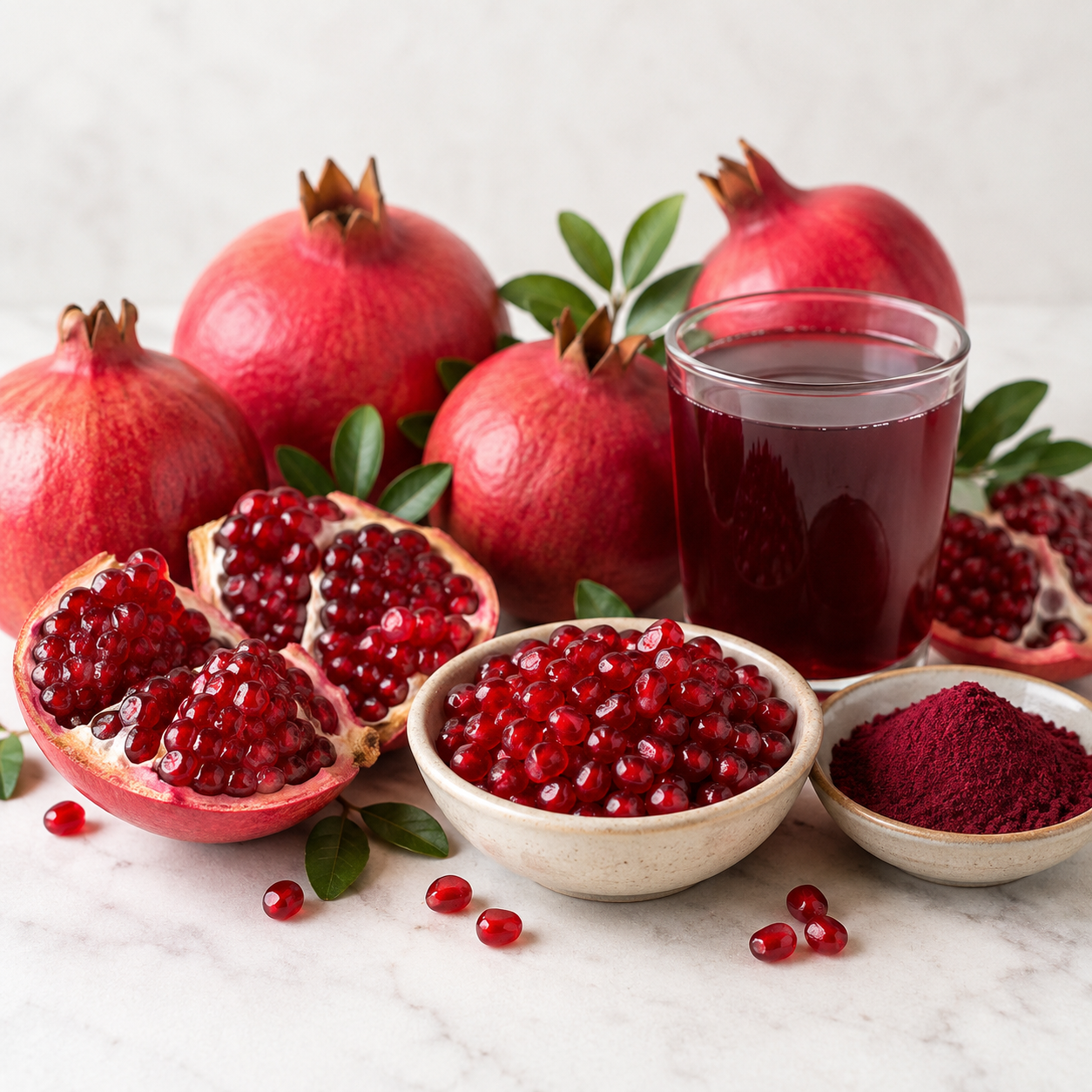
Pomegranate polyphenols are not a single compound. They are an umbrella term for multiple plant bioactives in pomegranate, mainly ellagitannins such as punicalagins, ellagic acid, and anthocyanins. Human research mainly focuses on blood pressure, inflammation, and oxidative-stress markers, but extract composition and dose vary greatly between products.
30-second check: which situation fits you best?
Just looking for everyday anti-inflammatory or antioxidant support
You have seen antioxidant and anti-inflammatory claims and want to use pomegranate polyphenols as a long-term wellness supplement, but you do not have a specific problem or measurable goal.
You have a specific goal you want to improve
If your main focus is blood pressure, inflammatory or oxidative-stress markers, exercise recovery, selected cognitive outcomes, or another defined target, review human studies that match your population, formulation, and goal.
You are planning to use it or already taking it
If you have already purchased or plan to use a product, the key is not finding the “highest dose.” Confirm whether the label refers to pomegranate extract, total polyphenols, punicalagins, or ellagic acid, and calculate the actual active amount you would take each day.
Basic Overview
What it is
Pomegranate polyphenols are a group of plant bioactives found in pomegranate fruit. Major components include ellagitannins such as punicalagins, ellagic acid, anthocyanins, and other phenolic compounds. They are not essential nutrients and there is no required daily intake. Supplements usually concentrate extracts from the fruit, peel, or whole fruit and standardize one or more polyphenol components.
Why people use it
- Obtain a more concentrated source of pomegranate polyphenols than ordinary food
- Try it for blood-pressure or cardiovascular targets
- Target inflammatory or oxidative-stress markers
- Use it in a specific exercise-recovery context
- Target selected cognitive or skin-related outcomes
- Obtain a more consistent dose from a standardized extract
How it relates to healthy aging
Pomegranate polyphenols can influence some oxidative-stress, inflammatory, and cardiovascular markers in humans, and these processes are relevant to long-term health.
That does not mean they reverse aging or extend lifespan. Existing human studies mostly measure blood pressure, inflammatory biomarkers, metabolism, cognition, or skin outcomes. These changes should not be interpreted as evidence that the body has become “younger.”
Supplement Assessment
Pomegranate polyphenols do not raise a basic-nutrition question of whether you “get enough” each day. The key questions are whether you have a clear goal, whether relevant human evidence applies to you, whether the product matches the research, and whether there is a meaningful change worth continuing for.
Low priority right now
- No specific outcome you want to improve
- Interested only because of “natural antioxidant” or “anti-inflammatory” marketing
- Only want antioxidant, anti-aging, or general-wellness benefits
- Hoping to prevent all chronic diseases
- Diet, exercise, sleep, or other basics still have substantial room for improvement
- Planning to take it indefinitely
Your next step:
Prioritize diet, physical activity, and sleep. If you still want to try it, first turn “anti-inflammatory” or “antioxidant” into a more specific, measurable target instead of chasing a laboratory mechanism or marketing concept.
Clear goal: worth a closer look
- Have a specific blood-pressure management goal
- Interested in inflammatory or oxidative-stress markers
- Want to try it for a specific exercise-recovery goal
- Interested in selected cognitive or skin-related outcomes
- Willing to reassess after about 6–12 weeks
- Accept that real-world benefit may be small or not noticeable
- Can choose a pomegranate extract reasonably similar to the relevant study
Your next step:
Prioritize human studies that match your specific goal, population, and product form. Pomegranate juice, ordinary pomegranate extract, punicalagin-standardized products, and ellagic-acid-standardized products should not be assumed to have identical effects.
Consult a professional first
- Current or previous liver problems
- Using warfarin or another anticoagulant, or antiplatelet drugs such as aspirin or clopidogrel
- Using multiple antihypertensive or glucose-lowering medications
- A bleeding disorder, or an upcoming surgery or invasive procedure
- Active peptic ulcer disease, significant gastrointestinal disease, or recent gastrointestinal surgery
- Previous allergic reaction to pomegranate or related plant ingredients
- Pregnancy or breastfeeding
- You plan long-term use of a high-dose concentrated extract
Your next step:
These situations should not use the same approach as a generally healthy adult. Ask a clinician or pharmacist to review risk, interactions, and whether self-use is appropriate.
Quick Self-Check
Do you have a clear, measurable goal?
Is the study population similar to you?
Does your product match the study formulation?
When will you reassess?
Food Sources
Pomegranate polyphenols have no formal RNI, RDA, or AI, so this table does not show a percentage of adult reference intake or create an artificial daily target.
Common Foods High in Pomegranate Polyphenols
| Food Form | Approximate amount per 100 g / 100 mL | Common Serving | Approx. per Serving | How to Read It |
|---|---|---|---|---|
| Fresh pomegranate arils | Total phenolics about 32 mg GAE/100 g in one study | 100 g | About 32 mg GAE | Variety, ripeness, and growing conditions affect content. This number is only for understanding the order of magnitude and is not a fixed value for all pomegranates. |
| 100% pomegranate juice | Total phenolics about 58–255 mg/100 mL | 240 mL | About 139–612 mg | Variety and processing make a large difference; one cup of pomegranate juice does not correspond to one fixed polyphenol dose. |
| Whole-fruit-pressed pomegranate juice | Punicalagins about 50–76 mg/100 mL | 240 mL | About 120–182 mg | Whole-fruit pressing more readily brings ellagitannins from the peel and white membranes into the juice, so it should not be compared directly with juice made from arils alone. |
What does GAE mean?
GAE is a laboratory unit used to express total phenolic content. It does not mean the product literally contains the same amount of gallic acid. Pomegranate polyphenol composition varies substantially with cultivar, fruit part, and pressing method, so it is not accurate to write “one cup of pomegranate juice = a fixed number of milligrams of pomegranate polyphenols.” Per-100-g / per-100-mL values are useful for comparing concentration, while common servings are more useful for understanding real intake at one time.
How Much Can Food Provide in a Day?
Example 1
About 100 g fresh pomegranate arils.
Rotate with other fruits; there is no need to eat large amounts to chase doses used in supplement research.
Example 2
150–240 mL of 100% pomegranate juice.
Products and processing methods vary considerably, so do not convert one glass of juice into a universal daily polyphenol target.
Cooking and storage tips
Avoid prolonged high heat: long heating is more likely to degrade anthocyanins, while brief heat treatment generally has a smaller effect.
Refrigerate juice: storage temperature affects the stability of some polyphenols, especially anthocyanins.
Color does not tell the whole story: fading color mainly reflects changes in anthocyanins and does not mean all pomegranate polyphenols decline in parallel.
Eat promptly after opening: once arils are removed, keep them sealed and refrigerated and consume them relatively soon.
Whole foods vs supplements
Whole Pomegranate
- Provides multiple plant polyphenols at the same time
- Also provides dietary fiber and other nutrients
- Better suited as part of a long-term dietary pattern
- Polyphenol dose per serving is not fixed
- Hard to reach the concentrated dose of a standardized supplement
Pomegranate Extract
- Active ingredients are more concentrated
- Can be standardized
- Easier to reach doses used in research
- Standardization methods vary greatly between products
- Label details, dose, and long-term safety data matter more
Dosage
Different numbers use different measurement bases and should not be turned into one continuous axis from “recommended dose” to UL.
Regulatory References & Human Research
Regulatory Safety References
This is a regulatory condition for a specific food ingredient, not a recommended supplement dose or UL.
Human-Study References
Each study uses a different formulation, measurement basis, population, and goal, so the results should not be combined into one recommended range.
How to Interpret Research Doses
Do not turn these studies into one “recommended pomegranate polyphenol dose range.”
Core boundary:Total pomegranate-extract weight, Total Polyphenols, Punicalagins, Ellagic Acid, and milliliters of pomegranate juice are not the same dose metric.
Important Note
Pomegranate polyphenols have no RNI, RDA, AI, formal UL, or universal recommended dose. The FDA’s 50 mg/serving figure applies only to a specific food ingredient and regulatory context, not to supplement dosing.
Human studies have used hundreds to more than 1,000 mg of pomegranate extract, but punicalagin, total-polyphenol, and ellagic-acid content varies greatly between products.
When choosing a product, the amount of genuinely standardized active ingredient matters more than total extract milligrams.
Dose Utilization
Intact punicalagins are not the main circulating form. After entering the digestive tract, they are broken down and metabolized, and ellagic acid and downstream metabolites are more commonly detected in blood.
The gut microbiome influences urolithin production and human exposure. Two people taking the same dose may produce very different amounts of urolithins.
Juice and extract cannot be compared only by weight. With similar total-polyphenol intake, overall ellagic-acid exposure may be similar while the time to peak blood concentration differs.
How to Read Common Product Doses
The number on the package is not necessarily the actual pomegranate-polyphenol dose. Total Polyphenols, Punicalagins, and Ellagic Acid are different metrics and should not be compared as though they were one value.
| Product | Package / Label Number | Dose That Is Actually Comparable | Formulation | How to Read It |
|---|---|---|---|---|
| Nature's Way PomegranateOfficial product link | 200 mg Pomegranate Fruit Extract + 150 mg Pomegranate Seed | About 170 mg Total Polyphenols/capsule | Standardized to 85% Total Polyphenols Pomegranate Fruit Extract + Pomegranate Seed |
200 mg × 85% ≈ 170 mg Total Polyphenols. The additional 150 mg pomegranate seed should not be counted directly as polyphenols. |
| Life Extension Pomegranate Fruit ExtractOfficial product link | 400 mg POMELLA® Pomegranate Extract + 100 mg 5:1 Pomegranate Extract | About 120 mg Punicalagins/capsule; the additional 100 mg cannot be reliably converted | Punicalagin-standardized POMELLA® standardized ingredient, standardized to 30% Punicalagins |
400 mg × 30% ≈ 120 mg Punicalagins. The additional 100 mg has no stated active percentage and should not be estimated. |
| Life Extension Pomegranate CompleteOfficial product link | 400 mg Standardized Pomegranate Extract + 137.5 mg Pomegranate Flower/Seed Complex | About 120 mg Punicalagins/capsule | Multi-Part Combination Formula Derived from pomegranate fruit, flower, and seed |
The 400 mg standardized extract provides 120 mg Punicalagins. Punicic acid from seed is not a pomegranate polyphenol and should not be added to that amount. |
| Swanson Pomegranate ExtractOfficial product link | 250 mg Botanical Extract Complex | About 175 mg Ellagic Acid/capsule | Standardized to 70% Ellagic Acid Derived from pomegranate and gallnut |
250 mg × 70% ≈ 175 mg Ellagic Acid; this should not be interpreted as 175 mg entirely from pomegranate. |
| Swanson Pomegranate ComplexOfficial product link | 250 mg 5:1 Pomegranate Extract + 100 mg PomegranateP40p™ Pomegranate Extract + 50 mg PomActiv™ Plus Pomegranate Extract | 40 mg Punicosides/capsule + 35 mg Ellagic Acid/capsule | Dual-Standardized Combination 100 mg PomegranateP40p™ standardized to 40% Punicosides; 50 mg PomActiv™ Plus standardized to 70% Ellagic Acid; also contains 250 mg ordinary 5:1 pomegranate extract. |
100 mg × 40% = 40 mg Punicosides; 50 mg × 70% = 35 mg Ellagic Acid. The additional 250 mg 5:1 pomegranate extract is larger by weight but has no stated standardization for total polyphenols, Punicalagins, or Ellagic Acid, so a specific active dose cannot be calculated. |
| Life Extension Blueberry Extract and Pomegranate Complete | 200 mg Standardized Pomegranate Extract + Blueberry Extract | About 60 mg Punicalagins/capsule | Berry Polyphenol Combination Pomegranate extract standardized to 30% Punicalagins |
200 mg × 30% ≈ 60 mg Punicalagins. Blueberry extract provides a different group of polyphenols and should not be added to the Punicalagin amount. |
Nature's Way Pomegranate
Official product link- Package / Label Number
- 200 mg Pomegranate Fruit Extract + 150 mg Pomegranate Seed
- Dose That Is Actually Comparable
- About 170 mg Total Polyphenols/capsule
- Formulation
- Standardized to 85% Total Polyphenols
Pomegranate Fruit Extract + Pomegranate Seed
- How to Read It
- 200 mg × 85% ≈ 170 mg Total Polyphenols. The additional 150 mg pomegranate seed should not be counted directly as polyphenols.
Life Extension Pomegranate Fruit Extract
Official product link- Package / Label Number
- 400 mg POMELLA® Pomegranate Extract + 100 mg 5:1 Pomegranate Extract
- Dose That Is Actually Comparable
- About 120 mg Punicalagins/capsule; the additional 100 mg cannot be reliably converted
- Formulation
- Punicalagin-standardized
POMELLA® standardized ingredient, standardized to 30% Punicalagins
- How to Read It
- 400 mg × 30% ≈ 120 mg Punicalagins. The additional 100 mg has no stated active percentage and should not be estimated.
Life Extension Pomegranate Complete
Official product link- Package / Label Number
- 400 mg Standardized Pomegranate Extract + 137.5 mg Pomegranate Flower/Seed Complex
- Dose That Is Actually Comparable
- About 120 mg Punicalagins/capsule
- Formulation
- Multi-Part Combination Formula
Derived from pomegranate fruit, flower, and seed
- How to Read It
- The 400 mg standardized extract provides 120 mg Punicalagins. Punicic acid from seed is not a pomegranate polyphenol and should not be added to that amount.
Swanson Pomegranate Extract
Official product link- Package / Label Number
- 250 mg Botanical Extract Complex
- Dose That Is Actually Comparable
- About 175 mg Ellagic Acid/capsule
- Formulation
- Standardized to 70% Ellagic Acid
Derived from pomegranate and gallnut
- How to Read It
- 250 mg × 70% ≈ 175 mg Ellagic Acid; this should not be interpreted as 175 mg entirely from pomegranate.
Swanson Pomegranate Complex
Official product link- Package / Label Number
- 250 mg 5:1 Pomegranate Extract + 100 mg PomegranateP40p™ Pomegranate Extract + 50 mg PomActiv™ Plus Pomegranate Extract
- Dose That Is Actually Comparable
- 40 mg Punicosides/capsule + 35 mg Ellagic Acid/capsule
- Formulation
- Dual-Standardized Combination
100 mg PomegranateP40p™ standardized to 40% Punicosides; 50 mg PomActiv™ Plus standardized to 70% Ellagic Acid; also contains 250 mg ordinary 5:1 pomegranate extract.
- How to Read It
- 100 mg × 40% = 40 mg Punicosides; 50 mg × 70% = 35 mg Ellagic Acid. The additional 250 mg 5:1 pomegranate extract is larger by weight but has no stated standardization for total polyphenols, Punicalagins, or Ellagic Acid, so a specific active dose cannot be calculated.
Life Extension Blueberry Extract and Pomegranate Complete
- Package / Label Number
- 200 mg Standardized Pomegranate Extract + Blueberry Extract
- Dose That Is Actually Comparable
- About 60 mg Punicalagins/capsule
- Formulation
- Berry Polyphenol Combination
Pomegranate extract standardized to 30% Punicalagins
- How to Read It
- 200 mg × 30% ≈ 60 mg Punicalagins. Blueberry extract provides a different group of polyphenols and should not be added to the Punicalagin amount.
Health Effects
Inflammation & Oxidative Stress
Meta-analysis of randomized trials suggests pomegranate products may slightly reduce CRP, IL-6, TNF-α, and lipid-oxidation markers while improving some antioxidant measures. However, the studies include both healthy people and many disease populations. Better laboratory markers do not mean a generally healthy person will clearly feel “less inflammation.”
View Meta-analysis
Blood Pressure & Cardiovascular Health
Across randomized trials, pomegranate products may reduce systolic and diastolic blood pressure, with larger changes often seen in people whose blood pressure is already elevated. Results vary substantially between studies, so average reductions should not be applied directly to healthy adults with normal blood pressure, and supplementation does not replace standard blood-pressure management.
View Meta-analysis
Glucose & Insulin
Recent meta-analysis of randomized trials suggests pomegranate products may slightly improve fasting glucose and some insulin-resistance measures, while longer-term measures such as HbA1c have not changed consistently. A more accurate description is “some metabolic markers may improve,” not “controls blood sugar.”
View Meta-analysis
Cognition & Memory
In a 12-month randomized trial of adults age 50–75 without dementia, about 237 mL pomegranate juice daily appeared to preserve some visual-learning performance, but several other visual- and verbal-memory outcomes did not differ significantly between groups. Current evidence is insufficient to describe pomegranate as a routine “memory-enhancing” supplement.
View Randomized Controlled Trial
Exercise Recovery
Some studies suggest ellagitannin-rich pomegranate products may improve aspects of post-exercise strength recovery or blood flow, while other trials find no clear advantage. They cannot reliably be promised to reduce muscle soreness or speed recovery and are better viewed as an optional trial for a specific goal.
View Meta-analysis
Skin Health
A few studies in healthy adults suggest standardized pomegranate extract may improve selected measures of wrinkles, fine lines, or skin radiance. The participant numbers remain small and most studies use specific standardized ingredients, so these findings should not be generalized to all pomegranate juice, powder, or polyphenol products.
View Systematic Review
Product Selection
Look at the standardized active ingredient rather than the largest milligram number on the front label.
Check these four things when buying
What is the active ingredient?
First confirm whether the product is standardized to Total Polyphenols, Punicalagins, or Ellagic Acid. A label that only says Pomegranate Extract without a standardization percentage makes the true active dose difficult to judge and harder to compare with human research.
How much do you actually get per serving?
Do not look only at total extract weight. If 400 mg Pomegranate Extract is standardized to 30% Punicalagins, the comparable amount is 120 mg Punicalagins. Also confirm how many capsules are in one Serving Size and how many servings are recommended per day.
Are there unnecessary added ingredients?
Combination products may also contain other berries, Grape Seed Extract, vitamins, or Pomegranate Seed Oil. These change the product’s composition and should not be added together as though all milligrams represented pomegranate polyphenols.
Does it have reliable quality control?
Prefer products that clearly state the Plant Part, extract weight, Standardized to percentage, Amount per Serving, and manufacturing information. Verifiable third-party, contaminant, or heavy-metal testing adds useful confidence.
How to Read the LabelFive steps to verify the real active dose
Pomegranate Seed Oil is not the same as a pomegranate-polyphenol extract; combination ingredients must be calculated separately.
List other botanicals or seed-oil ingredients separately
Calculate the actual active dose from the Serving Size and number of daily servings.
Plant Part | Standardization | Lot | Third-Party Testing
400 mg Pomegranate Extract × 30% Punicalagins = 120 mg Punicalagins. This is a label calculation, not a recommendation from this site to take 120 mg/day.
Find the pomegranate raw material first
The label may list fruit, whole fruit, peel, or seed extract. Different Plant Parts have different compositions.
Check the Plant Part
Pay particular attention to Pomegranate Seed Oil ≠ pomegranate-polyphenol extract. Pomegranate seed oil mainly provides fatty acids rather than key polyphenols such as Punicalagins.
Find the standardized active ingredient
Look for Total Polyphenols, Punicalagins, or Ellagic Acid. A label that only says Pomegranate Extract is usually not enough.
Calculate the real active dose
400 mg Pomegranate Extract × 30% Punicalagins = 120 mg Punicalagins. This is only a label calculation and is not a recommended dose.
Calculate combination ingredients separately
Pomegranate Seed Oil, Blueberry Extract, Grape Seed Extract, other polyphenols, vitamins, and minerals should all be interpreted separately. 120 mg Punicalagins + 100 mg Blueberry Extract should not be written as 220 mg pomegranate polyphenols.
How to Choose Among Common Forms(Different standardization markers should not be compared only by milligrams)
Punicalagin-Standardized Extract
Key Features
Clearly states the proportion of representative ellagitannins, making the dose easy to calculate and easier to compare with human studies of standardized pomegranate extract.
Site Guidance
If you want dose transparency and easier comparison with human research, prefer products that clearly state the actual Punicalagin amount.
Total-Polyphenol-Standardized Extract
Key Features
Standardized to laboratory-measured Total Polyphenols, which reflects the overall polyphenol level, but the exact composition can still differ substantially between products.
Site Guidance
Suitable if you want a broader pomegranate-polyphenol profile. If representative components such as Punicalagins are also listed, the composition is easier to interpret.
Ellagic-Acid-Standardized Product
Key Features
The actual Ellagic Acid dose is easy to confirm, but it represents only part of the pomegranate-polyphenol system and may also come from other botanical sources.
Site Guidance
Consider it when the research target is specifically Ellagic Acid. If you are simply looking for pomegranate polyphenols, do not assume a high Ellagic Acid percentage means a better product.
Pomegranate Seed Oil or Full-Spectrum Combination
Key Features
Pomegranate seed oil mainly provides fatty acids such as punicic acid, which belong to a different component system from Punicalagins and Ellagic Acid. Some products combine fruit extract with seed oil.
Site Guidance
If your goal is pomegranate polyphenols, still focus on the actual standardized polyphenol dose and do not count seed-oil milligrams toward it.
How to Take
The priority is to identify the actual active ingredient and then set a trial period around a defined goal before reassessing.
Default plan (healthy adults)
Official recommended dose: No universal official recommended dose has been established
Everyday-use reference: There is currently not enough evidence to define one universal daily range
Frequency: Judge by the specific product label and active dose
Gastrointestinal tolerance: If your stomach is sensitive, taking it with food is reasonable
Split doses?: There is no universal requirement to divide the dose
Long-term use?: Set an observation period based on a defined goal
Missed dose: If you occasionally miss a dose, skip it rather than doubling the next dose
Frequently asked questions
With food or on an empty stomach?
There is no reliable evidence that pomegranate polyphenols must be taken on an empty stomach for better effect. People with sensitive digestion can take them with food; there is no need to force fasting for presumed higher absorption.
Morning or evening?
There is no required morning or evening timing. Choose a time you can maintain that does not cause gastrointestinal discomfort.
Is pomegranate juice or pomegranate extract better?
At similar total-polyphenol intake, they may produce similar exposure to some metabolites, but their compositions differ greatly. One glass of juice cannot be converted into a fixed number of milligrams of extract.
Can I take it together with urolithin A?
They are not the same ingredient. Urolithin A is a metabolite formed by some people’s gut microbiota from ellagitannins. Adding both does not mean health effects will necessarily be stronger.
How long should I take it?
Human studies range from several weeks to several months, and pomegranate-juice studies extend to about 12 months. Set the trial period according to the specific goal and evidence rather than taking it indefinitely because of an “antioxidant” concept.
How do I know if it is working?
If the goal is blood pressure, record blood pressure; if the goal is exercise recovery, track recovery time, soreness, and training performance. If there is no practical improvement, do not continue indefinitely simply because of antioxidant marketing.
Risks & Precautions
Common Side Effects
- Some studies report diarrhea, nausea, stomach discomfort, abdominal pain, or changes in bowel habits.
- Most people do not develop significant symptoms, but gastrointestinal tolerance deserves more attention at higher doses of concentrated extract.
High-Dose Risks
- No UL does not mean the dose can be increased without limit.
- Short-term studies have used relatively high doses of specific extracts, but long-term, large-sample, and high-concentration formulation data remain clearly limited.
- Do not treat the highest dose tested in a human study as a proven safe long-term ceiling.
People Who Need More Caution
- Known pomegranate allergy
- You are pregnant or breastfeeding and considering a concentrated extract
- Gastrointestinal sensitivity to concentrated plant extracts
- You are receiving complex medical treatment
- Planning long-term use at clearly high doses
Medications & Special Situations
- Warfarin and other anticoagulants: a small number of case reports suggest a possible effect on INR, but controlled human evidence is insufficient to establish causality. Because warfarin has a narrow therapeutic range, users should consult a clinician or pharmacist first.
- Aspirin, clopidogrel, and other antiplatelet drugs: review overall bleeding risk before long-term use of a concentrated extract; do not stack high doses on your own.
- Antihypertensive or glucose-lowering drugs: pomegranate products may affect some of the same markers. People using multiple related medications, especially those requiring close monitoring, should not ignore additive effects simply because the ingredient is “natural.”
- Surgery or invasive procedures: tell your clinician about all supplements and let the medical team decide whether anything needs to be stopped in advance.
Stop and consult
Stop and speak with a clinician or pharmacist if persistent diarrhea, nausea, stomach pain, or other clear discomfort occurs, or if relevant monitoring values become abnormal while you are taking medication.
Seek Medical Care Promptly
Stop use and seek prompt care for difficulty breathing, generalized hives, marked swelling of the face or lips, or another severe allergic reaction.
Sources
Sources on this page support background data on pomegranate polyphenols, health effects, safety and absorption, use considerations, and mainstream product-dose examples.
Nutrition Standards & Basic Data
Used for regulatory safety information on a specific whole-fruit pomegranate extract used as an ordinary food ingredient.
Used for Punicalagins, Ellagic Acid, and related compounds in peel, mesocarp, arils, and juice.
Used for variation in Total Polyphenols across cultivars and processing methods.
Used for Punicalagins, Ellagic Acid, and total phenolics after whole-fruit pressing.
Health Effects & Scientific Evidence
Safety, Absorption & Use
Mainstream Product Dose Examples
Data Boundaries
Research may use pomegranate juice, whole-fruit extract, peel extract, Total Polyphenol-standardized products, Punicalagin-standardized products, or Ellagic Acid-standardized products, so research doses should not be merged into one recommended intake. Product-comparison order: what is the pomegranate extract → what is it standardized to → what is the actual active dose → only then compare products. Do not rank by the largest milligram number on the package.
Last updated: August 12, 2026