Flavanols
Flavanols / Flavan-3-ols / Cocoa Flavanols
Flavanols (flavan-3-ols) are plant polyphenols found in tea, cocoa, and some fruits. Standardized cocoa flavanols are among the better-studied supplement forms. They are not essential nutrients and there is no required daily intake.
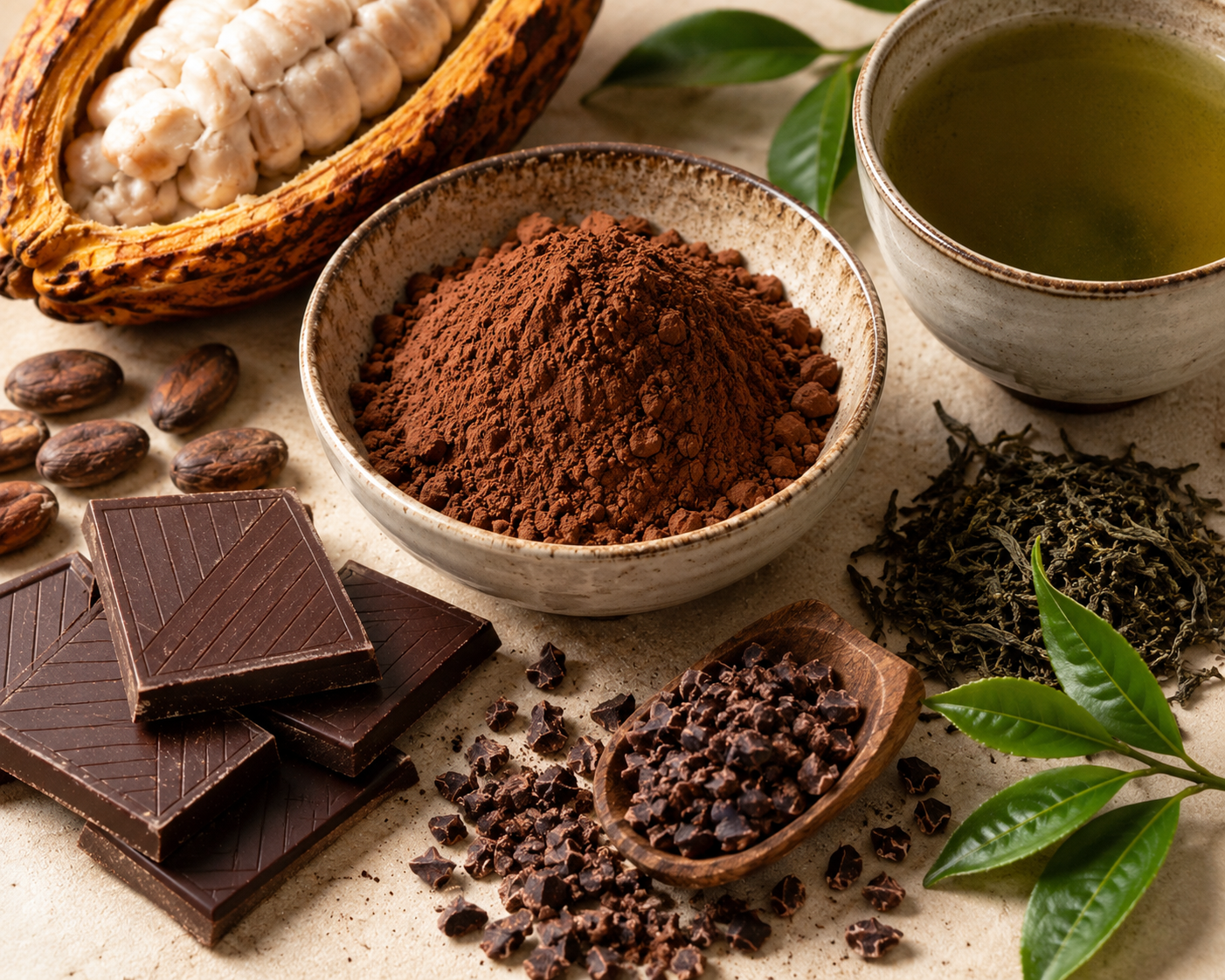
30-second check: which situation fits you best?
I mainly want everyday antioxidant or healthy-aging support
If you are interested mainly because of “antioxidant” or “anti-aging” marketing and do not have a specific outcome to improve, flavanol supplements are usually not a priority. Tea, non-alkalized cocoa, and some fruits already provide flavanols.
I have a specific vascular or skin goal
If you are focused on endothelial function or blood pressure, or want to improve skin tolerance to UV exposure and some photoaging features, there is human research to review. Check whether the study population, dose, and product resemble your situation.
I am planning to use it or already take it
Flavanol sources and products vary widely. If you are choosing a product based on vascular or skin research, confirm the actual total cocoa flavanols and epicatechin rather than only looking at “Cocoa Extract XXX mg.”
Basic Overview
What it is
Flavanols are natural plant polyphenols found in tea, cocoa, and some fruits, including catechins, epicatechins, EGCG, and theaflavins. They are not essential vitamins or minerals. Standardized cocoa flavanols are among the better-studied supplemental forms.
Why people use it
- Support normal endothelial function
- Try a time-limited intervention for blood pressure
- Increase skin tolerance to UV exposure
- Support wrinkles, roughness, and skin elasticity
- Obtain a standardized cocoa-flavanol dose
- Evaluate functions related to healthy aging
How it relates to healthy aging
Flavanols may be relevant to long-term vascular and skin health by supporting vascular function and increasing skin tolerance to some UV exposure.
Human studies report improvements in UV-induced erythema and some wrinkle and elasticity measures, but this does not mean flavanols reverse skin aging, meaningfully extend lifespan, or offset unhealthy lifestyle habits.
Supplement Assessment
Whether they are worth using should be judged against a specific vascular or skin goal, not against a nonexistent flavanol deficiency.
Low supplementation priority
- Mainly interested because of antioxidant or anti-aging marketing
- No specific body or skin outcome to improve
- You already regularly drink tea and eat cocoa or fruit
- Basic lifestyle habits and sun protection still have room for improvement
Your next step:
If you do not have a specific measurable goal, flavanol supplements are usually a lower priority.
Clear goal: a trial may be reasonable
- [Vascular function & blood pressure] You care about endothelial function or blood pressure and accept that average improvements are usually small
- [Skin photoaging & UV tolerance] You care about sun-induced redness, fine lines, roughness, or elasticity and already use routine sun protection
- You are willing to choose a cocoa-flavanol product, dose, and duration similar to those used in relevant studies
Your next step:
First decide whether the main goal is vascular or skin-related. Oral cocoa flavanols do not replace sunscreen.
Talk with a healthcare professional first
- You take anticoagulant or antiplatelet medication
- You are receiving blood-pressure treatment and tend toward low blood pressure
- You are highly sensitive to caffeine or theobromine
- You are pregnant or breastfeeding and considering a concentrated extract
- You plan long-term use at doses clearly above common study amounts
Your next step:
First confirm whether concentrated cocoa flavanols are appropriate for you, then consider the specific product and dose.
Quick self-check
Is my goal vascular function, blood pressure, or skin photoaging?
Are diet, exercise, sleep, and sun protection already in place?
Does the label clearly state total cocoa flavanols?
When will I reassess whether it is worth continuing?
Food Sources
Flavanols have no formal RNI, RDA, or AI, so this table does not show a percentage of adult reference intake. A 2022 expert guideline proposed 400–600 mg/day from foods; this is dietary bioactive guidance, not an RNI, RDA, or supplement recommendation.
Common Food Sources With Higher Flavanol Content
| Food | Form | Approx. Flavanols per 100 g / 100 mL | Common Serving | Approx. per Serving | How to Interpret It |
|---|---|---|---|---|---|
| Natural (Non-Alkalized) Cocoa Powder | Powder | Average about 3,460 mg/100 g | 5 g | Approx. 173 mg | Without Dutch processing, it usually retains more flavanols |
| Alkalized Cocoa Powder | Powder | Approx. 390–1,380 mg/100 g | 5 g | Approx. 20–69 mg | Flavanol content generally falls further as alkalization becomes more intense |
| Green Tea | Brewed | Approx. 133 mg/100 mL | 240 mL | Approx. 319 mg | A typical cup can provide a relatively high amount, but brewing conditions substantially affect the result |
| Black Tea | Brewed | Approx. 116 mg/100 mL | 240 mL | Approx. 277 mg | Fermentation changes the polyphenol profile and increases the proportion of theaflavins and related compounds |
| Blackberries | Fresh | Approx. 42.5 mg/100 g | — | — | A relatively high fruit source that is easy to eat in normal portions |
| 70%–85% Dark Chocolate | Solid | Approx. 108 mg/100 g | 18 g | Approx. 19.5 mg | A higher cocoa percentage does not guarantee a higher flavanol content |
How should these two cocoa datasets be interpreted?
USDA flavan-3-ol data and studies measuring total cocoa flavanols plus proanthocyanidins do not use the same analytical scope and should not be compared as absolute numbers. Within the same testing method, non-alkalized cocoa powder is usually much higher than alkalized cocoa, and greater alkalization generally means greater flavanol loss.
How Much Can Food Provide in a Day?
Example 1 | Tea + fruit
240 mL green tea provides about 319 mg, and 100 g blackberries about 42.5 mg.
This is only to illustrate food intake, not a fixed daily target.
Example 2 | Natural cocoa + everyday diet
A small amount of non-alkalized cocoa powder + regular tea + fruit.
When buying cocoa, prioritize labels such as Natural or Non-alkalized rather than simply increasing the grams of cocoa powder.
Cooking and storage tips
Prefer non-alkalized cocoa: More intensive alkalization generally means greater flavanol loss.
Do not judge by color alone: Darker color or a smoother taste does not mean more flavanols.
Brewing matters for tea: Water temperature, time, and tea-to-water ratio all affect how much enters the infusion.
Do not use cocoa percentage alone: The cocoa percentage on dark chocolate cannot be converted directly into a flavanol dose.
Watch long storage: Heat, moisture, and prolonged exposure can affect the stability of some polyphenols.
Whole foods vs supplements
Whole Foods
- Also provides multiple plant bioactives
- Tea and fruit fit well into long-term dietary use
- Non-alkalized cocoa can provide relatively rich cocoa flavanols
- Dose can vary with processing and batch
- It is difficult to reproduce a precise clinical-study dose
Supplements
- Total cocoa flavanol dose can be standardized
- Easier to compare with human-study doses
- Can reach amounts that are difficult to obtain consistently from ordinary foods
- Different extracts and formulations should not be treated as milligram-for-milligram equivalents
- Requires attention to caffeine, theobromine, and long-term safety
Dosage
These numbers come from different purposes and conditions and should not be placed on one “recommended intake to UL” dose axis.
Official Dose Status, Regulatory References, and Human Research
Food-Source & Regulatory References
These figures come from food-source guidance or specific regulatory health-claim conditions. They are not a supplement RDA or a universal recommended dose.
Skin Human Studies
These are human-study doses for specific skin goals, not daily sunscreen or anti-aging recommendations.
Long-Term Research & Regulatory Conditions
Higher-Dose Short-Term Safety Study
Represents only a specific short-term human-study condition and should not be rewritten as a safety ceiling.
Who These Numbers Apply To:Applies mainly to generally healthy adults. Skin studies primarily used standardized cocoa flavanols and should not automatically be generalized to EGCG or all flavan-3-ols.
Important Note
Flavanols have no formal RNI, RDA, AI, UL, or universal daily supplement recommendation.
400–600 mg/day is a food-source dietary bioactive guideline; 200 mg/day is a specific cocoa-flavanol amount linked with vascular-function evidence.
320–326 mg/day comes from specific skin studies; 500 mg/day was used in the COSMOS long-term trial.
600 mg/day applies only to a specific Novel Food regulatory condition; up to 2,000 mg/day comes from a 12-week short-term safety study.
These numbers come from different study, regulatory, and food-guideline contexts and should not be interpreted as “more is better” or combined into a basic-nutrient-style dose axis from recommended intake to UL.
Epicatechin is one of the most useful individual flavanol monomers to track because it is relatively well absorbed and is an important active marker in many vascular-function studies.
How Formulation Affects Exposure
Epicatechin is absorbed relatively quickly and converted into multiple metabolites; some compounds then reach the colon and are further metabolized by the gut microbiota.
Systemic exposure increases with dose, but individual variation is substantial and effects do not rise in direct proportion to dose.
At higher intakes, improvement in endothelial function may approach a plateau, so there is no reason to keep increasing the dose in pursuit of more effect.
How to Read Common Product Doses: Package Numbers ≠ Actual Target Ingredient Dose
Epicatechin is one of the main cocoa flavanol monomers and is already included in the total cocoa flavanol amount; it should not be added again. Extra epicatechin in a combination formula should be listed separately.
| Product | Package Highlight | Dose That Is Actually Comparable | Other Ingredients / Features | How to Interpret It |
|---|---|---|---|---|
| CocoaVia 500 mg Cocoa Flavanols CapsulesOfficial product link | 500 mg | 500 mg total cocoa flavanols, including 85 mg epicatechin | Capsules About 25 mg naturally occurring caffeine |
The 500 mg is total cocoa flavanols and already includes the 85 mg epicatechin; do not add them together as 585 mg. |
| CocoaVia 500 mg Cocoa Flavanols PowderOfficial product link | 500 mg | 500 mg total cocoa flavanols, including 80 mg epicatechin | Drink mix powder About 30 mg naturally occurring caffeine; mixes into a drink |
The total flavanol amount is similar to that used in the COSMOS study, but that does not mean every health goal requires 500 mg. |
| CocoaVia 750 mg Ultra Cocoa Flavanols CapsulesOfficial product link | 750 mg | 750 mg total cocoa flavanols, including 135 mg epicatechin | Higher dose About 30 mg naturally occurring caffeine; 3 capsules per serving |
This is a higher-flavanol product, but 750 mg is above the roughly 320–326 mg used in common skin studies and does not mean stronger skin effects are guaranteed. |
| CocoaVia Memory & Focus [discontinued]Official product link | Combination formula | 200 mg cocoa flavanols + 135 mg added epicatechin | Discontinued combination formula 10 mg FloraGLO lutein + 50 mg added caffeine |
Unlike the first three products, the 135 mg epicatechin here is added separately. It should therefore be shown separately rather than calling 335 mg “total cocoa flavanols.” This product is now discontinued. |
CocoaVia 500 mg Cocoa Flavanols Capsules
Official product link- Package Highlight
- 500 mg
- Dose That Is Actually Comparable
- 500 mg total cocoa flavanols, including 85 mg epicatechin
- Other Ingredients / Features
- Capsules
About 25 mg naturally occurring caffeine
- How to Interpret It
- The 500 mg is total cocoa flavanols and already includes the 85 mg epicatechin; do not add them together as 585 mg.
CocoaVia 500 mg Cocoa Flavanols Powder
Official product link- Package Highlight
- 500 mg
- Dose That Is Actually Comparable
- 500 mg total cocoa flavanols, including 80 mg epicatechin
- Other Ingredients / Features
- Drink mix powder
About 30 mg naturally occurring caffeine; mixes into a drink
- How to Interpret It
- The total flavanol amount is similar to that used in the COSMOS study, but that does not mean every health goal requires 500 mg.
CocoaVia 750 mg Ultra Cocoa Flavanols Capsules
Official product link- Package Highlight
- 750 mg
- Dose That Is Actually Comparable
- 750 mg total cocoa flavanols, including 135 mg epicatechin
- Other Ingredients / Features
- Higher dose
About 30 mg naturally occurring caffeine; 3 capsules per serving
- How to Interpret It
- This is a higher-flavanol product, but 750 mg is above the roughly 320–326 mg used in common skin studies and does not mean stronger skin effects are guaranteed.
CocoaVia Memory & Focus [discontinued]
Official product link- Package Highlight
- Combination formula
- Dose That Is Actually Comparable
- 200 mg cocoa flavanols + 135 mg added epicatechin
- Other Ingredients / Features
- Discontinued combination formula
10 mg FloraGLO lutein + 50 mg added caffeine
- How to Interpret It
- Unlike the first three products, the 135 mg epicatechin here is added separately. It should therefore be shown separately rather than calling 335 mg “total cocoa flavanols.” This product is now discontinued.
Health Effects
Endothelial Function
One of the more consistent human findings for cocoa flavanols is improvement in endothelium-dependent vasodilation and some microcirculatory measures. EFSA also recognizes a specific cocoa-flavanol dose in relation to maintenance of normal vasodilation. This is better understood as support for normal vascular function, not treatment of atherosclerosis or a substitute for cardiovascular care.
View official assessment
Blood Pressure
Meta-analysis of randomized trials suggests longer-term flavanol interventions produce small reductions in systolic and diastolic blood pressure, with larger changes often seen in people whose blood pressure is higher at baseline. In people with normal blood pressure, additional benefit may be limited, so flavanols should not replace exercise, weight management, or necessary antihypertensive treatment.
View meta-analysis
Glucose, Lipids & Metabolic Health
Some human studies report small changes in total cholesterol, HDL, insulin, glucose dynamics, or related markers, but food source, dose, population, and study duration vary considerably. At present, flavanols are better viewed as an adjunct for cardiometabolic health rather than something that prevents, reverses, or treats diabetes or dyslipidemia.
View meta-analysis
Skin Tolerance to UV Exposure
Some human studies found that sustained intake of high-flavanol cocoa increased skin tolerance to UV exposure and reduced UV-induced erythema, while other randomized trials found no clear advantage. Overall there is some human evidence, but results are not fully consistent. It should be viewed only as supportive photoprotection and cannot replace sunscreen.
View systematic review
Skin Photoaging, Wrinkles & Elasticity
In women with moderate facial photoaging, 320 mg/day cocoa flavanols for 24 weeks modestly improved some measures of wrinkle roughness and skin elasticity versus placebo. Pooled research has not established a consistent overall elasticity benefit, so this is better described as possible improvement in selected photoaging features rather than reversal of skin aging.
View randomized controlled trial
Cognition & Long-Term Health
Pooled randomized trials suggest cocoa or cocoa flavanols may improve attention, processing speed, and some executive-function measures, while memory and overall cognition are inconsistent. Large longer-term studies also have not shown stable improvement in overall cognition. It is reasonable to say that some cognitive abilities may benefit, but not that flavanols prevent cognitive decline or slow whole-body aging.
View meta-analysis
Product Selection
Compare the true target active ingredient, not the largest milligram number on the front label.
Check These Four Things
What is the active ingredient?
First confirm that the product actually provides Cocoa Flavanols / Total Cocoa Flavanols, ideally with the amount of (-)-Epicatechin also stated. Do not assume “Cocoa Extract 500 mg” means 500 mg flavanols; total cocoa extract weight and active flavanol dose are different numbers.
How much do you actually get per serving?
Confirm the actual total cocoa flavanols per capsule, serving, and day. If you are using skin research as the reference, also note whether the daily amount is near the roughly 320–326 mg used in studies rather than focusing on the largest cocoa-powder, cocoa-bean, or extract weight on the package.
Are there unnecessary added ingredients?
Check for large amounts of added sugar, syrup, sweeteners, or unnecessary combination ingredients. Cocoa products should also state caffeine and theobromine where possible, especially for people who drink a lot of coffee or tea or are sensitive to stimulants.
Is quality control credible?
Prefer products with a verifiable manufacturer, lot number, actual total cocoa flavanols, standardization method, and third-party quality information. Products that only say “high flavanol,” “high polyphenol,” or list a proprietary cocoa complex without giving actual milligrams are difficult to compare with human research.
How to Read a Botanical Extract LabelNo %NRV
Illustrative label for understanding the hierarchy between total extract weight, total cocoa flavanols, and epicatechin.
Caffeine and theobromine are listed separately and are not counted as flavanols.
Calculate actual daily total cocoa flavanols from the labeled serving size.
Lot number, manufacturing information, standardization, and third-party quality documentation should be verifiable.
The 80 mg epicatechin is already included within the 500 mg total cocoa flavanols and should not be written as 580 mg; flavanols have no %NRV.
Find the true target ingredient first
Prioritize Cocoa Flavanols or Total Cocoa Flavanols. If (-)-Epicatechin is also listed, record it separately. Do not start by comparing the total weight of Cocoa Powder, Cocoa Extract, or Cocoa Bean Extract.
Read the ingredient form and actual dose
For example, if a label says Cocoa Extract 700 mg and below it says Provides 500 mg Cocoa Flavanols, the number relevant to human research is 500 mg total cocoa flavanols, not 700 mg cocoa extract.
Calculate the actual daily intake
Confirm capsules per serving, total cocoa flavanols per serving, and servings per day, then convert to total cocoa flavanols mg/day. Example: 250 mg/capsule × 2 capsules/day = 500 mg total cocoa flavanols/day. This is only a label calculation, not a recommendation to take 500 mg/day.
Read epicatechin separately
Epicatechin is an important cocoa flavanol monomer. If the label says 500 mg Total Cocoa Flavanols, including 80 mg Epicatechin, that 80 mg is already part of the 500 mg total.
Read caffeine and theobromine separately
Cocoa extracts can naturally contain small amounts of caffeine and theobromine. These are not counted as flavanol dose, but caffeine-sensitive people, those whose sleep is easily affected, or people who drink a lot of coffee should pay attention to the actual amounts.
Then check formulation and quality
Confirm the cocoa source, cocoa powder vs concentrated extract, actual total cocoa flavanols, epicatechin, actual daily dose, caffeine and theobromine, lot and manufacturing information, and third-party quality documentation.
How to Choose Among Common FormsDifferent forms should not be compared by milligrams alone
Standardized Cocoa Flavanol Extract
Main features
Clearly states total cocoa flavanols and epicatechin. Representative human studies on vascular function, skin UV tolerance, wrinkles, and elasticity mainly use quantifiable high-flavanol cocoa preparations like these.
Site guidance
If you have a specific vascular or skin-photoaging goal and want to compare with human-study doses, this is the most useful form. If you simply want more plant polyphenols, there is no need to chase supplement-level doses.
Natural (Non-Alkalized) Cocoa Powder
Main features
A whole-food source that usually retains more cocoa flavanols than alkalized cocoa, although raw material, fermentation, roasting, and processing can create large differences. The dose is less stable than a standardized extract.
Site guidance
Useful for everyday cocoa-polyphenol intake. Look for Natural, Non-alkalized, or equivalent wording, but do not assume a few grams of cocoa powder will precisely reproduce a clinical-study dose.
Isolated Epicatechin
Main features
(-)-Epicatechin is an important flavan-3-ol monomer in cocoa and is studied in some human research, but whole cocoa flavanols also include other monomers and proanthocyanidins of different chain lengths.
Site guidance
Unless the target study specifically used isolated epicatechin, most users are better served by a product closer to the composition used in cocoa-flavanol studies and with a clearly stated total flavanol dose.
Liposomal or Phospholipid-Complex Forms
Main features
Some products use liposomal, phospholipid, or other delivery technologies and claim higher absorption, but there is not enough independent human evidence to show clearly better real-world health outcomes than standard standardized cocoa flavanols.
Site guidance
Do not pay a large premium based only on “high absorption” or “liposomal” marketing. Prioritize true total flavanol dose, fit with the relevant human research, and reliable quality documentation.
How to Take
A goal-specific trial period matters more than frequent dose changes.
Default plan (healthy adults)
With food or on an empty stomach: There is no need to take flavanols fasting. Depending on gastrointestinal tolerance and the product directions, taking them with food is often convenient.
Morning or evening: There is no fixed time of day. If the product contains caffeine or theobromine, sensitive users may prefer daytime use.
Does the dose need to be divided?: No mandatory split is required. There is no evidence that dividing the dose necessarily improves vascular or skin effects.
Can I take it with milk?: There is generally no need to avoid milk. Existing studies have not consistently shown that milk meaningfully reduces cocoa epicatechin absorption.
Frequently asked questions
How long should I use it for a skin goal?
Skin studies usually last 6–24 weeks. With a clear goal, about 12 weeks is a practical first reassessment point. Do not keep increasing the dose because changes are not obvious in the short term.
What can I track for a skin goal?
Track longer-term changes in redness after sun exposure, roughness, fine lines, and overall skin condition. Do not deliberately increase UV exposure to “test” whether the supplement works.
Can it replace sunscreen?
No. Flavanols are, at most, a potential adjunct for photoprotection. Daily protection still depends on sunscreen, clothing, hats, shade, and limiting intense sun exposure.
How long for a blood-pressure goal?
Blood-pressure studies usually last several weeks to months. Track home blood-pressure trends consistently; if there is no meaningful improvement after a reasonable trial, there is no need to continue indefinitely just because of “antioxidant” claims.
More questions about use (click to expand)
Is long-term use appropriate?
Human studies range from several months to several years, but that does not mean every product should be used indefinitely. A better goal-based approach is: define the goal → keep product and dose stable → use for a set period → reassess → stop if there is no meaningful benefit.
What if I miss a dose?
If you occasionally miss a dose, skip it and return to the usual amount next time. Do not double the dose to make up for it.
Risks & Precautions
Common Side Effects
- Stomach upset
- Nausea
- Bloating
- Headache
- Palpitations or sleep disruption in caffeine-sensitive users
- Caffeine, theobromine, and other ingredients included in the product can also affect tolerability.
- If discomfort is persistent or clearly bothersome, reduce the dose or stop use.
Higher-Dose Risks
- No formal UL does not mean the dose can increase without limit.
- Short-term studies in healthy adults have used up to 2,000 mg/day, but only for 12 weeks. This does not show that 2,000 mg is appropriate for long-term routine use.
- Positive skin studies mostly use about 320–326 mg/day. There is no evidence that 500, 1,000, or 2,000 mg produces proportionally greater skin effects.
- Especially avoid: Do not sharply increase flavanol intake because you expect more sun exposure.
- Skin studies evaluate changes after weeks to months of regular intake, not an immediate “oral sunscreen” effect from a single dose.
People Who Need More Caution
- Blood pressure already runs low or you are prone to dizziness
- Very sensitive to caffeine
- Pronounced sensitivity to theobromine
- Pregnancy or breastfeeding
- High intake of coffee, tea, or energy drinks at the same time
- Using multiple high-dose botanical extracts
- You plan long-term use at doses clearly above common study amounts
- These situations do not necessarily mean flavanols cannot be used, but the specific product and dose should be reviewed more carefully first.
Medications & Special Situations
- Antiplatelet drugs: Cocoa and flavanols may affect platelet function. A small human study found that cocoa may enhance the platelet-inhibitory effect of clopidogrel, so people taking clopidogrel or similar drugs should consult a doctor or pharmacist before long-term use of concentrated cocoa flavanols.
- Anticoagulants: Direct clinical evidence is limited, but people receiving anticoagulation should not add high-dose concentrated cocoa flavanols on their own.
- Blood-pressure medication: Average blood-pressure reductions with flavanols are usually small, but people with higher baseline blood pressure may see larger changes. Those already taking antihypertensive medication, especially people with low blood pressure or dizziness, should monitor blood pressure when using concentrated flavanols.
Stop and Ask for Advice
If you develop persistent gastrointestinal discomfort, dizziness, palpitations, significant sleep disruption, or another symptom clearly different from usual, stop use and consult a doctor or pharmacist.
Seek Medical Care Promptly
Seek prompt medical care for fainting, a severe allergic reaction, unusual bleeding, persistent severe chest tightness or palpitations, or another clearly serious symptom.
Sources
Sources on this page support flavanol food data, regulatory and human research, absorption and safety, processing differences, and representative product labels.
Nutrition Standards & Basic Data
Use: classification and food data for tea, fruit, and other sources.
Use: the 400–600 mg/day food-based guideline and representative intake data.
Health Effects & Scientific Evidence
Safety, Dose & Absorption
Cocoa Processing & Food Data
Product Labels & Market-Dose Examples
Use: centralized comparison of total cocoa flavanols, epicatechin, caffeine, added actives, dosage forms, and product differences across CocoaVia products.
Last updated: August 11, 2026