Garlic Extract
Garlic Extract / Allicin | Aged Garlic Extract | Black Garlic Extract | Garlic Oil
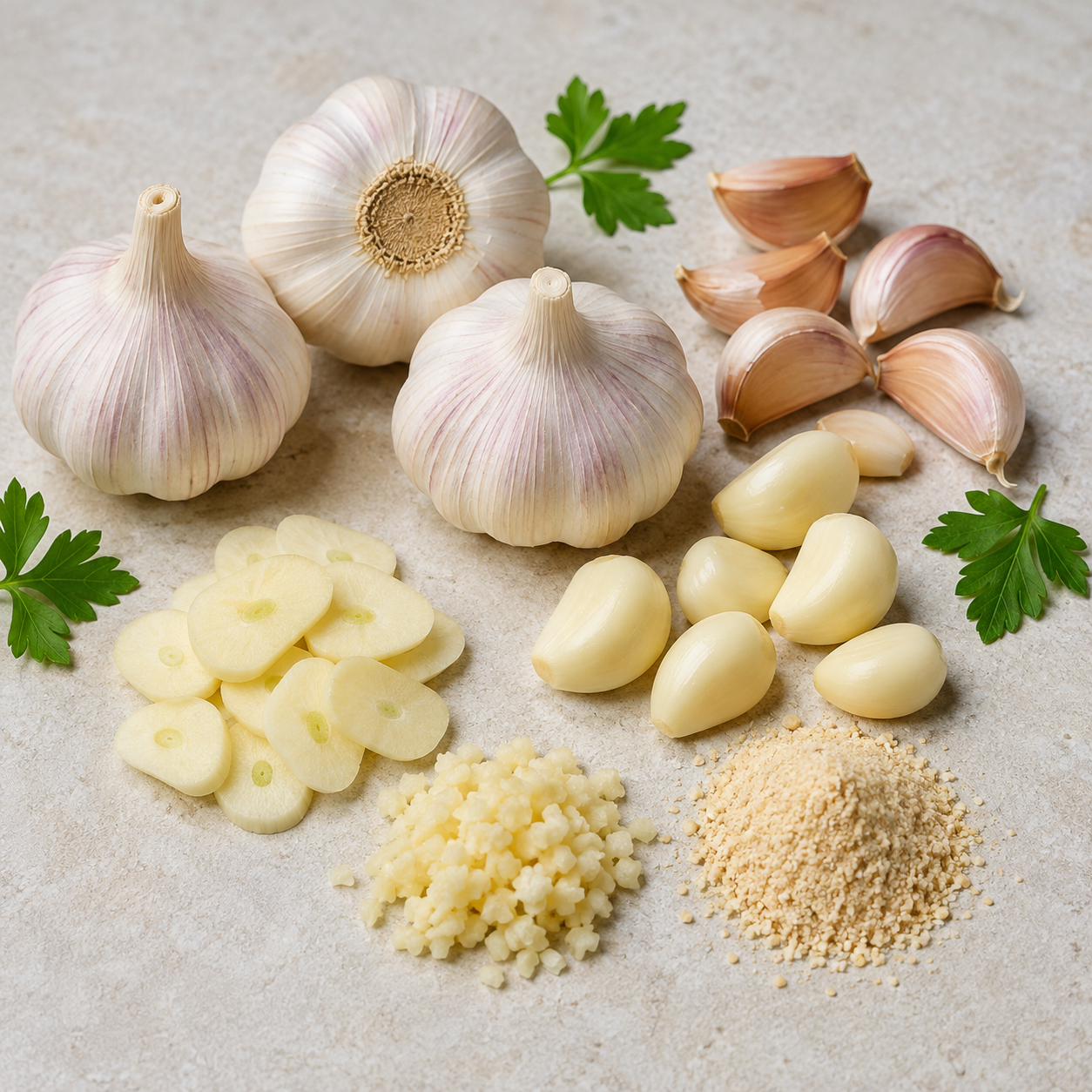
30-second check: which situation fits you best?
Just looking for everyday anti-inflammatory or antioxidant support
If your blood pressure and lipids are normal and you have no specific goal, there is no need to supplement long term simply because of “antioxidant,” “vascular protection,” or “immune support” marketing. Studies in healthy adults with normal lipids have not consistently shown additional benefit.
You have a specific goal you want to improve
Focus on home blood pressure, LDL, total cholesterol, and selected vascular measures. More positive results mainly come from people with hypertension, elevated lipids, or higher cardiovascular risk.
You are planning to use it or already taking it
When you see “Garlic 500 mg,” “Garlic Oil 1,500 mg,” or “Aged Garlic 600 mg,” first determine whether it is ordinary garlic powder, aged garlic/black garlic, or garlic oil, then look for the number that actually matters for that product type.
Basic Overview
What it is
Garlic extract is a processed, concentrated product made from garlic and is not one fixed ingredient. When garlic is cut or chewed, Allicin can form. During aging and other processing, more stable sulfur compounds such as S-Allyl-L-Cysteine (SAC) can form. Because processing methods produce very different compound profiles, garlic supplements should not be compared only by figures such as “500 mg” or “1,000 mg.” First identify the type of garlic preparation and which active compound is actually listed.
Why people use it
- Try it for a specific elevated-blood-pressure goal
- Target total cholesterol, LDL, and other lipid measures
- Further support selected vascular measures
- Target inflammatory or oxidative-stress markers
- Avoid the smell and irritation of eating large amounts of raw garlic
- Use a fixed product and defined trial period to evaluate response
How it relates to healthy aging
Garlic sulfur compounds may influence blood pressure, blood lipids, vascular function, and some oxidative-stress markers.
Changes in these cardiovascular risk factors do not mean aging has been reversed, lifespan extended, or healthy adult function made “younger.”
Supplement Assessment
Do you have a clear goal → is the study population similar → does the product type match → is there a meaningful change worth continuing for?
Lower Supplement Priority
- Major markers such as blood pressure and lipids are already normal
- No clear goal; only interested because of antioxidant marketing
- Simply hope to use a supplement for anti-aging
- Already consume garlic normally
- Diet, exercise, and sleep still have room for improvement
- Planning long-term use without a measurable outcome
Your next step:
Continue normal diet and lifestyle habits. If you still want to try a supplement, turn “cardiovascular protection” into a concrete target such as home blood pressure or LDL.
Clear goal: worth a closer look
- Home blood pressure is persistently elevated
- LDL or total cholesterol is elevated
- Want adjunctive support for selected vascular measures
- Accept that benefit may be modest
- Willing to choose a product similar to the one used in human research
- Can distinguish ordinary garlic, aged garlic, black garlic, and garlic oil
- Willing to reassess after a defined period
Your next step:
Choose a formulation that matches the evidence for your goal, and define the outcome and trial period in advance.
Consult a professional first
- Anticoagulant medication
- Antiplatelet medication
- Some HIV antiviral medications
- Multiple antihypertensive medications
- Glucose-lowering medication
- Preparing for surgery or an invasive procedure
- Pregnancy
- Breastfeeding
- Children or adolescents using adult high doses
- Long-term high-dose use
Your next step:
Have a clinician or pharmacist evaluate the exact formulation, dose, medications, and procedure timing.
Quick Self-Check
Is this ordinary garlic powder or aged garlic / black garlic?
Is it a garlic-oil product?
Does an ordinary garlic-powder product clearly state Allicin?
Does a black-garlic product clearly state S-Allyl-L-Cysteine (SAC)?
Is the large package number only a Fresh Garlic Equivalent?
How many capsules are in one serving and how many servings per day?
Are combination ingredients calculated separately?
Food Sources
Representative Food Sources
| Food | Representative amount per 100 g | Common Serving | Approx. per Serving | How to Read It |
|---|---|---|---|---|
| Raw garlic | fresh clove | Alliin about 970 mg; potential Allicin about 360 mg | About 4 g / 1 clove | Alliin about 39 mg; potential Allicin about 14 mg | Potential Allicin is the theoretical amount that could form when precursor and enzyme conditions are suitable; it is not a stable amount of Allicin already present in an intact clove |
| Black garlic | aged clove | S-Allyl-L-Cysteine about 22–64 mg | Depends on the product | — | Processing and batch differences are substantial and cannot be converted from raw-garlic values |
What does potential Allicin mean?
It does not mean that an intact garlic clove already contains that amount of stable Allicin. It is the theoretical amount that could form when the precursor and enzyme conditions are appropriate. No single fixed value is given for cooked garlic because cutting before cooking, temperature, time, boiling or roasting, and alliinase inactivation all affect the result. Cooked garlic is not “useless”; its sulfur-compound profile simply changes.
How Much Can Food Provide in a Day?
Example 1
About 1 chopped garlic clove (about 4 g).
Roughly 39 mg Alliin and about 14 mg potential Allicin formation, provided only to illustrate the order of magnitude and not as a daily target.
Example 2
Add several cloves of garlic normally to stir-fries, soups, or roasted vegetables.
Heating may reduce Allicin formation, but cooked garlic still provides other sulfur compounds. There is no need to eat very large amounts of raw garlic long term just to maximize Allicin.
Cooking and storage tips
Chop before cooking: allow time for precursor and enzyme reactions.
Avoid prolonged high heat: cooking method and duration affect Allicin formation.
Cooked garlic still has value: the sulfur-compound profile simply changes.
Do not convert black garlic from raw-garlic values: aging and SAC-based measurements use a different composition framework.
Store homemade garlic oil safely: refrigerate homemade garlic oil and use it promptly to reduce botulism risk.
Whole foods vs supplements
Whole Garlic
- Food
- Provides multiple sulfur compounds
- Cutting and heating change the compound profile
- Content varies by variety and cooking method
- More suitable for everyday diet
Garlic Supplements
- May be garlic powder, aged garlic, black garlic, or garlic oil
- Active markers differ completely between product types
- Standardized products are easier to calculate
- Drug interactions matter more with concentrated preparations
- Should not be compared only by package milligrams
Dosage
Regulatory conditions and human-study doses for different garlic preparations cannot be merged into one “recommended garlic supplement range.”
Official Dose Status, Regulatory References & Human Research
Health Canada Natural Health Product Monograph Use Ranges
These are formulation-specific regulatory monograph conditions, not an RNI, RDA, recommended intake, or UL.
Human Research Dose References
Look first at the exact formulation and active ingredient used in the study, then at the dose. Different garlic preparations should not be compared only by milligrams or grams.
How to Interpret Dose
Research numbers are not recommended doses for all healthy adults.
Core boundary:Health Canada figures apply to different formulations under separate regulatory conditions and must not be merged into one recommended dose range.
Important Note
There is no RNI, RDA, AI, formal UL, or universal daily recommended dose.
Health Canada figures for dried garlic, Allicin, Alliin, and Garlic Essential Oil refer to different preparation-specific regulatory conditions, not nutritional recommendations.
Human research using 240–960 mg Aged Garlic Extract/day, 1.2 g/day, or 2.4 g/day must identify exactly what is being weighed; the number alone is not meaningful.
Different product forms cannot be compared directly by package milligrams.
Dose Utilization
The same 5 mg Allicin on a label does not guarantee identical human exposure. Product quality, formulation, and release characteristics can affect utilization.
Enteric coating does not automatically mean better absorption; different enteric-coated products can still differ substantially in human bioavailability.
Aged garlic should not be interpreted using ordinary Allicin logic. Ordinary garlic powder is often evaluated by Allicin formation, whereas Aged Garlic Extract is interpreted using matching study doses and stable markers such as S-Allyl-L-Cysteine (SAC).
How to Read Common Product Doses
The number on the package is not necessarily the dose you should compare
| Product | Package / Label Number | Dose That Is Actually Comparable | Formulation | How to Read It |
|---|---|---|---|---|
| NOW Foods Garlic 5000Official product link | 500 mg Garlic Powder/tablet | ≥5 mg Allicin/tablet | Allicin-standardized Enteric-coated tablet |
The 500 mg figure is garlic raw-material weight, not 500 mg Allicin. The relevant comparable value is the clearly stated ≥5 mg Allicin. |
| Nature's Way Garlinase® 5000Official product link | 320 mg Garlic Extract/tablet; additional 10.8 mg precursor information | About 5 mg Allicin/tablet | Allicin Standardized Garlic Extract |
For most users, the more relevant comparable figure is about 5 mg Allicin. |
| Life Extension Optimized GarlicOfficial product link | 1,200 mg Garlic Extract/2 capsules | About 12 mg Allicin Potential/serving | Allicin Potential Allicin Potential |
Allicin Potential is the theoretical amount of Allicin that can form under suitable conditions. It does not mean the capsules already contain 12 mg of stable Allicin. |
| Life Extension Aged Black GarlicOfficial product link | 500 mg Black Garlic Extract/capsule; 0.5% S-Allyl-L-Cysteine (SAC) | 2.5 mg S-Allyl-L-Cysteine (SAC)/capsule | 0.5% S-Allyl-L-Cysteine Black Garlic Extract |
The more useful comparison is 2.5 mg SAC, not 500 mg extract. |
| Kyolic Aged Garlic Extract Formula 100Official product link | 600 mg Aged Garlic Extract/2 capsules | 600 mg Aged Garlic Extract + matching human research | Aged Garlic Extract Manufacturer does not provide SAC milligrams |
Do not estimate SAC yourself and do not convert it to Allicin. |
| Solgar Garlic Oil PerlesOfficial product link | Equivalent to about 500 mg fresh garlic/capsule | 1 mg Garlic Oil Concentrate/capsule | Garlic Oil Garlic Oil softgel |
The 500 mg figure is a fresh-garlic equivalent; the actual Garlic Oil Concentrate is 1 mg. |
| NOW Foods Garlic Oil 1500 mgOfficial product link | Equivalent to about 1,500 mg whole garlic/capsule | 3 mg Garlic Oil Concentrate/capsule | Garlic Oil Garlic Oil softgel |
The actual dose is 3 mg Garlic Oil Concentrate, definitely not 1,500 mg garlic oil. |
NOW Foods Garlic 5000
Official product link- Package / Label Number
- 500 mg Garlic Powder/tablet
- Dose That Is Actually Comparable
- ≥5 mg Allicin/tablet
- Formulation
- Allicin-standardized
Enteric-coated tablet
- How to Read It
- The 500 mg figure is garlic raw-material weight, not 500 mg Allicin. The relevant comparable value is the clearly stated ≥5 mg Allicin.
Nature's Way Garlinase® 5000
Official product link- Package / Label Number
- 320 mg Garlic Extract/tablet; additional 10.8 mg precursor information
- Dose That Is Actually Comparable
- About 5 mg Allicin/tablet
- Formulation
- Allicin
Standardized Garlic Extract
- How to Read It
- For most users, the more relevant comparable figure is about 5 mg Allicin.
Life Extension Optimized Garlic
Official product link- Package / Label Number
- 1,200 mg Garlic Extract/2 capsules
- Dose That Is Actually Comparable
- About 12 mg Allicin Potential/serving
- Formulation
- Allicin Potential
Allicin Potential
- How to Read It
- Allicin Potential is the theoretical amount of Allicin that can form under suitable conditions. It does not mean the capsules already contain 12 mg of stable Allicin.
Life Extension Aged Black Garlic
Official product link- Package / Label Number
- 500 mg Black Garlic Extract/capsule; 0.5% S-Allyl-L-Cysteine (SAC)
- Dose That Is Actually Comparable
- 2.5 mg S-Allyl-L-Cysteine (SAC)/capsule
- Formulation
- 0.5% S-Allyl-L-Cysteine
Black Garlic Extract
- How to Read It
- The more useful comparison is 2.5 mg SAC, not 500 mg extract.
Kyolic Aged Garlic Extract Formula 100
Official product link- Package / Label Number
- 600 mg Aged Garlic Extract/2 capsules
- Dose That Is Actually Comparable
- 600 mg Aged Garlic Extract + matching human research
- Formulation
- Aged Garlic Extract
Manufacturer does not provide SAC milligrams
- How to Read It
- Do not estimate SAC yourself and do not convert it to Allicin.
Solgar Garlic Oil Perles
Official product link- Package / Label Number
- Equivalent to about 500 mg fresh garlic/capsule
- Dose That Is Actually Comparable
- 1 mg Garlic Oil Concentrate/capsule
- Formulation
- Garlic Oil
Garlic Oil softgel
- How to Read It
- The 500 mg figure is a fresh-garlic equivalent; the actual Garlic Oil Concentrate is 1 mg.
NOW Foods Garlic Oil 1500 mg
Official product link- Package / Label Number
- Equivalent to about 1,500 mg whole garlic/capsule
- Dose That Is Actually Comparable
- 3 mg Garlic Oil Concentrate/capsule
- Formulation
- Garlic Oil
Garlic Oil softgel
- How to Read It
- The actual dose is 3 mg Garlic Oil Concentrate, definitely not 1,500 mg garlic oil.
Health Effects
Blood Pressure
Multiple Aged Garlic studies report improved systolic blood pressure in people with elevated or poorly controlled blood pressure, but dose-response is not simply “more is better.” Benefit in hypertension does not mean people with normal blood pressure need supplementation.
View Meta-analysis
Blood Lipids
Meta-analysis suggests total cholesterol and LDL may decline, while a standardized garlic-powder study in healthy people with normal lipids found no clear improvement. Lower LDL does not prove a reduction in heart attack or stroke.
View Meta-analysis
Vascular Function
Aged-garlic studies have examined arterial stiffness, endothelial function, and coronary-related markers, but populations, durations, and endpoints differ. Changes in these measures do not equal prevention of cardiovascular events.
View Systematic Review
Glucose & Metabolic Health
Some studies report changes in fasting glucose or metabolic measures, but results and populations are inconsistent. People using glucose-lowering medication should consider possible additive effects.
View Meta-analysis
Inflammation & Oxidative Stress
Some sulfur compounds have antioxidant mechanisms, and human studies show signals in selected markers. Changes in inflammatory markers do not mean the whole body has been “de-inflamed,” and mechanistic or animal studies cannot replace conclusions in healthy adults.
View Inflammation Meta-analysis · View Oxidative-Stress Meta-analysis
Immunity, Colds & Healthy Aging
Cold and immune studies are limited and products vary substantially. There is no reliable evidence that long-term supplementation in healthy adults slows aging or prevents cancer. Aged Garlic research ≠ the same effect from ordinary garlic powder, and S-Allyl-L-Cysteine ≠ Allicin.
View Cochrane Review
Product Selection
First classify the product into 3 broad types → find the number that truly matters → ignore exaggerated Fresh Garlic Equivalent figures → then evaluate the formula and quality.
Check these four things when buying
Which type of garlic product is it?
First distinguish ordinary garlic powder/allicin-type products, Aged Garlic, Black Garlic, and Garlic Oil. Aged Garlic ≠ Black Garlic ≠ ordinary garlic powder.
What number actually matters per serving?
For ordinary garlic powder or allicin-type products, look at Allicin or Allicin Potential. For Black Garlic, look at S-Allyl-L-Cysteine (SAC). For Aged Garlic, look at SAC or the Aged Garlic Extract dose used in matching research. For Garlic Oil, look at the actual Garlic Oil Concentrate and confirm the Serving Size.
Are there unnecessary added ingredients?
Review added botanicals, oils, flavorings, and other active ingredients. Combination ingredients should be calculated separately and should not be merged into one “effective garlic dose.”
Does it have reliable quality control?
Prefer products that clearly state the botanical name, plant part, product type, standardized marker, and batch-quality testing. “Enteric-coated” or “odorless” by itself does not guarantee a better product.
How to Read the LabelFive steps to verify the actual active dose
The example below uses the NOW Foods Garlic 5000 product from the current dose table. 500 mg Garlic Powder is not 500 mg Allicin.
This example does not convert any unstated ingredient into an active dose.
Calculate from the actual Allicin amount per serving, not from the large Fresh Garlic Equivalent number on the front label.
Botanical Source | Actual Active Dose | Standardization | Lot / Quality Testing
NOW Foods Garlic 5000 contains 500 mg Garlic Powder per tablet and explicitly provides at least 5 mg Allicin. This example uses only values clearly stated in the current product data and does not invent a standardization percentage from 500 mg and 5 mg.
First identify the garlic product type
Ordinary garlic/allicin-type products, Aged Garlic Extract, Black Garlic, and Garlic Oil use different dose frameworks and should not be compared directly by package milligrams. This example is an ordinary allicin-type product.
Find the active marker that should actually be compared
For ordinary allicin-type products, prioritize Allicin or Allicin Potential. For Aged Garlic Extract, prioritize S-Allyl-L-Cysteine (SAC). For Garlic Oil, look at Garlic Oil Concentrate.
Check the actual dose per serving
In this example, the Serving Size is 1 tablet. The 500 mg figure is total Garlic Powder weight, while the comparable active figure is at least 5 mg Allicin. Do not read 500 mg garlic as 500 mg Allicin.
Do not treat Fresh Garlic Equivalent as the active dose
Figures such as 5,000 mg or 1,500 mg “Fresh Garlic Equivalent” only describe raw-material conversion and do not equal the actual Allicin or SAC dose.
Then check formulation and quality
Confirm the product type, botanical source, serving size, active ingredient, standardization information, and quality testing. Different garlic product types should not be ranked by the same milligram number.
How to Choose Among Common Forms(The five forms use different active-dose frameworks)
Allicin-Standardized Garlic Powder
Key Features
Based on Garlic Powder or Garlic Extract and explicitly lists Allicin or Allicin Potential. Actual human utilization depends on product and formulation.
Site Guidance
Prefer products that clearly state Allicin per serving rather than only total Garlic Powder weight. Allicin Potential does not mean the capsule already contains the same amount of stable Allicin.
Aged Garlic Extract
Key Features
Prolonged aging produces stable water-soluble sulfur compounds such as S-Allyl-L-Cysteine (SAC). Many blood-pressure studies use this form.
Site Guidance
If SAC is stated, use SAC. If not, interpret the actual Aged Garlic Extract dose against matching human research and do not convert it to ordinary Allicin.
Black Garlic Extract
Key Features
Aged under controlled heat and humidity with browning reactions. It may be standardized to S-Allyl-L-Cysteine (SAC), but it is not the same as traditional Aged Garlic Extract.
Site Guidance
Prefer products with a clear SAC amount. 500 mg × 0.5% = 2.5 mg SAC; compare SAC rather than total extract weight.
Garlic Oil
Key Features
Labels often use large Fresh Garlic Equivalent numbers, while the actual oil concentrate may be only 1–3 mg. Its composition framework differs from water-soluble Aged Garlic.
Site Guidance
Look for the actual milligrams of Garlic Oil Concentrate. Do not rewrite a 1,500 mg Equivalent as 1,500 mg garlic oil.
Ordinary Odorless Garlic
Key Features
“Odorless” describes odor processing, not the active composition, and does not prove equivalence to Aged Garlic or Garlic Oil.
Site Guidance
If there is no clear Allicin, SAC, or actual oil amount, you only know the raw-material weight and it is difficult to match the product to human research.
Quick Comparison of Five Forms
| Form | What to Look At | How Easy Is It to Compare? | Main Caution |
|---|---|---|---|
| Allicin-Standardized Garlic Powder | Allicin or Allicin Potential | Relatively easy | Allicin Potential is not the same as stable Allicin already present |
| Aged Garlic Extract | S-Allyl-L-Cysteine (SAC) or the matching research dose | Moderate | Do not apply ordinary Allicin logic |
| Black Garlic Extract | S-Allyl-L-Cysteine (SAC) | Easier when SAC is clearly stated | Black Garlic is not the same as traditional Aged Garlic |
| Garlic Oil | Actual Garlic Oil Concentrate | Relatively easy | Fresh Garlic Equivalent is not the actual oil amount |
| Ordinary Odorless Garlic | Verifiable active standardization data | More difficult | “Odorless” does not define composition or effect |
How to Take
There is no universal official recommendation across garlic preparations. Use the specific product label, goal, and tolerability.
Default plan (healthy adults)
Official recommended dose: No universal official recommendation has been established
Frequency: Follow the specific product label
With food?: If your stomach is sensitive, take it with food
Split doses?: Follow the product’s daily-use instructions
Morning or evening: No universal timing requirement
Long-term use?: Set an observation period first, then decide
Missed dose: If you occasionally miss a dose, there is no need to double the next one
Frequently asked questions
With food or on an empty stomach?
If you are prone to nausea, reflux, or stomach sensitivity, taking it with food is more reasonable. There is no need to force fasting for a supposed absorption advantage.
Morning or evening?
There is no universal time-of-day requirement. Choose a time that is easy to maintain and well tolerated.
Are enteric-coated products always better?
Not necessarily. Different enteric-coated products can still vary substantially in human utilization, and “enteric-coated” does not replace actual Allicin data.
Can Aged Garlic and ordinary garlic tablets be used interchangeably?
No. Aged Garlic is interpreted by matching study doses and S-Allyl-L-Cysteine, while ordinary garlic powder is interpreted by Allicin formation.
How long should I take it?
Most goal-specific studies last about 12 weeks, while longer-term data depend on the specific Aged Garlic formulation. Set a trial period and reassess rather than using it indefinitely.
How do I know if it is working?
For blood pressure, use standardized home measurements. For lipids, recheck LDL and total cholesterol as planned. Without a defined measure, it is difficult to know whether continued use is worthwhile.
Risks & Precautions
Common Side Effects
- Garlic breath and body odor
- Stomach irritation
- Bloating and gas
- Nausea
- Allergic reactions
- For mild aftertaste or stomach discomfort, taking it with food or changing formulation may help
- Stop rather than forcing continued use if significant discomfort persists
High-Dose Risks
- No formal UL ≠ unlimited dose escalation is safe
- Higher doses may affect platelets
- Different formulations do not share one threshold
- A one-year study is not a safety ceiling
- Extra caution is needed when combined with anticoagulant treatment
- Platelet changes seen with 2.4–7.2 g/day Aged Garlic are a risk signal, not a universal UL
People Who Need More Caution
- People prone to bleeding or with coagulation disorders
- Preparing for surgery or an invasive procedure
- Pregnancy
- Breastfeeding
- Diabetes with glucose-lowering medication
- Gastrointestinal tract easily irritated by garlic
- Using multiple cardiovascular medications
- Children or adolescents using adult high doses
Medications & Special Situations
- Anticoagulant and antiplatelet drugs: in a medically monitored human study, Aged Garlic used with warfarin for 12 weeks did not clearly increase bleeding events, but that result cannot be generalized to every product, dose, or population. Professional review is still appropriate.
- Some HIV antivirals: in a human study with saquinavir, a garlic supplement markedly reduced drug exposure. This kind of interaction cannot be solved simply by taking the products 2 hours apart.
- Glucose-lowering medication: additive effects on blood glucose are possible and should be assessed with monitoring.
- Antihypertensive medication: people using multiple blood-pressure drugs should monitor blood pressure and consult first.
- Upcoming surgery: proactively tell your clinician that you use a concentrated garlic supplement. Some product labels may specify a stop period, but one brand’s rule should not be generalized into a universal 7- or 14-day recommendation.
Stop and consult
Stop and speak with a clinician or pharmacist for persistent stomach pain, nausea, bloating, recurrent diarrhea, or a clear increase in bruising, nosebleeds, or similar symptoms.
Seek Medical Care Promptly
Seek prompt medical care for a severe allergic reaction, persistent heavy bleeding, black stools, vomiting blood, fainting, or another clearly serious symptom.
Sources
Sources support regulation, safety, composition and human utilization, health effects, dose studies, drug interactions, and labels from seven products. The frontend displays the specific source URLs from the original dataset.
1. Regulation, Safety & Background
2. Composition, Food & Human Utilization
3. Human Evidence for Health Effects
4. Aged Garlic Dose Studies
5. Drug Interactions & Safety
6. Mainstream Product Label Examples
7. Data Boundaries
Last updated: August 12, 2026