Glutathione
Glutathione / GSH / L-Glutathione / Reduced Glutathione / GSH
Glutathione is an important antioxidant tripeptide that the body can synthesize from glutamate, cysteine, and glycine. It is not an essential nutrient that must be obtained from food every day, so supplementation is best viewed as an optional, goal-directed strategy rather than a basic requirement.
30-second check: which situation fits you best?
I just want everyday antioxidant or anti-aging support
Glutathione is important in human physiology, but that does not mean generally healthy people need to take a glutathione supplement long term. Without a measurable goal, antioxidant, detox, or anti-aging marketing alone is not a strong reason for routine use.
I have a skin-tone, pigmentation, or skin-quality goal
Some human studies using 250–500 mg glutathione/day for 4–12 weeks have reported signals in pigmentation, wrinkles, or hydration, but samples are small, results are inconsistent, and evidence for elasticity is weaker.
I am planning to use it or already taking it
Products may use standard reduced glutathione, liposomal delivery, S-acetyl forms, or skin-focused combination formulas. Package milligrams, capsules per serving, delivery system, and added ingredients need to be interpreted separately.
Basic Overview
What it is
Glutathione is a small tripeptide made from glutamate, cysteine, and glycine. The body can synthesize it, and it plays broad roles in redox balance, antioxidant defense, and cellular protection. Common supplement forms include reduced glutathione, liposomal glutathione, and S-acetyl L-glutathione. It is not a vitamin or mineral and has no established daily dietary requirement.
Why people use it
- Wanting to raise blood or cellular glutathione levels
- Concern about uneven skin tone or localized pigmentation
- Interest in selected wrinkle or skin-hydration measures
- A goal-directed trial focused on antioxidant status
- Interest in delivery systems such as liposomal formulations
- Considering supplementation because of healthy-aging marketing
How it relates to healthy aging
Glutathione is an important part of normal antioxidant defense.
Changes in pigmentation, localized wrinkles, or hydration in skin studies may indicate mild changes in specific measures, but they do not prove age reversal. Higher blood glutathione also does not mean the body as a whole has become younger.
Supplement Assessment
Turn a vague antioxidant goal into an observable skin or glutathione-related outcome before deciding whether a time-limited trial is worthwhile.
Low supplementation priority
- No specific skin goal and no defined goal of raising body glutathione
- Interest driven mainly by antioxidant, detox, whitening, or anti-aging marketing
- Expecting a dramatic or permanent change in natural skin tone
- Sun protection, sleep, or diet still have substantial room for improvement
Your next step:
Define one outcome you can actually observe. Without a clear goal, indefinite use based only on a concept is low priority.
Clear goal: a trial may be reasonable
- Concern about uneven tone, localized pigmentation, or dark spots
- Interest in selected wrinkle or skin-hydration measures
- Accepting that skin changes are usually mild and inconsistent
- Able to choose a conventional reduced-glutathione form and dose reasonably similar to the studies
- Willing to use a 4–12 week observation window
Your next step:
Compare the exact form, glutathione dose, study duration, and effect size used in skin trials.
Talk with a healthcare professional first
- Pregnancy or breastfeeding
- Children or adolescents
- Significant liver or kidney problems
- Complex disease or cancer treatment
- Use of multiple medications
- Planning prolonged high-dose use or intravenous glutathione
Your next step:
Have a doctor or pharmacist review the treatment context, medications, dose, and route of administration.
Quick self-check
Is my goal more even skin tone, pigmentation, wrinkles, hydration, or just general anti-aging?
Can I record skin changes under consistent lighting and camera angles?
Am I willing to set an observation window of about 4–12 weeks?
Can I identify the exact form, dose per serving, and Serving Size?
Can I evaluate the ingredients in a skin combination formula separately?
Am I receiving medical treatment, taking medications, pregnant or breastfeeding, or dealing with liver or kidney problems?
Do I need testing?
Generally healthy people do not need routine glutathione testing just to decide whether to supplement.
- Studies may measure whole-blood, red-blood-cell, or plasma glutathione.
- Some studies also measure lymphocyte or other intracellular glutathione.
- Different specimens, assays, and GSH/GSSG measures should not be treated as interchangeable.
There is no standardized clinical threshold such as “below this value = glutathione deficiency requiring a supplement.”
Food Sources
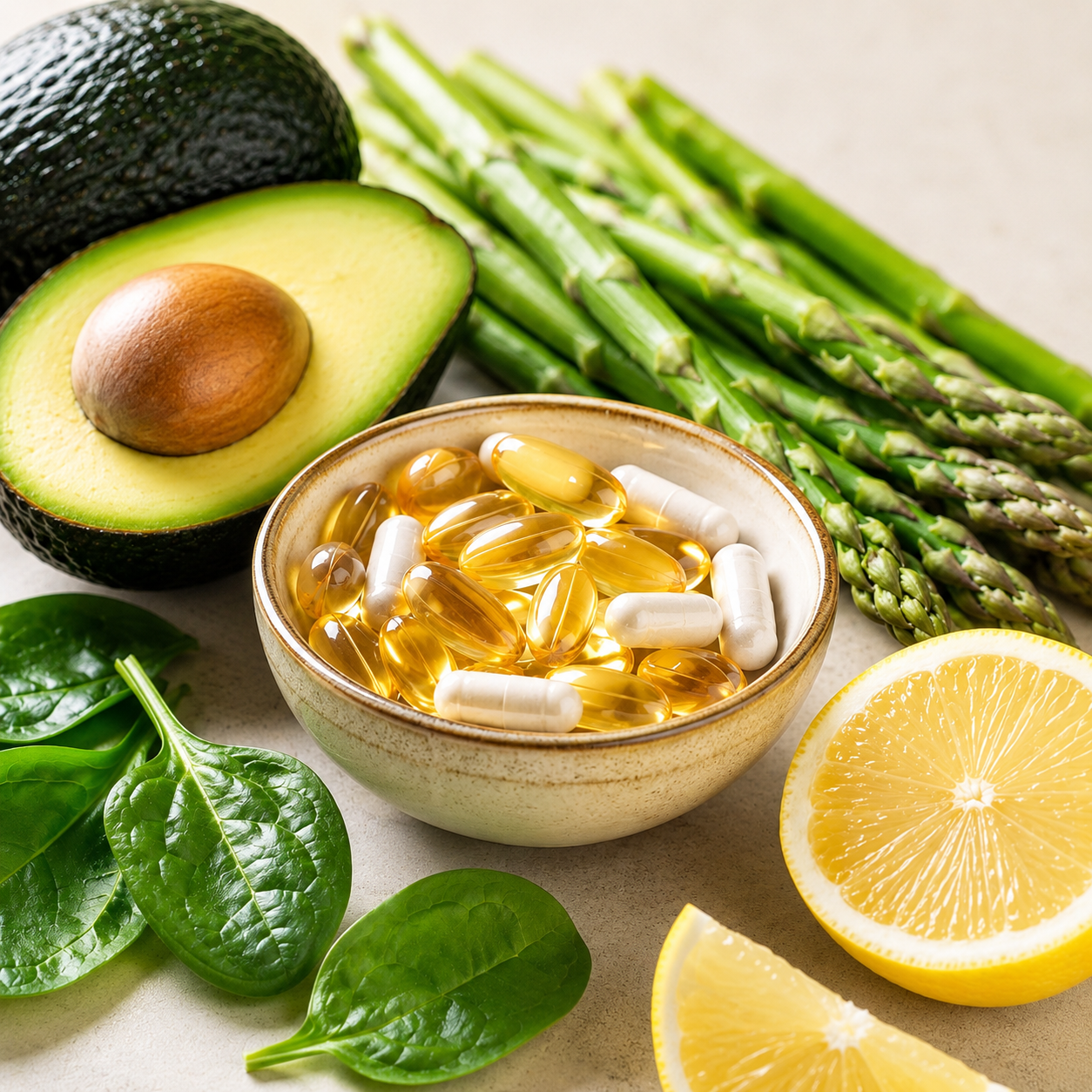
Common Foods With Higher Glutathione Content
| Food | State | Approx. Reduced Glutathione per 100 g | How to Interpret It |
|---|---|---|---|
| Asparagus | Cooked | About 21.8 mg GSH | Relatively high in classic food analyses; interpret it specifically as a cooked-food value. |
| Avocado | Raw | About 20.6 mg GSH | One of the more notable natural sources among fruits. |
| Spinach | Raw | About 11.4 mg GSH | Relatively high among leafy vegetables. |
| Okra | Cooked | About 11.3 mg GSH | A cooked sample still showed a relatively high amount. |
| Potato with skin | Boiled | About 11.0 mg GSH | A relatively useful source among common starchy foods. |
| Tomato | Raw | About 7.5 mg GSH | Lower in concentration but easy to include regularly. |
Classic figures such as about 28.3 mg/100 g for asparagus and 27.7 mg/100 g for avocado refer to total glutathione (GSHt), not reduced GSH. Food glutathione content also does not directly equal the amount that reaches human cells or skin.
How Much Can Food Provide in a Day?
Example 1
100 g avocado + 100 g tomato provides about 28 mg of reduced glutathione. This is only to show the scale of natural food exposure, not a daily intake target.
Example 2
100 g cooked asparagus + 100 g raw spinach provides about 33 mg of reduced glutathione. Do not eat unusually large amounts of one food just to match the 250–500 mg doses used in skin studies.
Cooking and storage tips
Match the food state: Raw, cooked, frozen, and differently processed values cannot be interchanged.
Avoid unnecessary heavy processing: Fresh foods are generally more informative than highly processed or long-stored foods.
Frozen does not automatically mean poor: Do not assume freezing always causes a large loss of GSH; check the actual analyzed state.
Do not chase supplement doses with food: Do not pile up one food just to reach several hundred milligrams.
Whole foods vs supplements
Whole Foods
- Also provide protein, vitamins, minerals, and plant bioactives
- GSH amounts are spread across foods and depend on food state
- Better suited to a long-term healthy dietary pattern
- Not designed to deliver a fixed skin-study dose
Supplements
- Provide a concentrated, clearly labeled glutathione dose
- Make it easier to reach the 250–500 mg range used in skin studies
- Standard, special-delivery, and combination formulas need separate interpretation
- Require additional consideration of need, observation period, and risk
Dosage
Glutathione has no established RNI, RDA, AI, formal UL, or universal daily recommended dose. Human oral studies commonly use about 250–1,000 mg/day, while single-ingredient skin studies mainly use about 250–500 mg/day for 4–12 weeks.
Skin Goals, Body GSH Research, and Dose Boundaries
Human Skin-Study Doses
These are study doses, not whitening recommendations, daily requirements, or official recommended intakes.
Body GSH and Oral-Supplement Studies
Study Range, Longer-Term Data, and Dose–Response
Important Note
Glutathione has no established RNI, RDA, AI, formal UL, or universal daily recommended dose.
250–500 mg glutathione/day is simply a common range in human skin studies, not a whitening recommendation.
1,000 mg/day is not necessarily better for skin than 500 mg or 250 mg, and it is not a UL.
Liposomal delivery, higher absorption, or a larger milligram number does not guarantee a stronger skin effect.
How Exposure & Duration Affect Interpretation
Conventional oral results may depend on duration: 1,000 mg/day for 4 weeks did not clearly change GSH status, while 250–1,000 mg/day for 6 months increased body GSH in another study.
Higher blood or cellular GSH does not mean skin effects rise in parallel.
Liposomal delivery may alter exposure, but pharmacokinetic differences among conventional, liposomal, or micellar products do not prove different skin outcomes.
Higher absorption cannot be translated directly into stronger brightening, anti-wrinkle, or anti-aging effects.
How to Read Common Product Doses
For conventional glutathione products, the package milligrams usually are the actual target-ingredient dose. Focus on the form, Serving Size, daily total, skin-related co-ingredients, and delivery system.
| Product | Package / Label Number | Dose That Is Actually Comparable | Formulation | How to Read It |
|---|---|---|---|---|
| NOW Foods Glutathione 500 mg Veg CapsulesOfficial product link | 500 mg Reduced Glutathione/capsule | 500 mg reduced glutathione/capsule | Conventional reduced form Combination formula |
500 mg is the actual glutathione dose. Milk thistle extract 100 mg and alpha-lipoic acid 50 mg are counted separately and do not make this 650 mg glutathione. |
| NOW Foods Glutathione Skin Brightener™ with Ceramosides® Veg CapsulesOfficial product link | 250 mg reduced glutathione + 30 mg phytoceramide complex/serving | 250 mg reduced glutathione/serving | Skin combination Combination formula |
Evaluate the 30 mg Phytoceramides separately. Do not add it to make 280 mg glutathione, and do not attribute every skin effect of the combination to GSH. |
| NOW Foods Liposomal Glutathione Veg CapsulesOfficial product link | 500 mg Reduced Glutathione/2 capsules | 500 mg reduced glutathione/serving (2 capsules) | Liposomal Phospholipid delivery |
Serving Size is 2 capsules, not 500 mg per capsule. Phospholipid delivery may alter exposure, but stronger skin effects have not been established. |
| Solgar Reduced L-Glutathione 250 mg Vegetable CapsulesOfficial product link | 250 mg Reduced L-Glutathione/capsule | 250 mg reduced glutathione/capsule | Conventional reduced form Free form |
250 mg is the actual glutathione dose and is close to the lower ranges used in skin and body-GSH studies. No standardization conversion is needed. |
| Jarrow Formulas Glutathione Reduced 500 mgOfficial product link | 500 mg Reduced Glutathione/capsule | 500 mg reduced glutathione/capsule | Conventional reduced form Free form |
500 mg is the actual target-ingredient dose. Daily Value (DV) has not been established and should not be interpreted as a daily requirement. |
| Jarrow Formulas S-Acetyl L-Glutathione 100 mgOfficial product link | 100 mg S-Acetyl L-Glutathione/tablet | 100 mg S-Acetyl L-Glutathione/tablet | S-acetyl form Stabilized form |
There is no reliable formula for converting this to an equivalent amount of conventional reduced glutathione. Do not rank it mechanically against 250 or 500 mg conventional products. |
NOW Foods Glutathione 500 mg Veg Capsules
Official product link- Package / Label Number
- 500 mg Reduced Glutathione/capsule
- Dose That Is Actually Comparable
- 500 mg reduced glutathione/capsule
- Formulation
- Conventional reduced form
Combination formula
- How to Read It
- 500 mg is the actual glutathione dose. Milk thistle extract 100 mg and alpha-lipoic acid 50 mg are counted separately and do not make this 650 mg glutathione.
NOW Foods Glutathione Skin Brightener™ with Ceramosides® Veg Capsules
Official product link- Package / Label Number
- 250 mg reduced glutathione + 30 mg phytoceramide complex/serving
- Dose That Is Actually Comparable
- 250 mg reduced glutathione/serving
- Formulation
- Skin combination
Combination formula
- How to Read It
- Evaluate the 30 mg Phytoceramides separately. Do not add it to make 280 mg glutathione, and do not attribute every skin effect of the combination to GSH.
NOW Foods Liposomal Glutathione Veg Capsules
Official product link- Package / Label Number
- 500 mg Reduced Glutathione/2 capsules
- Dose That Is Actually Comparable
- 500 mg reduced glutathione/serving (2 capsules)
- Formulation
- Liposomal
Phospholipid delivery
- How to Read It
- Serving Size is 2 capsules, not 500 mg per capsule. Phospholipid delivery may alter exposure, but stronger skin effects have not been established.
Solgar Reduced L-Glutathione 250 mg Vegetable Capsules
Official product link- Package / Label Number
- 250 mg Reduced L-Glutathione/capsule
- Dose That Is Actually Comparable
- 250 mg reduced glutathione/capsule
- Formulation
- Conventional reduced form
Free form
- How to Read It
- 250 mg is the actual glutathione dose and is close to the lower ranges used in skin and body-GSH studies. No standardization conversion is needed.
Jarrow Formulas Glutathione Reduced 500 mg
Official product link- Package / Label Number
- 500 mg Reduced Glutathione/capsule
- Dose That Is Actually Comparable
- 500 mg reduced glutathione/capsule
- Formulation
- Conventional reduced form
Free form
- How to Read It
- 500 mg is the actual target-ingredient dose. Daily Value (DV) has not been established and should not be interpreted as a daily requirement.
Jarrow Formulas S-Acetyl L-Glutathione 100 mg
Official product link- Package / Label Number
- 100 mg S-Acetyl L-Glutathione/tablet
- Dose That Is Actually Comparable
- 100 mg S-Acetyl L-Glutathione/tablet
- Formulation
- S-acetyl form
Stabilized form
- How to Read It
- There is no reliable formula for converting this to an equivalent amount of conventional reduced glutathione. Do not rank it mechanically against 250 or 500 mg conventional products.
Health Effects
Raising Body Glutathione
250 or 1,000 mg glutathione/day for 6 months increased some blood and cellular glutathione measures, while 1,000 mg/day for 4 weeks did not clearly change glutathione status. Higher glutathione does not mean the body as a whole becomes younger.
View randomized controlled trial
Skin Pigmentation & Brightening
Systematic reviews of oral human studies suggest about 250–500 mg glutathione/day may slightly lower melanin index at some sites. Results are not fully consistent, studies are generally small, and long-term persistence is unclear. This is better interpreted as possible mild brightening, not dramatic whole-body whitening or a change in natural skin tone.
View systematic review
Wrinkles & Skin Condition
A 12-week study using 250 mg/day of reduced or oxidized glutathione reported changes in some wrinkle, hydration, and other skin measures. Improved wrinkles ≠ age reversal; better hydration ≠ complete barrier restoration; evidence for elasticity is weaker.
View randomized controlled trial · View systematic review
Antioxidant Status
Glutathione is part of normal antioxidant defense, but short-term oral supplementation does not necessarily change systemic oxidative-stress measures. Laboratory changes should not be equated with noticeable benefit or disease prevention.
View randomized controlled trial
Immune Function
A small liposomal pilot study reported changes in some immune-related measures, but the sample was small and does not establish that glutathione clearly “boosts immunity” in generally healthy adults.
View pilot study
Healthy Aging
Current evidence does not show that oral glutathione slows whole-body biological aging, reverses skin aging, prevents chronic disease, or extends lifespan.
View systematic review
Product Selection
If skin is the main goal, start with the specific glutathione form, actual GSH per serving, skin-related co-ingredients, delivery system, and product quality.
Check These Four Things
What is the active ingredient?
Confirm whether the product contains Reduced Glutathione, Oxidized Glutathione (GSSG), Liposomal Glutathione, or S-Acetyl L-Glutathione.
How much do you actually get per serving?
Check Serving Size and Amount Per Serving. 500 mg per 2 capsules is very different from 500 mg per capsule; calculate the actual daily glutathione intake.
Are there unnecessary added ingredients?
Evaluate Phytoceramides, milk thistle, alpha-lipoic acid, vitamin C, and other ingredients separately. Do not add them to the GSH dose or attribute all effects of a combination formula to GSH.
Is quality control credible?
Check the form, dose, capsules per serving, manufacturer, lot number, expiration date, quality standards, and verifiable testing. Phospholipids or Phosphatidylcholine describe delivery and do not prove a skin benefit.
How to Read the Label6 steps to read a glutathione label
Specific form → actual GSH per serving → Serving Size → usually no standardization math → skin co-ingredients → delivery system & quality
Phytoceramides 30 mg; evaluate separately
Follow the actual product directions; they are not a site-recommended dose.
Form | Dose per serving | Co-ingredients | Lot number | Quality testing
250 mg reduced glutathione + 30 mg phytoceramide complex does not equal 280 mg glutathione. Conventional glutathione usually does not require a standardization conversion.
Confirm the specific form first
Find Reduced Glutathione, Liposomal Glutathione, or S-Acetyl L-Glutathione rather than relying on whitening or high-absorption claims on the front.
Find actual GSH per serving
Locate the glutathione milligrams under Amount Per Serving.
Check Serving Size
Confirm whether one serving is 1 or 2 capsules. 500 mg/2 capsules must not be read as 500 mg/capsule.
Usually no standardization math is needed
If the label lists Reduced Glutathione 500 mg, that 500 mg is already the target-ingredient dose.
Separate skin co-ingredients
Count phytoceramides, milk thistle, alpha-lipoic acid, and vitamins separately.
Interpret delivery terms separately
Liposomal, Phospholipids, and Phosphatidylcholine describe delivery and do not prove stronger skin effects.
How to Choose Among Common FormsFor skin goals, prioritize forms that match direct human evidence rather than high-absorption marketing
Conventional Reduced Glutathione
Main features
Reduced Glutathione is the most common form and is the direct form used in single-ingredient skin studies around 250–500 mg/day.
Site guidance
For a skin-focused trial, a clearly dosed conventional reduced-glutathione product can be a reasonable starting point. There is no need to default to an expensive special formulation.
Liposomal Glutathione
Main features
Liposomal Glutathione uses phospholipid delivery and may alter human exposure.
Site guidance
There are not enough skin randomized trials to show clearly better brightening, wrinkle, or elasticity outcomes. Also check the capsules per serving.
S-Acetyl L-Glutathione
Main features
S-Acetyl L-Glutathione is promoted for greater stability and is often sold at lower milligram amounts. There is no reliable conversion to conventional reduced glutathione.
Site guidance
Direct human skin evidence is more limited. Do not assume 100 mg of this special form is equivalent to a larger amount of conventional GSH.
Skin Combination Formulas
Main features
May combine reduced glutathione with Phytoceramides, L-cystine, or other skin-focused ingredients.
Site guidance
These can be considered when both tone and hydration are goals, but each ingredient and its evidence must be evaluated separately.
How to Take
Glutathione has no universal recommended dose. Single-ingredient skin studies mainly use about 250–500 mg/day for 4–12 weeks; this is a research range and an observation timescale.
Default plan (healthy adults)
Official recommended dose: No RNI, RDA, AI, or universal daily recommended dose has been established
Skin-study range: About 250–500 mg glutathione/day; not a whitening recommendation
Frequency: Usually once or twice daily, depending on the product
With food or on an empty stomach?: No universal rule; manufacturer directions differ
Skin observation period: Existing studies mainly last about 4–12 weeks
Long-term use?: Use for a defined goal and reassess when the observation period ends
Missed dose: If you occasionally miss a dose, skip it; do not double the next dose
Frequently asked questions
How long should I take it for a skin goal?
Oral skin studies mainly last 4–12 weeks. That can be used as an observation window; if there is no meaningful change, reassess whether continuing is worthwhile.
Is 500 mg definitely better for whitening than 250 mg?
No. There is not enough direct dose-comparison evidence to show that. Study populations and durations differ, so the doses should not be mechanically ranked.
Is liposomal glutathione better for skin?
It may alter human exposure, but skin randomized trials have not established clearly better brightening, wrinkle, or elasticity outcomes.
Is absorption best on an empty stomach?
Manufacturer directions differ, and there is not enough evidence to require all glutathione products to be taken fasting.
How can I tell whether my skin is changing?
Use consistent lighting, camera angle, and device, and record skin-tone uniformity, spots, and overall skin condition about every 4 weeks to reduce subjective bias.
Are NAC and glutathione the same thing?
No. NAC mainly supplies the cysteine precursor that supports endogenous GSH synthesis. Their doses and human studies cannot be directly interchanged.
Risks & Precautions
Common Side Effects
- Small oral studies have generally reported good tolerability
- Some people may experience stomach upset, nausea, bloating, or other gastrointestinal intolerance
- Rash or other individual reactions may occur
- For mild symptoms, try taking it with food or lowering the dose; stop if symptoms persist
Higher-Dose Risks
- 1,000 mg glutathione/day has been used for about 6 months, but this is not a long-term safety ceiling
- Long-term benefit and safety are less certain at doses well above common study ranges
- No formal UL does not mean the dose can be increased without limit
- A higher dose does not guarantee greater skin benefit
People Who Need More Caution
- Pregnancy or breastfeeding
- Children or adolescents
- Significant liver or kidney problems
- Complex disease or cancer treatment
- Planning prolonged use at substantially high doses
- Contraindications related to other ingredients in a combination formula
Medications, Treatment & Intravenous Use
- There is no mature, standardized list of classic glutathione drug interactions
- During cancer treatment, complex medication use, major chronic disease, or before surgery, do not add high-dose glutathione solely because it is an antioxidant
- Intravenous glutathione is not simply oral glutathione with higher absorption; it involves sterile compounding and medical administration
- A 2019 FDA event involved compounded intravenous products containing 1,400 mg L-glutathione and endotoxin concerns
- In August–September 2026, the FDA posted multiple warnings and recalls involving compounded injectable glutathione because of elevated endotoxin or ingredient-quality concerns. These events involved compounded injections and should not be interpreted as evidence that ordinary oral glutathione supplements carry the same risk.
Stop and Ask for Advice
Stop use and ask a doctor or pharmacist if persistent gastrointestinal symptoms, rash, or another clear new reaction develops.
Seek Medical Care Promptly
After an injection, seek immediate medical care for fever, chills, difficulty breathing, marked low blood pressure, or another severe systemic reaction.
Sources
These sources replace the previous list. Paper titles, institutions, and official product names are retained in their original English, and every entry includes a direct clickable URL.
Basic Information & Regulatory Sources
Food Sources
Body Glutathione & Oral Dosing
Skin Pigmentation, Brightening & Skin Condition
Safety Sources
Mainstream Product Information
Last updated: August 14, 2026