Zinc
Zinc / Zn / Elemental Zinc
Zinc is an essential trace mineral that the body cannot make and must obtain regularly from food. It supports the normal activity of hundreds of enzymes and is involved in immune function, protein and DNA synthesis, cell division, wound healing, and normal taste.
30-second check: which situation fits you best?
Your Food Sources of Zinc Are Consistent
You regularly eat meat, seafood, dairy, or eggs, or you combine legumes, nuts, and seeds well, without a long-term restrictive diet. Your current multivitamin also does not suggest a clear zinc gap.
Your Food Sources of Zinc Are Often Low
Long-term low intake of seafood and meat, limited food variety, or a diet centered on whole grains and legumes with a high phytate load can reduce the amount of zinc you actually absorb. Because phytate in plant foods lowers zinc bioavailability, vegetarians and vegans need to pay particular attention to food choices and preparation.
Your Basics Are Good; Your Goal Is Immunity or Healthy Aging
Your diet is already stable and there is no obvious zinc gap, but you are hoping for extra benefits for immunity, skin, exercise recovery, antioxidant protection, or long-term health.
Basic Overview
What it is
Zinc is an essential trace mineral. The body cannot make it, so it must come mainly from food, with supplements used when intake is insufficient. Zinc participates in hundreds of enzyme reactions and supports immunity, protein and DNA synthesis, cell signaling and division, tissue repair, and normal taste. The body can regulate zinc absorption and excretion, but it still requires a regular dietary supply.
Why people use it
- You rarely eat major sources such as seafood or meat
- You follow a long-term vegetarian or vegan diet, where zinc bioavailability can be lower
- Your diet lacks variety and you want a more reliable baseline intake
- You have a known gastrointestinal condition that can impair zinc absorption
- You are evaluating zinc for basic support of immunity, skin, or tissue repair
- You use specific zinc lozenges during a cold, which is a separate use case
How it relates to healthy aging
Adequate zinc supports cell renewal, immune responses, protein synthesis, and tissue repair—all basic requirements for long-term body function. Correcting a true zinc shortfall has clear value.
But zinc is not an “anti-aging supplement.” In healthy adults who already have adequate zinc status, there is no reliable evidence that chronically increasing the dose keeps strengthening immunity, slows overall aging, or produces a noticeably more youthful state.
Supplement Assessment
Do I need a supplement? Start by seeing which group fits you.
Usually No Dedicated Supplement Needed
- You regularly eat meat, fish, shellfish, dairy, or eggs
- Eat a varied diet
- You regularly eat legumes, nuts, and seeds
- Your current multivitamin already contains some zinc
- You do not follow a markedly restrictive diet
- Your main reason is simply to “boost immunity” or pursue anti-aging with high-dose zinc
Your next step:
Keep your current diet and check the total elemental zinc across supplements you already use. If food reliably covers the reference intake, there is no need to add a separate high-dose zinc product.
You May Have an Intake Gap
- You rarely eat meat or seafood over the long term
- You follow a long-term vegan or mostly plant-based diet
- You eat plenty of legumes, whole grains, and seeds but use few preparation methods that reduce phytate
- You are a long-term picky eater or have very limited food variety
- Your current diet makes it difficult to consistently reach the adult reference intake
Your next step:
Increase natural food sources first. If you still cannot meet needs consistently, choose a low dose of elemental zinc based on the actual dietary gap.
Talk to a Health Professional First
- Long-term malabsorption problems such as inflammatory bowel disease or celiac disease
- A history of bariatric or gastrointestinal surgery that affects absorption
- Known copper deficiency, unexplained anemia, or neurologic symptoms
- You are taking tetracycline or quinolone antibiotics
- You are taking penicillamine
- You plan to take 20–40 mg or more of zinc long term
- Pregnancy, breastfeeding, or another situation where standard adult guidance should not be applied directly
Your next step:
Ask a physician, pharmacist, or qualified nutrition professional to determine whether supplementation is actually needed and whether the dose or other related tests should be adjusted.
Quick self-check
Over the past week, have you regularly eaten meat, seafood, dairy, eggs, or other major zinc sources?
Do you follow a long-term vegan or vegetarian diet, or rely heavily on whole grains and legumes?
Do your current multivitamins, mineral supplements, or cold products already contain zinc?
Do you have chronic diarrhea, gastrointestinal malabsorption, or a history of gastrointestinal surgery?
Are you taking a supplement that provides 25 mg or more of iron?
Are you taking any medications that may interact with zinc?
Food Sources
The per-100-g values below were converted and rounded from the serving sizes listed by NIH. Actual amounts vary by variety, cut, and cooking method.
Representative food sources
| Food | Preparation | Approx. per 100 g | Common Serving | Approx. per Serving | % of China Adult RNI |
|---|---|---|---|---|---|
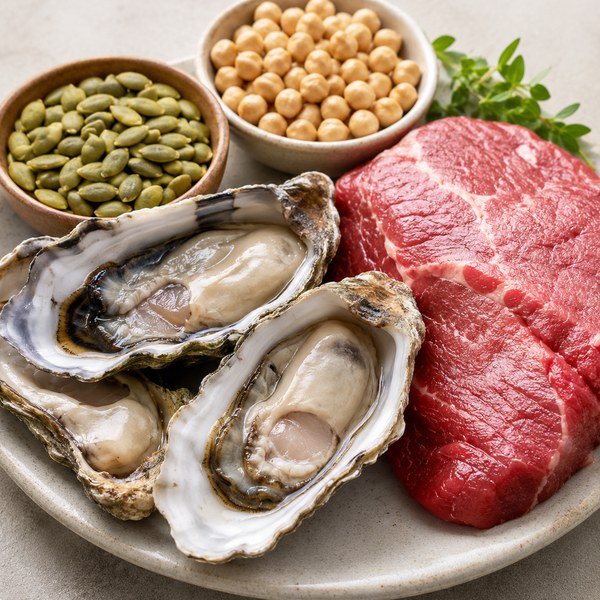
| Pacific oysters | Cooked | about 33.2 mg | 85 g | about 28.2 mg | 226%—332% |
| Pumpkin seeds | Roasted | about 7.8 mg | 28 g | about 2.2 mg | 18%—26% |
| Beef | Roasted | about 4.5 mg | 85 g | about 3.8 mg | 30%—45% |
| Blue crab | Cooked | about 3.8 mg | 85 g | about 3.2 mg | 26%—38% |
| Cheddar cheese | Natural | about 3.5 mg | 42 g | about 1.5 mg | 12%—18% |
| Peanuts | Roasted | about 2.8 mg | 28 g | about 0.8 mg | 6%—9% |
| Pork loin | Roasted | about 2.2 mg | 85 g | about 1.9 mg | 15%—22% |
| Turkey breast | Roasted | about 1.8 mg | 85 g | about 1.5 mg | 12%—18% |
Percentages are based on the 2023 China adult RNI of 8.5–12.5 mg/day, so they are shown as ranges.
How to get it from food in a day
Example One
An 85-g serving of cooked Pacific oysters provides about 28.2 mg of zinc. One serving already exceeds the daily RNI for most adults, so oysters can make a large contribution without needing to be eaten in large amounts every day just to “get more zinc.”
Example Two
This provides about 66%–98% of the China adult RNI; grains, dairy, eggs, meat, or legumes eaten at other meals will add more zinc.
Cooking and storage tips
Zinc is stable during ordinary heating, so cooking does not meaningfully destroy the mineral.
A small amount of zinc can move into cooking liquid, so consuming the broth can help retain it.
Soaking legumes, whole grains, and seeds can reduce some of the effect of phytate.
Fermentation can lower some phytate and improve zinc bioavailability from plant foods.
Whole foods vs supplements
Whole Foods
- Also provides protein and other nutrients
- Better suited as a long-term foundation
- Animal sources are generally more bioavailable
- Plant sources are more affected by phytate
Zinc Supplements
- Provides a clear, consistent elemental zinc dose
- Convenient when there is a dietary gap
- Makes duplicate intake easier
- Long-term high doses can impair copper status
Dosage
How much zinc is appropriate each day, and what should you count when using a supplement?
China and U.S. Adult Reference Intakes and Upper Limits
Reference points: U.S. RDA 8–11 mg/day, China RNI 8.5–12.5 mg/day, and a 40 mg/day UL in both systems. The site's practical range of about 5–10 mg/day is not placed on the axis because it is not an official intake reference.
Special populations:This section is intended for generally healthy adults. Children, adolescents, pregnancy, breastfeeding, confirmed deficiency, gastrointestinal malabsorption, and people receiving medical treatment should not automatically use these default values.
Chinese and U.S. Reference Standards
China RNI
8.5–12.5 mg/day
UL (Tolerable Upper Intake Level)
40 mg/day
U.S. RDA
8–11 mg/day
UL (Tolerable Upper Intake Level)
40 mg/day
China's RNI differs by sex: 8.5 mg/day for adult women and 12.5 mg/day for adult men, with the same sex difference across adult age groups 18–64. The U.S. RDA for adults age 19+ is 8 mg/day for women and 11 mg/day for men.
Absorption & Use
Zinc absorption is strongly regulated: as intake rises, the total amount absorbed increases, but the percentage absorbed falls. NIH also notes that zinc absorption from food can range from about 5% to over 50%, largely depending on phytate content and overall diet composition.
A study in healthy adult men illustrates this clearly: average fractional absorption was about 60.9% from a 4 mg zinc diet and about 36.1% from an 11 mg zinc diet, while the total amount absorbed still increased from about 2.48 mg to 3.60 mg.
Health Effects
Immune Function
Zinc is involved in normal immune responses, and deficiency can impair multiple immune functions, so correcting a clear shortfall has established value. But in healthy adults with adequate zinc intake, there is no reliable evidence that chronically increasing the dose continues to “boost immunity.” Long-term excess can instead impair immune function.
View official guidance
Protein, DNA & Cell Renewal
Zinc supports protein and DNA synthesis, cell signaling, and cell division, making it a basic nutrient for normal tissue maintenance and renewal. Correcting inadequate intake is physiologically important, but once needs are met, there is no evidence that taking more makes cells “repair faster” or makes the body younger overall.
View official guidance
Skin & Wound Healing
Zinc contributes to normal wound healing, and zinc deficiency can be associated with skin changes and delayed healing, so repletion is useful when deficiency is present. In healthy adults with adequate nutrition, however, extra zinc has not been shown to reliably improve skin texture, acne, collagen status, or produce a clear “anti-aging” effect.
View official guidance
Taste & Smell
Zinc is involved in normal taste, and deficiency can affect taste and smell, so correcting a confirmed shortfall can be meaningful. But changes in taste or smell can result from many illnesses, infections, and medications, so these symptoms alone do not establish zinc deficiency, and high-dose zinc should not be used as a general treatment.
View official guidance
Common Cold
Some studies suggest that using certain zinc lozenges or oral products early after cold symptoms begin may shorten symptom duration by about 2 days. Effects on preventing colds and reducing symptom severity are less consistent, and certainty in the evidence is limited. This is a short-term, specific use case and does not support long-term high-dose zinc use in healthy people.
View Cochrane review
Inflammation, Metabolism & Healthy Aging
Zinc participates in many cellular and immune processes, and some studies in people with disease have reported changes in inflammatory or metabolic markers. That does not prove that extra zinc lowers chronic-disease risk or slows aging in healthy adults who already have adequate zinc status. Its most appropriate role is maintaining adequate nutrition, not serving as a routine anti-inflammatory or anti-aging supplement.
View official guidance
Product Selection
What Should I Look for on the Label?
Only Check These Four Things
What Is the Active Ingredient?
First identify the zinc form on the label, such as zinc glycinate/bisglycinate, gluconate, citrate, sulfate, acetate, or oxide. What you need to calculate is the elemental zinc provided—not the total weight of the zinc salt or chelate.
How Much Is Actually in Each Serving?
Check how much elemental zinc each capsule or serving provides and how many servings are suggested per day, then calculate the daily total. Also check multivitamins, mineral products, and cold lozenges to avoid stacking products and staying near 40 mg/day long term.
Are There Unnecessary Additives?
Standard tablets or capsules do not need a complicated formula. For gummies and lozenges, also check added sugar, sweeteners, flavors, and colors. Combining zinc with vitamin C, copper, or other minerals is not automatically a problem, but make sure those ingredients fit your goals and are not duplicated elsewhere.
Is Quality Control Verifiable?
Prefer products with clear manufacturing and quality information, and look for third-party verification, label-claim accuracy, and control of contaminants such as heavy metals and microbes. Independent programs such as USP Verified or NSF can provide quality information, but they do not certify clinical effectiveness.
How to Read the LabelExample: a product providing 10 mg elemental zinc per serving
Take 1 time daily, 1 serving (1 capsule), with or after a meal; if your stomach is sensitive, take it with food and consider a lower single dose.
Capsule shell, fillers, etc. (see actual product label).
Manufacturer, lot, expiration, GMP, USP, NSF, or third-party testing information (see actual product label).
*This example is 1 capsule per serving and provides 10 mg elemental zinc: 10 mg ÷ the FDA Daily Value of 11 mg ≈ 91%. For commercial products, use the actual label and check the elemental zinc per capsule and per serving. This is an educational example, not certification of an actual product label. %DV uses FDA Daily Values for adults and children aged 4 and older, excluding pregnancy and lactation; this adult example is not a child dosage recommendation. FDA Daily Values.
Product Form
Start with the zinc form: glycinate/bisglycinate, gluconate, citrate, sulfate, acetate, or oxide. Calculate the elemental zinc provided, not the total weight of the zinc salt or chelate.
Elemental Zinc per Serving
Check how much elemental zinc each capsule, tablet, or serving actually provides—for example, Zinc 10 mg—not the total weight of the zinc compound.
Serving Size
Confirm whether one serving is one capsule, two capsules, or one scoop, and how many servings are suggested per day so you do not confuse the per-serving amount with the daily total.
Other Ingredients
Distinguish capsule shells and fillers from added sugar, sugar alcohols, sweeteners, flavors, and colors in gummies or lozenges. These ingredients do not make zinc itself more effective.
Quality Information
Check the manufacturer, lot number, expiration date, and any GMP, USP, NSF, or third-party testing information. Certification mainly supports label/manufacturing reliability; it does not prove stronger health effects.
How to Choose a FormPractical differences and whether they are worth choosing
Zinc Glycinate / Bisglycinate
Practical Difference
An amino-acid chelate commonly used in supplements. Small human studies suggest good absorption. In a randomized crossover study of 12 healthy women, a single 15 mg elemental-zinc dose from zinc bisglycinate had about 43.4% higher oral bioavailability than zinc gluconate.
Worth Choosing?
A reasonable first choice, but there is no need to pay a large premium simply for “chelated” or “high absorption” claims.
Zinc Gluconate / Citrate
Practical Difference
Common forms with reasonable human absorption data; zinc citrate and zinc gluconate have similar absorption.
Worth Choosing?
A reasonable first choice.
Zinc Sulfate / Acetate
Practical Difference
Common effective forms; zinc acetate is also widely used in cold lozenges.
Worth Choosing?
A reasonable option.
Zinc Oxide
Practical Difference
Contains a high proportion of elemental zinc and is inexpensive, but some human studies suggest slightly lower absorption. In one fasting study using 10 mg elemental zinc, median absorption from zinc oxide was about 50%.
Worth Choosing?
Usually not necessary as a first choice.
How to Read Zinc Glycinate / Bisglycinate
Zinc glycinate—especially zinc bisglycinate, which is common in supplements—is an amino-acid chelate. In a randomized crossover study of 12 healthy women, a single 15 mg elemental-zinc dose from zinc bisglycinate had about 43.4% higher oral bioavailability than zinc gluconate.
However, this was a small study and measured absorption after a single dose. Higher bioavailability does not mean greater immune, skin, or other health benefits in healthy adults whose zinc intake is already adequate.
So zinc glycinate/bisglycinate can be one reasonable everyday option, but there is no need to pay a large premium solely for “chelated” or “high absorption” claims.
Absorption Comparison of Other Forms
In a crossover study of 15 healthy adults taking 10 mg elemental zinc while fasting, median absorption was about 61% from zinc citrate and zinc gluconate and about 50% from zinc oxide. This suggests absorption can differ by form, but it does not show that healthy people will experience meaningfully different long-term health outcomes.
How to Take
When should you take it, and what is the most practical way to use it?
Default plan (healthy adults)
Suggested Dose: For a mild dietary gap, a practical starting point is about 5–10 mg/day of elemental zinc, adjusted for food intake.
Frequency: Usually 1 time daily is enough
Stomach Tolerance: Absorption may be better on an empty stomach, but nausea is more common; take it with food if fasting causes nausea
If Mild Discomfort Occurs: Lower the single dose, take it with food, and divide the dose if needed
Long-Term Use?: There is no fixed course. Continue a low dose while the dietary gap persists; reduce or stop once intake improves
Missed Dose: If you miss a dose, skip it and resume your usual amount next time; do not double the dose
Frequently asked questions
With Food or on an Empty Stomach?
Food—especially a high-phytate meal—can reduce zinc absorption, but taking zinc on an empty stomach is more likely to cause nausea. For healthy adults filling a dietary gap, tolerability and consistency matter more than forcing fasting use.
Do I Need to Split the Dose?
A low dose around 5–10 mg usually does not need to be divided. If one dose causes stomach upset, lower it or split it.
What Time Should I Take It?
There is no clear evidence that zinc must be taken in the morning or evening. Choose a time you can follow consistently that also avoids conflicts with relevant medications.
Should I Separate It from Other Supplements?
High-dose iron deserves attention: taking ≥25 mg elemental iron at the same time may reduce zinc absorption, so a higher-dose iron supplement can be separated from zinc by about 2 hours. Iron in ordinary foods usually does not need to be separated. Calcium and magnesium at typical daily doses do not automatically need to be spaced away from zinc; if you use several high-dose minerals, separating them and checking the totals is more reasonable.
More questions about use (click to expand)
How Long Should I Take It?
If the goal is to fill a long-term dietary gap, use zinc while the gap remains and periodically reassess your diet and other supplements. Once intake becomes reliable, you can reduce or stop rather than assuming lifelong use.
How Can I Tell Whether It Is Working?
Zinc is a basic nutrient. If you are not clearly deficient, supplementation often produces no obvious subjective change. A better way to judge use is whether the dietary gap is filled and total intake is sensible; if medical risk factors are present, add professional assessment and serum or plasma zinc testing when appropriate.
Do I Need to Separate It from Medications?
Quinolone and tetracycline antibiotics should be taken at least 2 hours before zinc or 4–6 hours after zinc. Penicillamine should be separated from zinc by at least 1 hour.
Risks & Precautions
Common Side Effects
- Nausea
- Stomach upset
- Vomiting
- Abdominal discomfort or diarrhea
- Headache or metallic taste
- For mild stomach upset, try taking zinc with food or lowering the dose. If symptoms persist or are significant, stop self-directed use.
High-Dose Risks
- Taking 50 mg/day or more for several weeks can inhibit copper absorption and lower copper status
- It may also impair immune function and lower HDL cholesterol
- Longer and higher-dose use can also lead to anemia or neurologic problems
- The adult UL is 40 mg/day of total intake; 40 mg/day is a UL, not a target—reaching 40 mg every day is not better
Use Higher Doses with Extra Caution If You Are
- People with known or suspected copper deficiency
- People who use multiple zinc-containing products long term
- People with gastrointestinal malabsorption or prior gastrointestinal surgery
- People taking medications that interact with zinc
- People planning to use 20–40 mg or more as a supplement long term
- Children, pregnancy, breastfeeding, and others who need separate reference values
Special Situations
- Antibiotics: tetracycline and quinolone antibiotics can interfere with zinc absorption and vice versa, so they should be separated as directed.
- Penicillamine: separate it from zinc by at least 1 hour to reduce interference with drug absorption and action.
- Intranasal zinc products: do not self-treat colds with zinc nasal sprays or other intranasal zinc products. The FDA received more than 130 reports of loss of smell associated with intranasal zinc products and considers high nasal zinc exposure a serious safety concern. This is a different route of use from ordinary oral zinc supplements.
Stop and Seek Advice
Persistent nausea, repeated vomiting, significant abdominal pain, or diarrhea: stop use and recheck the dose.
Seek Prompt Medical Evaluation
Unexplained anemia, numbness, gait changes, or other neurologic symptoms after long-term high-dose use: stop self-supplementation and seek medical evaluation because chronic excess zinc can cause secondary copper deficiency.
Sources
This page supports the basic information, food sources, reference intakes, upper limits, health effects, product selection, use, and safety guidance for zinc. It is intended mainly for generally healthy adults and does not directly apply to children, pregnancy, breastfeeding, confirmed deficiency, or people receiving medical treatment.
Nutrition Standards & Basic Data
Use: China adult RNI, UL, and official age- and sex-specific reference values for adults 18–64.
Use: U.S. RDA and UL, physiological roles, food sources, absorption, deficiency risk, supplement forms, high-dose risks, and drug interactions.
Use: Additional checking of nutrient content and food-state data for whole foods.
Absorption, Utilization & Product Forms
The American Journal of Clinical Nutrition. 87(5):1224–1229. DOI: 10.1093/ajcn/87.5.1224
Use: Explains the dose-utilization pattern in which fractional zinc absorption falls as intake rises.
International Journal for Vitamin and Nutrition Research. 77(4):243–248. DOI: 10.1024/0300-9831.77.4.243
Use: Single-dose human absorption comparison of zinc bisglycinate and zinc gluconate. In 12 healthy women given 15 mg elemental zinc, oral bioavailability from zinc bisglycinate was about 43.4% higher. The study was small, so it is used only to illustrate absorption differences, not to show superior long-term health outcomes.
The Journal of Nutrition. 144(2):132–136. DOI: 10.3945/jn.113.181487
Use: Human absorption comparison of zinc citrate, zinc gluconate, and zinc oxide.
Health Effects & Scientific Evidence
Cochrane Database of Systematic Reviews. 2024(5). DOI: 10.1002/14651858.CD014914.pub2
Use: Randomized-trial and systematic-review evidence on zinc for preventing and treating the common cold. This involves short-term cold-treatment settings and higher-dose zinc products and should not be used as a basis for long-term daily zinc supplementation in generally healthy adults.
Safety, Product & Use References
Use: Historical safety risk of loss of smell with intranasal zinc products.
Use: Third-party quality verification, manufacturing audits, label-claim accuracy, and product testing.
Use: Supplement label verification, contaminant testing, and third-party certification information.
Last updated: August 7, 2026