Berberine
Berberine / Berberine HCl / Berberine Hydrochloride / Huangliansu Tablets (medicinal context)
30-second check: which situation fits you best?
Just looking for everyday anti-inflammatory, glucose-control, or healthy-aging support
Most metabolic studies of berberine involve people with diabetes, dyslipidemia, obesity, or metabolic syndrome. Healthy adults with normal glucose and lipid levels lack good evidence that long-term supplementation provides worthwhile additional benefit.
You have a specific glucose, lipid, or weight-management goal
Evidence comes mainly from people with diabetes, dyslipidemia, and metabolic syndrome. If fasting glucose, HbA1c, LDL cholesterol, or triglycerides are already abnormal, this is approaching a disease-management setting.
You are planning to use it or already taking it
First confirm the actual berberine dose, salt form, specific formulation, and your current medications. Conventional berberine HCl and enhanced-absorption formulations such as phytosomes, emulsions, or micelles can produce different human exposure and should not be compared only by milligrams.
Basic Overview
What it is
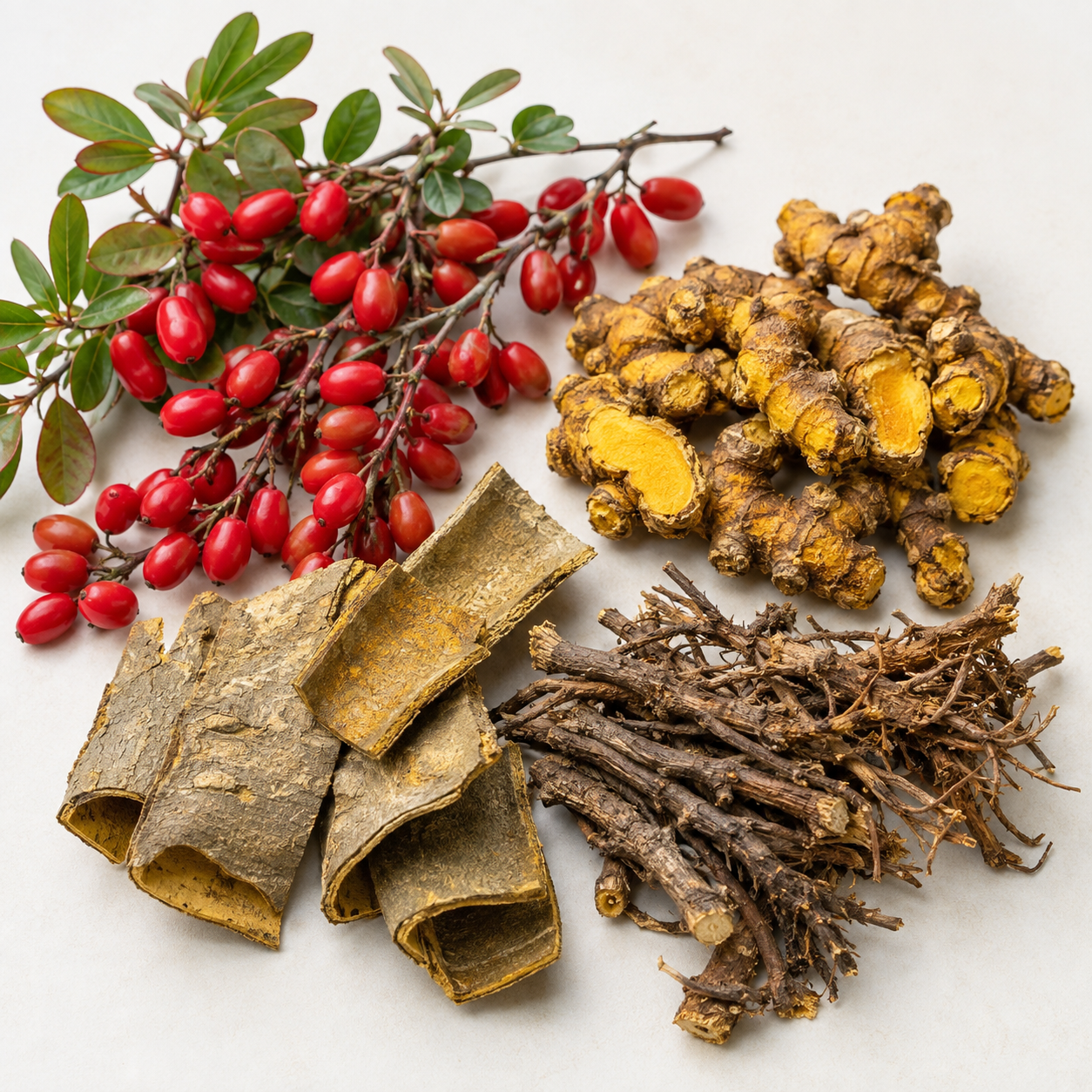
Berberine is a yellow alkaloid naturally present in medicinal plants such as Coptis, Berberis, and goldenseal. It is not an essential nutrient. Supplements most often use berberine hydrochloride, but standardized botanical extracts, phospholipid complexes, and other absorption-enhancing formulations also exist. Berberine is the active compound; berberine hydrochloride is a common salt form; and Coptis and related plants are botanical raw materials that also contain other alkaloids. Total plant-material weight is not the same as actual berberine weight. In China, “Huangliansu tablets” usually refers to berberine hydrochloride medication.
Why people use it
- Try it for specific glucose and insulin-resistance markers
- Use it for LDL cholesterol, triglycerides, or other lipid targets
- Adjunctive use in metabolic-syndrome research
- Interest driven by weight-loss or “natural GLP-1” marketing
- Obtain a more standardized dose than medicinal plant material
- Use a special delivery system to increase human exposure
How it relates to healthy aging
Glucose, blood lipids, abdominal obesity, and chronic inflammation are relevant to long-term metabolic health, so improving these markers may theoretically support healthy aging.
However, human trials mainly measure metabolic outcomes. There is no evidence that long-term berberine use in healthy adults extends lifespan, reverses aging, or makes the body generally “younger.”
Supplement Assessment
Lower Supplement Priority
- Glucose and lipid levels are already normal
- Only want to prevent diabetes, reduce inflammation, or slow aging
- Interested because of “natural weight-loss drug” marketing
- Want to replace diet and exercise for weight control
- No clear target or reassessment period
- Average effects are small: body weight about −0.88 kg and BMI about −0.48 kg/m²
Your next step:
Prioritize diet, physical activity, sleep, and weight management for long-term metabolic health.
Clear goal: worth a closer look
- Elevated blood lipids with a specific target
- Abnormal glucose metabolism
- Weight-management plan with objective measures
- Can match the study population and formulation
- Understand that modest weight loss should not be compared with GLP-1 medications
Your next step:
First determine whether you are already in a medical-management range, then discuss whether berberine has a role as an adjunct.
Consult a professional first
- Currently using glucose-lowering medication
- Currently using multiple prescription medications
- Using a narrow-therapeutic-index drug such as cyclosporine
- Prone to hypoglycemia or low blood pressure
- Liver or kidney disease, or gallstones
- Pregnancy or breastfeeding
- Planning long-term use at a relatively high dose
- Planning to use a high-bioavailability formulation
Your next step:
Have a clinician or pharmacist review risk, current treatment, and formulation exposure first.
Quick Self-Check
Are your glucose, HbA1c, or blood lipids already abnormal?
Are you taking prescription medication or Huangliansu tablets?
Are you prone to hypoglycemia or low blood pressure?
Have you chosen a high-absorption formulation?
Food Sources
Medicinal Plants High in Berberine
| Plant Source | Part / Form | Berberine per 100 g | Common Serving | How to Read It |
|---|---|---|---|---|
| Coptis species | Dried rhizome | About 5,000–15,000 mg | — | USP dried-weight specification of 5%–15%; this is a medicinal-herb quality standard, not an ordinary food value |
| Goldenseal | Rhizome | About 4,600 mg | — | Measured at about 4.6% in research and also contains other alkaloids |
| Barberry bark | Dried medicinal bark | Average about 2,500 mg | — | Also contains magnoflorine, jatrorrhizine, and palmatine |
| Berberis species used as “Sankezhen” medicinal material | Root | About 700–2,920 mg | — | Roots from five species contained about 0.70%–2.92%; species and origin made a substantial difference |
| Berberis species used as “Sankezhen” medicinal material | Stem | About 230–1,070 mg | — | In the same study, stems contained less than roots, about 0.23%–1.07% |
How should you read these numbers?
These values compare berberine concentration in medicinal-plant raw materials only. They should not be used to design a daily Coptis intake, make a homemade supplement, or compare a whole herb directly with a 500 mg berberine HCl capsule. A Coptis specification of 5%–15% berberine does not mean the herb is a 5%–15% pure berberine preparation; it also contains coptisine, palmatine, jatrorrhizine, and other alkaloids.
Raw-Material & Processing Notes
Roots and rhizomes are more concentrated: Berberis plant parts can differ greatly, with roots generally containing more than stems.
Do not treat medicinal herbs as ordinary foods: Coptis and similar plants are medicinal materials and should not be eaten in large amounts simply to obtain berberine.
Look for the actual standardized amount: a large botanical-extract weight does not mean a large berberine dose.
Different plants cannot be converted directly: Coptis, Berberis, and goldenseal also contain other alkaloids.
Whole foods vs supplements
Medicinal Plant Raw Material
- Contains multiple alkaloids
- Content varies by plant species and plant part
- Raw-material milligrams do not equal berberine milligrams
- Not suitable for setting an ordinary food intake
- Other active compounds in the herb also matter
Single-Ingredient Berberine Preparation
- Active ingredient is easier to standardize
- Can reach the several-hundred-milligram doses used in human studies
- Salt form and delivery system affect comparisons
- Drug interactions deserve more attention
- High doses are not ordinary nutritional supplementation
Dosage
Regulatory pharmacology signals, medicinal dosing, patient-study doses, and high-absorption formulations cannot be combined into a recommended dose range for healthy adults.
Official Dose Status, Regulatory References & Human Research
Regulatory & Medicinal Status
None of these figures is a supplement recommendation or UL for generally healthy adults.
Human-Study References
Populations, goals, treatment durations, and formulations differ, so the evidence should not be collapsed into a recommended range of 600–1,500 mg/day.
How to Interpret Dose
There is currently no single daily dose, minimum effective dose, or high-risk threshold for healthy adults.
Core boundary:Berberine is not an essential nutrient. Drug dosing, patient-study doses, and high-absorption complexes should not be rewritten as everyday recommendations for healthy adults.
Important Note
There is no RNI, RDA, AI, formal UL, or universal recommended dose. The French regulator notes that around 400 mg/day is already within a clearly pharmacologic range, but that is not a safe dose.
About 900–1,500 mg/day comes mainly from patient studies. Chinese medicinal dosing of berberine HCl at 300–900 mg/day should not be transferred directly to supplements.
High-absorption formulations must be evaluated separately. Conventional berberine HCl should not be compared only by milligrams with phytosome, emulsified, or micellar formulations.
Dose Utilization
Conventional oral berberine has bioavailability below 1%; label milligrams are not the same as actual human exposure.
Emulsified formulations can markedly increase overall blood exposure (AUC) and peak concentration (Cmax). In one study, a specific phytosome produced about 10-fold greater molar-adjusted overall blood exposure than conventional berberine, but the authors were affiliated with the patented ingredient company, so the result should not be generalized to every phospholipid product.
Micellar formulations can also increase human exposure; a multiple increase in absorption should not be rewritten as the same multiple increase in clinical effect.
How to Read Common Product Doses
The number on the package is not necessarily the actual berberine dose. Berberine HCl, free berberine, standardized botanical extracts, and high-absorption complexes need to be interpreted separately.
| Product | Package / Label Number | Dose That Is Actually Comparable | Formulation | How to Read It |
|---|---|---|---|---|
| NOW Foods Berberine HCl 500 mgOfficial product link | 500 mg Berberine HCl/capsule | 500 mg berberine hydrochloride/capsule | Conventional hydrochloride salt From Indian barberry (Berberis aristata) bark |
The label is straightforward. Do not automatically convert this to 500 mg of free berberine. |
| Swanson Berberine 400 mgOfficial product link | 400 mg/capsule | 400 mg Berberine HCl/capsule | Conventional hydrochloride salt Single-ingredient formula |
The manufacturer clearly lists berberine HCl, so there is no need to convert from total botanical-extract weight. |
| CanPrev Berberine 500 mgOfficial product link | 500 mg per capsule | 500 mg berberine/capsule | Standardized botanical source From Oregon grape |
The manufacturer states 500 mg berberine per capsule; this is not 500 mg of ordinary root powder. |
| NOW Berberine Glucose SupportOfficial product link | 400 mg Berberine HCl/softgel | 400 mg berberine hydrochloride/capsule | Combined with medium-chain triglycerides Also contains 700 mg medium-chain triglycerides (MCTs) and 238 mg capric acid |
MCTs and capric acid should be considered separately; they cannot be added to create “1,338 mg berberine.” |
| NOW Berberine PhytosomeOfficial product link | 550 mg Phytosome complex/capsule | At least about 154 mg berberine/capsule | Phospholipid complex Minimum 28% Berberine |
The 550 mg figure is not berberine weight. About 154 mg in a high-absorption formulation also should not be treated as equivalent to the same amount of conventional berberine HCl. |
NOW Foods Berberine HCl 500 mg
Official product link- Package / Label Number
- 500 mg Berberine HCl/capsule
- Dose That Is Actually Comparable
- 500 mg berberine hydrochloride/capsule
- Formulation
- Conventional hydrochloride salt
From Indian barberry (Berberis aristata) bark
- How to Read It
- The label is straightforward. Do not automatically convert this to 500 mg of free berberine.
Swanson Berberine 400 mg
Official product link- Package / Label Number
- 400 mg/capsule
- Dose That Is Actually Comparable
- 400 mg Berberine HCl/capsule
- Formulation
- Conventional hydrochloride salt
Single-ingredient formula
- How to Read It
- The manufacturer clearly lists berberine HCl, so there is no need to convert from total botanical-extract weight.
CanPrev Berberine 500 mg
Official product link- Package / Label Number
- 500 mg per capsule
- Dose That Is Actually Comparable
- 500 mg berberine/capsule
- Formulation
- Standardized botanical source
From Oregon grape
- How to Read It
- The manufacturer states 500 mg berberine per capsule; this is not 500 mg of ordinary root powder.
NOW Berberine Glucose Support
Official product link- Package / Label Number
- 400 mg Berberine HCl/softgel
- Dose That Is Actually Comparable
- 400 mg berberine hydrochloride/capsule
- Formulation
- Combined with medium-chain triglycerides
Also contains 700 mg medium-chain triglycerides (MCTs) and 238 mg capric acid
- How to Read It
- MCTs and capric acid should be considered separately; they cannot be added to create “1,338 mg berberine.”
NOW Berberine Phytosome
Official product link- Package / Label Number
- 550 mg Phytosome complex/capsule
- Dose That Is Actually Comparable
- At least about 154 mg berberine/capsule
- Formulation
- Phospholipid complex
Minimum 28% Berberine
- How to Read It
- The 550 mg figure is not berberine weight. About 154 mg in a high-absorption formulation also should not be treated as equivalent to the same amount of conventional berberine HCl.
Health Effects
Helps Control Blood Glucose
In studies of people with type 2 diabetes, berberine lowered fasting glucose by an average of about 0.59 mmol/L and 2-hour post-meal glucose by about 1.57 mmol/L. This suggests it can help lower elevated glucose, but the evidence mainly comes from people with diabetes and cannot be used to claim that people with normal glucose will become “healthier” by taking it.
View Meta-analysis
Helps Improve Blood Lipids
Across 18 placebo-controlled studies, berberine lowered LDL (“bad”) cholesterol by an average of about 0.46 mmol/L (about 18 mg/dL) and triglycerides by about 0.34 mmol/L (about 30 mg/dL). These are meaningful but modest changes, and the studies mainly involved people with dyslipidemia. Berberine does not replace standard lipid-lowering treatment.
View Meta-analysis
Weight-Loss Effect Is Limited
A 2026 meta-analysis of 23 randomized trials found an average weight reduction of only about 0.88 kg and a waist reduction of about 1.32 cm. Berberine may provide a small adjunctive effect, but the magnitude is modest and far below that of established weight-loss medications. The evidence does not support marketing it as “natural semaglutide.”
View Meta-analysis
Visceral Fat & Fatty Liver
In a relatively high-quality trial of 337 adults with obesity and fatty liver, participants took 1 g berberine daily for 6 months. Compared with placebo, neither visceral fat nor liver fat decreased significantly. Therefore, a small average weight-loss effect should not be interpreted as proof that berberine “reduces visceral fat” or “clears fatty liver.”
View Large Randomized Trial
Blood-Pressure Benefits Are Inconsistent
Some earlier studies reported lower blood pressure, but more recent placebo-controlled meta-analyses have not shown consistent improvement in either systolic or diastolic pressure. Compared with evidence for glucose and lipids, the blood-pressure evidence is much less consistent, so berberine should not be used specifically as a “blood-pressure supplement” and cannot replace standard blood-pressure management.
View Meta-analysis
Inflammation & Healthy Aging
Some human studies report reductions in CRP, IL-6, TNF-α, and other inflammatory markers; a large 2026 trial also observed a small decrease in CRP. These are mainly laboratory markers, however. There is still no evidence that long-term supplementation in healthy people slows aging, prevents disease, or extends lifespan because of these changes.
View Meta-analysis · View Large Randomized Trial
Product Selection
Compare the actual active ingredient and formulation, not the largest milligram number on the front of the package.
Check these four things when buying
What is the active ingredient?
Confirm whether the label lists Berberine, Berberine HCl, or a Berberis/Coptis botanical extract. Without an explicit equivalent statement, do not freely convert between the hydrochloride salt and free berberine. Botanical raw materials also contain other alkaloids.
How much do you actually get per serving?
Prioritize the amount of berberine or berberine HCl per capsule. If the label only states 550 mg Phytosome or 1,000 mg botanical complex, keep looking for the standardization percentage or a statement such as “providing X mg.”
Are there unnecessary added ingredients?
Calculate MCTs, chromium, cinnamon, and other glucose-related botanicals separately. Combination formulas are harder to interpret and those ingredients should not be added together as a “total berberine dose.”
Does it have reliable quality control?
Salt form, hydration state, and potency can differ. Prioritize clear identification of the active ingredient, botanical source, standardization percentage, batch information, and verifiable testing.
How to Read the LabelFive steps to verify the active ingredient and formulation
Total complex weight is not the berberine dose; high-absorption formulations must be interpreted separately.
Count combination ingredients separately
Interpret according to the formulation and daily number of servings.
Salt form | Standardization | Lot | Testing
550 mg × 28% = at least about 154 mg berberine. A high-absorption formulation should not be treated as milligram-equivalent to conventional berberine HCl.
Find the true target ingredient first
Look first for Berberine or Berberine HCl, not just the plant or complex name.
Confirm the salt form
Berberine HCl 500 mg is most accurately read as 500 mg berberine hydrochloride. Do not automatically rewrite it as 500 mg free berberine.
Convert standardized botanical extracts carefully
If a 1,000 mg botanical extract states “providing 50% Berberine HCl,” it provides 500 mg berberine HCl.
Keep looking when the product is a high-absorption complex
A 550 mg Phytosome standardized to a minimum of 28% berberine provides at least about 154 mg berberine.
Calculate combination ingredients separately
400 mg Berberine HCl + 700 mg MCTs + 238 mg capric acid still equals 400 mg berberine HCl, not 1,338 mg.
How to Choose Among Common Forms(Salt forms, derivatives, and delivery systems differ)
Conventional Berberine HCl
Key Features
The most common form on the market and in metabolic studies, with an easy-to-read dose. Conventional oral absorption is very low, and gastrointestinal side effects are relatively common.
Site Guidance
The easiest form to interpret if you want dose transparency and comparison with traditional studies. Medication users should still assess interactions first.
Standardized Botanical Extract
Key Features
May come from Oregon grape, Berberis, or Coptis and be standardized to a stated percentage. It can also contain other alkaloids, so it is not identical to pure berberine HCl.
Site Guidance
Choose it only when the actual berberine milligrams or a reliable standardization percentage is clear. “Natural whole plant” does not automatically mean safer or more effective.
Berberine Phytosome
Key Features
A phospholipid/protein delivery matrix can markedly increase blood exposure, but the total complex weight is far greater than the actual berberine weight.
Site Guidance
Most appropriate when the actual active amount can be verified and there is a reason to use a higher-exposure formulation. About 10-fold higher absorption does not mean 10-fold greater clinical effect.
Micellar or Emulsified Berberine
Key Features
Micellar or emulsified systems improve dispersion and absorption. Small studies have shown higher overall blood exposure (AUC) and peak concentration (Cmax) than conventional berberine.
Site Guidance
Do not transfer one technology’s absorption multiple to another. Comparison is most meaningful when clinical research used the same formulation.
Dihydroberberine
Key Features
This is a reduced derivative, not simply another salt form. In a pharmacokinetic study of five men, 100–200 mg produced greater plasma berberine exposure than 500 mg conventional berberine.
Site Guidance
Clinical-effect and long-term safety data are much more limited. Do not calculate an equivalent dose from a single small pharmacokinetic study.
How to Take
There is no universal official dose, and conventional berberine HCl cannot be directly converted to high-absorption formulations.
Default plan (healthy adults)
Official recommended dose: No universal official recommended dose has been established
Frequency: Conventional studies and products often divide the dose into 2–3 daily servings
Gastrointestinal tolerance: People with sensitive digestion may prefer to take it with food
Split doses?: Higher daily amounts of conventional berberine HCl are usually divided
Long-term use?: Set an 8–12 week goal and then reassess
Medication spacing: Potential interactions cannot be solved simply by separating doses by a few hours
Missed dose: If you occasionally miss a dose, skip it rather than doubling the next dose
Frequently asked questions
With food or on an empty stomach?
Conventional berberine HCl is often easier on the stomach with food. Food effects differ across formulations, so there is no universal fasting rule.
Do I need to split the dose?
Studies using 900–1,500 mg/day usually divide the dose, but that does not mean healthy adults should reach those daily amounts.
How long should I take it?
Most metabolic studies last 1–3 months. Set an observation period around a defined marker and do not continue indefinitely if there is no improvement.
How do I know if it is working?
Track the objective marker you started with, such as glucose, HbA1c, or blood lipids, rather than relying only on how you feel.
Can I take it with glucose-lowering medication?
Do not add it on your own. Berberine affects glucose metabolism, so people with diabetes or a tendency toward hypoglycemia should consult first.
Is it safe if I take it two hours apart from my medication?
Not necessarily. Some interactions involve drug-metabolizing enzymes and blood concentrations, so separating the timing may not eliminate the interaction.
Risks & Precautions
Common Side Effects
- Nausea
- Abdominal pain or stomach discomfort
- Bloating
- Diarrhea
- Constipation
- Some products also report vomiting
High-Dose Risks
- Around 400 mg/day can already produce clear pharmacologic effects
- No UL does not mean the dose can be increased without limit
- Long-term high-dose data in healthy adults are insufficient
- Phytosome, emulsified, and micellar formulations can markedly increase human exposure
- High-absorption formulations should not inherit milligram-based safety assumptions from conventional berberine HCl
People Who Need More Caution
- Avoid use during pregnancy or breastfeeding
- Do not use in infants or young children because of concerns about abnormal bilirubin accumulation and kernicterus
- People prone to hypoglycemia
- Low blood pressure or cardiovascular disease
- Liver or kidney disease
- Gallstones
- People undergoing complex disease treatment or considering long-term high-dose use
Medications & Special Situations
- Cyclosporine: a human interaction has been reported, with changes in exposure to this transplant immunosuppressant. Users should not add berberine on their own.
- Drugs involving CYP3A4, CYP2D6, or CYP2C9: after 300 mg three times daily for 2 weeks in healthy men, activity of these enzymes decreased; overall midazolam exposure (AUC) increased by about 40%.
- Glucose-lowering drugs: combining them may increase hypoglycemia risk; do not combine without guidance.
- Antihypertensive drugs: people prone to low blood pressure or already receiving treatment should first check for additive effects.
- Berberine HCl / Huangliansu tablets: these already provide the same or a highly overlapping active ingredient. Do not stack an imported berberine supplement as if it were a completely different product.
- Drug interactions cannot be solved simply by taking the products 2 hours apart.
Stop and consult
Stop and seek professional advice for persistent abdominal pain, diarrhea, vomiting, or constipation, or for symptoms suggestive of low blood glucose such as dizziness, sweating, or tremor.
Seek Medical Care Promptly
Seek prompt medical attention for confusion, fainting, severe persistent vomiting, difficulty breathing, or another clearly serious acute reaction.
Sources
Sources support berberine’s chemical identity, regulatory status, medicinal plant sources, human evidence, formulation absorption, drug interactions, Chinese medicinal status, and product labels.
1. Background & Regulation
Used for chemical identity, molecular classification, and synonyms.
2. Natural Plant Sources
3. Glucose & Metabolic Health
4. Blood Lipids
5. Weight & Adiposity
6. Long-Term Human Data
7. Absorption & Formulations
8. Drug Interactions
9. Chinese Medicinal Information
10. Official Mainstream Product Information
Data Boundaries
Long-term benefit for generally healthy adults is insufficient; most metabolic studies involve patients or higher-risk populations; exposure varies greatly across formulations; berberine HCl, free berberine, and botanical-extract labels do not use a single basis; drug interactions deserve more attention than with ordinary plant polyphenols; long-term data are insufficient to establish a UL; weight-loss effects are small and should not be compared with GLP-1 drugs; an EFSA draft is not a final Opinion.
Last updated: August 12, 2026