NAC | N-Acetyl-L-Cysteine
N-Acetyl-L-Cysteine / NAC / N-Acetyl-L-Cysteine / N-Acetylcysteine / Acetylcysteine / N-Acetyl Cysteine
NAC is a stable derivative of cysteine. It provides cysteine that the body can use with glutamate and glycine to make glutathione. A glutathione supplement delivers glutathione directly; NAC instead supplies cysteine so the body can make its own glutathione. NAC is usually less expensive and has a longer research and clinical-use history, which is why some people choose it to support their own glutathione system.
30-second check: which situation fits you best?
I just want everyday antioxidant or healthy-aging support
You mainly want to raise glutathione, reduce oxidative stress or inflammation, or slow aging, but you do not have a specific goal such as exercise recovery or a respiratory mucus problem that you can actually track.
I have an exercise-recovery or other clear goal
You are recovering more slowly after recent high-intensity training, feel unusually fatigued, or want a time-limited trial focused on glutathione or oxidative stress rather than vague “antioxidant support.”
I have already bought it or am taking it
You already have a 500, 600, or 1,000 mg product and need to confirm the actual NAC per capsule, total daily intake, immediate- or sustained-release form, combination ingredients, and medication risks.
Basic Overview
What it is
NAC is made from cysteine. After ingestion, it can provide a building block needed to make glutathione and is therefore used to support the body’s own antioxidant system. It is not a vitamin or mineral and is not an essential nutrient that must be consumed every day.
Main roles
- Helps the body make glutathione
NAC can supply one of the building blocks the body needs to synthesize glutathione. - Supports the body’s own antioxidant system
Glutathione is an important endogenous antioxidant. NAC works mainly by helping the body make its own glutathione.
Why people use it
- Goal-directed support for glutathione and antioxidant reserves
- Exercise recovery during periods of intensified training
- Selected inflammatory or oxidative-stress markers
- Specific respiratory mucus problems under professional guidance
- Interest in healthy-aging and mitochondrial research
- Mistaking its clinical antidote use for an everyday “detox” reason
How it relates to healthy aging
NAC’s connection with healthy aging comes mainly from its role in helping the body make glutathione. Glutathione participates in cellular antioxidant defense, energy use, and recovery, which are relevant to age-related physiology. However, the more positive human “healthy-aging” studies have mainly used glycine plus NAC together, so the findings cannot all be attributed to NAC alone.
Supplement Assessment
Define the goal, baseline status, and medication risks first, then decide whether a time-limited trial is worthwhile.
Low supplementation priority
- Only wanting to raise glutathione or get everyday antioxidant support
- Wanting to lower inflammatory markers long term
- Mainly seeking skin whitening, fewer wrinkles, or better skin appearance
- Hoping NAC will slow aging or improve mitochondrial function
- No clear recovery problem and no specific outcome to track
Your next step:
NAC can support the glutathione system, and some studies report changes in inflammatory or oxidative-stress markers, but practical benefits in healthy people are inconsistent.
Clear goal: a trial may be reasonable
- A recent substantial increase in high-intensity training
- Slower post-training recovery
- Declining performance during repeated high-intensity exercise
- Wanting a short-term trial focused on glutathione status
- Able to track fatigue, training performance, or recovery
- Willing to reassess after a defined period
Your next step:
The most directly relevant NAC evidence is for exercise performance and recovery and for glutathione/redox status. Review the study doses in Section 04 and see whether the study populations resemble you.
Talk with a healthcare professional first
- Currently using antibiotics
- Currently using nitroglycerin
- History of kidney stones
- Pregnancy or breastfeeding
- Receiving treatment for a complex medical condition
- Planning to use a clearly high NAC dose
- Planning to replace standard respiratory treatment with NAC
Your next step:
Do not replace risk assessment with a self-imposed two-hour spacing rule. Ask a doctor or pharmacist to review the specific medication, condition, and goal.
Quick self-check
Is my goal exercise recovery, a medical respiratory indication, or just general antioxidant support?
Can I track a specific outcome such as performance, fatigue, or recovery?
Can I confirm the actual NAC per serving, daily total, and release form?
Am I mistaking GlyNAC research for evidence on NAC alone?
Am I using antibiotics, nitroglycerin, or several prescription medications?
Do I have a history of kidney stones, pregnancy or breastfeeding, or a complex medical condition?
Do I need testing?
Generally healthy adults do not usually need to test glutathione before deciding whether to try NAC.
- There is no consumer-ready clinical threshold at which “glutathione below this value means you must take NAC.”
- Baseline glutathione status may affect response: in a 30-day exercise study, the main improvements occurred in participants with lower starting levels.
- This helps explain why NAC may not work equally for everyone; it is not a recommendation that all users get tested first.
The decision should depend more on the goal, evidence, product dose, and medication risks.
Food Sources
How food supports the same physiological pathway
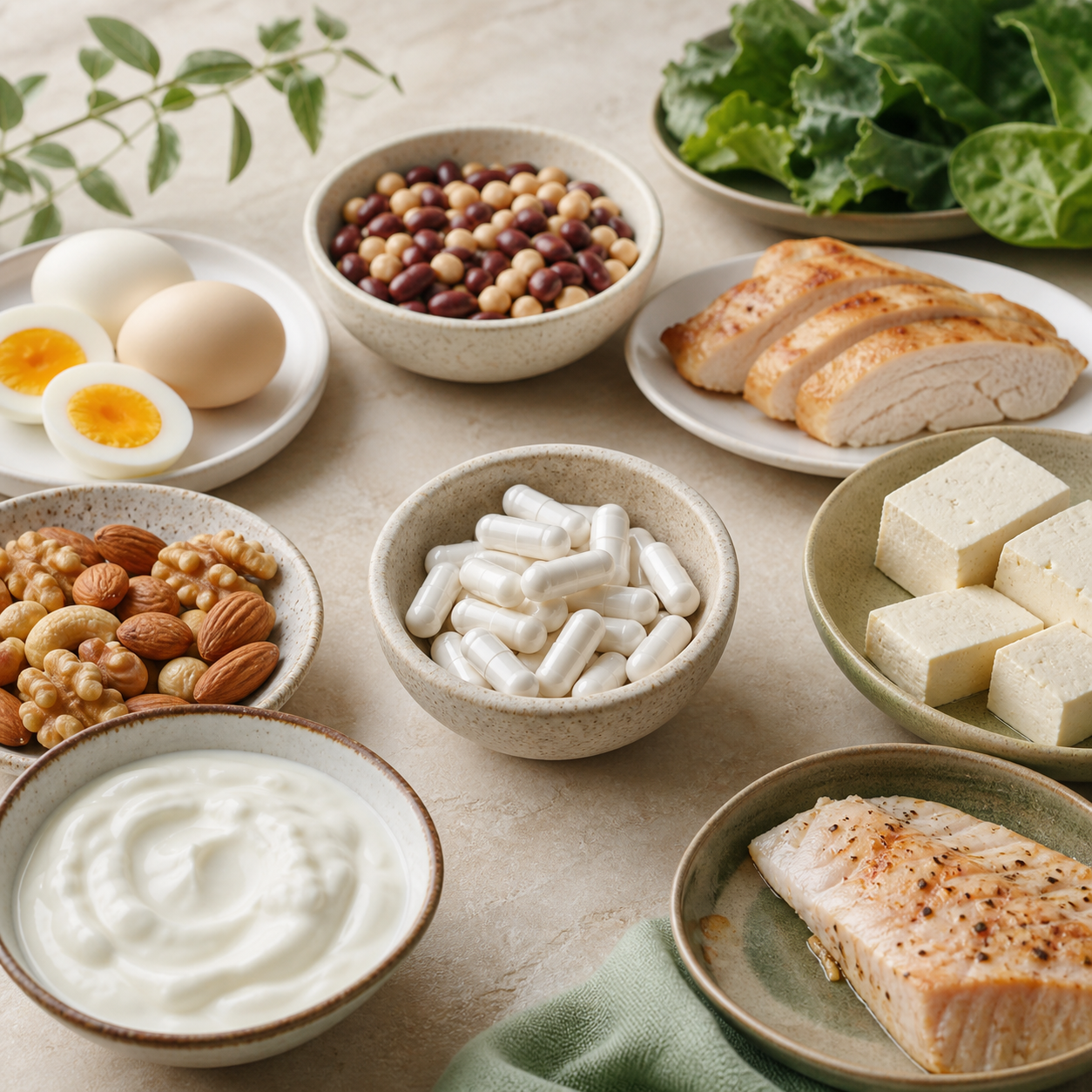
Eggs, fish, meat, and legumes provide protein and amino acids rather than NAC itself. The body uses these nutrients to make cysteine and then synthesize glutathione.
Food supplies protein and amino acids, which the body can use to make cysteine and glutathione.
How to Support This Pathway Through Food
Example One
Eggs or fish/poultry + legumes + vegetables provide protein, sulfur-containing amino acids, and other nutrients that support normal metabolism, but they cannot be converted into an equivalent number of milligrams of NAC.
Example Two
Soy foods + dairy + nuts + vegetables provide diverse protein and amino-acid sources that support the same pathway; this is not the same as taking supplemental NAC.
Cooking and storage tips
Do not look for “NAC foods”: foods provide amino acids and protein, not supplemental NAC.
Get enough protein first: normal cooking of eggs, fish, poultry, legumes, or dairy is sufficient.
Keep sources varied: combine animal and plant proteins with vegetables and nuts.
Whole foods vs supplements
Whole Foods
- Provide protein and multiple amino acids
- Support the body’s own metabolic pathways
- Fit a long-term healthy dietary pattern
- Cannot be converted into a fixed NAC dose
NAC Supplements
- Usually use manufactured NAC as the ingredient
- Labels usually state the actual NAC amount in milligrams
- Available as immediate-release, sustained-release, or combination products
- Goal, total daily intake, and medication risks still matter
Dosage
NAC has no established RNI, RDA, AI, formal UL, or universal daily recommended dose. Health Canada’s adult antioxidant monograph allows ≤600 mg NAC/day under specific conditions, while studies in healthy adults and exercise settings commonly use about 600–1,200 mg/day.
Regulatory References, Human Study Ranges & Dose Boundaries
Health Canada Adult Antioxidant Use
A permitted-use condition in a specific natural health product monograph, not an RNI, formal UL, or recommended intake for every healthy adult.
Human Research References
Interpret the study goal, population, and exact dose before interpreting the result.
Dose Levels & Longer-Term Data
How to Interpret Higher Doses
Important Note
600 mg NAC/day means 600 mg of actual N-acetyl-L-cysteine per day. 1,200 mg NAC/day is often divided, for example 600 mg per dose × 2 doses daily. Neither number is a glutathione dose.
Study doses differ by goal: 600 mg NAC/day has human glutathione-related data, exercise research more often uses 1,200 mg/day, and there is currently no established effective dose range for skin goals.
GlyNAC is not an NAC formulation; it is glycine + NAC. Healthy-aging findings from GlyNAC cannot all be attributed to NAC, and GlyNAC doses should not be transferred directly to ordinary NAC products.
About 600–1,200 mg NAC/day is a common human research range, not a universal recommended dose. Above 1,200 mg/day, more evidence comes from disease or treatment studies, and a higher dose does not guarantee a better result.
Dose Utilization Features
Oral NAC undergoes substantial metabolism and intact bioavailability is relatively low, but that does not mean most of the dose is “wasted.”
Actual effects depend not only on dose but also on baseline glutathione status, training load, and the study population.
Higher dose does not mean stronger effect. 1,200 mg/day is common in some exercise studies, but 1,800 mg/day may still fail to produce a clearer benefit.
Sustained release changes release speed only. A 600 mg sustained-release product still contains 600 mg NAC; it is not a higher dose or automatically more effective.
How to Read Common Product Doses
The NAC milligram amount on the label is usually the actual NAC dose; no botanical standardization conversion is needed.
| Product | Package / Label Number | Dose That Is Actually Comparable | Formulation | How to Read It |
|---|---|---|---|---|
| GNC N-Acetyl-L-Cysteine NAC - 600mg - 120 Vegetarian CapsulesOfficial product link | N-Acetyl-L-Cysteine 600 mg/capsule | 600 mg NAC/capsule | Single-ingredient Serving Size: 1 capsule |
600 mg is the actual NAC amount per capsule. A Daily Value has not been established, and no standardization conversion is needed. |
| NOW Foods NAC 600 mg CapsulesOfficial product link | 600 mg NAC + 25 μg Selenium/capsule | 600 mg NAC/capsule | Combination formula NAC + Selenium |
Selenium is counted separately; this is not 600.025 mg NAC. If the label directs 2 capsules daily, that equals 1,200 mg NAC/day, but that is a manufacturer direction, not an official recommendation. |
| NOW Foods NAC 1000 mg TabletsOfficial product link | N-Acetyl Cysteine 1,000 mg/tablet | 1,000 mg NAC/tablet | Higher-dose Conventional tablet |
1,000 mg is the actual NAC amount in one tablet, not a special high-absorption form. A larger number does not prove a stronger effect. |
| Jarrow Formulas N-A-C (N-Acetyl-L-Cysteine)Official product link | N-Acetyl-L-Cysteine 500 mg/capsule | 500 mg NAC/capsule | Single-ingredient Quick Release |
Each capsule provides 500 mg actual NAC; no standardization or equivalence conversion is needed. |
| Jarrow Formulas N-A-C (N-Acetyl-L-Cysteine) SustainOfficial product link | N-Acetyl-L-Cysteine 600 mg/tablet | 600 mg NAC/tablet | Sustained release Sustained Release |
The total remains 600 mg NAC. A bilayer tablet changes release speed, not the NAC amount. |
| NOW Foods NAC Quercetin & Zinc Veg CapsulesOfficial product link | 1,000 mg NAC + 500 mg Quercetin + 15 mg Zinc/serving | 1,000 mg NAC/serving | Combination formula NAC + Quercetin + Zinc |
Evaluate the three ingredients separately. The product still provides 1,000 mg NAC, not 1,515 mg NAC. |
GNC N-Acetyl-L-Cysteine NAC - 600mg - 120 Vegetarian Capsules
Official product link- Package / Label Number
- N-Acetyl-L-Cysteine 600 mg/capsule
- Dose That Is Actually Comparable
- 600 mg NAC/capsule
- Formulation
- Single-ingredient
Serving Size: 1 capsule
- How to Read It
- 600 mg is the actual NAC amount per capsule. A Daily Value has not been established, and no standardization conversion is needed.
NOW Foods NAC 600 mg Capsules
Official product link- Package / Label Number
- 600 mg NAC + 25 μg Selenium/capsule
- Dose That Is Actually Comparable
- 600 mg NAC/capsule
- Formulation
- Combination formula
NAC + Selenium
- How to Read It
- Selenium is counted separately; this is not 600.025 mg NAC. If the label directs 2 capsules daily, that equals 1,200 mg NAC/day, but that is a manufacturer direction, not an official recommendation.
NOW Foods NAC 1000 mg Tablets
Official product link- Package / Label Number
- N-Acetyl Cysteine 1,000 mg/tablet
- Dose That Is Actually Comparable
- 1,000 mg NAC/tablet
- Formulation
- Higher-dose
Conventional tablet
- How to Read It
- 1,000 mg is the actual NAC amount in one tablet, not a special high-absorption form. A larger number does not prove a stronger effect.
Jarrow Formulas N-A-C (N-Acetyl-L-Cysteine)
Official product link- Package / Label Number
- N-Acetyl-L-Cysteine 500 mg/capsule
- Dose That Is Actually Comparable
- 500 mg NAC/capsule
- Formulation
- Single-ingredient
Quick Release
- How to Read It
- Each capsule provides 500 mg actual NAC; no standardization or equivalence conversion is needed.
Jarrow Formulas N-A-C (N-Acetyl-L-Cysteine) Sustain
Official product link- Package / Label Number
- N-Acetyl-L-Cysteine 600 mg/tablet
- Dose That Is Actually Comparable
- 600 mg NAC/tablet
- Formulation
- Sustained release
Sustained Release
- How to Read It
- The total remains 600 mg NAC. A bilayer tablet changes release speed, not the NAC amount.
NOW Foods NAC Quercetin & Zinc Veg Capsules
Official product link- Package / Label Number
- 1,000 mg NAC + 500 mg Quercetin + 15 mg Zinc/serving
- Dose That Is Actually Comparable
- 1,000 mg NAC/serving
- Formulation
- Combination formula
NAC + Quercetin + Zinc
- How to Read It
- Evaluate the three ingredients separately. The product still provides 1,000 mg NAC, not 1,515 mg NAC.
Health Effects
Glutathione & Antioxidant Reserves
NAC provides cysteine needed for glutathione synthesis. In a 30-day study using 1,200 mg NAC/day, the main improvements occurred in people with lower baseline glutathione; raising glutathione does not mean slowing whole-body aging.
View randomized trial
Exercise Performance & Recovery
Pooled evidence is not fully consistent. An earlier meta-analysis did not find stable improvements in exercise performance, and another meta-analysis covering 37 studies and 1,388 participants found no clear overall improvement in common recovery outcomes. A newer meta-analysis reported small improvements in soreness, lactate, and selected inflammatory and oxidative markers. The most accurate summary is that some recovery markers may improve, but effects are inconsistent; NAC should not be treated as a routine sports supplement.
View meta-analysis
Inflammatory & Oxidative-Stress Markers
Oral NAC may reduce some CRP and IL-6 measures overall, but not every inflammatory marker improves consistently. Changes in antioxidant or inflammatory biomarkers do not necessarily mean you will feel better or have a lower disease risk.
View meta-analysis
Respiratory Mucus
NAC has mucolytic activity and has been studied for years in settings such as chronic bronchitis and COPD. Long-term disease data should not be converted into everyday advice for healthy adults.
View official monograph
Skin & UV-Induced Oxidative Stress
A single 1,200 mg NAC dose in 100 people at high melanoma risk did not significantly reduce UV-induced oxidative stress in melanocytic nevi. This does not support describing NAC as a whitening, sunscreen, anti-wrinkle, or complexion-improving supplement.
View randomized trial
Healthy Aging & Mitochondrial Function
A 16-week GlyNAC study in older adults reported changes in glutathione, mitochondrial, and physical-function measures, but glycine was given at the same time. Benefits from GlyNAC do not prove that NAC alone is an anti-aging supplement.
View GlyNAC trial
Product Selection
NAC labels are usually more straightforward than botanical-extract labels: the NAC milligrams shown on the package usually are the actual NAC dose.
Check These Four Things
What is the active ingredient?
Confirm N-Acetyl-L-Cysteine or N-Acetyl Cysteine. Do not treat cysteine, glutathione, or GlyNAC as the same ingredient.
How much do you actually get per serving?
Check Serving Size, Amount Per Serving, and servings per day so you can calculate the actual daily NAC intake.
Are there unnecessary added ingredients?
Evaluate selenium, quercetin, zinc, and other added actives separately; do not add them to the NAC dose. A single-ingredient product is easier to evaluate when trying NAC for the first time.
Is quality control credible?
Check the manufacturer, lot number, expiration date, immediate- or sustained-release form, Daily Value status, and any verifiable quality information.
How to Read the Label6 steps to read an NAC label
Find NAC → actual amount per serving → Serving Size → daily total → release form → evaluate combinations separately
Selenium, quercetin, zinc, or other added actives are listed separately
Swallow sustained-release tablets whole; manufacturer directions are not site-recommended doses.
Actual NAC | Release form | Lot number | Expiration date | Testing
A 600 mg sustained-release NAC product still provides 600 mg NAC. Sustained release changes release speed; it does not increase the total amount or automatically mean higher absorption.
Find NAC first
Confirm N-Acetyl-L-Cysteine, not ordinary cysteine or glutathione.
Check the actual amount per serving
Find the NAC milligrams under Amount Per Serving.
Confirm how many capsules or tablets make one serving
Serving Size may be 1 capsule, 1 tablet, or multiple units.
Calculate the daily total
NAC per serving × servings per day. Example: 600 mg/capsule × 2 capsules/day = 1,200 mg NAC/day.
Check the release form
Sustained Release or Quick Release changes the delivery pattern, not the labeled total amount.
Count combination ingredients separately
Do not add selenium, quercetin, or zinc to the NAC dose.
How to Choose Among Common FormsThere is no “high-absorption NAC” category that users need to dose up on their own
Conventional NAC Capsules / Tablets
Main features
The actual NAC dose is direct and transparent, commonly 500–1,000 mg per capsule or tablet.
Site guidance
A simple single-ingredient product is easier to match to research when dose transparency is the priority.
Sustained-Release NAC
Main features
Sustained Release extends delivery through the tablet design; 600 mg still means 600 mg NAC.
Site guidance
Swallow according to the product directions and do not split it casually. Do not interpret sustained release as more NAC or higher absorption.
NAC Powder
Main features
Makes dose adjustment easier, but accurate weighing, odor, storage, and measurement error matter more.
Site guidance
Consider it only if you can weigh the amount accurately and understand the daily total; do not estimate by spoon size.
NAC Combination Formulas
Main features
May include selenium, quercetin, zinc, or other antioxidant ingredients.
Site guidance
A combination is not automatically better. Evaluate each ingredient separately to avoid duplicate supplementation and incorrect dose addition.
How to Take
NAC has no universal recommended dose. Health Canada’s adult antioxidant monograph allows ≤600 mg NAC/day with food, while healthy-adult and exercise studies commonly use about 600–1,200 mg/day.
Default plan (healthy adults)
Official recommended dose: No RNI, RDA, AI, or universal daily recommended intake has been established
Regulatory-use reference: Health Canada adult antioxidant monograph: ≤600 mg NAC/day; not an RNI or UL
Frequency: Depends on total daily intake and the specific product directions
With food or on an empty stomach?: Health Canada’s antioxidant monograph specifies taking it with food; there is no rule that every product must be taken fasting.
Split the dose?: Higher daily amounts are split according to the study protocol or product label.
Sustained-release products: Swallow whole; do not split or chew casually.
Duration: Set a duration based on the specific goal and reassess.
Missed dose: If you occasionally miss a dose, skip it rather than doubling the next dose.
Frequently asked questions
Does NAC have to be taken on an empty stomach?
No. Health Canada’s adult antioxidant monograph specifies use with food; individual product directions may differ.
600 mg or 1,200 mg?
600 mg NAC/day appears in regulatory and healthy-adult data, while 1,200 mg/day is common in some exercise studies. Neither is a universal site-recommended dose.
Is 600 mg sustained release stronger?
No. It still provides 600 mg NAC; only the release speed differs.
Before or after exercise?
Study protocols, training types, and goals differ, so there is no single timing rule for every athlete.
Can GlyNAC be treated as high-absorption NAC?
No. GlyNAC is a combination of glycine + NAC, not an NAC formulation.
How much glutathione is 600 mg NAC equivalent to?
There is no reliable conversion. NAC supplies cysteine, and the final change in glutathione is regulated by the body.
Risks & Precautions
Common Side Effects
- Nausea
- Stomach discomfort
- Vomiting
- Diarrhea
- For mild symptoms, try taking it with food or lowering the dose; stop if symptoms persist or recur.
Higher-Dose Risks
- Above 1,200 mg NAC/day, more evidence comes from disease-treatment settings.
- Doses such as 1,800–3,000 mg NAC/day should not be converted into antioxidant regimens for healthy adults.
- Higher doses do not guarantee additional benefit.
- No formal UL does not mean the dose can be increased without limit.
People Who Need More Caution
- History of kidney stones
- Pregnancy or breastfeeding
- Complex liver, kidney, or chronic disease
- Planning long-term use of clearly high doses
- Planning to replace standard respiratory treatment with NAC
Medications & Special Situations
- Antibiotics: Health Canada’s monograph says not to self-use products under that monograph while taking antibiotics; do not replace this with a self-imposed two-hour spacing rule.
- Nitroglycerin: do not combine on your own; ask a doctor or pharmacist to assess it.
- Acetaminophen overdose: NAC is used medically as an antidote, but supplement dosing is not an overdose-treatment protocol. Do not try to manage an overdose by taking a few supplement capsules.
- NAC dietary supplements have a special regulatory/legal status in the United States; this does not mean NAC was suddenly found to be unsafe.
Stop and Ask for Advice
Stop if you develop persistent nausea, vomiting, diarrhea, stomach discomfort, or another clear new reaction. Ask for advice before use with antibiotics, nitroglycerin, or complex prescription regimens.
Seek Medical Care Promptly
If acetaminophen overdose is suspected, or you develop a severe allergic reaction, breathing difficulty, marked low blood pressure, or another acute serious reaction, seek immediate medical care rather than trying to self-treat with supplements.
Sources
Paper titles, institution names, and official product names are kept in their original language; each entry shows the actual clickable URL.
Regulatory & Basic Information
Glutathione, Antioxidant & Exercise Evidence
Inflammation-Related Evidence
Healthy-Adult Studies
Respiratory Research
Skin & UV Research
Healthy Aging & GlyNAC
Mainstream Product Official Information
Last updated: August 14, 2026