Ergothioneine
Ergothioneine / L-Ergothioneine / EGT / ERGO / ET / L-Ergothioneine
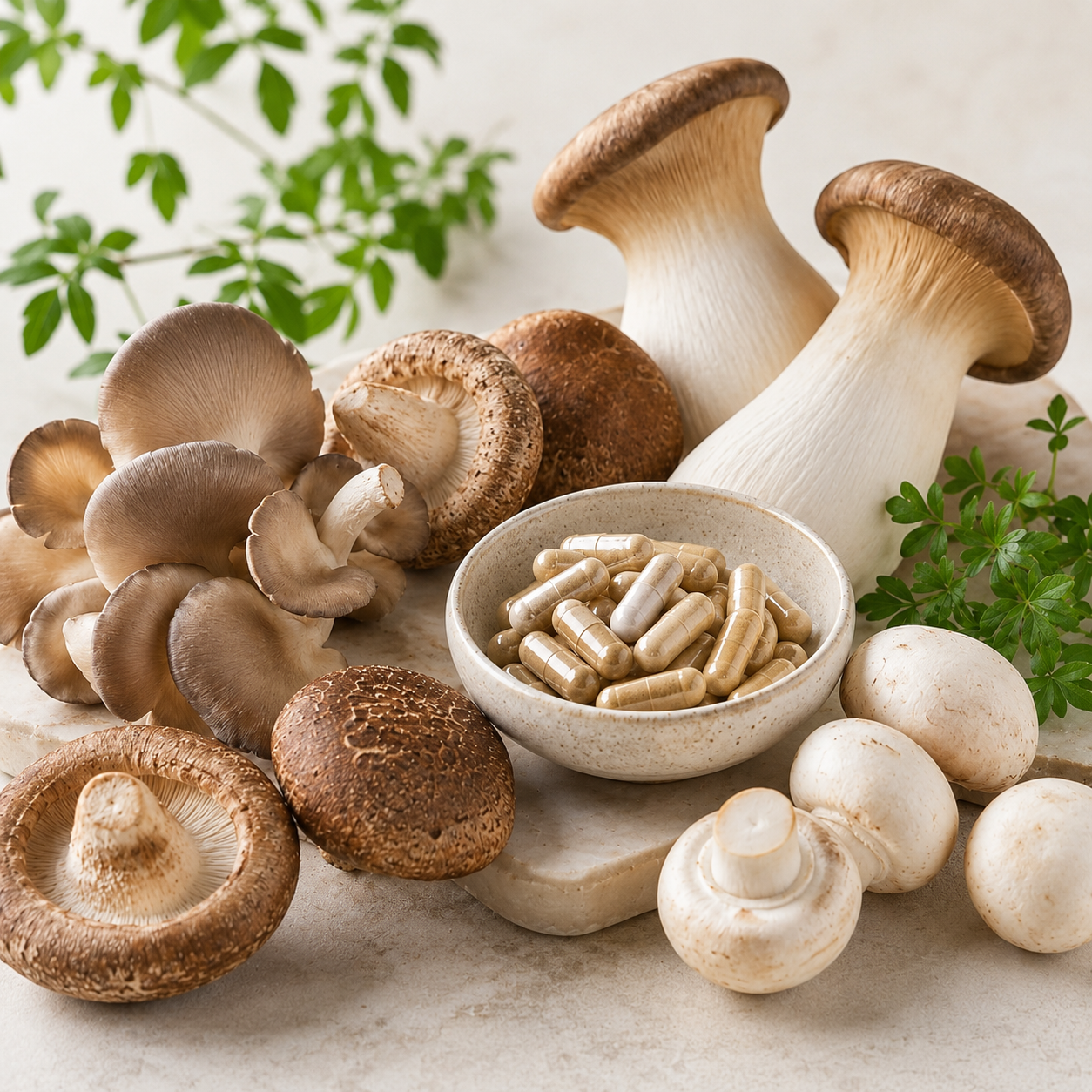
Ergothioneine is a sulfur-containing amino-acid derivative that humans cannot synthesize and mainly obtain from foods such as mushrooms. The body has a dedicated transport system that absorbs and retains it, but ergothioneine is not currently recognized as a vitamin or essential nutrient.
30-second check: which situation fits you best?
I only want everyday antioxidant or anti-aging support
Ergothioneine has interesting antioxidant and cell-protective biology, but in short-term studies of healthy adults, blood levels rose substantially without consistent changes in most oxidative-damage or inflammatory markers. Strong antioxidant chemistry alone does not show that long-term supplementation provides extra health benefits.
I have a specific skin, sleep, or cognition goal
Skin hydration, wrinkles, and texture have been studied in a formal randomized controlled trial, while newer oral studies report signals for brightness, radiance, and pigmentation. Sleep has randomized trials at different doses, and cognition has studies in older adults, but results remain inconsistent. Evidence for directly reducing yellow tone is still limited.
I am planning to use it or already taking it
The doses used for different goals are not the same: sleep studies generally used lower amounts, skin studies often used more, and cognition studies used their own ranges. There is no evidence that simply taking more produces better results.
Basic Overview
What it is
Ergothioneine is a naturally occurring sulfur-containing amino-acid derivative synthesized by certain fungi and microorganisms. Humans cannot make it and obtain it from food. The body uses the OCTN1/SLC22A4 transport system to absorb and retain ergothioneine, allowing it to accumulate in blood and multiple tissues. It is not currently recognized as a vitamin or essential nutrient.
Why people use it
- Improve dull or sallow-looking skin and overall brightness
- Support skin hydration, fine lines, wrinkles, and texture
- Track mild declines in sleep quality
- Support memory and cognition after about age 55
- Try a goal-directed approach related to healthy aging
- Obtain a consistent dose when mushroom intake is low
How it relates to healthy aging
The body actively absorbs and retains ergothioneine, and animal studies have reported improvements in lifespan, non-frail lifespan, and some age-related physical functions.
Human observational studies have also linked higher blood levels with lower cardiovascular-event and mortality risk. These findings support further research but do not prove that supplementation reverses aging or extends human lifespan.
Supplement Assessment
A clear skin, sleep, or cognition goal can justify a closer look; routine use only for antioxidant or longevity claims is a lower priority.
Lower supplement priority
- Interested mainly because of “longevity molecule” or “super antioxidant” marketing
- No specific health or functional goal
- Expecting one supplement to make skin broadly younger
- Wanting ergothioneine to treat a clear pigmentation problem
- Diet, sleep, sun protection, or exercise still have substantial room for improvement
- Planning indefinite use without a measurable outcome
Your next step:
Break “anti-aging” into a concrete goal such as sallowness, dullness, skin hydration, sleep, or memory. Without a specific target, antioxidant claims alone are not a reason for routine long-term use.
Clear goal: a trial may be reasonable
- Sallowness or dullness: human studies report some improvement in brightness, radiance, and pigmentation, but direct reduction in yellow tone has not been established.
- Dry skin, fine lines, and texture: 25 mg/day for 12 weeks produced relatively direct signals in a randomized human trial.
- Sleep quality: randomized human trials using 8–20 mg/day for 4–16 weeks reported some improvement.
- Memory and cognition: 10 or 25 mg/day for 16 weeks produced some positive findings, but overall effects were not consistent.
Your next step:
First decide whether the real goal is sallowness, dullness, dry skin, sleep, or memory, then use the closest human study as the reference.
Talk with a healthcare professional first
- Clear or progressive cognitive decline
- Diagnosed neurologic disease or another complex chronic condition
- Use of multiple prescription medications
- Pregnancy or breastfeeding
- A child or adolescent considering an adult product
- Planning long-term use clearly above 30 mg/day
- Wanting a supplement to replace treatment for a skin or sleep disorder
Your next step:
The EU 30 mg/day supplement-use condition for the general population excludes pregnancy and breastfeeding. Special populations should have a clinician or pharmacist review the full situation.
Quick Self-Check
Is your skin dull, sallow, or lacking radiance?
Is your skin dry, and do you want to track hydration or texture?
Has your sleep quality declined mildly?
Are you over 55 and concerned about subjective memory?
Are you willing to run a time-limited trial around one goal?
Do I need testing?
Routine testing is generally unnecessary for healthy adults.
- Research can measure plasma or whole-blood ergothioneine, and oral supplementation clearly raises these levels.
- There is currently no clinical deficiency cutoff, ideal range, or standard showing that a value below a certain level requires supplementation.
A higher blood level does not mean health benefits increase proportionally and should not be used to self-adjust the dose.
Food Sources
Common Foods Higher in Ergothioneine (Fresh Weight)
| Food | Form | Approx. Ergothioneine per 100 g | How to Interpret It |
|---|---|---|---|
| Porcini mushrooms | Fresh | About 52.8 mg | A representative high source; wild species and samples still vary |
| Golden oyster mushrooms | Fresh | About 41.7 mg | Substantially higher than common gray oyster mushrooms in the same comparison |
| Enoki mushrooms | Fresh | About 29.8 mg | A common higher source, although cultivated samples still vary |
| Morel mushrooms | Fresh-weight equivalent | About 15–26 mg | Caps and stems differ; the range overlaps with lion’s mane and maitake, so this is not a fixed ranking |
| Lion’s mane mushrooms | Fresh | About 18.1 mg | Origin, strain, and cultivation conditions affect content |
| Maitake mushrooms | Fresh | About 15.8 mg | The range overlaps with morel mushrooms |
| Shiitake mushrooms | Fresh | About 11.2 mg | Do not treat one high measurement as a fixed value for all shiitake |
| Oyster / gray oyster mushrooms | Fresh | About 10–12 mg | Representative fresh-weight values from several studies are near this range |
Key data rule: Fresh-weight and dry-weight values should not be ranked together directly. Even within the same mushroom species, strain, cultivation, part, storage, and batch can create substantial differences. The 15–26 mg/100 g range for morels overlaps with lion’s mane and maitake and does not imply a fixed absolute ranking. Ergothioneine has no RNI, RDA, or AI, so this page does not show a percentage of an adult reference intake or create an artificial daily food target.
How to Get Ergothioneine Naturally From Food
Example 1 | Enoki with vegetables in a normal meal
Use enoki as a normal mushroom ingredient alongside other vegetables and a protein source.
The goal is a varied whole-food diet, not to precisely reproduce the 25 mg supplement-study dose.
Example 2 | Shiitake + oyster mushrooms, with occasional variety
Use shiitake and oyster mushrooms routinely and occasionally rotate in morels or lion’s mane.
There is no need to rely on large amounts of one mushroom just to chase a supplement-level dose.
Cooking and storage tips
Cook normally: Mushrooms can be cooked normally; there is no need to eat them raw for ergothioneine.
Avoid prolonged boiling in large amounts of water: Some ergothioneine can move into the cooking liquid.
Consume the broth: When making soup, eating the liquid as well can reduce loss of water-soluble compounds.
Use fresh mushrooms reasonably soon: Avoid very long storage when possible.
Whole foods vs supplements
Whole Mushrooms
- Also provide fiber and other mushroom compounds
- Suitable for long-term dietary use
- Actual content varies by species and batch
- No need to match a precise research dose
Ergothioneine Supplements
- The target ingredient can be labeled directly in milligrams
- Easier to compare with a specific human study
- Total mushroom-extract weight is not the same as ergothioneine
- Standardization, serving size, and quality still need to be checked
Dosage
Ergothioneine has no RNI, RDA, AI, formal UL, or universal daily recommended dose. Interpret human-study doses by specific goals such as skin tone, skin condition, sleep, and cognition rather than chasing the highest milligram number.
Regulatory Safety References, Human-Study Doses & Evidence Boundaries
Regulatory Safety References
Regulatory numbers are not recommended intakes, RNI values, ULs, or best-effective doses.
Human-Study Doses by Goal
If Your Goal Is Sallowness or Dullness
Skin brightening is not the same as proven reduction of yellow tone.
How to Interpret Dose
Important Note
There is no established RNI, RDA, AI, formal UL, or universal daily recommended dose.
For sallowness in particular, dose alone does not settle the question: 30 mg oral studies support brightness, radiance, melanin, and glycation-related outcomes, but do not directly prove a lower b* yellowness value.
The EU 30 mg/day figure is a Novel Food authorized use level, not a health target or UL.
Animal longevity findings are scientifically interesting, but there is no established longevity dose for healthy adults.
Dose Utilization
Humans absorb and retain ergothioneine efficiently, and specific transport plus renal reabsorption reduces losses.
Whole-blood levels do not immediately return to baseline after supplementation stops and can remain elevated for several weeks.
Higher blood levels do not mean benefits increase proportionally; skin, sleep, and cognition do not yet have simple linear dose–response relationships.
How to Read Common Product Doses: Is the Package Number the Actual Ergothioneine Dose?
When a single-ingredient product directly lists L-Ergothioneine XX mg, that usually is the actual target dose. Total mushroom-ingredient weight must be interpreted separately.
| Product | Package / Label Number | Dose That Is Actually Comparable | Formulation | How to Read It |
|---|---|---|---|---|
| Life Extension Essential Youth L-ErgothioneineOfficial product link | ErgoActive® L-Ergothioneine 5 mg | 5 mg L-Ergothioneine/capsule | Low-dose single ingredient 1 capsule/serving + 5 mg vitamin C |
The 5 mg is the actual ergothioneine dose and requires no further conversion; vitamin C is a separate ingredient. |
| Real Mushrooms Ergo+Official product link | L-Ergothioneine 10 mg | 10 mg L-Ergothioneine/capsule | Mushroom combination Golden oyster mushroom extract blend |
Compare the actual 10 mg ergothioneine dose. Do not add total mushroom weight to the 10 mg. |
| Designs for Health MycoSupreme™Official product link | 1,000 mg Whole Mushroom Extracts + 15 mg ergothioneine + 160 mg Beta-Glucans | 15 mg ergothioneine/serving | Multi-mushroom blend Whole mushroom extract blend |
The 1,000 mg figure is total mushroom-extract weight, not ergothioneine. Compare the 15 mg ergothioneine; beta-glucans are a separate component. |
| Life Extension Mega L-ErgothioneineOfficial product link | ErgoActive® L-Ergothioneine 25 mg | 25 mg L-Ergothioneine/capsule | Higher-dose single ingredient 1 capsule/serving |
The 25 mg is the actual target dose. It is close to some skin and cognition studies but is not the best dose for every goal. |
| ProHealth L-Ergothioneine - 25 mg, 30 capsulesOfficial product link | L-Ergothioneine 25 mg | 25 mg L-Ergothioneine/capsule | Single-ingredient formula 1 capsule/serving |
The label directly provides 25 mg ergothioneine; there is no need to recalculate from a mushroom-equivalent amount. |
| Double Wood L-Ergothioneine SupplementOfficial product link | L-Ergothioneine 30 mg | 30 mg L-Ergothioneine/serving | Higher-dose single ingredient Public testing documentation |
The manufacturer’s testing page lists both the label claim and measured amount as 30 mg and publishes heavy-metal and microbiological testing. The 30 mg is still not an official recommended dose. |
| GeneIII® L-Ergothioneine 30mgOfficial product link | L-Ergothioneine 30 mg; Purity 99.99% | 30 mg L-Ergothioneine/capsule | High-purity fermented single ingredient Fermentation-derived; third-party tested |
The 30 mg on the package is the actual ergothioneine per capsule and needs no further conversion. The 99.99% figure describes ingredient purity, not a larger active dose. Product comparison should still use 30 mg/capsule. |
Life Extension Essential Youth L-Ergothioneine
Official product link- Package / Label Number
- ErgoActive® L-Ergothioneine 5 mg
- Dose That Is Actually Comparable
- 5 mg L-Ergothioneine/capsule
- Formulation
- Low-dose single ingredient
1 capsule/serving + 5 mg vitamin C
- How to Read It
- The 5 mg is the actual ergothioneine dose and requires no further conversion; vitamin C is a separate ingredient.
Real Mushrooms Ergo+
Official product link- Package / Label Number
- L-Ergothioneine 10 mg
- Dose That Is Actually Comparable
- 10 mg L-Ergothioneine/capsule
- Formulation
- Mushroom combination
Golden oyster mushroom extract blend
- How to Read It
- Compare the actual 10 mg ergothioneine dose. Do not add total mushroom weight to the 10 mg.
Designs for Health MycoSupreme™
Official product link- Package / Label Number
- 1,000 mg Whole Mushroom Extracts + 15 mg ergothioneine + 160 mg Beta-Glucans
- Dose That Is Actually Comparable
- 15 mg ergothioneine/serving
- Formulation
- Multi-mushroom blend
Whole mushroom extract blend
- How to Read It
- The 1,000 mg figure is total mushroom-extract weight, not ergothioneine. Compare the 15 mg ergothioneine; beta-glucans are a separate component.
Life Extension Mega L-Ergothioneine
Official product link- Package / Label Number
- ErgoActive® L-Ergothioneine 25 mg
- Dose That Is Actually Comparable
- 25 mg L-Ergothioneine/capsule
- Formulation
- Higher-dose single ingredient
1 capsule/serving
- How to Read It
- The 25 mg is the actual target dose. It is close to some skin and cognition studies but is not the best dose for every goal.
ProHealth L-Ergothioneine - 25 mg, 30 capsules
Official product link- Package / Label Number
- L-Ergothioneine 25 mg
- Dose That Is Actually Comparable
- 25 mg L-Ergothioneine/capsule
- Formulation
- Single-ingredient formula
1 capsule/serving
- How to Read It
- The label directly provides 25 mg ergothioneine; there is no need to recalculate from a mushroom-equivalent amount.
Double Wood L-Ergothioneine Supplement
Official product link- Package / Label Number
- L-Ergothioneine 30 mg
- Dose That Is Actually Comparable
- 30 mg L-Ergothioneine/serving
- Formulation
- Higher-dose single ingredient
Public testing documentation
- How to Read It
- The manufacturer’s testing page lists both the label claim and measured amount as 30 mg and publishes heavy-metal and microbiological testing. The 30 mg is still not an official recommended dose.
GeneIII® L-Ergothioneine 30mg
Official product link- Package / Label Number
- L-Ergothioneine 30 mg; Purity 99.99%
- Dose That Is Actually Comparable
- 30 mg L-Ergothioneine/capsule
- Formulation
- High-purity fermented single ingredient
Fermentation-derived; third-party tested
- How to Read It
- The 30 mg on the package is the actual ergothioneine per capsule and needs no further conversion. The 99.99% figure describes ingredient purity, not a larger active dose. Product comparison should still use 30 mg/capsule.
Health Effects
Skin Sallowness, Dullness & Brightness
In a randomized study that has not yet completed formal peer review, 30 mg/day of oral ergothioneine for about 8 weeks improved skin brightness, radiance, and some other skin measures. This suggests a possible effect on dullness, but direct oral evidence is still preliminary and does not yet show a clear reduction in “yellow tone.”
View Preprint Study
Skin Hydration, Wrinkles & Texture
In 80 healthy women, ergothioneine-rich oyster-mushroom tablets providing 25 mg/day for 12 weeks improved some hydration measures by week 8 and wrinkle and texture scores by week 12. Because the intervention was a mushroom tablet, contributions from other mushroom components cannot be excluded.
View Randomized Controlled Trial
Sleep Quality
Studies using 20 mg/day for 4 weeks and 8 mg/day for 16 weeks both reported some improvement in sleep outcomes. The evidence base is still small and does not replace regular sleep schedules, sleep hygiene, or treatment for insomnia.
View Randomized Controlled Trial
Memory & Cognitive Function
Among 147 adults aged 55–79 with subjective memory concerns, 10 or 25 mg/day for 16 weeks improved some memory and subjective measures, but the main composite memory outcome did not improve consistently. A smaller study in mild cognitive impairment also reported positive signals. Ergothioneine remains worth studying, but stable cognitive benefit has not been established.
View Randomized Controlled Trial
Healthy Aging & Long-Term Physical Function
A long-term study in male mice reported about a 16% increase in median lifespan, about a 21% increase in mean lifespan, and improvements in some functional measures. These are animal findings and should not be rewritten as evidence that ergothioneine extends human lifespan.
View Animal Study
Blood Levels & Long-Term Health
Long-term observational research has linked higher blood ergothioneine levels with lower risk of some cardiovascular outcomes and mortality. These findings show an association, not that taking an ergothioneine supplement lowers those risks. Supplement trials directly testing cardiovascular outcomes are still lacking.
View Observational Study
Product Selection
Whether your goal is sallowness, dullness, overall skin condition, sleep, or cognition, first confirm the actual L-Ergothioneine dose per serving and then see whether it is reasonably close to the relevant human research.
Check These Four Things
What is the active ingredient?
Confirm that the ingredient list directly states L-Ergothioneine rather than only Mushroom Powder, Mushroom Extract, or Mushroom Complex.
How much do you actually get per serving?
Focus on whether one serving provides 5, 10, 15, 25, or 30 mg and whether that serving is one capsule or two. Do not let “beauty” or “brightening” claims substitute for the actual dose.
Are there unnecessary added ingredients?
Mushroom Extract, Beta-Glucans, vitamins, and other antioxidants may each have their own role, but they should not be added together to create a larger ergothioneine dose.
Is quality control credible?
Check the manufacturer, lot number, actual active amount, Third-Party Testing, Certificate of Analysis (COA), heavy-metal testing, and microbiological testing.
How to Read the LabelStep-by-step example of an ergothioneine product label
Target ingredient → actual amount per serving → serving vs capsule → source & combinations → label directions → quality
160 mg Beta-Glucans and other combination ingredients are counted separately
One serving daily is a label direction, not a site-recommended dose.
Source | Lot | Actual amount | Third-party testing | COA | Contaminant control
1,000 mg Whole Mushroom Extracts and 15 mg ergothioneine are separate numbers. The amount that should be compared with human research is 15 mg.
Find the true target ingredient first
Look for L-Ergothioneine or Ergothioneine.
Check the actual amount per serving
Read Serving and Per Capsule together. If the label directly states 25 mg, no standardization calculation is usually needed.
Keep mushroom extract separate from ergothioneine
1,000 mg Whole Mushroom Extracts does not mean 1,000 mg ergothioneine.
Only calculate when standardization is stated
If the label clearly says Standardized to 2% Ergothioneine, then 500 mg × 2% = 10 mg ergothioneine.
Separate per-capsule from per-serving amounts
If one serving is 2 capsules and provides 30 mg/serving, each capsule provides about 15 mg, not 30 mg.
Count combination ingredients separately
Beta-glucans, vitamins, and other antioxidants should not be added to the ergothioneine dose.
How to Choose Among Common FormsSource and marketing language do not replace actual dose, lot, and quality information
Pure L-Ergothioneine
Main features
Lists the actual milligrams per serving directly, uses a simple formula, and is easiest to compare with human studies using 8, 20, 25, or 30 mg.
Site guidance
For a trial focused on sallowness, skin, sleep, or cognition, a transparent single-ingredient dose makes changes easier to interpret.
Mushroom-Derived Ergothioneine
Main features
Can be compared by the target ingredient as long as the final label clearly states the actual L-Ergothioneine milligrams per serving.
Site guidance
A mushroom-derived source is reasonable if you prefer it, but there is no evidence that the same milligram dose works better for sallowness, sleep, or cognition simply because of the source.
Fermentation-Derived Ergothioneine
Main features
Microbial fermentation is a common commercial route that allows better control of purity and actual dose.
Site guidance
Focus on actual amount, purity, batch testing, and contaminant control rather than assuming “natural” or “fermented” is inherently better.
Mushroom Complex + Ergothioneine
Main features
Provides Mushroom Extract, Beta-Glucans, and other mushroom components in addition to ergothioneine.
Site guidance
Reasonable if you also want a mushroom complex. If your main goal is to judge whether ergothioneine affects sallowness or skin, a single-ingredient product is easier to interpret.
How to Take
Ergothioneine has no universal official dose. It is more useful to match the dose to a specific goal such as sallowness, skin condition, sleep, or cognition than to chase the highest milligram number.
Default plan (healthy adults)
Official recommended dose: No universal official recommended dose has been established
Frequency: Most adult studies used once-daily dosing
With food?: There is no clear requirement to take it with food
Split doses?: Common research doses usually do not require splitting
Observation period: Set about 4–16 weeks depending on the specific goal
Long-term use?: Decide whether to continue only after a clear benefit is observed
Missed dose: If you occasionally miss a dose, skip it; do not double the next dose
Frequently asked questions
How long should I take it for sallowness?
Oral skin-tone studies mainly observed outcomes over about 8 weeks. Eight weeks can be used as an evaluation window, but this is based on brightness, radiance, and pigmentation data—not a validated “de-sallowing” treatment duration.
Should I choose 25 mg or 30 mg for sallowness?
There is no evidence that 25 or 30 mg is the optimal dose for reducing yellow tone. The 30 mg studies provide only signals for dullness, brightness, and pigmentation; direct b* yellowness evidence remains limited.
How long for dryness and fine lines?
A formal skin RCT showed some hydration changes by week 8 and wrinkle and texture differences by week 12, making about 8–12 weeks a more useful evaluation period.
With food or on an empty stomach?
There is no evidence that ergothioneine must be taken with fat. Choose the approach that is easiest to maintain and comfortable for your stomach.
Morning or evening?
There is no evidence that one time of day is required. Positive sleep findings do not mean taking it right before bed is necessarily better.
How do I know whether it is working?
Use consistent lighting to track skin tone, radiance, and dryness; record sleep latency and night awakenings; and track day-to-day memory rather than relying on a vague sense of “antioxidant support.”
Risks & Precautions
Common Side Effects
- No consistent ergothioneine-specific side-effect pattern has been established
- In a 25 mg/day × 12-week skin RCT, a small number of mild events were judged unrelated to the study product
- Blood chemistry did not show clear abnormalities
- Do not invent diarrhea, headache, or nausea as established common side effects
Higher-Dose Risks
- No formal UL has been established, and human data do not define a clear toxic-dose threshold
- The EU 30 mg/day figure is an authorized-use level, not a toxicity threshold
- Safety data are limited for long-term self-use clearly above 30 mg/day
- Do not keep increasing the dose in pursuit of stronger brightening, beauty, or anti-aging effects
People Who Need More Caution
- Pregnancy or breastfeeding
- Children and adolescents
- Significant liver or kidney dysfunction
- Established cognitive impairment or neurologic disease
- Complex chronic-disease treatment
- Planning long-term use clearly above 30 mg/day
Medications & Special Situations
- No mature list of classic ergothioneine drug interactions has been established
- Do not invent a rule that it cannot be taken with blood-pressure or anticoagulant medication
- People taking multiple prescription drugs or receiving complex treatment should have the full combination reviewed by a clinician or pharmacist
- Limited data do not prove that drug interactions are impossible
Stop and Ask for Advice
Stop and seek advice if persistent new gastrointestinal symptoms, rash, or other unusual symptoms repeatedly appear, especially after increasing the dose.
Seek Medical Care Promptly
Stop the new supplement and seek prompt medical care for difficulty breathing, marked swelling of the face, lips, or tongue, a severe generalized allergic reaction, or another acute serious symptom.
Sources
Source titles, specific document titles, and official product names are kept in their original language. Each row shows the full URL and opens in a new tab.
Nutrition Standards & Background Data
Human Absorption & Dose
Skin Sallowness, Dullness & Skin Condition
Sleep
Cognition & Memory
Healthy Aging & Cardiovascular Health
Regulation & Safety
Mainstream Product Dose Examples
Last updated: August 14, 2026