PQQ (Pyrroloquinoline Quinone)
Pyrroloquinoline Quinone / PQQ / Pyrroloquinoline Quinone / PQQ / Pyrroloquinoline Quinone Disodium Salt / BioPQQ / mnemoPQQ
PQQ is a vitamin-like compound with redox activity. Supplements mainly use pyrroloquinoline quinone disodium salt, with branded ingredients such as BioPQQ® and mnemoPQQ®. It has not been established as an essential human vitamin and has no defined daily requirement.
30-second check: which situation fits you best?
I just want mitochondrial, antioxidant, or anti-aging support
You are interested in ideas such as mitochondria, antioxidants, or healthy aging, but do not have a clear goal related to memory, fatigue, muscle strength, or physical function and are considering PQQ for long-term general wellness.
I have one clear goal I want to improve
Your main goal is memory and attention, muscle strength and physical function, or fatigue, stress, or sleep, and you want to see whether human research truly supports that goal and are willing to set an observation period.
I am planning to use it or already taking it
If you have bought PQQ or plan to start, confirm whether it is PQQ disodium salt, the actual amount per capsule, total daily intake, and whether it also contains CoQ10, alpha-lipoic acid, or other active ingredients.
Basic Overview
What it is
PQQ is a naturally occurring quinone with redox activity and acts as a cofactor for some bacterial enzymes. Trace amounts can be detected in foods, but PQQ has not been established as an essential human vitamin and has no defined daily requirement. Supplements mainly use the more stable PQQ disodium salt.
Why people use it
- Improve memory, attention, or cognitive performance
- Support muscle strength and everyday physical function
- Improve fatigue, stress, or sleep
- Support mitochondrial and cellular-energy-related functions
- Reduce long-term oxidative and inflammatory burden
- Interest driven by healthy-aging or longevity research
How it relates to healthy aging
Healthy-aging research on PQQ has expanded in recent years. Animal and cell studies have examined muscle atrophy, loss of strength, inflammation, cellular senescence, and some survival-related outcomes.
These remain preclinical findings. No human research shows that PQQ lowers biological age, slows overall human aging, reduces all-cause mortality, or extends lifespan.
Supplement Assessment
Turn a vague mitochondrial or anti-aging goal into something observable—such as memory, fatigue, muscle strength, or physical function—before deciding whether PQQ is worth trying.
Low supplementation priority
- No clear memory, fatigue, or physical-function problem to improve
- Considering long-term use mainly because of “antioxidant,” “mitochondrial,” or “anti-aging” marketing
- Expecting long-term supplementation to slow aging in otherwise healthy adults
Your next step:
First turn “anti-aging” into an outcome you can actually observe, such as memory, fatigue, muscle strength, or physical function.
Clear goal: a trial may be reasonable
- Frequent fatigue and wanting to improve everyday energy
- Concerned about memory, attention, or cognitive state
- Wanting to improve post-exercise fatigue or physical recovery
- Middle-aged or older adult focused on maintaining cognition and physical function
- Willing to use it consistently for a defined period and decide whether to continue based on actual change
Your next step:
Choose human research that matches your real goal, then compare the population, dose, product form, and observation period.
Talk with a healthcare professional first
- Infants, children, pregnancy, or breastfeeding
- Known significant kidney dysfunction
- Receiving treatment for a complex medical condition
- Long-term use of multiple prescription medications
- Planning long-term use clearly above 20 mg/day
Your next step:
Ask a doctor or pharmacist to review your health status, medications, and planned dose before deciding whether PQQ is appropriate.
Quick Self-Check
Do I have a clear memory or attention goal?
Do I have a clear muscle-strength or physical-function goal?
Can I track changes in fatigue or sleep?
Am I willing to set an 8–12 week observation period?
Can I accept that any benefit may be small or not noticeable?
Can I avoid using “anti-aging” as an unmeasurable long-term goal?
Do I need testing?
Generally healthy people do not need blood PQQ testing before deciding whether to supplement.
- No normal blood PQQ range has been established.
- There is no diagnostic threshold for PQQ deficiency and no clinical pathway that uses blood PQQ to determine supplement dosing.
- Human data on PQQ absorption, distribution, metabolism, and excretion remain limited.
Do not invent a PQQ testing threshold.
Food Sources
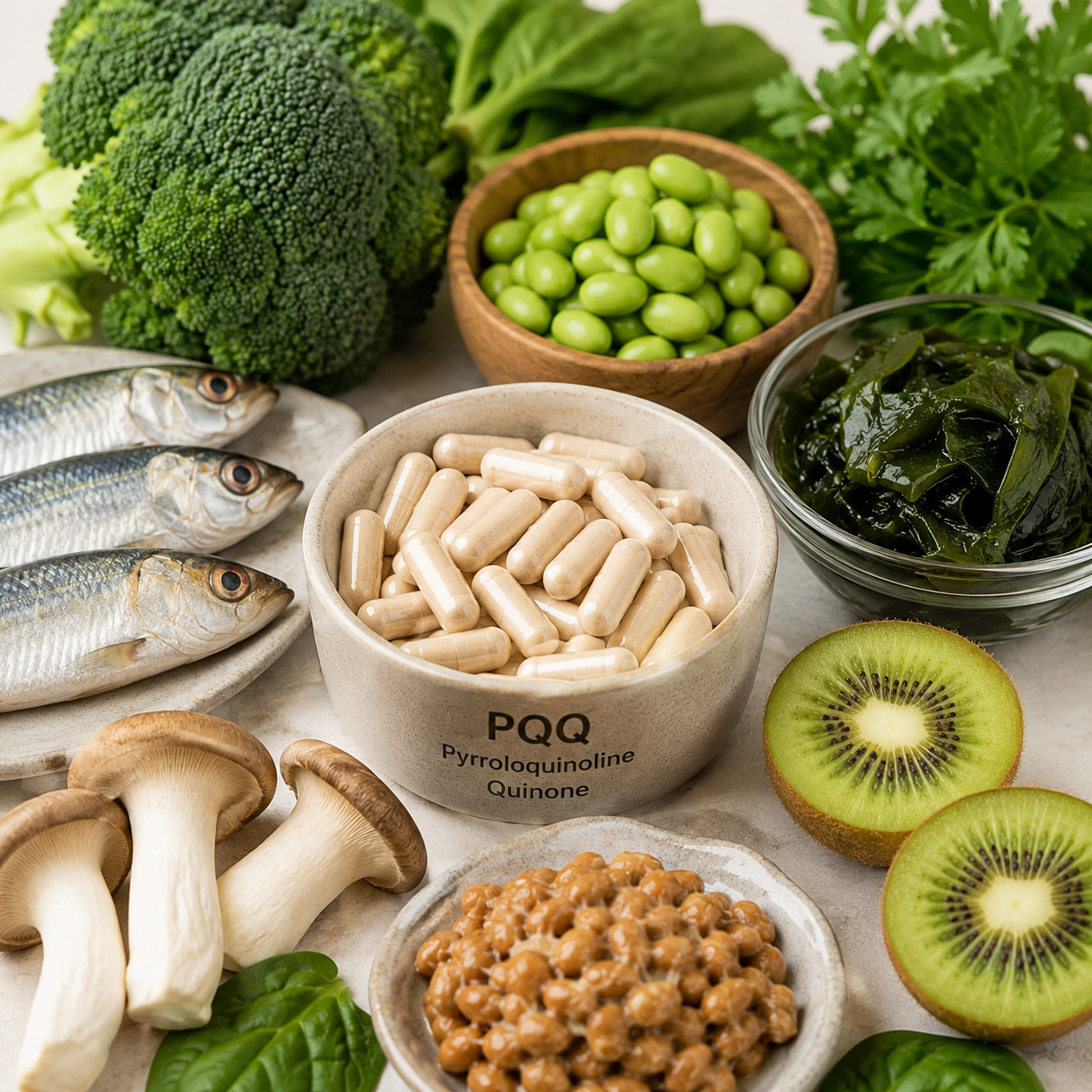
Why no high-content food list
Even at 7.02 ng/g, 100 g of food provides only about 0.702 μg PQQ.
Some fermentation-related samples contain about 1.94–5.59 ng/mL, which is only relatively high within an overall trace-level range.
Older rankings that place natto, parsley, or kiwi at the top often rely on earlier analytical methods and should not be treated as a stable food-composition table.
How to read these numbers
1 mg = 1,000,000 ng. Food studies report nanograms, while human studies and supplements use milligrams; these are very different orders of magnitude.
Relatively higher does not mean high in absolute terms; 5 ng/g is still a trace amount.
Methods for measuring free PQQ and related derivatives differ, and the food-composition database remains immature.
How PQQ appears naturally in the diet
Example 1
Milk, eggs, spinach, and other ordinary foods may naturally contain small amounts of PQQ. A varied diet provides some dietary exposure without the need to emphasize any one food.
Example 2
Some fermented foods have relatively higher measured PQQ, but still only at nanogram levels. There is no reason to consume large amounts or drink vinegar to try to match supplement-study doses.
Whole foods vs supplements
Whole Foods
- PQQ occurs naturally but only in trace amounts overall
- Usually only at nanogram levels
- Results vary substantially by analytical method
- No formal daily food target for PQQ
- No need to consume large amounts of any one food
Supplements
- Commonly provide about 10–40 mg
- Mainly use PQQ disodium salt
- Many orders of magnitude above natural dietary exposure
- Easier to compare with human-study doses
- Whether it is worthwhile depends on the specific goal
Dosage
PQQ has no RNI, RDA, AI, formal UL, or universal daily recommended dose. Regulatory use levels, human-study doses, and market product strengths must be interpreted separately.
Regulatory Safety References, Human-Study Doses & Risk Signals
Regulatory Safety References
These are regulatory conditions for specific ingredients or food uses, not daily requirements, recommended intakes, or a UL.
Human-Study Doses by Goal
These figures belong to specific goals and studies and should not be combined into one recommended range.
Common Human-Study Doses & Longer-Term Data
Important Note
PQQ has no established RNI, RDA, AI, formal UL, or universal daily recommended dose.
China's ≤20 mg/day and the EU's 20 mg/day figures are regulatory conditions for PQQ disodium salt; they do not mean the body requires 20 mg per day.
Most cognition and physical-function studies use about 20–21.5 mg PQQ/day, but this is a common research dose.
A fatigue study used 20 mg PQQ/day; that does not establish 20 mg as a proven anti-fatigue dose.
There is no established effective human dose for healthy aging.
Dose Utilization
After oral PQQ, PQQ exposure changes in plasma and urine.
Reliable data are still lacking on absolute absorption, complete metabolite proportions, the dose–exposure relationship, and brand-to-brand equivalence.
There is no basis for conversions such as 20 mg BioPQQ® = 40 mg ordinary PQQ.
How to Read Common Product Doses: Focus on Actual Daily PQQ, Not the Largest Package Number
Labels usually state the actual PQQ milligrams directly, unlike many botanical extracts that require a standardization calculation.
| Product | Package / Label Number | Dose That Is Actually Comparable | Formulation | How to Read It |
|---|---|---|---|---|
| Jarrow Formulas PQQ - 20mgOfficial product link | 20 mg PQQ | 20 mg PQQ disodium salt/capsule | Single-ingredient disodium salt BioPQQ™ ingredient |
20 mg is the stated PQQ dose per capsule; no standardization multiplier is needed. One serving is 1 capsule. |
| Life Extension PQQOfficial product link | 20 mg PQQ | 20 mg PQQ disodium salt/capsule | Single-ingredient disodium salt PQQ Disodium Salt |
Each capsule directly provides 20 mg PQQ disodium salt; no additional conversion is needed. |
| Doctor's Best PQQ with BioPQQ, 20 mg, 30 Veggie CapsOfficial product link | 20 mg PQQ | 20 mg PQQ/capsule | Branded ingredient BioPQQ® PQQ Disodium Salt |
BioPQQ® is a branded ingredient, not an additional active ingredient; each capsule provides 20 mg PQQ. |
| NOW Foods PQQ, Extra Strength 40 mg Veg CapsulesOfficial product link | 40 mg PQQ + 200 mg alpha-lipoic acid | 40 mg PQQ/capsule | Higher-strength combination PQQ disodium salt + alpha-lipoic acid |
PQQ is 40 mg; the additional 200 mg is alpha-lipoic acid and cannot be added to make 240 mg PQQ. |
| Jarrow Formulas QH-absorb® + PQQ™Official product link | 100 mg ubiquinol + 10 mg PQQ | 10 mg PQQ/capsule | Ubiquinol combination PQQ disodium salt + ubiquinol |
Each capsule contains only 10 mg PQQ; the additional 100 mg is ubiquinol-form CoQ10 and must be evaluated separately. |
| Doctor's Best CoQ10 100 mg, PQQ 20 mg, 60 Veggie CapsOfficial product link | 100 mg CoQ10+20 mg PQQ | 20 mg PQQ/capsule | Ubiquinone combination PQQ + ubiquinone + black pepper extract |
PQQ is 20 mg; the product also contains 100 mg ubiquinone and 5 mg black pepper extract, which should not be added together. |
Jarrow Formulas PQQ - 20mg
Official product link- Package / Label Number
- 20 mg PQQ
- Dose That Is Actually Comparable
- 20 mg PQQ disodium salt/capsule
- Formulation
- Single-ingredient disodium salt
BioPQQ™ ingredient
- How to Read It
- 20 mg is the stated PQQ dose per capsule; no standardization multiplier is needed. One serving is 1 capsule.
Life Extension PQQ
Official product link- Package / Label Number
- 20 mg PQQ
- Dose That Is Actually Comparable
- 20 mg PQQ disodium salt/capsule
- Formulation
- Single-ingredient disodium salt
PQQ Disodium Salt
- How to Read It
- Each capsule directly provides 20 mg PQQ disodium salt; no additional conversion is needed.
Doctor's Best PQQ with BioPQQ, 20 mg, 30 Veggie Caps
Official product link- Package / Label Number
- 20 mg PQQ
- Dose That Is Actually Comparable
- 20 mg PQQ/capsule
- Formulation
- Branded ingredient
BioPQQ® PQQ Disodium Salt
- How to Read It
- BioPQQ® is a branded ingredient, not an additional active ingredient; each capsule provides 20 mg PQQ.
NOW Foods PQQ, Extra Strength 40 mg Veg Capsules
Official product link- Package / Label Number
- 40 mg PQQ + 200 mg alpha-lipoic acid
- Dose That Is Actually Comparable
- 40 mg PQQ/capsule
- Formulation
- Higher-strength combination
PQQ disodium salt + alpha-lipoic acid
- How to Read It
- PQQ is 40 mg; the additional 200 mg is alpha-lipoic acid and cannot be added to make 240 mg PQQ.
Jarrow Formulas QH-absorb® + PQQ™
Official product link- Package / Label Number
- 100 mg ubiquinol + 10 mg PQQ
- Dose That Is Actually Comparable
- 10 mg PQQ/capsule
- Formulation
- Ubiquinol combination
PQQ disodium salt + ubiquinol
- How to Read It
- Each capsule contains only 10 mg PQQ; the additional 100 mg is ubiquinol-form CoQ10 and must be evaluated separately.
Doctor's Best CoQ10 100 mg, PQQ 20 mg, 60 Veggie Caps
Official product link- Package / Label Number
- 100 mg CoQ10+20 mg PQQ
- Dose That Is Actually Comparable
- 20 mg PQQ/capsule
- Formulation
- Ubiquinone combination
PQQ + ubiquinone + black pepper extract
- How to Read It
- PQQ is 20 mg; the product also contains 100 mg ubiquinone and 5 mg black pepper extract, which should not be added together.
Health Effects
Memory & Cognitive Function
PQQ is linked with neuronal energy metabolism, oxidative-stress regulation, and mitochondrial function, which is why it has been studied for memory, attention, and cognition. However, human studies meeting this page's size threshold are lacking, so stable, meaningful cognitive improvement in generally healthy adults has not been established.
View randomized controlled trial
Muscle Strength & Physical Function
Normal muscle function depends on steady energy supply and mitochondrial metabolism, and PQQ may influence muscle status and physical activity through these processes. But sufficiently large human studies are lacking, so PQQ cannot yet be considered proven to improve strength, walking ability, or prevent age-related physical decline.
View randomized controlled trial
Fatigue, Stress & Sleep
PQQ is involved in cellular energy use and redox processes and is therefore often discussed for fatigue, vitality, stress, and sleep recovery. These outcomes are strongly influenced by lifestyle, and large human studies are lacking, so PQQ should not be described as a proven anti-fatigue or sleep-support supplement.
View human study
Mitochondrial Function & Physical Energy
PQQ may affect mitochondrial biogenesis, energy metabolism, and related signaling pathways. But changes in mitochondrial markers do not mean users will necessarily feel more energetic, have greater endurance, or perform better, and sufficiently large human outcome studies are still lacking.
View human study
Antioxidant & Inflammatory Regulation
PQQ has redox activity and may influence oxidative-stress and inflammatory signaling. But adequately sized studies of long-term human health outcomes are lacking, so improvements in experimental markers should not be interpreted as chronic-disease prevention.
View human study
Healthy Aging
Animal and cell research links PQQ with mitochondria, inflammation, oxidative stress, muscle aging, and cellular senescence. But no adequately sized human study shows that PQQ lowers biological age, slows overall aging, or extends lifespan.
View preclinical research
Product Selection
First confirm PQQ disodium salt, then check the actual amount per serving, daily servings, branded ingredient, combination ingredients, and quality control.
Check These Four Things
What is the active ingredient?
Find pyrroloquinoline quinone (PQQ) and confirm whether it is pyrroloquinoline quinone disodium salt.
How much do you actually get per serving?
Check the Serving Size, whether each capsule provides 10, 20, or 40 mg, and how many capsules you actually take per day.
Are there unnecessary added ingredients?
Count ubiquinol, ubiquinone, alpha-lipoic acid, black pepper extract, and other combination ingredients separately.
Is quality control credible?
Prefer products that clearly state the form, dose, manufacturer, lot number, expiration date, GMP information, and testing.
How to Read the Label6 steps to read a PQQ label
Target ingredient → ingredient form → mg per serving → daily total → branded ingredient → combinations & quality
Ubiquinol, ubiquinone, alpha-lipoic acid, etc. listed separately
1 capsule daily is only a product-label direction, not a site-recommended dose.
Form | Actual Dose | Ingredient | Lot | GMP | Testing
PQQ [from PQQ disodium salt] 20 mg means each serving provides 20 mg PQQ; no standardization calculation is needed.
Find the target ingredient first
Confirm pyrroloquinoline quinone (PQQ).
Confirm the specific ingredient form
PQQ disodium salt is the main form used in regulatory assessments and research.
Check the actual amount per serving
Use the Serving Size to confirm actual PQQ per capsule or serving.
Calculate the true daily intake
20 mg/capsule × 1 capsule/day = 20 mg PQQ/day; label directions are not site recommendations.
Interpret branded ingredients separately
Do not double-count BioPQQ® or mnemoPQQ®.
Evaluate combination ingredients separately
Do not add ubiquinol, ubiquinone, alpha-lipoic acid, or black pepper extract to the PQQ dose.
How to Choose Among Common FormsForm, branded ingredient, and combination ingredients must be interpreted separately
PQQ Disodium Salt
Main features
Used in Chinese and European regulatory assessments and most major human studies; the actual PQQ dose is usually easy to confirm from the label.
Site guidance
This dose-transparent form is a practical default choice.
BioPQQ®
Main features
A branded PQQ disodium salt; it is still PQQ disodium salt.
Site guidance
Useful as a transparency signal, but not evidence that the effect is stronger.
mnemoPQQ®
Main features
A PQQ disodium-salt ingredient used in research; some RCTs used 21.5 mg/day.
Site guidance
The research ingredient may be worth noting, but it is not the only potentially effective form.
PQQ + CoQ10
Main features
Calculate PQQ and ubiquinol or ubiquinone separately.
Site guidance
There is not enough evidence that the combination is necessarily better than a single ingredient.
40 mg Higher-Strength Combination
Main features
Provides twice the common 20 mg PQQ strength and may also include alpha-lipoic acid.
Site guidance
Do not choose 40 mg simply because it seems “stronger.”
How to Take
PQQ does not need to be taken fasting, with fat, or at a fixed time. Consistency and a defined observation period matter more.
Default plan (healthy adults)
Frequency: Most ~20 mg studies and products use 1 dose daily
With food?: No universal requirement; take with food if you have a sensitive stomach
Morning or evening?: No clearly preferred time; choose one that is easy to maintain
Split doses?: Around 20 mg/day generally does not need to be split
Observation period: Set an 8–12 week reassessment period based on the goal
Missed dose: If you occasionally miss a dose, skip it; do not double the next dose
Frequently asked questions
With food or on an empty stomach?
There is no evidence it must be taken fasting; take it with food if your stomach is sensitive.
Morning or evening?
There is no established best time. If evening use is uncomfortable, move it to daytime.
Do I need to take it with fat?
PQQ is not typically dependent on a fat carrier, so there is no need to add large amounts of fat.
Can I take it with CoQ10?
Combination products exist, but there is no proof that combining them is necessarily better than using PQQ alone.
10 mg or 20 mg?
More research uses doses around 20 mg, but direct dose comparisons are lacking.
Is 40 mg more effective?
There is no evidence that 40 mg produces a stronger effect than 20 mg.
Risks & Precautions
Common Side Effects
- Existing human studies generally report good tolerability
- There is no well-established PQQ-specific side-effect profile with clear incidence rates
- Do not label nausea, headache, or diarrhea as established common side effects
- Pause use if a new, noticeable symptom appears
Higher-Dose Risks
- High-dose human data and human kidney-function assessments are limited
- A 90-day EFSA animal study treated kidney toxicity as a key safety endpoint
- Animal findings do not mean that 20 or 40 mg in humans causes kidney damage
- Short-term tolerability does not prove greater benefit at higher doses
- No formal UL does not mean the dose can be increased without limit
People Who Need More Caution
- Infants and children
- Pregnant women
- Breastfeeding women
- Significant kidney dysfunction
- Treatment for complex medical conditions
- Long-term use of multiple prescription medications
- Planning long-term use clearly above 20 mg/day
Medications & Special Situations
- There is no established list of classic PQQ drug interactions
- Do not invent a blanket rule that PQQ cannot be used with anticoagulants, blood-pressure drugs, or glucose-lowering drugs
- Data are limited in people with complex medication regimens or active disease treatment
- If you use prescription drugs long term or are receiving treatment, consult a doctor or pharmacist first
Stop and Ask for Advice
Pause use if persistent stomach discomfort, headache, or another clearly unusual symptom develops; seek advice if symptoms recur or persist after stopping.
Seek Medical Care Promptly
Seek prompt medical care for difficulty breathing, marked swelling of the face, lips, or tongue, a severe generalized allergic reaction, or another acute serious symptom.
Sources
These sources support PQQ identity, regulation and safety, cognition, muscle and physical function, fatigue and sleep, mitochondrial and inflammatory markers, healthy aging, food sources, and mainstream product labels.
Nutrient Status, Regulation & Safety
Cognitive Function Evidence
Muscle, Physical Function & Exercise Evidence
Fatigue, Stress & Sleep Evidence
Human Evidence on Antioxidant, Inflammation & Mitochondrial Outcomes
Preclinical Healthy-Aging Evidence
Food Sources
Mainstream Product Dose Examples
Last updated: August 14, 2026