Lycopene
Lycopene / all-trans-Lycopene / Tomato Lycopene
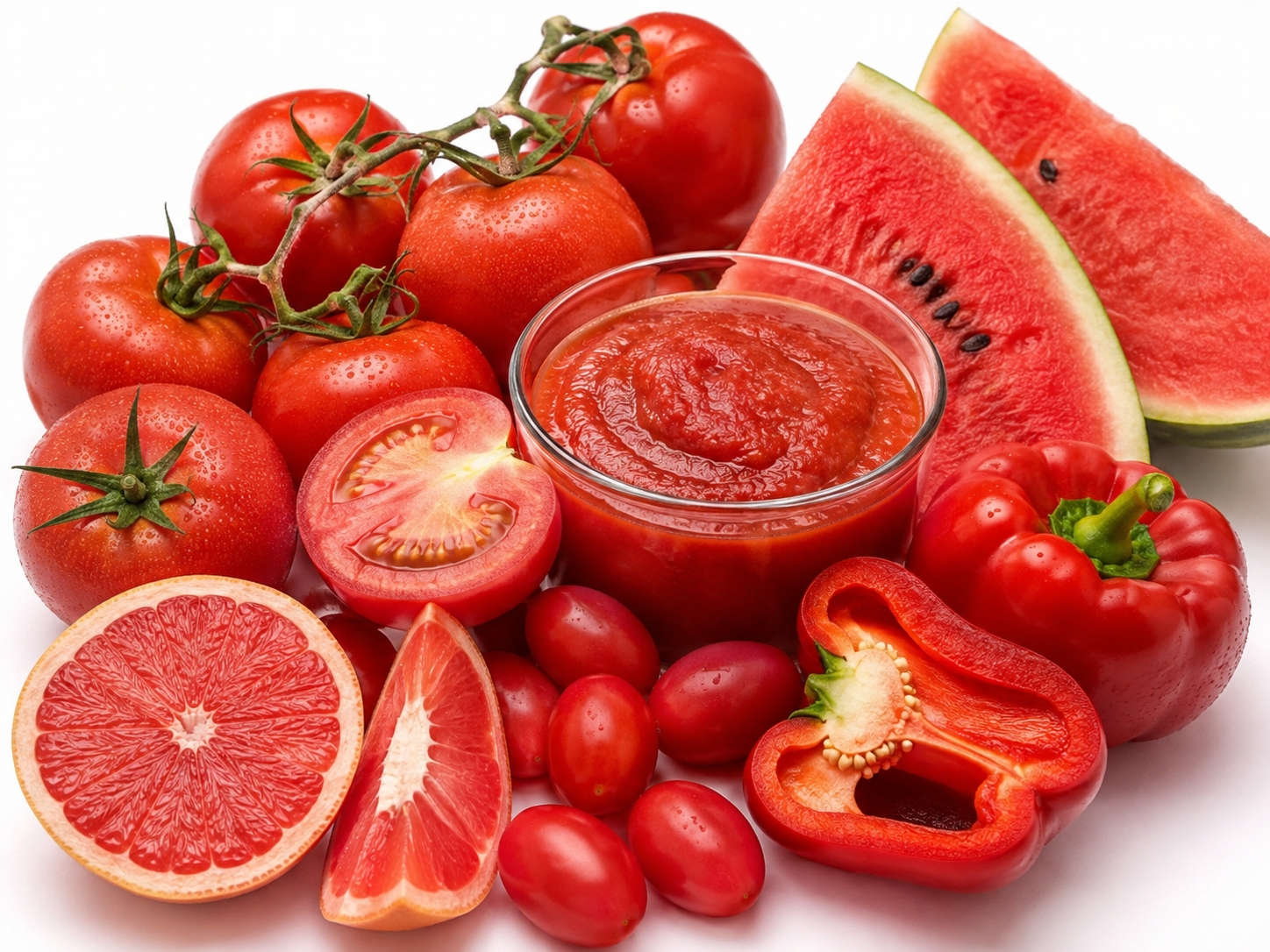
Lycopene is a fat-soluble carotenoid found in red foods such as tomatoes and watermelon. It cannot be converted into vitamin A and is not an essential nutrient. Ordinary foods can already provide meaningful amounts, while supplements may use whole-tomato extracts, purified or synthetic all-trans-lycopene, tomato oleoresin, beadlets, or prostate-health combination formulas.
30-second check: which situation fits you best?
I mainly want everyday antioxidant or healthy-aging support
Lycopene has strong singlet-oxygen quenching activity, but laboratory antioxidant capacity does not mean that healthy adults will necessarily gain a clear additional benefit from supplementation.
I am focused on skin photoaging or prostate health
Skin studies commonly use about 10–16 mg/day for roughly 10–12 weeks and report changes in selected UV-erythema and photodamage markers. A small BPH trial used 15 mg/day for 6 months and showed only preliminary signals; evidence for prostate-cancer prevention remains insufficient.
I am planning to use it or already taking it
Lycopene is a fat-soluble carotenoid. Processing, dietary fat, cis/trans isomers, and formulation all affect absorption, and blood exposure does not rise proportionally as the dose increases.
Basic Overview
What it is
Lycopene is a fat-soluble carotenoid with 11 conjugated double bonds and is found mainly in tomatoes, red-fleshed watermelon, pink guava, and red-fleshed papaya. It lacks the beta-ionone ring found in beta-carotene and therefore cannot be converted into vitamin A, so vitamin A RDA, RAE, and UL values do not apply. Foods and supplements contain all-trans lycopene as well as several cis isomers, and isomer composition can affect human utilization.
Why people use it
- Long-term skin photoaging related to sun exposure
- Reducing UV-induced erythema and skin damage
- A goal related to male prostate health
- A fixed, standardized lycopene dose
- Selected vascular or cardiovascular markers
- Very low intake of tomatoes and other lycopene-rich foods
How it relates to healthy aging
Lycopene participates in antioxidant defense and can influence UV-induced erythema, MMP-1, procollagen, inflammatory markers, mitochondrial DNA damage, and other measures related to skin photoaging.
These human signals represent limited nutritional photoprotection. Current evidence does not show that lycopene reverses aging, extends lifespan, or replaces sunscreen.
Supplement Assessment
Whether supplementation is worthwhile depends on the goal, population evidence, actual lycopene dose, formulation, and observation period. Ordinary foods can already reach the milligram range used in many studies.
Lower supplementation priority
- Only seeking general antioxidant or anti-aging effects
- No specific skin, prostate, or vascular goal
- Rarely eating cooked tomatoes, tomato products, or red-fleshed watermelon
- Planning to use a supplement instead of sunscreen, diet, or exercise
- Planning indefinite use without reassessing benefit
Your next step:
First increase dietary intake with cooked tomatoes, tomato sauce or paste, and red-fleshed watermelon. Whole foods can already reach the milligram range used in some human studies.
Clear goal: a trial may be reasonable
- Skin photoaging or UV damage: studies commonly use 10–16 mg/day for 10–12 weeks
- Male BPH: a small RCT used 15 mg/day for 6 months and showed only preliminary signals
- Vascular or cardiovascular markers: a secondary use with inconsistent findings
- You can distinguish BPH, PSA, and prostate-cancer prevention
- You can confirm the actual lycopene milligrams and formulation
- You are willing to set a trial period and reassess
Your next step:
Match the specific goal, population, dose, duration, and formulation to human research. Do not treat observational cancer associations as causal supplement evidence.
Talk with a healthcare professional first
- Elevated PSA or ongoing evaluation for prostate disease
- Marked difficulty urinating, urinary retention, or blood in the urine
- Current treatment for prostate cancer or another malignancy
- Planning to replace medical treatment with high-dose lycopene
- Pregnancy or breastfeeding with plans for long-term concentrated supplementation
- Long-term high-dose use alongside multiple prescription medications
- Known allergy to tomato-derived extracts
Your next step:
Address symptoms that need medical evaluation first, then have a doctor or pharmacist review treatment, medications, and the complete formula.
Quick Self-Check
Is my goal general antioxidant support, or something specific such as skin, BPH, or vascular markers?
Could cooked tomatoes or red-fleshed watermelon provide a similar order of magnitude first?
Does the label list actual Lycopene or only total Tomato Extract?
Am I willing to use it long enough to evaluate the target properly?
Food Sources
Common Foods High in Lycopene
| Food | Form | Lycopene per 100 g | Common Serving | Approx. per Serving | How to Read It |
|---|---|---|---|---|---|
| Tomato paste | Concentrated | About 35.80–51.27 mg | 15 g | About 5.4–7.7 mg | The highest concentration here, but only a small amount is usually eaten at one time. |
| Tomato sauce | Cooked | About 5.80–8.60 mg | 125 g | About 7.3–10.8 mg | Cooking and disruption of the food matrix can improve release. |
| Red-fleshed watermelon | Raw | About 4.7–6.9 mg | 250 g | About 11.8–17.3 mg | A large serving is common; yellow or orange varieties may contain very little. |
| Pink guava | Raw | About 4.53 ± 0.80 mg | 100 g | About 4.5 mg | Cultivar and ripeness affect the actual amount. |
| Red-fleshed papaya | Raw | About 1.35–3.67 mg | 150 g | About 2.0–5.5 mg | The red-fleshed variety matters; some yellow-fleshed papayas may have little or no detectable lycopene. |
| Raw red tomato | Raw | About 1.22–2.29 mg | 150 g | About 1.8–3.4 mg | Less concentrated than processed tomato products but easy to include regularly. |
How should you read these numbers? The per-100-g value is useful for comparing concentration; the serving value is more useful for understanding real intake. Tomato paste is highly concentrated but a serving may be only 15 g. Red-fleshed watermelon is less concentrated, but a 250 g serving is common and can still provide about 12–17 mg. For watermelon and papaya, the red-fleshed variety matters.
How Much Can Food Provide?
Example 1 | Tomato paste + red-fleshed watermelon
15 g tomato paste + 250 g red-fleshed watermelon provides roughly 17–25 mg lycopene.
This only illustrates dietary scale. It is not a daily target or recommended intake.
Example 2 | Tomato sauce + pink guava
125 g tomato sauce + 100 g pink guava provides roughly 12–15 mg lycopene.
Again, this only shows what a meal or day might provide and is not a target you must reach.
Cooking and storage tips
Cooking can improve availability: processing and heating can disrupt the food matrix and increase lycopene release.
Pair with some dietary fat: lycopene is fat soluble, so normal meal fat can support absorption.
Concentrated products are more concentrated: tomato paste and sauces usually contain substantially more per 100 g.
Watermelon variety and ripeness matter: ripe red-fleshed watermelon is the relevant example; yellow and orange varieties may be much lower.
Refrigerate after cutting: reduce prolonged heat, light, and air exposure.
Whole foods vs supplements
Whole Foods
- Provide multiple tomato carotenoids together
- A serving can provide several to more than 10 mg
- Cooked tomatoes with some fat can have good bioavailability
- Many skin studies use tomato foods or whole-tomato complexes
- Fit better into a long-term dietary pattern
Supplements
- Provide a more consistent dose
- Commonly provide about 5–30 mg
- Useful when a fixed dose is needed for a specific goal
- Include both pure lycopene and whole-tomato complexes
- Should not automatically be assumed to work better than food
Dosage
Lycopene has no RNI, RDA, AI, formal UL, or universal daily recommended dose. EFSA’s food-safety ADI, Health Canada’s maximum daily product dose, and human-study doses must be interpreted separately.
Official Dose Status, Regulatory References & Human Research
Official Dose Status & Regulatory References
These figures have different regulatory meanings and should not be combined into one recommended range.
Human-Study References by Goal
These are doses used in specific populations, goals, and treatment periods, not recommendations for generally healthy adults.
Research Range & Longer-Term Data
It is more accurate to show the research range without creating one daily recommendation for generally healthy adults.
Dose–Exposure Relationship
A larger package number does not mean proportionally greater absorption or stronger effects.
Core boundary:EFSA 0.5 mg/kg/day = food-safety ADI; Health Canada 30 mg/day = maximum daily dose under a product monograph; about 6.5–30 mg/day = a common human-research range. None is a universal recommended intake or formal UL.
Important Note
Lycopene has no RNI, RDA, AI, or formal UL.
EFSA’s 0.5 mg/kg/day is a food-safety ADI, not a supplement UL.
Health Canada’s 30 mg/day is the maximum daily dose under a monograph, not an RDA.
Skin studies using 10–16 mg/day for 10–12 weeks do not create an “oral SPF.”
The 15 mg and 30 mg prostate studies involved different populations and should not be rewritten as a prostate-cancer-prevention dose for healthy men.
Dose Utilization
Absorption from raw tomatoes is relatively limited because the food matrix restricts lycopene release.
Processing can increase bioavailability: when the same 23 mg dose was consumed with fat, total lycopene AUC from tomato paste was about 3.8 times that from fresh tomatoes.
Cis isomers generally form mixed micelles more readily and may be more bioavailable than all-trans lycopene.
Absorption begins to plateau as the dose rises, so Cmax and AUC do not increase proportionally.
In a 25 mg/day study, plasma lycopene reached a plateau at about 2 weeks; continuing longer or taking more does not produce a linear rise.
How to Read Common Product Doses
Total Tomato Extract or Lyc-O-Mato® weight is not necessarily the actual Lycopene dose. Compare the milligrams of lycopene provided per serving.
| Product | Package / Label Number | Dose That Is Actually Comparable | Formulation | How to Read It |
|---|---|---|---|---|
| NOW Foods Lycopene 10 mgOfficial product link | 10 mg/capsule | 10 mg Lycopene/capsule | Whole-tomato extract Lycomato® tomato complex + olive oil |
The 10 mg figure is the actual Lycopene dose. Lycomato® identifies the whole-tomato source. |
| Life Extension Mega LycopeneOfficial product link | 15 mg/capsule | 15 mg Lycopene/capsule | Whole-tomato extract Lyc-O-Mato® tomato complex + rice bran oil |
15 mg is the actual Lycopene dose. The oil carrier and accompanying tomato compounds are formulation details. |
| Swanson Lyc-O-Mato Double StrengthOfficial product link | 133 mg Tomato Extract/capsule | 20 mg Lycopene/capsule | Whole-tomato complex Also contains 2 mg Natural Tocopherols and 1.4 mg Phytoene + Phytofluene |
133 mg is the total Tomato Extract weight, not 133 mg lycopene. The relevant comparable dose is 20 mg Lycopene. |
| NOW Foods Lycopene 20 mgOfficial product link | 20 mg/capsule | 20 mg Lycopene/capsule | Oil-based softgel Tomato-derived Lycopene + olive oil |
The 20 mg figure directly represents the target ingredient. Then compare source, carrier, and daily servings. |
| GNC Lycopene 30 mgOfficial product link | 30 mg / 2 capsules | 30 mg Lycopene/serving; about 15 mg/capsule | 2 capsules per serving Serving Size: 2 Softgels |
The 30 mg figure applies to two capsules, not each capsule. Always check the Serving Size first. |
| NOW Prostate SupportOfficial product link | Multi-ingredient formula | 3 mg Lycopene/serving | Prostate combination formula Saw palmetto, nettle root, pumpkin-seed oil, zinc, and other ingredients |
Other ingredients should not be added to the lycopene dose. Safety should be assessed for the whole formula. |
NOW Foods Lycopene 10 mg
Official product link- Package / Label Number
- 10 mg/capsule
- Dose That Is Actually Comparable
- 10 mg Lycopene/capsule
- Formulation
- Whole-tomato extract
Lycomato® tomato complex + olive oil
- How to Read It
- The 10 mg figure is the actual Lycopene dose. Lycomato® identifies the whole-tomato source.
Life Extension Mega Lycopene
Official product link- Package / Label Number
- 15 mg/capsule
- Dose That Is Actually Comparable
- 15 mg Lycopene/capsule
- Formulation
- Whole-tomato extract
Lyc-O-Mato® tomato complex + rice bran oil
- How to Read It
- 15 mg is the actual Lycopene dose. The oil carrier and accompanying tomato compounds are formulation details.
Swanson Lyc-O-Mato Double Strength
Official product link- Package / Label Number
- 133 mg Tomato Extract/capsule
- Dose That Is Actually Comparable
- 20 mg Lycopene/capsule
- Formulation
- Whole-tomato complex
Also contains 2 mg Natural Tocopherols and 1.4 mg Phytoene + Phytofluene
- How to Read It
- 133 mg is the total Tomato Extract weight, not 133 mg lycopene. The relevant comparable dose is 20 mg Lycopene.
NOW Foods Lycopene 20 mg
Official product link- Package / Label Number
- 20 mg/capsule
- Dose That Is Actually Comparable
- 20 mg Lycopene/capsule
- Formulation
- Oil-based softgel
Tomato-derived Lycopene + olive oil
- How to Read It
- The 20 mg figure directly represents the target ingredient. Then compare source, carrier, and daily servings.
GNC Lycopene 30 mg
Official product link- Package / Label Number
- 30 mg / 2 capsules
- Dose That Is Actually Comparable
- 30 mg Lycopene/serving; about 15 mg/capsule
- Formulation
- 2 capsules per serving
Serving Size: 2 Softgels
- How to Read It
- The 30 mg figure applies to two capsules, not each capsule. Always check the Serving Size first.
NOW Prostate Support
Official product link- Package / Label Number
- Multi-ingredient formula
- Dose That Is Actually Comparable
- 3 mg Lycopene/serving
- Formulation
- Prostate combination formula
Saw palmetto, nettle root, pumpkin-seed oil, zinc, and other ingredients
- How to Read It
- Other ingredients should not be added to the lycopene dose. Safety should be assessed for the whole formula.
Health Effects
Skin Photoaging & UV Damage
Systematic reviews and human studies have often used about 10–16 mg/day for 10–12 weeks and reported changes in selected UV-induced erythema, MMP-1, procollagen, inflammatory markers, mitochondrial DNA damage, and skin thickness or density. The evidence is closer to limited nutritional photoprotection—not a “natural sunscreen” or oral SPF—and does not replace sunscreen, protective clothing, or reducing intense sun exposure.
View systematic review
Male Prostate Health
A small randomized trial using 15 mg/day for 6 months found a preliminary signal for benign prostatic hyperplasia (BPH), but the sample was limited. BPH is not prostate cancer; a PSA change does not equal lower cancer risk; and observational associations do not prove that supplements prevent cancer. A 30 mg/day study in men with high-grade prostatic intraepithelial neoplasia (HGPIN) involved a specific high-risk population and should not be generalized to healthy men.
View BPH randomized trial · View prostate systematic review
Vascular & Cardiovascular Function
Some earlier studies and meta-analyses suggested possible improvements in endothelial function or selected cardiovascular markers, and 7 mg/day has been studied in a specific cardiovascular-disease population. However, a 2023 meta-analysis and a 2026 cardiovascular umbrella review show that findings differ by outcome and population. Lycopene should not be treated as a routine cardiovascular supplement for generally healthy adults.
View meta-analysis
Blood Lipids
Some studies report changes in total cholesterol, LDL, HDL, or triglycerides, but the direction and size of effect are not consistent, and many studies include people with metabolic abnormalities or cardiovascular risk. Small laboratory changes should not be presented as a reliable lipid-lowering effect, and lycopene does not replace diet, exercise, or lipid-lowering treatment.
View meta-analysis
Antioxidant Status & Oxidative Damage
Lycopene can quench singlet oxygen and may influence markers of oxidative damage. Human studies using about 6.5–30 mg/day for 8 weeks have reported inconsistent changes across biomarkers. Mechanistic activity and biomarker changes do not guarantee a noticeable benefit, and they do not show that higher doses produce stronger anti-aging effects.
View meta-analysis
Blood Pressure
Some pooled analyses suggest a small reduction in systolic blood pressure, but populations, doses, formulations, and baseline blood pressure vary substantially, and diastolic results are inconsistent. If you try lycopene for a blood-pressure goal, track a standardized home blood-pressure trend. It should not replace established lifestyle measures or antihypertensive treatment.
View meta-analysis
Product Selection
Prioritize the actual Lycopene milligrams per serving, then check Serving Size, purified lycopene vs tomato complex, formulation, and quality.
Check these four things when buying
What is the active ingredient?
Find Lycopene on the label first. If the front emphasizes Tomato Extract, Lyc-O-Mato®, or a prostate complex, keep looking for the actual lycopene amount. A natural tomato complex and purified all-trans-Lycopene should not be assumed to be fully equivalent.
How much do you actually get per serving?
Check Serving Size, actual Lycopene milligrams per capsule or serving, and daily servings. GNC 30 mg is listed per 2 capsules, or about 15 mg/capsule; Swanson 133 mg Tomato Extract provides only 20 mg Lycopene.
Are there unnecessary added ingredients?
An oil carrier can be useful for fat-soluble lycopene. Phytoene, Phytofluene, Beta-Carotene, Tocopherols, and plant sterols are separate active ingredients and should not be added together as “total lycopene.” Evaluate complex prostate formulas as a whole.
Is quality control credible?
Check the manufacturer, source, lot number, expiration date, actual active content, and third-party quality information. Natural extract, Beadlet, or patented-ingredient wording helps identify the formulation but does not prove stronger health effects at the same milligram dose.
How to Read the Label5 steps to find the true lycopene dose
Find Lycopene first, then calculate the actual amount per serving and per day; total extract weight is not the target-ingredient dose.
Phytoene + Phytofluene 1.4 mg; Natural Tocopherols 2 mg. Evaluate separately.
Calculate the dose from the actual 20 mg Lycopene per softgel.
Source | Actual active dose | Serving Size | Batch testing
Illustrative label: 133 mg is the total Tomato Extract weight, which provides 20 mg Lycopene. Compare the 20 mg figure when evaluating products.
Find the target ingredient: Lycopene
Confirm that the label clearly lists Lycopene. Do not begin by comparing the total weight of Tomato Extract, Lyc-O-Mato®, or a proprietary complex.
Find the actual lycopene dose
If 133 mg Tomato Extract provides 20 mg Lycopene, the comparable target-ingredient dose is 20 mg—not 133 mg.
Check Serving Size
If Serving Size is 2 capsules and the serving provides 30 mg Lycopene, each capsule provides about 15 mg. Do not confuse a per-serving dose with a per-capsule dose.
Evaluate other tomato actives separately
Phytoene, Phytofluene, Beta-Carotene, Tocopherols, and similar compounds should be interpreted separately and should not be added to create a larger “total lycopene” number.
Match the formulation to your goal
Skin research may use tomato foods or whole-tomato complexes. Prostate formulas may also contain saw palmetto, plant sterols, zinc, and other ingredients, so do not judge the whole formula by lycopene dose alone.
How to Choose Among Common Forms(Source, isomer profile, delivery system, and combination ingredients differ)
Natural Tomato Complex Extract
Main features
Derived from tomato and may contain Phytoene, Phytofluene, Beta-Carotene, and Tocopherols in addition to Lycopene. Many skin studies use tomato foods or whole-tomato complexes.
Site guidance
A reasonable choice when you want a product closer to tomato-food research, but do not treat total complex weight as lycopene dose or attribute every effect to lycopene alone.
Purified or Synthetic all-trans-Lycopene
Main features
The target active ingredient and milligram amount are straightforward, making products easier to compare. The isomer profile differs from a whole-tomato complex.
Site guidance
Useful when you want a clearly defined single-ingredient dose, but do not assume results from whole tomato foods or complexes transfer perfectly to purified lycopene.
Tomato Oleoresin
Main features
Concentrates fat-soluble tomato components in an oil phase, which is useful for stability and softgel formulations. The actual Lycopene percentage still depends on standardization.
Site guidance
Check the oleoresin weight and the Lycopene milligrams it actually provides. Do not compare products using the larger total extract number.
Beadlet
Main features
Microencapsulation can improve stability and make lycopene easier to use in tablets, capsules, or powders. Excipients and release characteristics differ from oil-based softgels.
Site guidance
Stability and quality data are useful, but “beadlet” does not mean the product has better clinical effects than an ordinary oil-based formulation.
Male Prostate Combination Formula
Main features
Often combines lycopene with saw palmetto, nettle root, pumpkin-seed oil, plant sterols, zinc, selenium, green tea, or other botanicals. Lycopene may contribute only a few milligrams.
Site guidance
Evaluate the entire formula for the prostate-related goal. Do not add other ingredient weights to the Lycopene dose, and do not use a combination product as a substitute for medical evaluation.
How to Take
There is no universal official recommended dose. Lycopene is fat soluble, so supplements are best taken with a normal meal containing some fat; for skin goals, consistency over about 10–12 weeks matters more than taking a capsule right before sun exposure.
Default plan (healthy adults)
Official recommended dose: No universal official recommended intake has been established
Frequency: Many common products are taken once daily
With food?: Prefer taking it with a meal containing some fat
Split doses?: Common research doses usually do not require deliberate dose splitting
Morning or evening?: There is no required time of day
Skin observation period: Usually about 10–12 weeks before reassessing
Missed dose: If you occasionally miss a dose, skip it; do not double the next dose
Frequently asked questions
With food or on an empty stomach?
Prefer taking it with a normal meal containing some fat. Lycopene is fat soluble, and food and fat affect absorption; there is no reason to take it fasting.
Do I need to take extra oil?
No. A normal meal containing some fat is usually enough, and many softgels already use olive oil, rice-bran oil, or another oil carrier.
Are cooked or raw tomatoes better?
Cooked tomatoes and tomato products often make lycopene easier to release and absorb. Raw tomatoes are still healthy foods; there is no need to choose only one.
Will one capsule before sun exposure help?
Do not think of lycopene as oral SPF. Skin studies generally use continuous intake for 10–12 weeks, and a last-minute capsule does not replace sunscreen, clothing, or shade.
Should men take it long term for prostate health?
First distinguish BPH, PSA changes, and cancer prevention. A small BPH study does not mean all men should supplement long term; urinary symptoms or an abnormal PSA should be medically assessed.
How do I know whether it is working?
For skin goals, use consistent lighting to track sun-related redness and overall skin changes. Prostate goals require standardized symptom measures and medical evaluation. Do not rely on a vague “antioxidant feeling.”
Risks & Precautions
Common Side Effects
- Stomach discomfort may occur
- Nausea may occur
- Bloating may occur
- Diarrhea or other bowel changes may occur
- These effects are not necessarily common or inevitable
- Also consider tolerance to the oil carrier and other ingredients in softgels or combination products
Higher-Dose Risks
- Single-dose studies from 10–120 mg show that absorption does not increase in direct proportion to dose
- A 50 mg or 100 mg product should not be assumed to work better simply because the package number is larger
- Very high long-term intake can lead to lycopene-related carotenoderma or lycopenemia
- This can cause a yellow-orange skin discoloration that is generally benign and reversible
- No formal UL does not mean the dose can be increased without limit
- Long-term data on high-dose use over many years remain limited
People Who Need More Caution
- Men with an abnormal PSA or existing prostate symptoms
- People receiving treatment for prostate cancer or another cancer
- Pregnancy with plans for long-term high-concentration supplementation
- Breastfeeding with plans for long-term high-concentration supplementation
- Allergy to tomato-derived products
- People who already have yellow-orange skin discoloration
Medications & Special Situations
- Multiple long-term prescription medications: there is no need to invent a fixed interaction list, but have a doctor or pharmacist review long-term high-dose use.
- Prostate symptoms: difficulty urinating, urinary retention, blood in the urine, or an abnormal PSA should not be self-managed with supplements alone.
- Skin photoaging: lycopene does not replace sunscreen or dermatologic evaluation.
- Complex prostate formulas that also contain saw palmetto, plant sterols, nettle, green tea, curcumin, quercetin, zinc, or selenium should be evaluated as a whole for safety and drug interactions.
Stop and Ask for Advice
Stop self-directed use and seek advice if persistent gastrointestinal symptoms or unusual skin discoloration develops, or if the skin or prostate symptoms you are trying to address continue.
Seek Medical Care Promptly
Seek prompt medical care for acute urinary retention, blood in the urine, a concerning skin lesion, difficulty breathing, or another severe acute reaction.
Sources
Sources are grouped by nutrition standards, regulatory safety, skin, prostate, food content, absorption, cardiovascular evidence, safety, and mainstream product-dose examples. Full source URLs are preserved.
Nutrition Standards & Basic Information
Regulatory Safety References
Skin Photoaging & UV Damage
Male Prostate Health
Food Content
Absorption & Food Processing
Cardiovascular Evidence
Safety References
Mainstream Product Label & Dose Examples
Last updated: August 12, 2026