Vitamin E
Vitamin E / Alpha-Tocopherol / Tocopherol
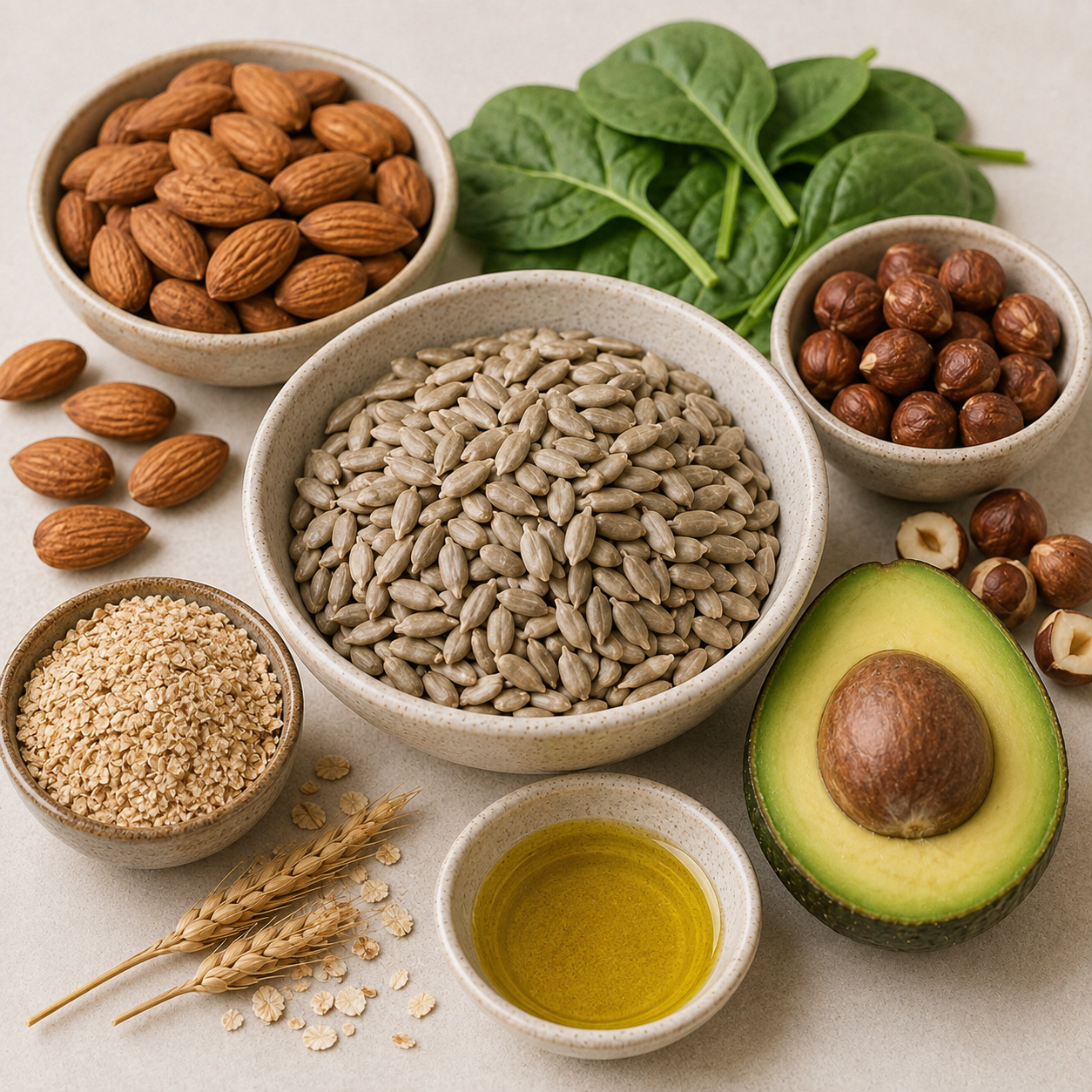
Vitamin E is a group of fat-soluble compounds with antioxidant activity, including tocopherols and tocotrienols. The body mainly retains and uses α-tocopherol, which helps protect lipids in cell membranes and supports normal immune function and cell signaling. Main dietary sources include nuts, seeds, vegetable oils, and some leafy green vegetables.
30-second check: which situation fits you best?
Daily Sources Are Fairly Consistent
You regularly eat nuts and seeds such as almonds, hazelnuts, peanuts, or sunflower seeds; use moderate amounts of vegetable oil; eat a varied diet; your current multivitamin already provides some vitamin E; or you mainly want high-dose vitamin E for anti-inflammatory, beauty, heart-health, or anti-aging claims.
Daily Sources Are Often Inconsistent
You rarely eat nuts or seeds; use very little dietary oil and have few other vitamin E sources; follow a strict low-fat diet long term; have a selective or restrictive diet with limited variety; or work and travel make your diet unreliable.
Mainly for Antioxidant or Healthy-Aging Goals
Your diet is already fairly consistent, and your main goals are skin appearance, exercise recovery, or long-term antioxidant support. You want to know whether vitamin E supplementation adds benefits beyond a solid diet.
Basic Overview
What it is
Vitamin E is not one single compound. It is a family of fat-soluble substances with vitamin E activity, including α-, β-, γ-, and δ-tocopherol and α-, β-, γ-, and δ-tocotrienol. After multiple forms are absorbed, the liver preferentially retains and re-secretes α-tocopherol, so it is the form maintained at the highest concentrations in blood and tissues and the most extensively studied.
Why people use it
- Fill gaps caused by low intake of nuts, seeds, and vegetable oils
- Maintain a basic intake during low-fat or restrictive diets
- Fill in vitamin E missing from a multivitamin
- Evaluate it for antioxidant, skin, or long-term health goals
How it relates to healthy aging
Vitamin E helps protect lipids in cell membranes and therefore contributes to normal tissue maintenance and the body's antioxidant system. However, there is no reliable evidence that high-dose vitamin E supplements reverse aging, extend lifespan, consistently improve skin appearance, prevent cardiovascular disease, prevent cancer, or stop normal cognitive aging in healthy adults whose diets are already adequate.
The U.S. Preventive Services Task Force recommends against vitamin E supplementation for prevention of cardiovascular disease or cancer in generally healthy adults.
Supplement Assessment
Quick Take: Vitamin E can come from nuts, seeds, and vegetable oils. Most healthy people with balanced diets do not need a dedicated supplement; when dietary sources are consistently low, a low-dose approach can fill the gap. People with bleeding risk, medication use, upcoming surgery, or fat-malabsorption problems should not self-start high-dose products.
Usually No Dedicated Supplement Needed
- Regularly eat nuts, seeds, or moderate amounts of vegetable oil
- Overall diet is fairly balanced and varied
- Do not follow a strict low-fat diet long term
- Your current multivitamin already provides vitamin E
- No problems affecting fat digestion or absorption
- You mainly want high-dose vitamin E for anti-inflammatory effects, beauty, heart protection, or anti-aging
Your next step:
Continue getting vitamin E from natural foods and check for duplication across supplements. Without a clear intake gap, there is no need to increase the dose just for “antioxidant” purposes.
You May Have an Intake Gap
- Rarely eat nuts such as almonds, hazelnuts, or peanuts
- Rarely eat seeds such as sunflower seeds
- Long-term use of very little dietary oil
- Follow a strict low-fat diet long term
- Selective eating, restrictive diets, or low food variety
- Work, travel, or other circumstances make food sources unreliable
Your next step:
Improve food sources first. If intake still remains unreliable, consider a low-dose supplement near the daily reference intake. The goal is to fill a gap, not to chase high potency.
Talk to a Health Professional First
- Using an anticoagulant such as warfarin
- Using an antiplatelet drug such as aspirin or clopidogrel
- Frequent unexplained bruising, nosebleeds, or gum bleeding
- A clotting disorder or a history of serious bleeding
- Preparing for surgery, dental extraction, or an invasive procedure
- Receiving chemotherapy, radiotherapy, or another complex treatment
- Fat-malabsorption problems, impaired bile secretion, or chronic diarrhea
- Pregnancy, breastfeeding, or childhood
- Planning long-term intake well above the daily reference amount
Your next step:
Talk with a physician, pharmacist, or registered dietitian first to assess whether supplementation is appropriate, whether testing is needed, and whether the dose, form, and drug interactions are acceptable. Simply spacing a supplement a few hours away from medication does not eliminate clotting-related interactions.
Quick self-check
Did I eat nuts, seeds, or moderate amounts of vegetable oil regularly over the past week?
Do I follow a strict low-fat or restrictive diet long term?
Does my multivitamin, eye-health formula, or beauty product already contain vitamin E?
Am I buying it to fill a real intake gap, or only because of “antioxidant” marketing?
Is the amount per serving far above the daily reference of 14–15 mg?
Am I using any medication that affects clotting?
Am I preparing for surgery, dental extraction, or complex treatment?
Food Sources
Food values are based mainly on α-tocopherol data from USDA FoodData Central. China uses mg α-TE for its AI, so the two systems are not identical; percentages are intended as a practical estimate rather than a laboratory-precise conversion. The front end uses simple food names without adding processing words such as “roasted” or “cooked.” Sunflower kernels, almonds, hazelnuts, pine nuts, and peanuts use raw, unroasted, unsalted edible-portion data; spinach uses raw edible-portion data; vegetable oils use finished edible-oil data.
Representative food sources
| Food | Approx. per 100 g | Common Serving | Approx. per Serving | % of China Adult AI |
|---|---|---|---|---|
| Sunflower oil | About 41.1 mg | 10 g | About 4.1 mg | About 29% |
| Sunflower seed kernels | About 35.2 mg | 25 g | About 8.8 mg | About 63% |
| Almonds | About 25.6 mg | 25 g | About 6.4 mg | About 46% |
| Hazelnuts | About 15.0 mg | 25 g | About 3.8 mg | About 27% |
| Corn oil | About 14.3 mg | 10 g | About 1.4 mg | About 10% |
| Pine nuts | About 9.3 mg | 20 g | About 1.9 mg | About 13% |
| Peanuts | About 8.3 mg | 25 g | About 2.1 mg | About 15% |
| Spinach | About 2.0 mg | 100 g | About 2.0 mg | About 14% |
Vegetable oils are high in vitamin E per 100 g, but they are also energy-dense. Do not drink or add large amounts of oil beyond normal cooking use just to get more vitamin E.
How to get it from food in a day
Example One
10 g sunflower oil provides about 4.1 mg vitamin E, 20 g almonds about 5.1 mg, 10 g sunflower seed kernels about 3.5 mg, and 100 g spinach about 2.0 mg, for a total of about 14.7 mg—close to the daily AI for a general Chinese adult.
Example Two
25 g almonds provide about 6.4 mg vitamin E, 25 g hazelnuts about 3.8 mg, 25 g peanuts about 2.1 mg, and 100 g spinach about 2.0 mg, for a total of about 14.3 mg—also close to the daily AI for a general Chinese adult.
Cooking and storage tips
Store nuts and seeds sealed, away from light, heat, and moisture.
Do not keep opened nuts or seeds for too long; discard them if they develop a clearly rancid smell or taste.
Store vegetable oils away from light and avoid repeatedly heating the same oil at high temperatures for long periods.
Nuts and seeds still need portion control; do not keep increasing them just for vitamin E.
Vegetables such as spinach can contribute vitamin E but do not fully replace nuts, seeds, and vegetable oils as sources.
Whole foods vs supplements
Whole Foods
- Also provide unsaturated fats, protein, magnesium, and other food components
- Better suited to a long-term dietary pattern
- Provide vitamin E in dispersed amounts, making excessive intake less likely
- Nuts and oils still require reasonable portion sizes
- There is no need to worry about the UL from naturally occurring vitamin E in foods
Vitamin E Supplements
- Provide a concentrated, consistent dose and are easy to use
- Can help fill a clear, persistent intake gap
- Easy to duplicate with multivitamins and beauty products
- Stand-alone products often provide far more than the daily reference amount
- High-dose supplements require particular attention to bleeding risk
Dosage
How much should you get each day, and what is the long-term upper limit?
China Adult Reference Standards (2023 DRIs)
The scale shows the China adult AI (14 mg α-TE/day), U.S. adult RDA (15 mg α-tocopherol/day), China adult UL (700 mg α-TE/day), and U.S. adult UL (1000 mg α-tocopherol/day). The UL is a risk boundary, not a target to pursue.
Scope of This Section:For generally healthy adults; it does not cover children, pregnancy, breastfeeding, confirmed deficiency, fat-malabsorption disorders, or people receiving treatment for disease.
Chinese and U.S. Reference Standards
China AI
14 mg α-TE/day
UL (Tolerable Upper Intake Level)
700 mg α-TE/day
U.S. RDA
15 mg α-tocopherol/day
UL (Tolerable Upper Intake Level)
1000 mg α-tocopherol/day
The China UL is based on total daily intake, while the U.S. UL mainly applies to supplemental α-tocopherol. The two systems use different units and calculation approaches, so they should not simply be merged into one identical scale.
Absorption & Use
Vitamin E is fat-soluble and depends on normal fat digestion and absorption. Taking it with a regular meal that contains some fat is generally appropriate, but there is no need to add a large amount of extra oil just for the supplement.
People with fat-malabsorption problems need individualized assessment of dose and product form.
Health Effects
Antioxidant Defense & Cell-Membrane Protection
Vitamin E can reduce lipid oxidation and help protect polyunsaturated fats in cell membranes. This explains why the body needs vitamin E for normal function, but it does not prove that increasing the dose after intake is already adequate provides stronger whole-body antioxidant or anti-aging effects.
View official guidance
Preventing and Correcting Vitamin E Deficiency
When true deficiency is present, vitamin E supplementation can restore normal nutritional status. Marked deficiency is uncommon in healthy people and is usually linked to fat-malabsorption disorders, impaired bile secretion, certain genetic conditions, or severe malabsorption. These patients may need special formulations and very different doses, so routine low-dose plans for healthy adults do not apply.
View official guidance
Cardiovascular Disease Prevention
Although vitamin E has antioxidant activity, randomized controlled trials have not shown that routine vitamin E supplementation consistently prevents cardiovascular disease. The U.S. Preventive Services Task Force concludes that vitamin E supplementation provides no net benefit for prevention of cardiovascular disease in community-dwelling adults.
View official recommendation
Cancer Prevention
Human evidence does not support vitamin E supplements for cancer prevention. In the large SELECT trial, men assigned the study’s high-dose vitamin E alone had a 17% relative increase in prostate cancer cases. This does not mean every vitamin E dose raises prostate cancer risk, but it does show that high-dose antioxidant supplements are not inherently safe and are not appropriate as a routine cancer-prevention strategy.
View large randomized trial
Cognitive Function & Healthy Aging
Studies in healthy older adults or people with mild cognitive problems have not consistently shown that vitamin E supplements preserve cognition, slow normal age-related decline, or prevent Alzheimer’s disease. Specific treatment doses and outcomes from disease populations cannot be generalized to generally healthy adults.
View official guidance
Inflammatory Markers & Exercise Recovery
Some meta-analyses suggest vitamin E supplementation may affect inflammatory markers such as CRP, but study populations, baseline health, product forms, and doses vary widely. Exercise research also has not consistently shown clear improvements in strength, performance, or recovery. Lower inflammatory or oxidative-damage markers do not necessarily mean a generally healthy person will recover better or have a “younger” body.
View inflammation meta-analysis · View exercise systematic review
Product Selection
What Should I Look for on the Label?
Only Check These Four Things
What Is the Active Ingredient?
First check which form of vitamin E the label lists. Common examples include α-tocopherol, RRR-α-tocopherol, dl-α-tocopherol, mixed tocopherols, and tocotrienols. For generally healthy people, the priority is clear labeling of the active ingredient; do not assume mixed tocopherols or tocotrienols are automatically better.
How Much Is Actually in Each Serving?
Check how many milligrams are in each capsule, how many capsules are in a serving, and how many servings are suggested per day, then calculate your actual daily total. Also check whether other products you use contain vitamin E. Do not mistake the weight of capsule oil or the amount in the whole bottle for the active vitamin E dose.
Are There Unnecessary Additives?
Carrier oils, gelatin, and glycerin in vitamin E softgels are usually standard excipients. Pay more attention to large amounts of added sugar, sweeteners, flavorings, colors, or other unnecessary ingredients. People with soy or other allergies should also check the source of carrier oils and allergen labeling.
Is Quality Control Verifiable?
Prefer products with a clearly identified manufacturer and manufacturing location, complete lot and expiration information, and clear storage conditions. The ingredient list and active amount per serving should be verifiable; third-party testing or quality certification can be a useful plus.
How to Read the Label(Example of a Low-Dose Vitamin E Product)
Take 1 softgel daily with a meal.
Sunflower oil, gelatin, glycerin, purified water.
Third-Party Tested
Lot: VE260806
Expiration: 2028-08
*The product label uses milligrams of α-tocopherol directly rather than International Units. For this natural RRR-α-tocopherol example, 10 mg ÷ the FDA Daily Value of 15 mg α-tocopherol ≈ 67%. This is an educational example, not certification of an actual product label. %DV uses FDA Daily Values for adults and children aged 4 and older, excluding pregnancy and lactation; this adult example is not a child dosage recommendation. FDA Daily Values.
Active Ingredient
First identify the ingredient that actually provides vitamin E: RRR-α-tocopherol, all-rac-α-tocopherol, α-tocopheryl acetate, α-tocopheryl succinate, mixed tocopherols, or tocotrienols. The body mainly maintains α-tocopherol; mixed tocopherols and tocotrienols are not automatically superior to α-tocopherol.
Actual Amount per Serving
Confirm the milligrams per capsule, number of capsules per serving, suggested servings per day, and your actual daily total. Do not mistake the total oil in a softgel, total raw-material weight, or the amount in the whole bottle for the active vitamin E dose.
How the Dose Is Expressed
Product labels should state milligrams of α-tocopherol directly rather than International Units. The China adult AI is 14 mg α-TE/day and the U.S. RDA is 15 mg α-tocopherol/day. Products that let you keep total intake near the daily reference amount are easier to use.
Is It Easy to Duplicate?
Check multivitamins, eye-health formulas, beauty or skin products, fertility/preconception formulas, antioxidant blends, some omega-3 products, and fortified foods, and total all vitamin E sources together.
Quality Information
Prefer products with a complete ingredient list, clear amount per capsule or serving, lot number and expiration date, identified manufacturer, storage conditions, and verifiable quality testing or third-party certification.
How to Choose a Form(Differences, Whether They Are Worth Paying More For, and Who They May Suit)
RRR-α-Tocopherol
Main Difference
Often described as naturally sourced and has higher biological activity per unit mass.
Worth Paying More?
A suitable dose at a reasonable price is enough; natural-source labeling does not automatically make it safer or more effective.
Best For
When you want the milligram amount per serving to be straightforward to interpret.
All-rac-α-Tocopherol
Main Difference
A synthetic form containing multiple stereoisomers.
Worth Paying More?
It is not ineffective; the key is the actual milligram amount on the Supplement Facts panel.
Best For
Low-cost supplementation to fill a clear gap.
Acetate or Succinate Forms
Main Difference
More stable forms that need to be hydrolyzed in the body.
Worth Paying More?
The body can use them, but that does not mean they provide stronger health effects.
Best For
No need to pay extra specifically for these forms.
Mixed Tocopherols
Main Difference
Contain multiple tocopherol forms.
Worth Paying More?
They are an option, but check the actual α-tocopherol content.
Best For
People with a specific product preference who understand the evidence limits.
Tocotrienols
Main Difference
Compounds related to vitamin E.
Worth Paying More?
Long-term benefits in healthy people remain unclear, so they are not the first choice for basic gap-filling.
Best For
Not a priority choice for generally healthy people.
Common pitfalls
- Treating tens to hundreds of milligrams per serving as the default dose for generally healthy adults
- Looking only for “natural vitamin E” without checking the actual milligram amount
- Treating the total amount of mixed tocopherols or tocotrienols as the α-tocopherol amount
- Defaulting to high doses for “strong antioxidant” effects
- Adding stand-alone vitamin E on top of a multivitamin or beauty product that already contains it
How to Take
When should you take it, and what is the most practical way to use it?
Default plan (healthy adults)
Daily Amount: About 5–15 mg when filling a gap
Frequency: Usually once daily
With Food or on an Empty Stomach?: Preferably with or after a regular meal
Meal Requirement: A normal amount of dietary fat is enough
Do I Need to Split the Dose?: Usually not for a low dose
Morning or Evening?: No universal requirement; choose the time you can follow consistently
Missed Dose: Skip it and take the usual amount next time; do not double the dose
Frequently asked questions
With Food or on an Empty Stomach?
Take it with breakfast, lunch, or dinner; the meal only needs to contain a normal amount of fat. Taking it completely fasting does not necessarily cause problems, but taking it with a meal better matches the absorption characteristics of a fat-soluble vitamin and is easier to make consistent.
Do I Need to Split the Dose?
A low dose of 5–15 mg/day usually does not need to be split. Consider changing the product or schedule only if the product itself is high-dose, it causes stomach discomfort, or a health professional recommends a different approach for a special situation.
What Time Should I Take It?
Vitamin E has no clear morning-versus-evening advantage. Choose a time that is easy to maintain and can be paired with a meal. Do not take a double dose after a missed dose.
Should I Separate It from Other Supplements?
There is usually no universal spacing requirement from other basic nutrient supplements, and they can be taken with the same meal. The more important checks are whether other products already contain vitamin E, whether you are using a high-dose antioxidant blend, whether you take anticoagulant or antiplatelet drugs, and whether you are receiving chemotherapy or radiotherapy. If relevant medications are involved, spacing products by a few hours is not enough to avoid risk; talk to a physician or pharmacist first.
More questions about use (click to expand)
How Long Should I Take It?
There is no fixed course of vitamin E for all healthy adults. If food sources are temporarily unreliable, it can be used while the gap persists; once the diet improves, it can be reduced or stopped. If a multivitamin already provides enough, there is no need to add a stand-alone product. If the only goal is antioxidant support or healthy aging and there is no clear gap, indefinite use is not recommended. Recheck the total whenever you change a multivitamin, eye-health formula, or other supplement.
How Can I Tell Whether It Is Working?
When vitamin E is used to fill a basic nutrition gap, it usually does not produce obvious sensations. The key questions are not whether your skin suddenly looks brighter or your energy rises, but whether food plus supplements now bring intake near the daily reference amount, whether an unstable intake gap has been reduced, whether duplication and clearly high doses are avoided, whether gastrointestinal symptoms, unexplained bruising, or bleeding occur, and whether the original reason for use still exists. Generally healthy people do not need routine blood testing solely to decide whether to take vitamin E; suspected fat malabsorption, inherited disorders, or true deficiency should be assessed clinically.
Risks & Precautions
Common Side Effects
- Nausea
- Diarrhea
- Stomach discomfort or abdominal cramps
- Fatigue
- Muscle weakness
- Headache
- Unusual bruising or bleeding
- For mild gastrointestinal discomfort, first check for duplicate intake, reduce the dose, and take it with food. If symptoms persist, do not continue self-supplementation.
Main Risks of High Doses
- High-dose α-tocopherol supplements may inhibit platelet aggregation
- Interfere with vitamin-K-dependent clotting processes
- Increase the risk of abnormal bleeding
- Increase the possibility of hemorrhagic stroke
- Interact with anticoagulant or antiplatelet medications
- Naturally occurring vitamin E in food has not shown the same high-dose risk; safety concerns mainly involve concentrated supplements.
Talk to a Health Professional Before Use If You Are
- Taking an anticoagulant such as warfarin
- Taking an antiplatelet drug such as aspirin or clopidogrel
- A clotting disorder
- Frequent unexplained bruising or bleeding
- A history of intracranial or gastrointestinal bleeding
- Preparing for surgery, dental extraction, or an invasive procedure
- Receiving chemotherapy or radiotherapy
- Long-term use of multiple prescription medications
- Fat-malabsorption problems or impaired bile secretion
- Pregnancy, breastfeeding, or childhood
- Planning long-term use of products far above the daily reference amount
- “Talk to a health professional first” does not mean vitamin E is absolutely prohibited; it means the routine low-dose plan for generally healthy adults should not be applied automatically.
Special Situations
- Anticoagulants and antiplatelet drugs: high-dose vitamin E may increase bleeding risk. Separating the medication and supplement by a few hours does not remove this interaction.
- Surgery and invasive procedures: if you are preparing for surgery, dental extraction, or an invasive test, tell the clinician about all supplements you use. Do not decide on your own when to continue or stop them.
- Chemotherapy and radiotherapy: high-dose antioxidant supplements may affect some treatment processes. People receiving cancer treatment should first ask their oncology team whether vitamin E is appropriate.
- Fat malabsorption: vitamin E deficiency is more common in these conditions, but the needed dose and formulation may be very different from routine supplements and require professional assessment.
Stop and Seek Advice
Repeated unexplained bruisingClearly increased nosebleeds or gum bleedingA marked change in menstrual bleedingPersistent nausea, diarrhea, or stomach discomfortPersistent fatigue or muscle weaknessNew concerns about a medication interaction after starting the supplementSymptoms that are interfering with daily life
Seek Prompt Medical Care
Black stools, bloody stools, or blood in the urineVomiting bloodSignificant bleeding that will not stopSudden severe headacheFacial drooping, limb weakness, or abnormal speechDifficulty breathingSwelling of the face or throatSevere rash or another suspected allergic reaction
Sources
Nutrition Standards & Basic Data
Health Effects & Scientific Evidence
Safety, Product & Use References
Last updated: August 6, 2026