Beetroot Powder
Beetroot Powder / Beet Root Powder / Red Beet Powder / Beta vulgaris Powder
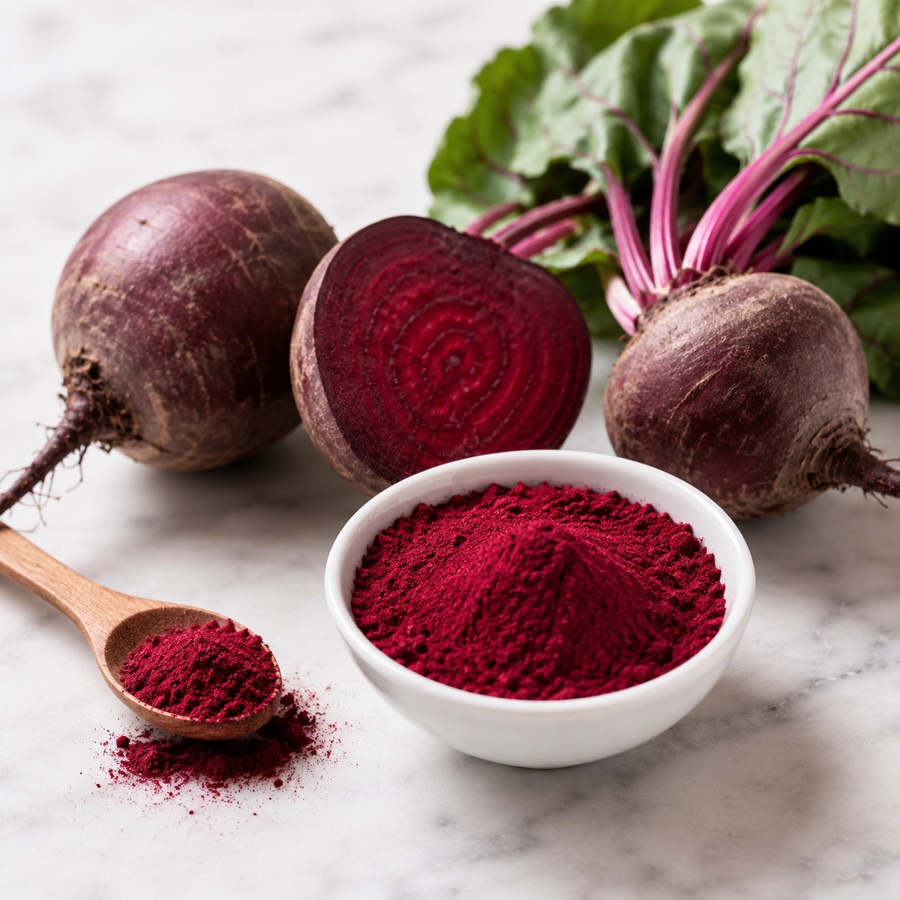
Beetroot powder is usually made from the root of red beet (Beta vulgaris). Its main naturally occurring compounds include nitrate, betacyanins, betaxanthins, betaine, and polyphenols. The most notable is nitrate, which can enter the nitrate–nitrite–nitric oxide pathway involving oral bacteria and influence vasodilation, muscle contraction, and exercise efficiency.
30-second check: which situation fits you best?
You Just Want Beetroot as an Everyday Food
If your main goal is simply more vegetable variety, adding beetroot to smoothies or yogurt, adding color to baked foods, or making beetroot easier to use, an ordinary 100% beetroot powder is enough. Without a specific exercise or nitrate goal, there is no need to chase a high-nitrate product just to “increase nitric oxide.”
Your Main Goal Is Exercise Performance
This is one of the most relevant human-evidence areas for beetroot. A large meta-analysis included 123 studies and 1,705 healthy adults and found a small but consistent overall improvement in exercise performance with dietary nitrate. Beetroot juice and high-nitrate foods showed more consistent results than nitrate salts alone.
I am already using or planning to use it
First confirm whether the product is whole beetroot powder, beetroot juice powder, concentrate, a nitrate-standardized product, or a blended sports formula. Then check powder weight per serving, Nitrate content, whether it is standardized, whether sugar or other sports ingredients are added, and whether sports-drug testing matters.
Basic Overview
What is it?
Beetroot powder is usually made by drying and milling the root of red beet (Beta vulgaris), but products labeled “Beetroot Powder” are not all the same. Some are whole-root powders, some are beetroot juice powders, concentrated juice crystals, or sports products further standardized for nitrate. The same number of grams can therefore contain very different amounts of fiber, sugar, and nitrate.
Why do people use it?
How does it relate to healthy aging?
The more reasonable link between beetroot and long-term physical function comes from the nitrate–nitrite–nitric oxide pathway. Nitric oxide is involved in vasodilation, blood-flow regulation, muscle contraction, and exercise efficiency.
These functions change with age and cardiovascular status, so dietary nitrate has been studied extensively. That still does not mean beetroot powder reverses vascular aging, slows aging, or extends lifespan.
Supplement Assessment
First decide whether your goal is ordinary food use, a specific exercise target, or whether low blood pressure, kidney stones, or medication creates an important boundary.
Just Everyday Food Use
- Use in smoothies, yogurt, oatmeal, or baking
- Use as a natural color
- Mainly to add vegetable variety
- No specific exercise or nitrate goal
Your next step:
Prioritize whether it is 100% beetroot, whether the ingredient list is simple, and whether food safety is reliable. There is no need to force Nitrate to match sports-study levels.
A Specific Exercise Goal May Justify Further Consideration
- You care about endurance or high-intensity exercise.
- You care about fatigue resistance.
- You care about explosive muscle power.
- You care about exercise efficiency.
Your next step:
Prioritize products that clearly state Nitrate mg/serving. If the manufacturer does not disclose nitrate, do not map ordinary powder weight directly onto exercise-study doses.
Ask a Professional First in Special Situations
- Your blood pressure is already low or you often feel dizzy when standing.
- You are taking blood-pressure-lowering medication.
- You have a history of recurrent calcium oxalate kidney stones.
- Your clinician has asked you to restrict potassium intake.
- You plan long-term, high intake of a functional product.
Your next step:
If your blood pressure is already low, you are being treated for hypertension, or you have recurrent calcium oxalate stones, do not treat high-nitrate beetroot products as ordinary vegetables that can be stacked without limit.
Quick Self-Check
Am I mainly eating beetroot as a food, or specifically for exercise performance or muscle power?
Does the product clearly state Nitrate: × mg / serving?
Is it Whole Root Powder, Juice Powder, Concentrate, or a standardized product?
Is my blood pressure already low?
Am I mainly using it for glucose control? Direct RCT evidence does not currently support that.
Products & Everyday Use
First distinguish whole-root powder, juice powder, concentrate, and standardized products, then compare Nitrate per serving and the testing basis.
Why compare real products here?
Even when packages all say “Beetroot Powder,” the product may actually be whole-root powder, beetroot juice powder, concentrated beet powder, beetroot juice crystals, a nitrate-standardized product, or a blended beetroot sports formula.
Nitrate also varies with cultivar, growing conditions, soil, harvest, and processing. If the manufacturer does not disclose nitrate, do not estimate it from powder grams.
The products below are included only to illustrate real market differences, not as brand recommendations or rankings.Same Label: Beetroot Powder
May Be Completely Different
Common Market Product Comparison
The most useful comparison order is product form → powder weight per serving → Nitrate mg per serving → whether it is standardized → whether there is a testing basis.
| Product | Package / Label Information | What Is Actually Comparable | Product Features | How to Read It |
|---|---|---|---|---|
| KOS Organic Beet Root PowderOfficial product link | Organic Beet Root Powder;Whole Red Beets;USDA Organic;Third-Party Tested | Whole Root Powder|Nitrate Not Disclosed | Everyday Food Type 100% whole red beet |
The brand clearly states that whole red beets are used, but does not disclose Nitrate mg per serving. You can identify the raw-material form, but not whether the nitrate amount reaches sports-study levels. |
| Micro Ingredients Organic Beet Root PowderOfficial product link | Beta vulgaris;about 3.5 g/serving;single ingredient;third-party tested | Root Powder|3.5 g/serving|Nitrate Not Disclosed | Ordinary Root-Powder Type Single-ingredient root powder |
The serving weight is clear, but specific Nitrate mg is not. The 3.5 g figure therefore describes powder weight, not a functional nitrate dose. |
| Micro Ingredients Organic Beet Root Juice PowderOfficial product link | Beet Root Juice Powder;about 3.5 g/serving;no additives or fillers | Juice Powder|Serving Weight|Nitrate Not Disclosed | Juice-Powder Type Beetroot juice powder |
This differs from whole-root powder and is more concentrated in the water-soluble components of beet juice. Nitrate mg per serving is still not disclosed. |
| Nutricost Organic Beet Root PowderOfficial product link | Product title says Beet Root Powder;official details identify Certified USDA Organic Beet Root Juice Powder | Product Name|Actual Product Form | Juice-Powder Type Organic beetroot juice powder |
Do not rely only on the product title. Check Ingredients and Product Details to confirm whether it is root powder or juice powder. |
| SuperBeets® Heart PowderOfficial product link | Beet Root Powder + Fermented Beet Root Powder;with natural flavors, vitamin C, stevia | Blend|Nitrate/Nitrite System|Specific Nitrate mg Not Disclosed | Functional Blend Beetroot blend formula |
The official page emphasizes a standardized nitrate/nitrite ratio, but does not provide a specific Nitrate mg per serving on the current page, so it cannot be quantitatively compared with a 400 mg standardized product. |
| Beet It Sport Nitrate 400 Crystals / ShotOfficial product link | From concentrated beetroot juice;400 mg Nitrate/serving | 400 mg Nitrate|Standardized|Batch Tested | Exercise-Targeted Standardized concentrated beetroot juice |
This is the clearest example of why functional dosing should be compared by Nitrate rather than beet grams. Beet It explicitly guarantees 400 mg of dietary nitrate per serving. |
| RedNite® Beetroot ConcentrateOfficial product link | Beetroot Concentrate Powder;standardized to 1.5%–2.75% Natural Nitrate | Nitrate Percentage|Ingredient Specification | Standardized Ingredient Standardized beetroot concentrate ingredient |
This is a food ingredient rather than ordinary retail beet powder, but it clearly illustrates what “standardized” means: a defined natural nitrate range. |
KOS Organic Beet Root Powder
Official product link- Package / Label Information
- Organic Beet Root Powder;Whole Red Beets;USDA Organic;Third-Party Tested
- What Is Actually Comparable
- Whole Root Powder|Nitrate Not Disclosed
- Product Features
- Everyday Food Type
100% whole red beet
- How to Read It
- The brand clearly states that whole red beets are used, but does not disclose Nitrate mg per serving. You can identify the raw-material form, but not whether the nitrate amount reaches sports-study levels.
Micro Ingredients Organic Beet Root Powder
Official product link- Package / Label Information
- Beta vulgaris;about 3.5 g/serving;single ingredient;third-party tested
- What Is Actually Comparable
- Root Powder|3.5 g/serving|Nitrate Not Disclosed
- Product Features
- Ordinary Root-Powder Type
Single-ingredient root powder
- How to Read It
- The serving weight is clear, but specific Nitrate mg is not. The 3.5 g figure therefore describes powder weight, not a functional nitrate dose.
Micro Ingredients Organic Beet Root Juice Powder
Official product link- Package / Label Information
- Beet Root Juice Powder;about 3.5 g/serving;no additives or fillers
- What Is Actually Comparable
- Juice Powder|Serving Weight|Nitrate Not Disclosed
- Product Features
- Juice-Powder Type
Beetroot juice powder
- How to Read It
- This differs from whole-root powder and is more concentrated in the water-soluble components of beet juice. Nitrate mg per serving is still not disclosed.
Nutricost Organic Beet Root Powder
Official product link- Package / Label Information
- Product title says Beet Root Powder;official details identify Certified USDA Organic Beet Root Juice Powder
- What Is Actually Comparable
- Product Name|Actual Product Form
- Product Features
- Juice-Powder Type
Organic beetroot juice powder
- How to Read It
- Do not rely only on the product title. Check Ingredients and Product Details to confirm whether it is root powder or juice powder.
SuperBeets® Heart Powder
Official product link- Package / Label Information
- Beet Root Powder + Fermented Beet Root Powder;with natural flavors, vitamin C, stevia
- What Is Actually Comparable
- Blend|Nitrate/Nitrite System|Specific Nitrate mg Not Disclosed
- Product Features
- Functional Blend
Beetroot blend formula
- How to Read It
- The official page emphasizes a standardized nitrate/nitrite ratio, but does not provide a specific Nitrate mg per serving on the current page, so it cannot be quantitatively compared with a 400 mg standardized product.
Beet It Sport Nitrate 400 Crystals / Shot
Official product link- Package / Label Information
- From concentrated beetroot juice;400 mg Nitrate/serving
- What Is Actually Comparable
- 400 mg Nitrate|Standardized|Batch Tested
- Product Features
- Exercise-Targeted
Standardized concentrated beetroot juice
- How to Read It
- This is the clearest example of why functional dosing should be compared by Nitrate rather than beet grams. Beet It explicitly guarantees 400 mg of dietary nitrate per serving.
RedNite® Beetroot Concentrate
Official product link- Package / Label Information
- Beetroot Concentrate Powder;standardized to 1.5%–2.75% Natural Nitrate
- What Is Actually Comparable
- Nitrate Percentage|Ingredient Specification
- Product Features
- Standardized Ingredient
Standardized beetroot concentrate ingredient
- How to Read It
- This is a food ingredient rather than ordinary retail beet powder, but it clearly illustrates what “standardized” means: a defined natural nitrate range.
Everyday Ways to Use It
Smoothies
Blend with banana, berries, cocoa, milk, or plant milk to reduce beetroot’s pronounced earthy flavor.
Yogurt
Add a small amount to plain yogurt; the natural color is vivid and the amount is easy to control.
Oatmeal
Add to overnight oats, cereal, or breakfast bowls.
Baking
Works in bread, muffins, pancakes, and oat cakes and can also act as a natural red color.
Hummus & Dips
A small amount can be mixed into hummus or other vegetable dips for beet flavor and color.
Pre-Exercise Drink
Timing and research doses become much more meaningful for exercise only when the product clearly states its nitrate dose.
Things to Keep in Mind
Do not judge nitrate by color
Beetroot’s red-purple color mainly comes from betalain pigments. A redder powder does not mean more nitrate.
Whole-root powder and juice powder are not the same
Whole-root powder usually retains more fiber and whole-root components; juice powder is more concentrated in water-soluble components from beet juice.
Ordinary powder and sports products cannot be compared directly
A 5 g ordinary powder may not disclose nitrate, while a standardized sports product may state 400 mg Nitrate. Powder weight alone does not tell you which is “stronger.”
Avoid strong antibacterial mouthwash immediately around use
Oral bacteria participate in the nitrate → nitrite conversion. Human studies show that antibacterial mouthwash can substantially blunt salivary and plasma nitrite responses after beetroot juice.
Red urine or stool can be normal
Beet pigments can cause beeturia, turning urine pink to dark red; this does not necessarily mean bleeding.
Dosage
There is no universal recommended amount. Exercise and vascular studies are better interpreted by nitrate mg or mmol than by grams of beetroot powder.
Beetroot / Nitrate Human-Study Reference
Human Study Amounts by Population, Goal & Product Form
These figures are for understanding study forms and dose scale, not a recommended powder amount for healthy adults.
Key reminder:400 mg Nitrate ≠ 400 mg beetroot powder; 5 g ordinary beetroot powder ≠ 5 g of standardized research beetroot powder; study doses ≠ official recommendations; more nitrate ≠ stronger effects for everyone; exercise-study results ≠ ordinary daily food use must reach the same dose.
Important Note
Beetroot powder has no established RNI, RDA, AI, formal UL, or universal daily gram recommendation.
In large exercise meta-analyses, more favorable acute protocols often provide about 5–14.9 mmol nitrate, roughly 310–924 mg, often about 2–3 hours before exercise. This is a human-research range, not a recommended intake range for generally healthy adults.
EFSA’s nitrate ADI is 3.7 mg/kg body weight/day, but an ADI is a long-term food-safety risk-assessment value, not a recommended amount of beetroot powder, an optimal sports dose, or a nitrate-supplement UL.
How Form Affects Exposure
Whole beetroot powder: Closer to an ordinary food, with more fiber and whole-root components, but nitrate may not be standardized.
Beetroot juice powder: Contains less insoluble structure and is more concentrated in water-soluble components from beet juice.
Concentrated beetroot product: A given weight may represent more original beetroot, but “10× concentrate” still does not tell you the exact Nitrate amount.
Nitrate-standardized product: Directly states Nitrate × mg / serving, making it easiest to compare with exercise-study doses.
Practical Use Reference
Everyday food use: Use normal food portions to taste; there is no need to chase exercise-study doses.
Mainly for exercise performance: First confirm Nitrate mg, then consider using it about 2–3 hours before exercise.
Long-term regular use: Define the goal first and do not keep increasing the amount indefinitely just to “increase nitric oxide.”
Health Effects
Exercise Performance & Endurance
Meta-analysis|123 studies|1,705 participants
Dietary nitrate produced a small overall improvement in exercise performance in healthy adults. Beetroot juice showed more consistent effects, high-nitrate foods also improved performance, and nitrate salts alone produced weaker results. Exercise tasks lasting about 2–10 minutes were more likely to show a benefit, but the overall effect was not large.
How to interpret this
This is one of the most mature human applications of beetroot nitrate, but it is better understood as a “small performance gain” than a dramatic boost in fitness. Ordinary powder without clear nitrate data cannot simply be mapped onto these studies.
View Meta-analysis of 123 Studies / 1,705 Participants
Explosive Muscle Power
Systematic review + individual-participant-data meta-analysis|19 studies|268 participants
Dietary nitrate increased maximal muscle power by about 5% on average. Acute protocols produced a larger average effect than multi-day protocols, while age, sex, and exercise mode did not clearly alter the overall result.
How to interpret this
Nitrate may modestly improve rapid, high-force output, but this research measures muscle power rather than muscle mass. Beetroot should not be positioned as a muscle-building supplement.
View Meta-analysis of 19 Studies / 268 Participants
Vascular Endothelial Function
Meta-analysis|12 RCTs|246 participants
Inorganic nitrate and beetroot supplementation improved endothelial function overall, with some relationship between effect size and nitrate dose. An updated 2026 meta-analysis of 13 studies similarly found an average increase of about 1.48 percentage points in flow-mediated dilation (FMD).
How to interpret this
Beetroot nitrate may improve the blood vessel’s ability to dilate in response to blood flow. This is a relatively reliable physiological marker, but it does not directly prove lower risk of heart attack, stroke, or death.
View Meta-analysis of 12 RCTs / 246 Participants
Systolic Blood Pressure in Hypertension
2024 meta-analysis|11 RCTs|349 patients with hypertension
Nitrate-rich beetroot juice reduced clinic systolic blood pressure by about 5.31 mmHg on average, but clinic diastolic pressure and 24-hour ambulatory blood pressure did not show stable overall improvement. GRADE certainty was low, and studies used about 200–800 mg Nitrate/day.
How to interpret this
This result mainly applies to people with hypertension, and most studies used nitrate-rich beetroot juice. It should not be rewritten as “all healthy people who take beetroot powder will lower their blood pressure.”
View Meta-analysis of 11 RCTs / 349 Participants
Product Selection
For everyday use, focus on 100% beetroot and food safety; for exercise goals, shift the main comparison to Nitrate per serving.
Which type fits your needs?The same “beetroot powder” needs different comparison criteria for different goals
Everyday Food Type
Cooking, smoothies, yogurt, or bakingPrioritize 100% beetroot (100% Beet Root), Whole Root Powder, Simple Ingredients, and No Added Sugar. Without an exercise goal, there is no need to pay a large premium for the highest Nitrate specification.
Clearly Quantified Nitrate Type
Mainly interested in nitric oxide, vascular function, or nitrate researchPrioritize Nitrate mg / serving, Standardized, and Batch Testing. Without a specific mg value, study comparability cannot be judged.
Exercise-Targeted Type
Mainly for endurance, high-intensity exercise, explosive power, or competition performancePrioritize Nitrate mg / serving, Serving Size, Product Form, and Sport Certification. Competitive athletes should evaluate batch banned-substance testing separately from nitrate dosing.
Clear raw-material identity + transparent ingredients + reliable food safety are the baseline. For exercise goals, add clearly quantified Nitrate data.
Check These Six Things
01 Ingredient & Origin
Confirm red beet (Beta vulgaris), then check whether the product uses beet root, whole root, or juice, where the raw material comes from, and whether it is traceable. “Beet Blend” without further composition details is less transparent.
02 Processing Method
Distinguish Whole Root Powder, Beet Root Juice Powder, Concentrate, and Crystals. The processing method by itself does not prove more Nitrate; prioritize finished-product data.
03 Ingredients & Purity
For ordinary food use, prefer 100% Beet Root. Check for Added Sugar, Maltodextrin, Flavoring, Sweetener, Caffeine, and other Pre-workout ingredients. Do not assume “Beet Powder” means a single-ingredient beetroot product.
04 Key Compounds & Content
The key compound to look for is Nitrate. An ideal label states Nitrate: 400 mg / serving. Claims such as High Nitrate, Nitric Oxide Support, or Equivalent to 40 Beets do not directly state the actual intake.
05 Certification & Testing
For food safety, look at heavy metals, pesticide residues, microorganisms, mold/fungi, and raw-material identity. For exercise goals, also check Nitrate Testing and Batch Testing. Competitive athletes may additionally look for Informed Sport or NSF Certified for Sport. Banned-substance testing is not the same as nitrate testing.
06 Packaging & Storage
Prefer sealed, moisture-protective, light-protective packaging in a size that matches your use rate. Good packaging does not mean the product necessarily contains more Nitrate.
Data TransparencySpecific Nitrate values and batch evidence are more useful than nitric-oxide marketing
🟢 Clear Measured Data
Nitrate: 400 mg / serving;Batch Tested;Laboratory and Batch clearly stated. Highest reference value.
🟡 Clear Specification
For example, Natural Nitrate 1.5%–2.75% or Nitrate 400 mg / serving without a public current-batch report. Still highly useful for comparison.
⚪ No Specific Data
Only Nitric Oxide Booster, Natural Nitrates, Performance Beets, or Super Strength Beetroot. The functional dose cannot be confirmed.
Data priority: Current-batch Nitrate measurement + laboratory > clear standardized specification > functional marketing only
How to Read the LabelCheck in this order
Ingredients:100% Beet Root
Plant:Beta vulgaris
Product Form:Whole Root / Juice / Concentrate
Serving Size:Specific g
Added Ingredients:None / list each one
Functional Compound
Check finished-product specification and batch(Do not infer from powder grams)
Test Items:Nitrate / Safety Testing
Laboratory:Laboratory
Batch:Batch
Report:COA / Test Report
Nitrate labeling is for comparing products and understanding study comparability, not a recommended intake for generally healthy adults.
First | Check the Ingredients
Confirm whether it is 100% target beetroot ingredient; check for Sugar, Maltodextrin, Sweetener, Flavor, and Caffeine.
Second | Confirm Product Form
Look for Whole Root Powder, Juice Powder, Concentrate, or Crystals.
Step Three|Check Serving Size
For example, 5 g / serving—but do not stop here.
Step Four|Check Nitrate
Look for Nitrate: × mg / serving. This is the most important line for functional beetroot products.
Step Five|Check Testing
Check who tested it, what was tested, whether it is the current batch, and whether a report is available.
Which Features Are Worth Paying More For?First meet the raw-material, ingredient, and safety basics; then decide which differences truly serve your goal.
Clearly Quantified Nitrate
Worth It
Worth paying for if your main goal is endurance, exercise performance, or muscle power.
Not Necessary
Not necessary if you simply want beetroot as an everyday food.
Batch Standardization
Worth It
Useful if you want each serving to stay reasonably close to the amounts used in human research.
Not Necessary
Ordinary cooking and food use do not require nitrate precision per serving.
Sport Banned-Substance Certification
Worth It
Worth considering for competitive athletes subject to anti-doping rules.
Not Necessary
Ordinary gym users do not need to pay a large premium solely for Informed Sport certification.
Organic Certification
Worth It
If organic farming, production methods, and pesticide management matter to you.
What It Does Not Mean
It does not mean nitrate content is necessarily higher.
How to Use
Use ordinary beetroot powder to taste as a food; for exercise goals, judge the plan by a clearly quantified nitrate dose and timing.
Default plan (healthy adults)
Everyday Use: Use normal food portions to taste.
How often: For ordinary food use, it can be eaten regularly; there is no need to force daily intake.
Exercise Goal: A common research timing is about 2–3 hours before exercise.
Do I need to split the dose?: Acute exercise protocols generally do not require splitting the dose just for absorption.
Can It Be Taken With Food?: Yes. Adjust preparation according to the product and your gastrointestinal tolerance.
What If I Miss a Serving?: For ordinary dietary use, there is no need to make up for it.
Frequently asked questions
Morning or evening?
There is no requirement for ordinary food use. For exercise goals, timing is mainly arranged around the workout.
How long before exercise?
Large meta-analyses suggest that about 2–3 hours before exercise fits the timing used in many positive studies.
Can I eat it every day?
Yes in ordinary food amounts. Standardized high-nitrate products should not be treated like ordinary vegetables that can be increased without limit.
Can I take it with coffee?
There is no universal requirement to separate them, but do not stack large amounts of stimulants on your own in a pre-workout plan just to chase an effect.
Can I brush my teeth normally?
Yes. The more relevant issue is strong antibacterial mouthwash.
Why avoid antibacterial mouthwash around an exercise dose?
Because it can suppress oral bacteria involved in nitrate conversion and reduce nitrite formation.
Risks & Precautions
Common Side Effects
- Possible effects include stomach upset, bloating, nausea, bowel changes, headache, or mild dizziness.
- Beet pigments can cause beeturia; pink to dark-red urine does not necessarily mean bleeding.
- If you cannot tell whether the color is truly blood—especially with pain or other symptoms—do not assume beetroot is the cause.
Risks of higher intake
- Beetroot powder has no formal UL; the absence of a UL does not mean intake can be increased without limit.
- Daily use of several hundred milligrams of standardized nitrate should be distinguished from ordinary dietary beetroot intake.
- EFSA’s 3.7 mg/kg body weight/day value is a long-term food-safety ADI, not a recommended dose for high-nitrate sports products.
People Who Need More Caution
- Already-low blood pressure: high-nitrate products may lower some blood-pressure measures further.
- Recurrent calcium oxalate kidney stones: beetroot can increase urinary oxalate excretion.
- Strict potassium restriction: use the specific label and your clinician’s dietary instructions.
- Pregnancy and breastfeeding: distinguish ordinary food use from concentrated nitrate supplementation; long-term high-dose data are limited.
Medications & Special Situations
- If you take blood-pressure-lowering medication and plan to use a standardized high-nitrate product, watch for further blood-pressure reduction.
- If you are receiving complex cardiovascular treatment, check before long-term use of functional-dose high-nitrate products.
- Competitive athletes subject to anti-doping rules should prioritize sports products with reliable batch banned-substance testing.
Stop and Ask for Advice
Persistent significant dizziness, low-blood-pressure symptoms, or severe gastrointestinal discomfortA history of recurrent calcium oxalate stones with plans for long-term high intake
Seek Medical Care Promptly
Fainting or persistent marked hypotensionTrue hematuria cannot be ruled out, severe abdominal pain, or other acute symptoms
Sources
This page organizes information around basic information, nitrate mechanisms, human health effects, safety and use, market products, and evidence boundaries. Brand information is used only to confirm product form, ingredients, labeled values, and testing.
01|Basic Information & Nitrate Safety
02|Nitrate Mechanism, Exercise & Muscle
03|Vascular Function, Blood Pressure & Metabolism
04|Oxalate, Beeturia & Safety
05|Market Product Information
Last updated: September 19, 2026