Nuts & Seeds · Tree nuts
Almonds
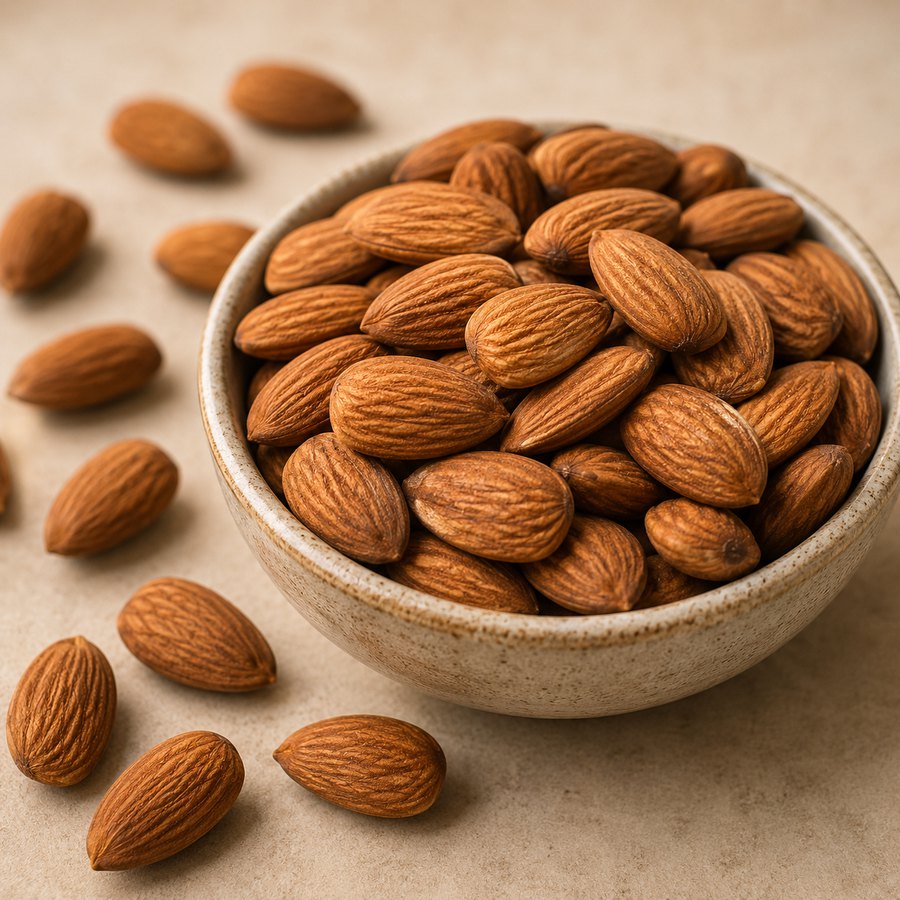
Almonds provide mainly oleic-acid-rich monounsaturated fat, plant protein, fiber, vitamin E, magnesium, and copper. A 25 g serving of raw almonds provides about 145 kcal, 5.3 g protein, 3.1 g fiber, and 6.4 mg vitamin E, making it a practical portioned nut or ingredient.
Food overview
Key strengths
Raw almonds provide about 21.2 g protein, 12.5 g fiber, and 49.9 g fat per 100 g, including about 31.6 g monounsaturated fat. A 25 g serving provides about 5.3 g protein, 3.1 g fiber, and 7.9 g monounsaturated fat.
How to use it
Use almonds as a portioned snack or chop them into oats, plain yogurt, grain salads, vegetables, or lower-sugar baking. Raw or unsalted dry-roasted almonds make it easier to limit sodium, added sugar, and extra oil.
What stands out
Almonds are a notable natural source of vitamin E. Raw almonds provide about 25.6 mg alpha-tocopherol per 100 g, or about 6.4 mg per 25 g—roughly 43% of the FDA Daily Value for adults.
Worth noting
Almonds are a tree-nut allergen and can cause severe, even life-threatening reactions. Packaged foods containing almonds should identify the specific nut rather than using only a generic “nuts” label.
Basic Nutrition
Showing:100 g Raw almonds
View complete nutrition data
GI note:GI varies with cultivar, food structure, processing, and cooking. Raw grains usually do not have directly applicable human GI data.
Almonds contain too little available carbohydrate for a standard GI test, so they should not be assigned a GI of 0, 10, or 15. Studies of almonds in mixed meals cannot be used to infer a fixed GI for almonds themselves.
Data notes:This page covers sweet almonds eaten as nuts. It does not cover bitter almonds, southern or northern apricot kernels, apricot kernels generally, or medicinal almond kernels.
Per-100 g and 25 g values are based on the edible kernel after the outer fruit and hard shell are removed.
Raw and unsalted dry-roasted almonds come from separate database entries, so their differences cannot all be attributed to roasting.
Vitamins & Minerals
Daily Values use FDA standards for adults and children age 4 and older. Only nutrients reaching at least 5% DV at the selected portion are shown; the first six appear by default.
At 25 g, the default display prioritizes vitamin E, copper, manganese, riboflavin, magnesium, and phosphorus. Zinc, niacin, calcium, and iron appear in the expanded view; nutrients below 5% DV are hidden.
View all vitamins and minerals
Percentages show how much the selected serving contributes to the adult Daily Value.
Key Bioactive Compounds
Alpha-Tocopherol
Vitamin EAlpha-tocopherol is the main form used to meet human vitamin E needs and is especially abundant in almonds.
Raw almonds provide about 25.6 mg/100 g and 6.4 mg/25 g; unsalted dry-roasted almonds provide about 23.9 mg/100 g and 6.0 mg/25 g. Levels vary by variety, origin, storage, and roasting.
Vitamin E is a fat-soluble antioxidant that helps protect membrane lipids and also supports normal immune function.
Raw or gently roasted unsalted almonds both work well. Store them sealed, dark, and cool; extra oil is unnecessary.
Almond vitamin E supports normal nutrition but does not treat disease or equal a high-dose supplement.
Almond-skin polyphenols
Flavonoids, phenolic acids, and proanthocyanidinsBrown almond skins contain catechin, epicatechin, quercetin and isorhamnetin glycosides, phenolic acids, proanthocyanidins, and other polyphenols.
Polyphenols are concentrated in the brown skin. Research reports about 0.2%–0.8% of skin dry weight as flavonoids and other polyphenols. In one sample, blanching reduced total phenolics from about 239 to 47 mg GAE/100 g; GAE is a lab comparison unit.
These compounds show antioxidant activity in laboratory studies. Human findings reflect the whole almond, not one isolated skin compound.
Keep the brown skin if you tolerate it. Skin-on raw or unsalted roasted almonds retain more skin polyphenols.
Test-tube antioxidant activity does not prove anti-inflammatory or anticancer effects in people. Skinless almonds remain nutritious.
β-Sitosterol & Other Phytosterols
Plant sterolsPhytosterols resemble cholesterol structurally. Almonds contain mainly beta-sitosterol, with smaller amounts of campesterol and stigmasterol.
Raw almonds provide about 130 mg beta-sitosterol per 100 g, or 32.5 mg per 25 g; dry-roasted almonds provide about 122 mg/100 g, or 30.5 mg per 25 g.
Phytosterols compete with cholesterol for intestinal absorption; higher-dose fortified foods can lower LDL cholesterol.
Get phytosterols from varied plant foods rather than eating large amounts of almonds for this compound alone.
A 25 g serving provides only about 30 mg beta-sitosterol, far below the 1.5–2.4 g/day often studied in fortified foods.
How preparation changes almonds
Raw almonds
Raw almonds contain about 4.4 g water and 579 kcal per 100 g. They keep the brown skin and provide vitamin E, fiber, and skin polyphenols. In the U.S., retail almonds labeled “raw” may still undergo steam, gentle heat, or other pasteurization.
Unsalted dry-roasted almonds
Unsalted dry-roasted almonds contain about 2.4 g water and 598 kcal per 100 g and have a crisper texture. The database lists about 23.9 mg vitamin E per 100 g. Because raw and roasted data come from separate entries, small nutrient differences should not automatically be attributed to roasting.
Skin-on vs. blanched almonds
The brown skin is rich in polyphenols. Blanching or removing it lowers some flavonoids, proanthocyanidins, and total phenolics, but skinless almonds still provide protein, fat, vitamin E, and minerals.
Soaked almonds
Soaking softens almonds and may make them easier to chew, but current evidence does not show a meaningful improvement in mineral absorption. One study found no better phytate-to-mineral ratio and some mineral loss into the water. Refrigerate soaked almonds and eat them promptly; wet weight cannot use dry-almond values per 100 g.
Almond flour
Grinding breaks the intact structure, making almonds easier to use in baking and potentially easier to eat quickly. Pure almond flour still contains fat, protein, and fiber, but defatted, skin-on, and blanched products need separate nutrition data.
Almond butter
Pure almond butter still derives its nutrients from almonds, but grinding makes larger portions easier to eat. Products with syrup, palm oil, or salt should be evaluated by their own labels.
Almond milk
Almond milk is diluted, ground, and filtered, so it usually contains far less almond than the same weight of whole nuts. Protein, fat, fiber, and vitamin E cannot be copied from this page; calcium and vitamin D may also come from fortification.
How to choose and store
How to choose
- Keep ingredients simple. If you are limiting sugar, sodium, or added fat, avoid products with sugar, syrup, honey coatings, chocolate, added oils, creamy flavor powders, or heavy seasoning.
- Check that the package clearly says sweet almonds, badam, or almond. Do not eat unknown wild almonds, bitter almonds, or unusually bitter kernels.
- Choose mostly intact nuts with natural brown skins, dry surfaces, minimal debris, intact packaging, and no insect holes, mold, or unusual oil seepage.
- Do not buy or keep almonds that smell rancid, paint-like, crayon-like, moldy, sour, musty, or taste unusually bitter.
How to store
- After opening, store in a dry airtight container away from sunlight, heat, moisture, sinks, stoves, and strong-smelling foods.
- For short storage, keep them cool and dry. For larger quantities or slower use, airtight refrigeration or freezing helps delay rancidity and insect damage.
- Discard almonds with visible mold, insects or eggs, marked dampness or softness, rancid or bitter odors, water-damaged packaging, abnormal darkening, or clumping.
When buying almonds, remember three things: choose sweet almonds; prefer unsalted, unsweetened products; and avoid moldy, rancid, or unusually bitter nuts.
How to use it in everyday meals
Portioned snack
Measure about 25 g raw or unsalted roasted almonds and pair with fresh fruit, plain yogurt, or unsweetened soy milk. Pre-portioning is easier for energy control than eating straight from a large bag.
Almond oats or yogurt
Chop 10–15 g almonds into oatmeal, overnight oats, or plain yogurt with berries, kiwi, or cinnamon. Almonds already contribute substantial fat, so large amounts of nut butter, cream, or syrup are unnecessary.
Grain and vegetable salad
Slice or chop almonds into brown rice, quinoa, buckwheat, dark leafy greens, tomatoes, and peppers. Dress with a little olive oil, vinegar, lemon, and herbs instead of creamy dressings or salty processed meat.
With vegetables
Sprinkle sliced almonds over broccoli, green beans, asparagus, squash, or spinach after steaming or a quick sauté. Adding them at the end keeps more crunch and avoids repeated browning.
Homemade almond butter
Blend unsalted almonds into a small batch of nut butter for whole-grain toast, oats, or yogurt. Because nut butter is easy to eat quickly, portion it by the equivalent almond weight rather than treating a spoonful as unlimited.
For lower-sugar baking
Use chopped almonds or almond flour in whole-grain breads, oat muffins, or lower-sugar cookies. Almond flour does not automatically make a dessert low in calories; sugar, butter, chocolate, and portion size still matter.
Who Should Take Extra Care
People with almond or tree-nut allergy
Almond allergy can cause oral itching, hives, facial or throat swelling, vomiting, wheezing, low blood pressure, or severe systemic reactions. People with diagnosed almond allergy should avoid almonds and almond-protein products and check ingredient and allergen statements carefully.
People allergic to peach, apricot, or related Rosaceae foods
Almonds, peaches, apricots, and cherries are related Prunus species. Some people may have pollen-food oral symptoms or protein cross-reactivity. Avoidance should be based on actual reactions and specialist evaluation, not plant classification alone.
Infants, young children, and people with swallowing difficulties
Whole almonds are hard and can be a choking hazard. The UK NHS advises against whole nuts for children under 5; age-appropriate options include finely ground almonds, almond flour, or a thin layer of smooth almond butter.
People with digestive sensitivity
A 25 g serving provides about 3.1 g fiber and 12.5 g fat. People who rarely eat nuts or fiber may notice bloating, gas, or stool changes after a large portion; start smaller and chew well.
People managing blood sugar
Whole almonds are low in available carbohydrate and may blunt the glucose response of a high-carbohydrate meal, but long-term trial results are mixed. Almonds do not replace glucose-lowering medication or insulin.
People with impaired kidney function
A 25 g serving of raw almonds provides about 183 mg potassium, 120 mg phosphorus, and 68 mg magnesium. People limiting potassium, phosphorus, magnesium, protein, or nuts should include almonds in their individualized renal diet plan.
People managing body weight or total energy intake
A 25 g serving provides about 145–150 kcal. Almonds work best as a replacement for chips, cookies, or candy rather than an unlimited add-on. Body-weight outcomes depend on what almonds replace, total energy intake, and the population studied.
People Limiting Sodium
Raw and unsalted dry-roasted almonds are very low in sodium, but salted, smoked, barbecue, and other flavored products can be much higher. Check sodium per serving on the package.
Similar Food Alternatives
Hazelnuts
Also rich in monounsaturated fat and vitamin E, with a similar crunchy use in snacks, oats, yogurt, and salads. Their phytochemical profile differs from almonds.
Pistachios
Provide plant protein, fiber, vitamin B6, lutein, and zeaxanthin and are useful for adding variety to mixed nuts.
Walnuts
Walnuts are richer in polyphenols and ALA plant omega-3. Their vitamin E forms and fatty-acid profile differ from almonds, so the two can be rotated.
Pumpkin Seeds
Provide plant protein, magnesium, iron, zinc, and unsaturated fat for salads, oats, and grain bowls. Pumpkin seeds are seeds rather than tree nuts, but people with tree-nut allergy should still check cross-contact labeling.
Data Sources & Last Updated
Nutrition Data
Basic Information & Food Safety
Research & References
Bolling B.W., et al. (2010). Polyphenol content and antioxidant activity of California almonds depend on cultivar and harvest year.
Food Chemistry. DOI / Original
Garrido I., et al. (2008). Polyphenols and antioxidant properties of almond skins: influence of industrial processing.
Journal of Food Science. DOI / Original
Bolling B.W. (2017). Almond Polyphenols: Methods of Analysis, Contribution to Food Quality, and Health Promotion.
Comprehensive Reviews in Food Science and Food Safety. DOI / Original
Kodad O., et al. (2018). Genotypic and Environmental Effects on Tocopherol Content in Almond Kernels.
Kumari M., et al. (2020). Does ‘activating’ nuts affect nutrient bioavailability?
Food Chemistry. DOI / Original
Lee-Bravatti M.A., et al. (2019). Almond Consumption and Risk Factors for Cardiovascular Disease: A Systematic Review and Meta-analysis of Randomized Controlled Trials.
Advances in Nutrition. DOI / Original
Fatahi S., et al. (2022). The Effects of Almond Consumption on Inflammatory and Oxidative Stress Biomarkers in Adults.