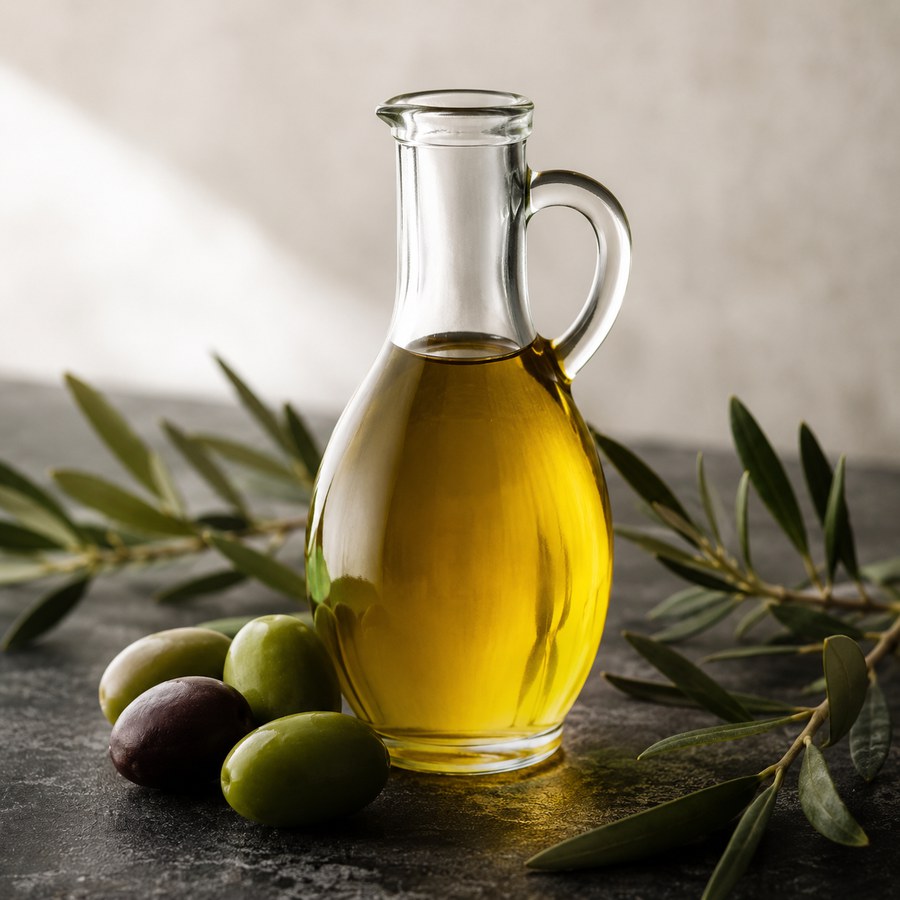
Healthy plant oils
Extra Virgin Olive Oil
Extra virgin olive oil is an oleic-acid-rich plant oil that retains natural olive aromas and some polyphenols. A 10 g serving provides about 88 kcal and 7.3 g monounsaturated fat. It works best as a replacement for butter, animal fats, and other more saturated fats, not as an unlimited extra source of calories.
Food overview
Key strengths
Extra virgin olive oil is dominated by oleic acid. USDA generic olive-oil data provide about 73.0 g monounsaturated fat per 100 g, including about 71.3 g oleic acid; International Olive Council authenticity standards place oleic acid at about 55%–85% of total fatty acids.
How to use it
Use it for salads, dipping, grains, legumes, quick sautéing, stewing, baking, and ordinary pan cooking. The key benefit is replacing butter, lard, coconut oil, or other more saturated fats rather than simply adding more oil to the diet.
What stands out
“Extra virgin” is not just a processing term; it also means the oil meets defined chemical and sensory standards. Good oil should show recognizable fruitiness and no clear rancid, musty, muddy, or other standard defects. Mild bitterness or a peppery throat sensation can come from polyphenols and does not mean the oil has spoiled.
Worth noting
A 10 g serving provides about 88 kcal. EVOO has a favorable fatty-acid profile, but its calorie content is similar to other oils. Its value comes mainly from replacing less suitable fats, controlling quantity, and using it within a diet rich in vegetables, legumes, whole grains, fish, and other minimally processed foods.
Basic Nutrition
Showing:100 g Extra Virgin Olive Oil
View complete nutrition data
GI note:GI varies with cultivar, food structure, processing, and cooking. Raw grains usually do not have directly applicable human GI data.
Pure EVOO contains no available carbohydrate and cannot supply 25 g or 50 g available carbohydrate for a standard GI test, so GI is shown as “—” rather than 0 or “ultra-low GI.”
Data notes:This page uses one formal food state: extra virgin olive oil produced from Olea europaea L. fruit by mechanical or other physical means, with only steps such as washing, settling, centrifugation, and filtration. It does not use raw/cooked states; heating effects are covered in the processing section.
Basic nutrition uses USDA FoodData Central “Oil, olive, salad or cooking” (FDC 171413). It is not an EVOO-specific entry stratified by polyphenol content, but it is suitable for energy, fatty acids, vitamin E, and vitamin K. Oleic acid and minor compounds vary by cultivar, origin, and harvest timing.
A common serving is 10 g, roughly 2 teaspoons. Household spoon volume varies, so grams are used for nutrition calculations rather than treating “1 tablespoon” as an exact weight.
100 g is a database reference amount, not a sensible single serving.
GI is shown as “—”: pure EVOO contains no available carbohydrate and cannot provide the 25 g or 50 g available carbohydrate needed for a standard GI test. It should not be labeled GI 0 or “ultra-low GI.” When eaten with bread, rice, pasta, or other carbohydrate foods, the meal’s glucose response depends on all foods, portions, and cooking—not on an oil GI value.
The USDA entry does not provide a directly usable starch measurement, so starch is shown as “—” rather than estimated from total carbohydrate.
Omega-3 is mainly ALA, but the amount is far lower than in ALA-rich oils such as flaxseed or perilla oil.
Vitamins & Minerals
Adult Daily Values are used, and only nutrients reaching at least 5% DV at the selected portion are shown. At 10 g, only vitamin E (alpha-tocopherol) and vitamin K meet that threshold.
At a 10 g serving, only vitamin E (alpha-tocopherol) and vitamin K reach the 5% display threshold, so near-zero minerals are not added just to fill cards. Vitamin E is about 14.35 mg/100 g and 1.44 mg/10 g, roughly 10% DV; vitamin K is about 60.2 micrograms/100 g and 6.0 micrograms/10 g, about 5% DV. Actual vitamin E varies with cultivar, ripeness, storage, and processing, so these are general reference values rather than a guarantee for any brand.
View all vitamins and minerals
Key Bioactive Compounds
Oleic Acid
Monounsaturated fatty acidOleic acid is the dominant fatty acid in EVOO.
USDA data provide about 71.27 g oleic acid per 100 g, or 7.13 g per 10 g. International Olive Council standards generally place it at 55%–85% of total fatty acids.
The FDA says supportive but not conclusive evidence suggests oleic-acid-rich oils may reduce coronary heart disease risk when they replace more saturated fats without adding calories.
Use EVOO instead of butter, lard, creamy sauces, or some coconut oil. About 5–10 g at a time is a practical starting point.
Oleic acid also occurs in other oils and nuts; it alone does not prove anti-inflammatory or therapeutic effects.
Hydroxytyrosol, tyrosol, and derivatives
Olive polyphenolsHydroxytyrosol and tyrosol are representative olive phenols, with many related compounds present as derivatives.
Research samples contain roughly 50–200 mg/kg hydrolyzed total hydroxytyrosol, or 0.5–2.0 mg per 10 g. The EU claim requires at least 5 mg hydroxytyrosol and derivatives per 20 g oil; not every EVOO qualifies.
Olive polyphenols support oil stability, and trials suggest polyphenol-rich oils may affect lipid-oxidation markers.
For more polyphenols, look for tested values tied to units and harvest batch. Cold use or adding after cooking generally retains more.
“Extra virgin” does not automatically mean “high polyphenol,” and the EU threshold is not advice to drink extra oil.
Oleocanthal and oleacein
Secoiridoid polyphenolsOleocanthal is linked to EVOO’s peppery throat sensation; oleacein is another important secoiridoid.
Across tested EVOOs, combined oleocanthal and oleacein range around 0–501 mg/kg, or about 0–5.0 mg per 10 g. Levels vary widely with cultivar, ripeness, processing, storage, and oxidation.
Oleocanthal can affect some cyclooxygenase activity and TRPA1 signaling, but these are mainly mechanistic findings, not drug effects from food amounts.
Mild bitterness and brief throat pepperiness can be normal. Use the oil cold or after cooking to preserve these qualities.
Mechanistic similarity to ibuprofen does not give EVOO the same dose, efficacy, or safety profile as medication.
How heating and processing change EVOO
Use cold or after cooking
Minimal heating better preserves fruitiness, bitterness, pepperiness, and some heat-sensitive polyphenols. This works well for salads, cooked vegetables, legumes, soups, and whole grains.
Quick sautéing and pan cooking
EVOO can be used for ordinary home sautéing. In studies simulating home cooking, total polyphenols fell by about 40% at 120°C and about 75% at 170°C. Oleic acid remains the main fatty acid, so heated EVOO should not be described as a “toxic oil.”
Baking and stewing
Use EVOO with roasted vegetables, fish, tofu, whole-grain foods, or stews. Heat changes some polyphenols, while some olive phenolics may transfer into vegetables during cooking; the result depends on temperature, time, and food composition.
Deep-frying
EVOO can be used for frying, but prolonged or repeated high-temperature frying markedly lowers polyphenols. A 2026 continuous-frying study reported about 70%–93% polyphenol loss depending on food and batter conditions. At home, avoid prolonged high heat, repeated reuse, and sustained smoking.
Repeated heating
Repeated heating increases oxidation and flavor deterioration. Discard oil that produces heavy smoke, obvious burnt odor, marked thickening/darkening, or abnormal rancid notes. Healthy cooking depends on temperature, time, and reuse—not just oil type.
Filtered vs. unfiltered
Unfiltered oil can retain tiny fruit solids and water, giving a cloudy appearance and vivid flavor, but storage stability depends more on good sealing and timely use. The International Olive Council notes that filtration or adequate settling can reduce fermentation and quality loss from water and solids.
Extra virgin vs. regular olive oil
Regular olive oil commonly contains refined olive oil blended with some virgin oil. Energy and fat are similar, but refining removes much of the natural aroma and some polyphenols, so regular olive oil should not use the bioactive data in Section 04.
How to choose and store
How to choose
- Check the product name first. The front label should clearly say “Extra Virgin Olive Oil,” not just “olive oil,” “pure olive oil,” “light olive oil,” or show olive imagery.
- Check the applicable standard and product category. Products sold in China should meet current GB/T 23347—2021 and relevant labeling requirements. Imported products may also list origin-country or international standards, but marketing names should not replace a clear product category.
- Do not judge by acidity alone. EVOO has a free-acidity limit of 0.8%, but it must also meet peroxide, UV-absorbance, fatty-acid-ethyl-ester, authenticity, and sensory criteria. A “0.2% acidity” label does not prove better aroma, polyphenols, freshness, or authenticity. Acidity is laboratory-measured free fatty acid, not sour taste, and consumers cannot reliably taste the number.
- Look for clear origin, producer, bottler, and lot information. A harvest year or milling date helps assess freshness, but it is not mandatory in every market; lack of a harvest date does not automatically make a product noncompliant.
- Prefer dark glass, opaque metal tins, intact seals, and package sizes you can finish within about 1–3 months. Clear bottles under bright light, poor cap seals, and oversized household containers increase light and oxygen exposure.
- Check the date. Olive oil does not improve with age like wine. Aroma and polyphenols generally decline over time, so favor reasonably recent products you can use soon after opening.
- Smell and taste. Fresh EVOO may show grassy, green-tomato, herb, nutty, or ripe-fruit notes with mild bitterness and throat pepperiness. Rancid, crayon-like, old-paint, stale-nut, moldy, damp-cardboard, earthy, or fermented odors are warning signs.
- Do not judge grade by color. EVOO can be golden, yellow-green, or green depending on cultivar, ripeness, and pigments. Bright green does not prove more polyphenols, authenticity, or higher grade; grade depends on standard testing and sensory assessment.
How to store
- Protect from light: store in a cupboard or other dark place, not on a sunny windowsill or transparent spice rack.
- Seal tightly after each use to reduce oxygen exposure. Do not leave an open oil cruet beside the stove.
- Keep away from heat sources such as the stove, oven, radiator, dishwasher, and direct sun. The International Olive Council recommends roughly 13–25°C storage.
- Buy a size you can finish within about 1–3 months after opening. Large containers can be decanted into food-safe dark glass, ceramic, or stainless-steel bottles with minimal headspace.
- Refrigeration is usually unnecessary at home. Cold oil may turn cloudy, flocculate, or solidify and often clears again at room temperature; this does not prove authenticity or quality. Refrigeration may slow oxidation but can also change suspended solids and polyphenols in unfiltered oils.
When buying EVOO, remember three things: look for the full “Extra Virgin Olive Oil” name; choose fresh, sealed, light-protected smaller packages; and do not use low acidity alone as proof of quality.
How to use it in everyday meals
Make a salad dressing
Use 5–10 g EVOO with vinegar, lemon, black pepper, and herbs over leafy greens, tomatoes, peppers, legumes, or whole grains. Limit sugary dressings and excess salt, cheese, or processed meat.
Drizzle over cooked vegetables
After steaming or blanching broccoli, carrots, tomatoes, squash, or mushrooms, add a small amount of EVOO. It adds flavor and can support absorption of fat-soluble carotenoids without soaking the vegetables in oil.
Quick home sauté
Use it for short cooking of onions, tomatoes, mushrooms, tofu, eggs, and vegetables. Add a moderate amount to a hot pan, avoid prolonged empty-pan heating, and lower the heat if food chars or the oil keeps smoking.
Roast vegetables or fish
Coat vegetables, fish, chicken, or tofu lightly before roasting. Control both oil amount and cooking time rather than adding lots of oil for extra crispness or repeatedly browning food to black.
Mix with whole grains and legumes
Add to brown rice, quinoa, buckwheat, chickpeas, lentils, or white beans with tomatoes, cucumber, purple cabbage, and herbs. Use enough for flavor while keeping the meal’s total fat moderate.
Make dips and spreads
Blend with chickpeas, white beans, roasted eggplant, or herbs for dips served with vegetables or whole-grain bread. Limit extra cream, butter, and salty seasonings, and count the oil actually added.
Who Should Take Extra Care
People managing body weight or total energy intake
A 10 g serving provides about 88 kcal. EVOO works better as a replacement for other fats than as an extra addition. Salads, bread dipping, and nut-based spreads can become surprisingly energy-dense when a lot of oil is used.
People on medically prescribed low-fat diets
People following a low-fat diet for digestive disease, recovery after surgery, or another medical reason should count olive oil toward total daily fat. Its unsaturated-fat profile does not override portion limits set by a clinician or dietitian.
People taking warfarin
A 10 g serving provides about 6 micrograms vitamin K and is not especially vitamin-K-rich. Warfarin users should keep overall vitamin K intake reasonably consistent and avoid sudden large changes in olive oil or other vitamin-K-containing foods; discuss major long-term diet changes with the anticoagulation team.
People who feel unwell after large amounts of oil
Drinking a large amount of oil can cause greasiness or digestive discomfort. It is usually better to distribute small amounts across vegetables, legumes, and staple foods rather than using “oil shots,” “detoxes,” or “bowel-cleansing” routines.
People allergic to olives or related products
People with known olive-fruit or olive-oil allergy should avoid it. For garlic-, chili-, nut-, or herb-infused oils, check those added ingredients and allergens separately rather than attributing all risks to pure EVOO.
Infants & Children
Small amounts can be mixed into foods appropriate for a child’s age and swallowing ability, but children should not be given spoonfuls of oil directly or follow adult internet trends of “daily oil drinking.”
Similar Food Alternatives
High-oleic canola oil
Also rich in oleic acid, with a milder flavor suited to everyday sautéing and baking. It does not contain the same olive polyphenols or fruit aromas; check that the product is specifically high-oleic.
High-oleic sunflower oil
Has a high oleic-acid proportion and neutral flavor for dishes where olive flavor is not desired. Its vitamin E and fatty-acid profile differ from olive oil, and EVOO polyphenol data do not apply.
Virgin avocado oil
Rich in monounsaturated fat and suitable for salads and cooking. Products may be virgin or refined, so check ingredients, processing type, and nutrition label.
Walnut oil
Provides more ALA plant omega-3 and a nutty flavor, making it better suited to dressings or lower-heat uses. Its higher polyunsaturated-fat content makes light, airtight storage and prompt use especially important.