Fermented foods · Fermented soy seasoning
Reduced-Sodium Miso
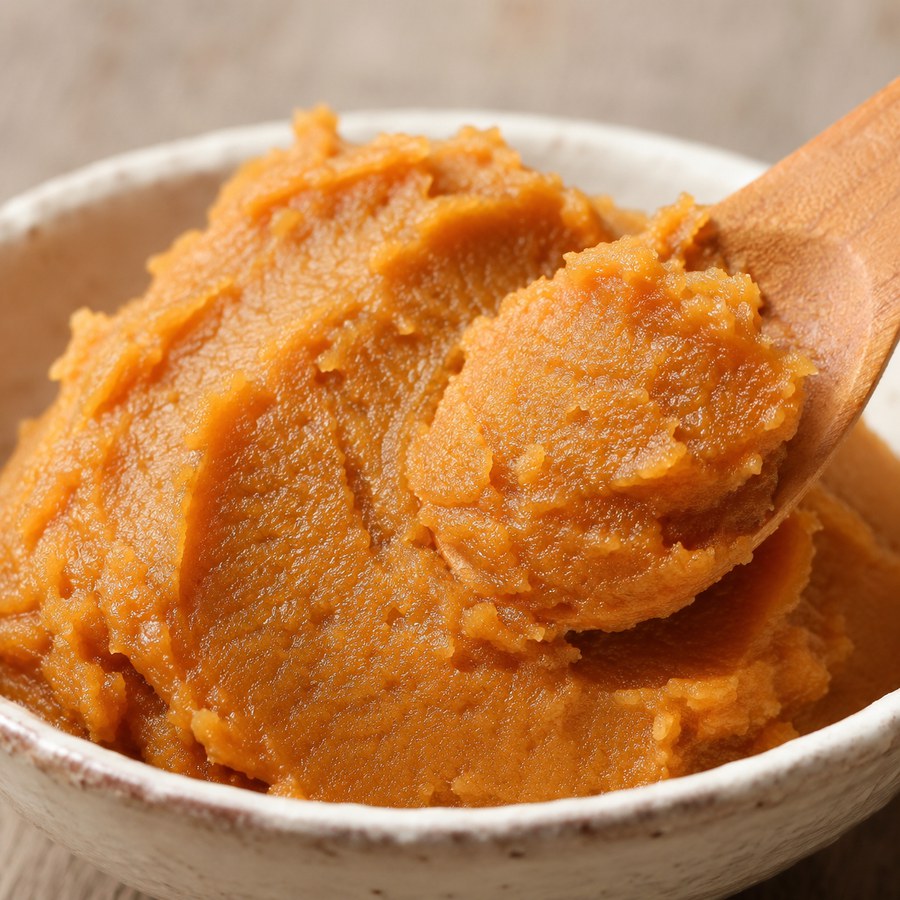
Reduced-sodium miso keeps the soy protein, isoflavones, and fermented umami of regular miso while cutting some salt. It works best as a replacement for regular miso or part of the salt/soy sauce in a dish, but it is still a high-sodium condiment. Whether it truly lowers sodium depends on the product and how much you use.
Food overview
Key strengths
Reduced-sodium miso provides about 11 g protein and 4.3 g fiber per 100 g plus potassium, magnesium, phosphorus, manganese, copper, folate, and biotin. Its practical value is not eating large amounts, but using umami to make vegetables, legumes, and whole grains more appealing.
How to eat it
Use it in vegetable miso soup or small amounts in dressings, tofu seasoning, fish marinades, stews, and roasted-vegetable sauces. To actually lower sodium, do not add large amounts of salt, soy sauce, stock concentrate, or salty processed meat on top.
What stands out
“25% less salt” means about one-quarter less than the named comparison product, not one-quarter as much salt as regular miso. One 25%-reduced product still contains 8.1 g salt equivalent per 100 g, while the Japanese database representative value for reduced-sodium miso is 10.7 g.
Worth noting
Using the database representative value, a 17 g serving provides about 714 mg sodium and 1.82 g salt equivalent, close to 36% of China's sodium NRV. Reduced-sodium miso should still be portioned as a condiment, not eaten freely as a fermented soy food.
Basic Nutrition
Showing:100 g Reduced-Sodium Miso
View complete nutrition data
GI note:GI varies with cultivar, food structure, processing, and cooking. Raw grains usually do not have directly applicable human GI data.
No reliable universal GI was found across reduced-sodium miso brands. Because miso is used in small amounts as a condiment, GI is shown as “—” rather than estimated from sugar or carbohydrate.
Data notes:This page defines reduced-sodium miso as fermented miso made mainly from soybeans, rice or barley, salt, and koji, with less salt than a regular comparison product. “Reduced sodium” is a relative claim, not a guarantee of low sodium. Japanese labeling rules generally require a meaningful absolute difference, at least a 25% relative reduction for this type of claim, and a stated comparison product, so the name alone does not reveal the actual sodium content.
Basic nutrition data use the 2023 supplement to Japan's Standard Tables of Food Composition, entry 17119, “Miso, salt reduced,” with a representative 10.7 g salt equivalent per 100 g. One current rice-koji miso labeled 25% reduced contains 8.1 g per 100 g. Formulas vary, so use the product label for actual intake.
Default display is per 100 g; a common serving is about 17 g, roughly one level tablespoon for a bowl of miso soup. Japanese miso makers often use about 17 g miso with around 160 mL hot water as a household reference, with strength adjusted to taste.
GI is shown as “—”. No reliable universal GI was found across reduced-sodium miso brands. Miso is eaten as a small seasoning, so GI should not be inferred from sugar or carbohydrate content or shown as 0.
The database lists glucose, fructose, galactose, maltose, and other sugars separately but does not provide one value matching this site's “total sugar” field, so sugar remains “—” rather than being added manually. Fatty-acid and starch values come from the same reduced-sodium miso entry.
Vitamin and mineral percentages use China's nutrition-label NRVs (GB 28050—2011). GB 28050—2025 takes effect on March 16, 2027, when all food pages should be updated together.
Sodium is not shown as a nutritional advantage. Using the representative data, a 17 g serving provides about 714 mg sodium, around 36% of China's sodium NRV. Even with a “reduced-sodium” claim, check salt equivalent per 100 g or per serving.
Vitamins & Minerals
Uses China's nutrition-label NRVs and shows only nutrients providing at least 5% of the daily reference value at the selected amount. At 100 g, 18 nutrients meet the threshold; at about 17 g, only molybdenum at about 64% and biotin at about 6% remain. Sodium is not treated as a nutrient highlight.
Percentages are calculated from Japan's food-composition values using China's NRVs and rounded. At 100 g, the first six qualifying nutrients are shown and the rest appear in the expanded area. At about 17 g, only molybdenum, about 25.5 micrograms or 64% of the reference value, and biotin, about 1.87 micrograms or 6%, meet the threshold. Molybdenum is a database representative value and can vary with formula, soybean proportion, and origin. Sodium is not shown as a benefit: one serving provides about 714 mg, around 36% NRV.
View all vitamins and minerals
Percentages show how much the selected serving contributes to the adult Daily Value.
Key Bioactive Compounds
Soy isoflavones and aglycones
Soy IsoflavonesDaidzin, genistin, and their aglycones daidzein and genistein are representative soy compounds. Fermentation and aging change the balance among these isoflavone forms.
There is no universal value for reduced-sodium miso. In one specific sample, 12.5 g miso contained about 2 mg combined daidzin plus daidzein and 3 mg combined genistin plus genistein, equivalent to roughly 40 mg/100 g for those two major groups. A rice-koji miso fermentation study found glycoside forms fell from 86.4% to 44.9% of the profile after 6 months, while aglycones rose from 9.6% to 53.3%. Soybean variety and aging conditions also affect the result.
Soy isoflavones have phytoestrogen-like activity and contribute to the food's antioxidant chemistry. Whole soy foods may modestly affect some blood-lipid and menopausal outcomes, but isolated isoflavone effects, individual responses, and long-term outcomes are not uniform.
Use reduced-sodium miso as an ordinary seasoning rather than increasing the amount for isoflavones. Pair it with tofu, mushrooms, seaweed, and vegetables while cutting back on salt, soy sauce, and stock concentrate.
Miso isoflavones are not equivalent to high-dose supplements and do not justify claims that reduced-sodium miso regulates hormones, replaces hormone therapy, or prevents cancer. Food intake and concentrated extracts differ in dose, absorption, and safety.
Melanoidins
Maillard-reaction productsMelanoidins are brown pigments formed when amino acids and sugars react during miso aging or heating. They contribute to darker color and some roasted aromas.
Specific content: —. There is no standardized per-100-g melanoidin value suitable for ordinary miso products. Browning generally increases with storage time and temperature, and miso darkens as amino acids and sugars react. Type, aging, and processing temperature all affect melanoidin formation, so color alone cannot be converted into a content value.
Melanoidins show antioxidant activity in laboratory assays. In one cooking study, heating increased browning and in-vitro antioxidant activity while total isoflavones and isoflavone aglycones decreased, showing that different compounds can move in opposite directions.
There is no need to boil miso for a long time or char it to create more brown pigments. For soup, add it after other ingredients are cooked and heat gently; for glazes, use moderate heat and avoid burning.
Darker color does not mean stronger anti-inflammatory effects. Laboratory antioxidant measurements do not prove darker miso has greater anti-inflammatory or anti-aging effects in people. Prolonged high heat may increase browning while reducing isoflavones and flavor quality.
Fermentation-derived peptides and amino acids
Fermentation-derived protein breakdown productsKoji and other fermentation microbes break down some soy protein into amino acids, short peptides, and other nitrogen-containing compounds that contribute to miso's umami and complex flavor.
Specific bioactive-peptide content: —. Japan's food-composition tables list about 11 g total amino-acid composition per 100 g reduced-sodium miso, including about 1.9 g glutamic acid and 1.2 g aspartic acid. These are amino-acid composition data after protein hydrolysis, not the amount of free glutamate or intact absorbable bioactive peptides. Koji type, fermentation time, and heat treatment all change the peptide profile.
From a cooking perspective, glutamate and other fermentation products provide umami that can help reduce other salty seasonings while keeping miso portions modest. A 2024 study identified several modified peptides in different misos; some entered rat blood after ingestion and showed ACE-inhibitory activity in laboratory testing.
Build umami with mushrooms, tomatoes, seaweed, onion, and spices so less miso is needed. Start with a small amount, taste, and adjust rather than automatically using more because the product is reduced-sodium.
Rat absorption studies and in-vitro enzyme inhibition do not prove ordinary reduced-sodium miso lowers blood pressure or replaces medication. One trial supports reduced-sodium soy sauce and miso as substitution tools for sodium reduction, but overall blood pressure did not significantly change, so the result is not evidence of a therapeutic effect.
How processing changes reduced-sodium miso
Reduced-sodium vs. regular miso
The Japanese database lists 10.7 g salt equivalent per 100 g for reduced-sodium miso versus about 12.4 g for light-colored salty rice miso; one current 25%-reduced product contains 8.1 g. The actual reduction depends on the formula and comparison product. It only lowers sodium if you do not compensate by using more.
Rice, barley, and soybean miso
Miso can be grouped by koji source. Rice miso commonly uses soybeans, rice koji, and salt; barley miso contains barley; soybean miso mainly uses soybean koji. Flavor, color, protein, and isoflavone profiles differ, so one nutrition dataset should not be reused across all types.
Plain miso vs. dashi miso
Dashi miso may contain bonito, kombu, yeast extract, sugar, alcohol, or other seasonings. Its sodium, sugar, and allergen profile differs from plain reduced-sodium miso and needs separate data. Vegans and people with fish allergy should check for bonito or other seafood extracts.
Cold use
Small amounts work in dressings or vegetable dips. Cold use preserves aroma, but ordinary miso still should not be labeled a probiotic product with fixed strains and viable counts.
Brief heating
For soups and stews, cook the other ingredients first, then stir in miso and warm briefly. This preserves more aroma and avoids repeated long boiling.
Prolonged boiling or high-temperature baking
Heating promotes browning and melanoidin formation but may reduce some isoflavones. Avoid burning miso glazes and do not use “more antioxidant activity” as a reason for prolonged high heat.
Instant miso soup, liquid miso, and granulated miso
These products often already contain stock, oil, vegetables, seaweed, or seasonings, so nutrition depends on the whole formula. One packet cannot be treated as equivalent to 17 g of pure reduced-sodium miso.
How to choose and store
How to choose
- Check actual salt: compare salt equivalent per 100 g, the amount you actually use, and salt per serving rather than relying on “reduced sodium,” “25% less salt,” or package color. The reduction is relative; the salt-equivalent value better reflects intake.
- Check the comparison product: if the label says “25% less salt,” see which regular product it is compared with. Brands start from different salt levels, so the same percentage reduction can still produce different final sodium values.
- Check ingredients: plain reduced-sodium rice miso can be simple—soybeans, rice, and salt. Some products add alcohol to slow further fermentation; dashi miso may include bonito, kelp, yeast extract, and other seasonings.
- Check allergens: traditional miso contains soy. Barley miso and blended products may contain barley, wheat, or other gluten-containing ingredients; dashi products may contain fish. People with soy or fish allergy or a strict gluten-free diet should check labels carefully.
How to store
- Unopened: store as directed and protect from heat and sunlight. Even shelf-stable products often retain color and flavor better when kept cool.
- After opening: refrigerate. Smooth the surface, press plastic wrap against the miso, and reseal the container to reduce air exposure, drying, and oxidation.
- Freezing: miso generally does not freeze completely solid in a home freezer and can be stored frozen. Take it out only briefly to reduce repeated condensation.
- Darkening: gradual darkening during storage is often a Maillard reaction and does not necessarily mean spoilage. Discard if there is obvious mold, abnormal foul odor, package damage, or changes unlike normal fermentation.
When buying reduced-sodium miso, remember four things: know the reduction claim, check the actual salt level, match ingredients to your needs, and refrigerate after opening.
How to use reduced-sodium miso in everyday meals
Vegetable miso soup
Build umami with mushrooms, seaweed, onion, daikon, cabbage, and tofu, then stir in reduced-sodium miso just before serving. A common reference is about 17 g per bowl, but 8–12 g is a reasonable starting point when further reducing sodium. Avoid adding lots of salt, soy sauce, or stock cubes.
Miso dressing
Whisk a small amount with vinegar, lemon juice, ginger, garlic, and a little tahini for cucumber, spinach, tofu, or mushrooms. Acidity and aromatics provide flavor without needing much extra soy sauce or salt.
Miso-roasted vegetables
Thin a little miso with water, vinegar, and a small amount of plant oil and brush lightly over eggplant, pumpkin, cauliflower, or tofu. Bake at moderate heat and avoid a thick glaze or blackened surface.
Miso marinade for fish or tofu
Mix reduced-sodium miso with ginger, scallion, lemon, and a little sake for fish, chicken, tofu, or tempeh. Scrape off excess before cooking to reduce burning; the marinade already contains salt, so do not add more.
Bean and miso stew
After lentils, chickpeas, tomatoes, carrots, and mushrooms are cooked, stir in a small amount of reduced-sodium miso. The legumes and mushrooms add umami and satiety and can replace salty stock bases or processed meats.
Whole-grain miso bowl
Combine brown rice, quinoa, or barley with tofu, edamame, red cabbage, and leafy greens and dress lightly with diluted miso-vinegar sauce. Adding the sauce separately makes sodium easier to control than coating everything heavily.
Who Should Take Extra Care
People limiting sodium
A 17 g serving of the database representative product provides about 714 mg sodium and 1.82 g salt equivalent. People with hypertension, heart failure, kidney impairment, or a prescribed low-sodium diet should fit portions to their clinician- or dietitian-set sodium target. Reduced-sodium miso can replace regular miso, but it is not an unlimited low-sodium food.
People with Soy Allergy
Miso is made primarily from soybeans. People with soy allergy should avoid traditional reduced-sodium miso and check compound sauces, instant soups, and marinades for hidden miso.
People with celiac disease or a strict gluten-free diet
Pure rice miso may contain only soybeans, rice, and salt, but barley miso, blended miso, dashi miso, or shared-line products may contain barley, wheat, or gluten-containing seasonings. Do not assume all miso is gluten-free; check ingredients and certification.
People sensitive to histamine or other biogenic amines
Miso is fermented, so histamine, tyramine, and other biogenic amines vary with microbes, hygiene, salt concentration, and storage. A survey of 40 miso products found low average levels of most biogenic amines but markedly higher histamine in some samples, so products are not identical.
People taking MAO inhibitors or linezolid
People taking MAO inhibitors or following a low-tyramine diet should follow medical and medication guidance for fermented soy foods. Clinical medication guidance often lists fermented soy among high-tyramine foods to limit, and linezolid guidance also advises avoiding large amounts of tyramine-rich fermented foods.
Infants & Children
Miso can be used in small amounts in family meals, but children eat smaller total portions and do not need adult-strength miso soup. “Fermented” is not a reason to ignore sodium.
Vegans
Plain rice miso can be entirely plant-based, but dashi miso, instant miso soup, and blended products may contain bonito, fish powder, or other animal-derived stock. Check the ingredient list.
Similar Food Alternatives
50% reduced-sodium miso
Provides a larger salt reduction for people wanting to lower sodium further. Some products increase rice-koji proportion, which can raise sweetness and carbohydrate, so still check salt equivalent per 100 g.
Regular rice miso
Offers a more traditional flavor and wider selection. Using a smaller amount and adding mushrooms, seaweed, tomatoes, ginger, and vinegar can reduce the sodium of the overall dish.
White miso
Often higher in rice koji and sweeter, and some products are relatively lower in salt, but “white” does not mean “reduced sodium.” Japan's database lists about 6.1 g salt equivalent per 100 g for sweet rice miso; check the actual product label.
Reduced-sodium soy sauce
Useful when a liquid seasoning is needed, but flavor, protein, and fermentation profile differ from miso. It still contains sodium and should not share reduced-sodium miso's nutrition data.