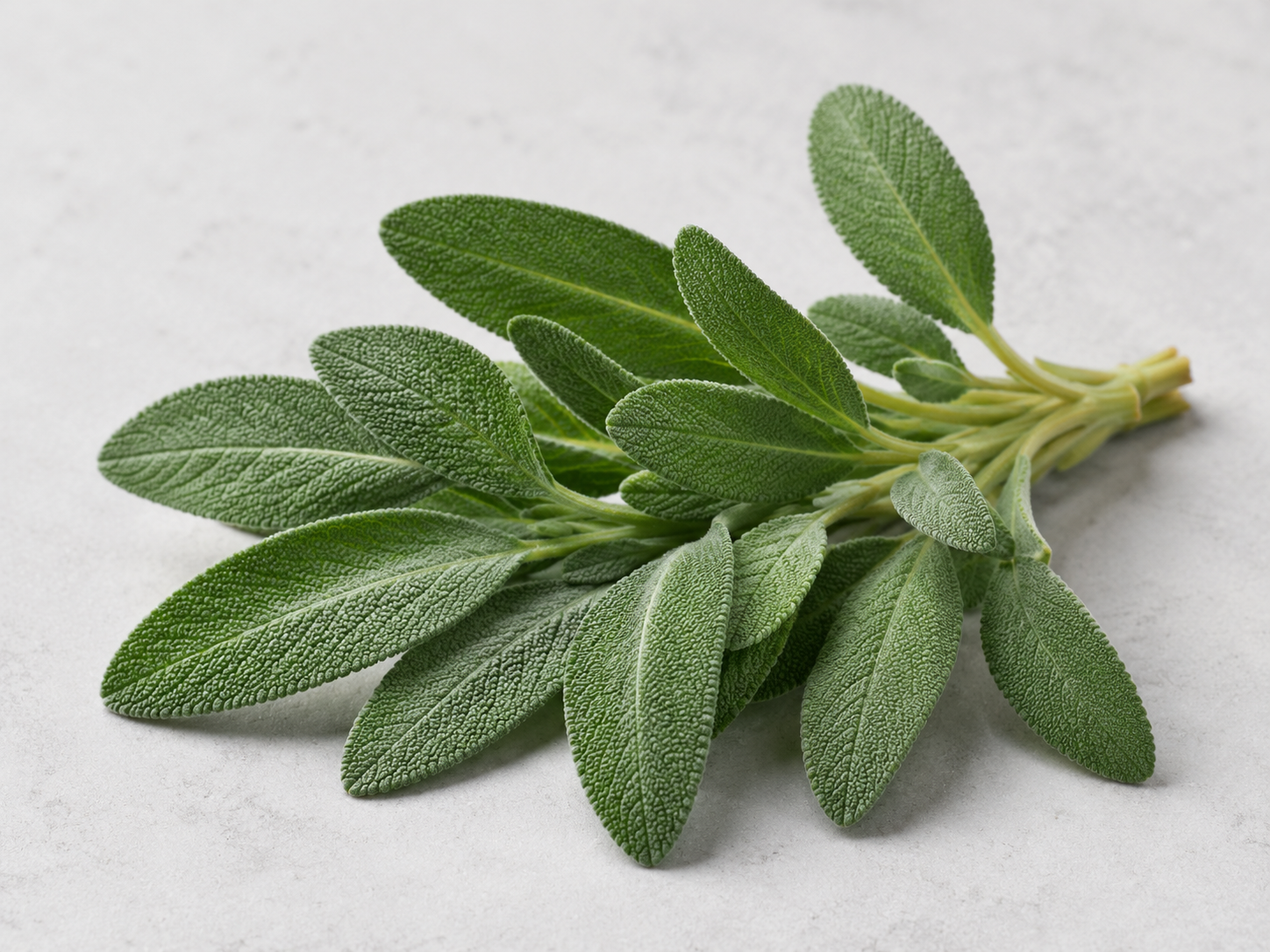
Spices and herbs · Mint-family sage herb
Sage
Sage is a mint-family herb; in everyday cooking, “sage” usually means common sage, Salvia officinalis. It has a strong herbal, camphor-like, slightly bitter aroma and is often used with squash, legumes, mushrooms, poultry, fish, and whole grains. Basic nutrition on this page uses USDA “Spices, sage, ground” (FDC 170935), with a default serving of about 0.7 g, roughly 1 teaspoon of dried ground sage. Some per-100-g nutrient values look high, but normal use is usually under 1 g, so sage is better treated as a flavoring herb and source of plant compounds than as a major source of calcium or iron.
Food Overview
Key strengths
Sage’s main everyday value is its strong aroma. A small amount can add complexity to vegetables, legumes, fish, or poultry without relying on large amounts of salt, butter, or salty sauces. Dried sage itself is very low in sodium, and a teaspoon contributes only a negligible amount.
How to use it
Use sage with squash, potatoes, carrots, white beans, chickpeas, mushrooms, chicken, fish, brown rice, or quinoa. Chop fresh leaves and add them later in cooking; dried leaves and ground sage are more concentrated, so start small. A rough kitchen substitution is about 1 teaspoon dried herbs for 1 tablespoon fresh.
What stands out
Sage contains rosmarinic acid, carnosic acid, carnosol, and several volatile terpenes. A 2025 analysis of 13 commercial dried sage products found wide variation, showing that origin, cultivar, processing, and storage can strongly affect actual levels.
Worth noting
Culinary sage leaves are very different from sage essential oil, alcoholic extracts, or high-dose medicinal teas. Essential oil is rich in volatile compounds such as thujone, and accidental ingestion or high doses can cause serious neurologic effects. It should not be taken by mouth like a normal food.
Basic Nutrition
Showing:0.7 g Dried ground sage
View complete nutrition data
GI note:GI varies with cultivar, food structure, processing, and cooking. Raw grains usually do not have directly applicable human GI data.
Reliable GI data for plain sage leaves or sage powder are lacking. Sage is normally used in small amounts, and GI should not be estimated from total carbohydrate or sugar content.
Data notes:This page uses one nutrition state: dried ground sage. Fresh sage, whole dried leaves, and different commercial powders should not automatically share the same values because only the ground dried form has sufficiently complete standardized nutrition data.
Basic nutrition uses USDA FoodData Central “Spices, sage, ground” (FDC ID 170935). Values default to per 100 g and are scaled to a common serving of 0.7 g, about 1 teaspoon of dried ground sage. An older USDA reference database listed 1 teaspoon ground sage at about 0.7 g, which this page uses to reflect home cooking.
Some nutrients look high per 100 g, but everyday use is usually under 1 g. Sage’s practical value is flavor and plant compounds, not using it as a major calcium or iron source. The 100 g view is mainly for standardized comparison; eating 100 g of dried sage would be unrealistic and intensely bitter.
The USDA entry provides individual values for alpha-linolenic acid and linoleic acid but not standardized omega-3 and omega-6 totals. This page therefore keeps both totals as “—” rather than substituting partial fatty-acid values.
GI is shown as “—” because reliable GI testing for plain sage leaves or sage powder is lacking. It is not estimated from carbohydrate or sugar content and is not shown as 0.
Vitamins & Minerals
Only vitamins and minerals reaching at least 5% of the Daily Value are shown, using FDA labeling standards for adults and children age 4 and older. At the default 0.7 g serving, only vitamin K reaches 5% or more. Calcium, iron, magnesium, manganese, vitamin B6, and folate may look high per 100 g, but at a normal seasoning amount they fall below the page’s display threshold and should not be promoted as major nutritional advantages.
The default display uses a common 0.7 g serving, about 1 teaspoon. At that amount, only vitamin K reaches at least 5% of the Daily Value: about 12 micrograms, or roughly 10%. Per 100 g, dried sage contains about 1710 micrograms vitamin K, 1650 mg calcium, 28.1 mg iron, and substantial magnesium, manganese, vitamin B6, and folate, but scaled to 0.7 g these are generally about 1% of the Daily Value or less. The 100 g view is for comparison, not a recommended serving. Vitamin K percentages use the FDA Daily Value of 120 micrograms.
View all vitamins and minerals
Key Bioactive Compounds
Rosmarinic acid
Phenolic acid compoundRosmarinic acid is one of the most characteristic phenolic compounds in sage leaves.
A 2025 analysis of 13 commercial dried sage products found about 3.2–20.6 mg/g, or roughly 2.2–14.4 mg in a 0.7 g serving. The more than sixfold variation means this is not a fixed product value; EMA also lists rosmarinic acid as an important sage-leaf constituent.
It has antioxidant activity, but small sage-tea and extract studies do not establish the effect of normal seasoning amounts.
Use fresh or dried sage in moderate amounts with gentle cooking; no specific home method is proven to greatly improve absorption.
Rosmarinic acid does not make culinary sage a treatment for inflammation, high blood lipids, or chronic disease.
Carnosic acid and carnosol
Phenolic diterpenesCarnosic acid and carnosol are fat-soluble phenolic diterpenes found in sage and rosemary.
A 2025 study measured about 1.25–32.42 mg/g carnosic acid and 0–9.06 mg/g carnosol; in 0.7 g, roughly 0.9–22.7 mg and 0–6.3 mg. Storage, oxygen, heat, and processing alter the profile because carnosic acid can oxidize into carnosol.
They show antioxidant activity in foods and experimental systems, but research on neuroprotection, inflammation, and metabolism often uses cells, animals, or concentrated extracts.
Use sage with foods that already contain some fat; extra oil is unnecessary. Store small packages sealed and away from light.
Laboratory or extract doses cannot be converted into a daily sage dose, and ordinary seasoning is not proven to improve memory or treat cognitive disorders.
Volatile oil compounds
Volatile monoterpenesThujone, 1,8-cineole, and camphor are major contributors to sage’s camphor-like, herbal aroma.
EMA reports up to about 3% essential oil in dried sage leaves. Within the oil, alpha-thujone may be about 10%–60%, beta-thujone 4%–36%, camphor 5%–20%, and 1,8-cineole 1%–15%. These are proportions inside the essential oil, not leaf-weight percentages.
These volatiles mainly provide aroma; some show antioxidant or antimicrobial activity in vitro.
Use whole dried leaves when possible, crush shortly before cooking, and avoid heating them until black or smoking.
Sage essential oil is far more concentrated than leaves. Accidental ingestion has been linked to seizures and serious neurologic reactions and should not be treated as a food.
How Preparation Changes Sage
Fresh sage leaves
Fresh sage has more water and a milder aroma. Chop it into fish, poultry, legumes, mushrooms, or roasted vegetables. Refrigerate and discard leaves that become discolored, slimy, or foul-smelling. Fresh values should not be back-calculated from dried powder.
Whole dried sage leaves
Drying reduces water and concentrates flavor. Whole dried leaves protect volatile oils better than preground powder; crush them just before use. Air-dry in a well-ventilated place until crisp, then store airtight.
Ground sage
Grinding releases aroma faster but also increases exposure to air, light, heat, and moisture. Ground sage is useful in soups and stews, but buy modest quantities and keep it away from the stove.
Brief heating
Moderate heating helps sage aroma blend into a dish. Whole dried leaves can go in earlier, while fresh leaves or powder can be added later. No exact cooking time is proven to improve absorption.
Prolonged high heat or charring
Volatile oils decline with prolonged heating. Frying sage until black, smoking, or sharply bitter does not increase its antioxidant value. Very high oven temperatures are also unnecessary for home drying because they can reduce aroma, oils, and color.
Sage tea, extracts, and capsules
Sage tea, alcoholic extracts, and standardized capsules usually provide much higher exposure than culinary seasoning. Cognition and tea studies using these products do not show that small amounts of sage leaves in food have the same effects.
Homemade sage-infused oil
Fresh herbs in oil create a low-oxygen environment that can support botulinum-toxin formation. Do not keep unvalidated sage oil at room temperature; refrigerate and use within 2–4 days, or use a validated acidification method.
How to Choose and Store
How to choose
- Confirm the plant: look for sage, common sage, or Salvia officinalis on the label. Common sage is not the same as Spanish sage, clary sage, pineapple sage, or other Salvia species, and these should not share one nutrition entry.
- Choose fresh leaves: look for intact leaves with a clear aroma and no extensive black or brown spots, slime, mustiness, or rotting stems. Avoid fresh herbs that are discolored, damaged, or unusually odorous.
- Choose dried leaves: whole dried leaves should still smell distinctly like sage and show no dampness, mold, insects, or excessive powdering. If there is almost no characteristic aroma after opening, much of the volatile oil has likely been lost.
- Choose ground sage: favor small packages whose only ingredient is sage. Seasoning salts, poultry seasonings, and mixed herb powders may contain salt, sugar, starch, MSG, or other spices and should not use pure-sage nutrition data.
- Do not treat essential oil as food: products labeled “sage essential oil” or aromatherapy oil are not equivalent to edible sage leaves and should not be swallowed simply because they are described as “natural.”
How to store
- Fresh sage: rinse gently in cold water and dry. The stems can be placed in a small amount of water, loosely covered, and refrigerated; properly chilled fresh sage often keeps about a week. Clean, dried leaves can also be frozen, although thawed texture softens and is better for soups, stews, and cooked dishes.
- Dried sage: store airtight in a cool, dry, dark place away from the stove, sink, oven, and dishwasher. Dried herbs generally have their best flavor for about a year under good conditions; replace them when the aroma has clearly faded even if they are not spoiled.
- Home drying: hang small bundles in a dry, well-ventilated place or use a temperature-controlled food dehydrator. Fully dried leaves should crumble easily before being packed into an airtight container.
- Do not keep using sage that smells moldy or rancid, has damp clumps, visible mold, insects, or webbing, fresh leaves that are extensively blackened or slimy, water-damaged packaging, or a product that has completely lost its characteristic aroma.
When buying sage, remember four things: confirm Salvia officinalis, choose intact fresh leaves or aromatic dried leaves, favor small packages of pure sage, and store sealed away from light, heat, and moisture.
How to Use It in Everyday Meals
Sage-roasted squash
Roast squash, carrots, or sweet potato with a little olive oil, chopped sage, black pepper, and garlic. Sage complements their natural sweetness and can reduce the need for syrup or butter. Avoid heavy charring.
Sage white-bean soup
Simmer white beans, chickpeas, or lentils with tomatoes, onion, celery, mushrooms, and sage. Whole dried leaves can go in earlier, while ground sage should start small. The legumes provide protein and fiber; sage mainly adds aroma, so bacon or salty stock is not necessary.
Sage-lemon fish
Season salmon, cod, or other fish with fresh sage, lemon, garlic, and black pepper, then bake, steam, or cook with a little oil. A few leaves or a small amount of dried sage is enough; avoid frying it black and bitter.
Sage chicken
Roast chicken breast or skinless thigh with sage, lemon, onion, and mushrooms. Herbs add flavor and can reduce the need for salty marinades, processed sauces, and lots of butter. Cook the meat through without repeatedly searing it into a heavily charred surface.
Sage mushrooms
Quickly cook mushrooms with onion, garlic, and a little sage, then pair with tofu, eggs, or whole-grain bread. Mushrooms take on sage aroma well, so a small amount of plant oil is enough; large amounts of cream, cheese, and salt are unnecessary.
Sage whole-grain rice
Cook brown rice, quinoa, barley, or millet with one or two sage leaves, then remove them before serving or add a little chopped fresh sage. Pair with legumes, colorful vegetables, and nuts for a more complete meal.
Who Should Take Extra Care
People allergic to sage or other mint-family herbs
People with a known allergy to sage, rosemary, oregano, thyme, or related herbs should avoid self-testing. If eating sage causes swelling of the mouth or throat, hives, wheezing, or systemic symptoms, stop using it and seek medical care.
Pregnancy & Breastfeeding
Culinary amounts differ from medicinal sage products. EMA considers safety of medicinal preparations during pregnancy and breastfeeding insufficiently established and cautions against pure essential oil and alcoholic extracts. Occasional food use should not be confused with prolonged strong teas, extracts, or essential oil.
Children
Children can have tiny culinary amounts of sage appropriate for age, but should not handle or swallow essential oil. EMA materials describe generalized seizures in infants and young children after exposure to or accidental ingestion of sage oil.
People with epilepsy or seizure risk
Sage essential oil and other concentrated products contain thujone and related compounds that can provoke seizures at high doses. People with epilepsy, unexplained prior seizures, or antiseizure medication use should not take essential oil, alcoholic extracts, or high-dose supplements on their own.
People with sensitive digestion
People prone to reflux, nausea, or stomach discomfort can use less sage and avoid pairing it with large amounts of alcohol, fried food, or very high-fat meals. Normal culinary portions are small, so there is no reason to increase intake because the 100 g table looks impressive.
People taking anticoagulant medication
A teaspoon of dried sage provides about 10% of the vitamin K Daily Value. With warfarin, the goal is generally stable intake rather than complete avoidance. Avoid sudden changes to large daily amounts and follow personal anticoagulation guidance.
People making homemade herb oils
Do not leave fresh sage submerged in oil at room temperature for long periods. The oil environment can support botulinum-toxin formation, and contamination may not cause an obvious smell. Refrigerate fresh-herb oil and use within 2–4 days, or follow a validated acidification method.
Similar Food Alternatives
Rosemary
Strong and aromatic, with piney, resinous notes. It is one of the closest substitutes in both culinary use and phytochemical profile, but use it sparingly.
Thyme
Milder and fresher than sage; good in soups, stews, tomatoes, mushrooms, legumes, and fish when you want less bitterness.
Oregano
Spicier and more savory; useful with tomatoes, legumes, roasted vegetables, whole-grain pasta, and fish. It cannot fully reproduce sage’s camphor warmth.
Marjoram
Sweeter and milder than oregano; useful with chicken, legumes, squash, potatoes, and mushrooms when sage feels too strong.