Healthy plant oils
Camellia oil
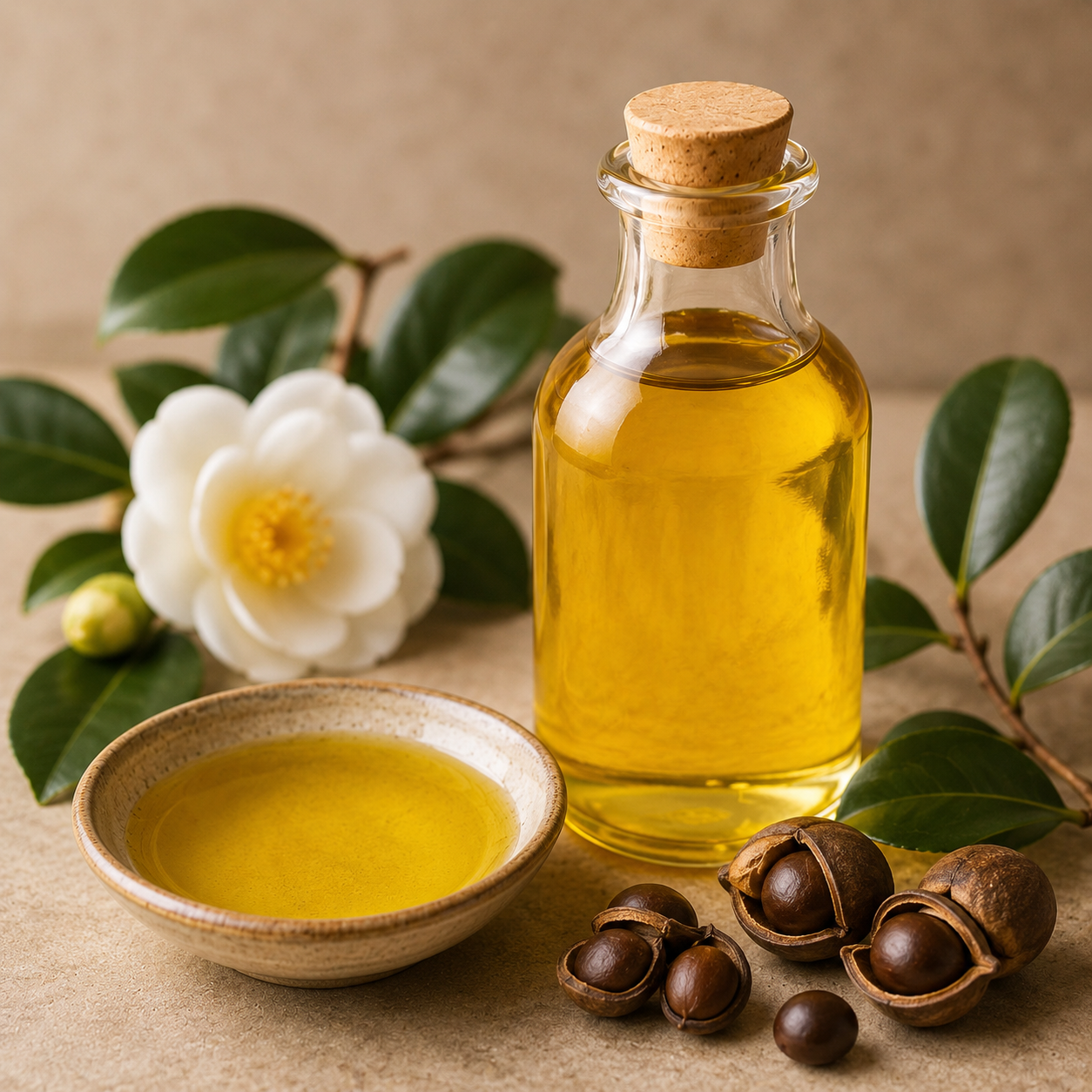
Camellia oil usually refers to edible oil made from oil-tea camellia seeds, with the standard product name “oil-tea camellia seed oil.” Camellia oleifera is a major source in China. It is not the same as tea-seed oil from Camellia sinensis. Check the product name, ingredient list, and standard rather than relying only on the English phrase “tea seed oil.”
Food overview
Key strengths
Camellia oil is rich in monounsaturated fat. The Chinese food-composition table lists about 10.0% saturated, 78.8% monounsaturated, and 11.1% polyunsaturated fatty acids.
Best ways to use it
It works for salads, noodles, steamed fish, everyday stir-frying, and moderate-temperature pan cooking. The best use still depends on whether the oil is pressed or refined, whether it is smoking, and whether it is being reused.
What stands out
Its standout feature is a high oleic-acid content, giving it a fatty-acid profile somewhat similar to olive oil. Polyphenols, squalene, and tocopherols vary by cultivar, origin, and processing, so the name alone does not reveal the exact amount.
Worth noting
Camellia oil is still energy-dense. About 10 g provides 88 kcal, so a high monounsaturated-fat content is not a reason to add unlimited extra oil.
Basic Nutrition
Showing:100 g Pure camellia oil
View complete nutrition data
GI note:GI varies with cultivar, food structure, processing, and cooking. Raw grains usually do not have directly applicable human GI data.
Camellia oil contains no available carbohydrate, so GI does not apply. It is not labeled 0, low-GI, or estimated.
Data notes:This page uses one formal food state: pure camellia seed oil with only oil-tea camellia seed oil in the ingredient list, not a blend. Basic nutrition does not distinguish pressed, cold-pressed, hot-pressed, or refined forms; processing differences are discussed separately.
Basic nutrition uses the Chinese Food Composition Table entry for camellia oil.
A common serving is 10 g, about 2 teaspoons; values are calculated from the 100 g data.
100 g is a database reference amount, not a sensible single serving.
GI is shown as “—” because camellia oil has no available carbohydrate and is not suitable for standard GI testing. “No carbohydrate” is not the same as a measured GI of 0.
The Chinese food-composition table does not provide reliable separate values for omega-3, omega-6, or trans fat, so they are shown as “—” rather than estimated from similar oils.
Alpha-tocopherol and polyphenols are shown only as research ranges, not fixed values for every product.
Vitamins & Minerals
Using adult Daily Values, only nutrients reaching at least 5% at the current serving are shown. At 10 g, only manganese is around 5%; minerals are not a major nutritional feature of the oil.
At a 10 g serving, manganese is about 0.12 mg, roughly 5% of the adult Daily Value. This comes from a specific database sample and minerals are not a stable, defining strength of camellia oil. Per 100 g, manganese is about 1.17 mg and iron about 1.10 mg, but 100 g is not a realistic single serving and should not be used to market the oil as high in these minerals.
View all vitamins and minerals
Key Bioactive Compounds
Oleic Acid
Monounsaturated fatty acidOleic acid is the dominant fatty acid in camellia oil and explains its high monounsaturated-fat content.
The Chinese food-composition table lists monounsaturated fat at about 78.8% of total fatty acids, around 7.9 g per 10 g. Research samples report oleic acid from about 59.66% to 86.18%, depending on cultivar and origin.
Replacing butter, lard, cream, and other higher-saturated-fat foods with unsaturated oils can improve overall fat quality.
Use camellia oil as a replacement oil, not an extra “health oil,” and rotate it with other plant oils.
Oleic acid is not unique to camellia oil and does not make it a treatment for high cholesterol, atherosclerosis, or chronic inflammation.
Alpha-Tocopherol
Vitamin E-active compoundAlpha-tocopherol is a fat-soluble antioxidant and the main vitamin E form used to meet human requirements.
Research samples contain about 11.24–41.05 mg per 100 g, or 1.12–4.10 mg per 10 g. The range comes from specific cultivars and is not a fixed value for every product.
Vitamin E helps protect cell membranes and lipids from excessive oxidation.
Choose a recent date, intact seal, and store away from light. Pressed oils may retain more, but less processing does not automatically mean better quality.
Do not apply the highest study value to every bottle. A serving is not equivalent to a high-dose vitamin E supplement or a treatment for disease.
Polyphenols
Plant phenolic compoundsCamellia oil contains small amounts of phenolic compounds that contribute to antioxidant activity measured in the oil.
Research samples contain about 1.42–5.36 mg total polyphenols per 100 g; other studies report 14.22–68.33 mg/kg. Cultivar, extraction, refining, and assay method all affect the result.
Polyphenols can help protect the oil from oxidation, but the food’s overall profile also depends on fatty acids, tocopherols, and other minor compounds.
If desired, choose a well-sourced pressed oil for salads, finishing, or low-to-moderate heat rather than increasing total oil intake.
These amounts are far below concentrated extracts, and in-vitro antioxidant tests do not prove anti-inflammatory, detox, or anti-aging effects in people.
How processing changes it
Pressed camellia oil
Mechanical pressing usually preserves more of the seed aroma. Products may still be filtered, degummed, or otherwise processed, so “pressed” does not mean unprocessed. Studies often find some alpha-tocopherol, phytosterols, squalene, and polyphenols, but amounts vary.
Cold-pressed camellia oil
Cold pressing uses relatively low-temperature mechanical extraction and may reduce loss of heat-sensitive compounds. It does not by itself prove better quality, authenticity, or higher bioactive content; date, acid value, peroxide value, and storage still matter.
Hot-pressed or roasted-pressed camellia oil
Heating or roasting seeds before pressing usually gives a stronger aroma. It can create flavor compounds and reduce some heat-sensitive components. Cold-pressed is not automatically healthier, and stronger aroma does not mean higher nutritional value.
Refined camellia oil
Refining may include degumming, neutralization, bleaching, and deodorization. It can reduce free fatty acids, off-flavors, and impurities but may also lower tocopherols, polyphenols, squalene, and volatile aroma compounds. One study found alpha-tocopherol declined more rapidly when deodorization exceeded 200°C.
Blended vegetable oil
If the ingredient list also contains soybean, canola, corn, sunflower, or other oils, the product is not pure camellia oil. Fatty-acid and bioactive data should be recalculated from the actual blend rather than copied from this page.
Prolonged high heat or repeated frying
High oleic acid gives camellia oil some oxidative stability, and studies suggest it can perform reasonably during frying. That does not make repeated heating harmless. Any oil oxidizes and polymerizes with sustained heat, oxygen, and water; discard oil that becomes dark, sticky, foamy, or sharply odorous.
How to choose and store it
How to choose
- Check the formal product name: prefer packaging that says oil-tea camellia seed oil rather than vague terms such as “camellia-flavored oil,” “camellia blended oil,” or simply “vegetable oil.”
- Check the ingredient list: pure camellia oil should list only oil-tea camellia seed oil. Other oils mean it is a blend.
- Check the product standard: as of August 6, 2026, GB/T 11765—2018 remains current; GB/T 11765—2026 was published April 30, 2026 and takes effect November 1, 2026, replacing the 2018 version. Products meeting the 2018 standard before then are not automatically outdated or noncompliant.
- Check processing: labels may state pressed, cold-pressed, aqueous enzymatic, solvent-extracted and refined, or other methods. Processing affects flavor and minor compounds but does not by itself determine healthfulness. The 2026 standard also clarifies that solvent-extracted crude oil must be refined before sale as edible oil.
- Check date and packaging: choose a recent date, intact seal, light-protective package, suitable bottle size, and clear producer information. Darker color is not automatically better; cultivar, pressing, refining, and storage all affect color.
- Smell it: normal oil may have a mild nutty or seed aroma. Avoid obvious rancid, paint-like, crayon-like, moldy, sharply stale, or unusually thick oil.
How to store
- Keep it away from light, such as in a cool cupboard, not by the window, stove, or oven.
- Reseal promptly after each use to limit contact with air.
- Store at a relatively stable, cool room temperature. Oxygen, light, and heat accelerate quality loss and oxidation.
- Choose a bottle size that matches your use rate; smaller bottles are better if you use oil slowly.
Remember five points: the name should be oil-tea camellia seed oil, the ingredient list should contain one oil, the standard should be verifiable, the date should be recent with light-protective packaging, and there should be no rancid odor.
How to use it in everyday meals
Salad vegetables
Use about 5–10 g with vinegar, lemon juice, garlic, herbs, or a little soy sauce. It works with spinach, lettuce, red cabbage, tomatoes, peppers, beans, and mushrooms without needing heavy dressings.
Noodles or mixed-grain rice
Add a small amount after cooking buckwheat noodles, whole-wheat noodles, brown rice, quinoa, or mixed grains. This controls oil use and avoids prolonged heat.
Steamed fish and vegetables
Drizzle a little over cooked fish, tofu, or vegetables with scallion, ginger, lemon, or low-sodium soy sauce. This makes total oil easier to control than heating a large amount from the start.
Everyday quick stir-frying
Its high oleic-acid content makes camellia oil suitable for short household stir-frying. Keep the temperature below heavy smoking and do not save leftover pan oil for repeated use.
Moderate-temperature pan cooking
Use a thin layer for eggs, tofu, fish, or small portions of meat. Avoid long empty-pan heating or cooking foods until charred.
Roasted vegetables
Toss a small amount with pumpkin, carrots, cauliflower, or mushrooms before roasting. Keep total oil and roasting time reasonable rather than pouring in large amounts just to prevent sticking.
Make sauces
Blend with nuts, herbs, garlic, lemon juice, or a little vinegar for vegetable, grain, or pasta sauces. Measure portions because the oil remains energy-dense.
Who Should Take Extra Care
People Managing Total Energy Intake
Camellia oil provides about 88 kcal per 10 g. It is best used to replace other oils or higher-saturated-fat foods rather than added as an extra drink.
People who need to restrict fat intake
Anyone on a medically prescribed low-fat diet should follow the amount set by their clinician or dietitian. A high monounsaturated-fat content does not override total-fat limits.
People with allergy to camellia seeds or related products
Allergy is uncommon, but any food can trigger an individual reaction. Anyone who develops hives, lip swelling, wheezing, or other clear symptoms after use should stop and seek professional evaluation.
Infants and young children
Camellia oil can be one household oil for infants’ complementary foods in small amounts as appropriate, but it should not be spoon-fed directly to “promote development” or “boost immunity.”
People prone to diarrhea or poor tolerance of high-fat foods
A large amount of oil at once can cause nausea, bloating, diarrhea, or other GI symptoms. Start small and spread intake across normal meals.
Frequent fryers
High oleic acid does not make repeated reuse safe. Discard oil that darkens markedly, thickens, foams persistently, smells irritating, or contains a lot of food debris.
Buying unpackaged oil from unclear sources
Loose oil makes it harder to verify raw materials, processing, adulteration, acid value, and peroxide value. Prefer packaged products with a traceable producer and product standard.
Similar Food Alternatives
Extra Virgin Olive Oil
Also rich in oleic acid and contains polyphenols and tocopherols. It works for salads, low-to-moderate heat, and finishing, but its characteristic phenolics differ from camellia oil and should not share the same bioactive data.
Virgin avocado oil
Mainly monounsaturated fat; refined versions suit many cooking methods and virgin versions keep more color and flavor. Its carotenoids, chlorophyll, and phytosterols differ from camellia oil.
High-oleic canola oil
Also high in monounsaturated fat and usually mild in flavor, suitable for everyday stir-frying. Check that “high oleic” is clearly stated and review the fatty-acid information.
Low-erucic-acid canola oil
Usually more affordable and provides monounsaturated fat, linoleic acid, and some ALA omega-3. It can be rotated with camellia oil rather than using only one oil long term.
Peanut oil
Provides both monounsaturated and polyunsaturated fats and has a more distinct aroma, making it common for Chinese-style stir-frying. Its fatty-acid profile, vitamin E forms, and flavor differ from camellia oil.