Spices and herbs
Cumin
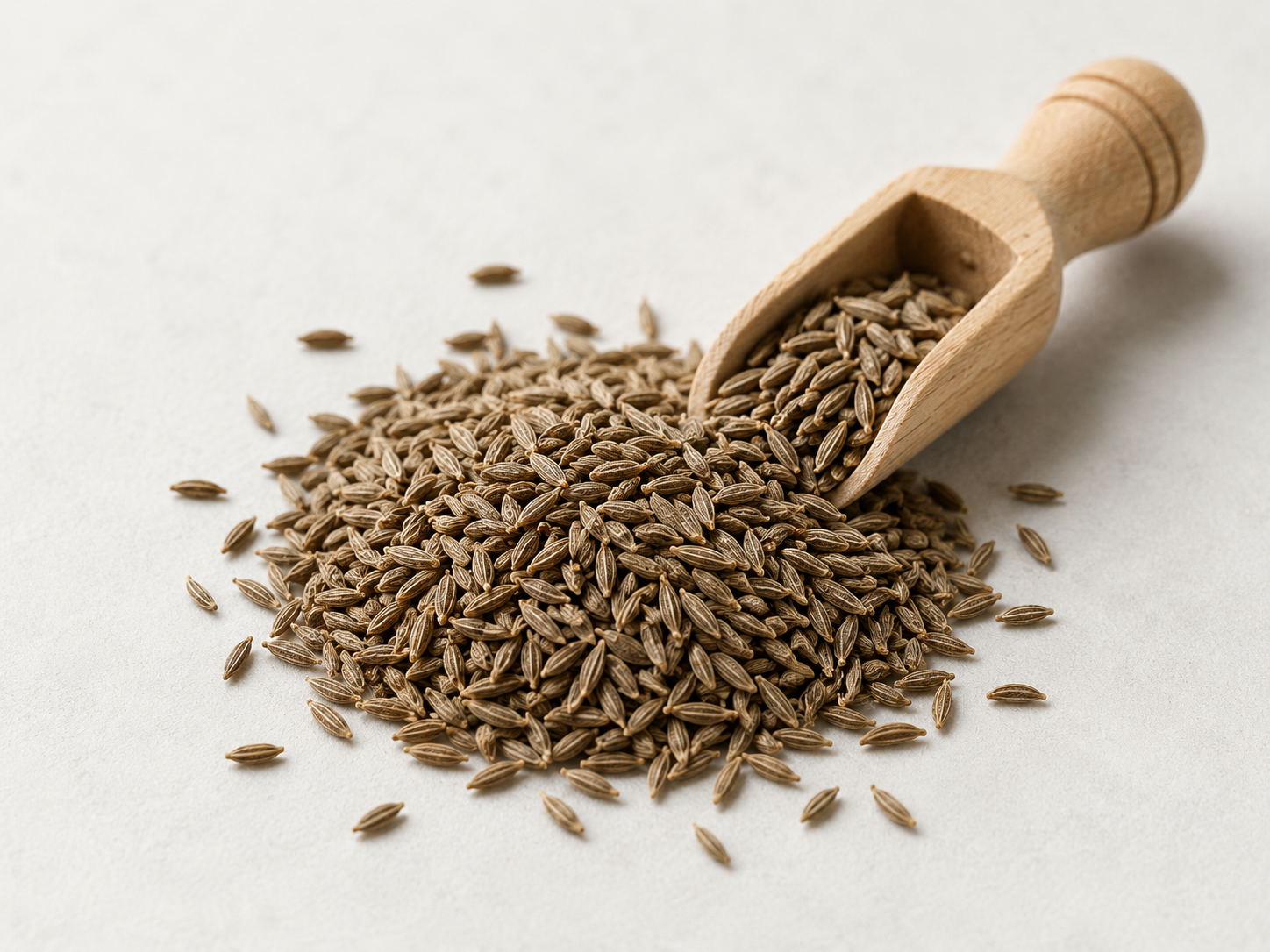
Cumin is an annual plant in the carrot family. What is commonly called a “cumin seed” is botanically a dried mature fruit, but it is still called a seed in food and cooking. It can be used whole or ground. Basic nutrition on this page uses USDA FoodData Central “Spices, cumin seed” (FDC 170923), with 2 g whole cumin as a common serving. Because cumin is usually a seasoning, high per-100 g mineral values should not be presented as if it were a major everyday nutrient source. This page covers Cuminum cyminum only; caraway is Carum carvi and black cumin usually refers to Nigella sativa—these are different plants.
Food Overview
Key strengths
Cumin’s main value is its strong, distinctive warm aroma, which helps beans, vegetables, fish, and meat stay flavorful with less salt or oil. Its volatile oil commonly contains cuminaldehyde, gamma-terpinene, p-cymene, beta-pinene, and related compounds.
How to use it
Use in roasted vegetables, legumes, whole-grain dishes, stews, fish, and meat. Whole cumin can be toasted briefly over low heat and lightly crushed; ground cumin is often better added later in cooking to reduce aroma loss. Heating changes volatile compounds, and prolonged or very high heat can flatten the characteristic aroma.
What stands out
USDA lists about 66.4 mg iron per 100 g cumin, but a usual 2 g serving provides only about 1.33 mg. Cumin can contribute a little iron but does not replace meat, shellfish, legumes, or other major iron sources.
Worth noting
Much cumin research uses essential oil, concentrated extracts, or isolated compounds at levels far above normal culinary use. Laboratory antioxidant, antimicrobial, or metabolic findings should not be translated into claims that eating cumin treats disease.
Basic Nutrition
Showing:2 g Cumin
View complete nutrition data
GI note:GI varies with cultivar, food structure, processing, and cooking. Raw grains usually do not have directly applicable human GI data.
Reliable GI data for pure cumin seed or powder are lacking. Because cumin is used in small amounts, GI is shown as “—” rather than estimated from carbohydrate or shown as 0.
Data notes:This page uses one formal food state, cumin: mature dried whole cumin seeds/fruits with no added salt, sugar, or oil. Ground cumin lacks a separate complete nutrition entry and is therefore not a nutrition-state toggle.
Basic nutrition uses USDA FoodData Central “Spices, cumin seed” (FDC 170923).
The common serving is 2 g, roughly a level teaspoon of whole cumin, used here to reflect household seasoning. Values are scaled from per 100 g; 100 g is for database comparison, not a reasonable single serving.
GI is shown as “—” because reliable GI data for pure cumin seed or powder are lacking. Cumin is usually eaten only in small seasoning amounts, so GI is not inferred from carbohydrate.
The USDA entry provides monounsaturated fat, polyunsaturated fat, and some individual fatty acids, but not a standardized total omega-3 or omega-6 value, so the page does not calculate its own totals.
Cumin is normally a seasoning. High per-100 g mineral values should not be used to present it as a major everyday nutrient source.
Vitamins & Minerals
Adult Daily Values are used, and only nutrients reaching at least 5% are shown. At a 2 g serving, only iron qualifies. Calcium, magnesium, manganese, copper, potassium, and vitamin B1 look high per 100 g but fall below 5% once scaled to 2 g.
The default 2 g serving reaches the 5% Daily Value display threshold only for iron, at about 1.33 mg or 7%. Other vitamins and minerals fall below the threshold. Per-100 g figures can mislead: cumin has about 66.4 mg iron and 931 mg calcium per 100 g, but a 2 g serving provides only about 1.33 mg iron and 18.6 mg calcium. Cumin is not a primary food for iron, calcium, or magnesium.
View all vitamins and minerals
Key Bioactive Compounds
Cuminaldehyde
Aromatic aldehydeCuminaldehyde is a major volatile behind cumin’s warm, pungent aroma.
Specific whole-seed amount: —. Studies usually report essential-oil composition, not direct food content. Particular oils have contained about 27.99%–32.26% cuminaldehyde, but these percentages cannot be read as grams per 100 g cumin and vary with origin, storage, and extraction.
Cuminaldehyde and cumin oil show antioxidant and antimicrobial activity in vitro, but this does not establish a clinical effect from ordinary seasoning amounts.
Prefer whole cumin and grind as needed. Toast briefly over low heat or add ground cumin later to protect aroma.
Essential-oil antimicrobial findings do not mean cumin treats infection, and food use is not equivalent to concentrated oil.
Gamma-terpinene and p-cymene
Monoterpene volatilesGamma-terpinene and p-cymene are common cumin-oil monoterpenes that contribute fresh, pungent, slightly citrus-like notes.
Specific whole-seed amount: —. One oil sample contained about 17.31% p-cymene and 16.67% gamma-terpinene. Proportions vary by origin and sample, and heating can reduce these and other volatiles.
These compounds show antioxidant-related activity in chemical and in-vitro systems, but dietary effects cannot be assigned to one terpene.
Lightly crush or freshly grind whole cumin. If toasting, stop once fragrant rather than blackening or smoking the seeds.
Laboratory radical-scavenging activity is not evidence that stronger-smelling cumin is more anti-inflammatory in people.
Polyphenols
Phenolic plant compoundsCumin also contains phenolic and flavonoid compounds, but the profile depends on origin, extraction, and analytical method.
Specific whole-seed amount: —. A 2025 Hotan-cumin ethanol-extract study tentatively identified compounds including luteolin and kaempferol glucuronide; the authors described the identifications as preliminary, not representative of all market cumin.
The extract showed antioxidant activity and potential to reduce formation of some heterocyclic amines in model systems, which is not the same as a human disease outcome.
Use cumin with other spices in high-heat dishes, while controlling temperature, avoiding heavy charring, and adding vegetables and herbs.
Extract studies do not show that a small amount of cumin detoxifies, prevents cancer, or cancels the effects of charred meat.
How Preparation Changes Cumin
Whole cumin
Whole seeds/fruits protect volatile oils better and usually retain aroma longer than ground cumin. Crush or grind only what you need for fresher flavor.
Ground cumin
Grinding increases surface area, making aroma release faster but also increasing contact with air and speeding flavor loss. Buy small packs and store sealed, away from light and stove heat.
Light toasting
Brief gentle heating can release and alter volatile aromas, making cumin smell more intense. Use soon after toasting rather than preparing a large batch for long storage.
Prolonged or high heat
Temperature and time alter cumin volatiles. Research on Xinjiang cumin found that extended treatment at 70°C reduced some common volatiles and lowered certain key aldehydes and terpenes.
Cumin seasoning blends
BBQ seasonings, cumin-chili powders, and spice blends may contain added salt, sugar, MSG, starch, plant oil, or other spices. Use the product label for sodium, sugar, and energy rather than pure-cumin data.
How to Choose and Store
How to choose
- Check the name: look for cumin and Cuminum cyminum. Do not rely on words such as “cumin” or “caraway” in translated market names; caraway is Carum carvi and black cumin is Nigella sativa, with different appearance, aroma, and characteristic compounds.
- Prefer whole seeds/fruits: cumin should be slender with obvious longitudinal ridges, usually yellow-brown to brown. Kew records cumin fruits at about 4–6 mm long and around 2 mm wide.
- Smell it: fresh cumin should have a clear warm, pungent aroma. Very faint aroma usually means substantial flavor loss; musty, damp, or rancid odors are reasons not to buy or use it.
- Check ground cumin: it should be dry and loose rather than badly clumped, damp, or unusually colored. For blends, see whether salt, sugar, or other ingredients appear high on the ingredient list.
- Check for storage pests: dried spices can be infested. Discard products with insects, eggs, webbing, or unusual powdery debris, and inspect nearby dry goods.
How to store
- Store cumin in an airtight container in a cool, dry, dark place away from the stove, oven, dishwasher, and sink. Heat, light, air, and moisture accelerate aroma and quality loss.
- Whole cumin retains volatile oils and flavor better than ground cumin. If you use it often, keep whole cumin and grind only the amount needed for a meal.
- Use a completely dry spoon and do not pour spice directly over a steaming pan, because moisture entering the container can cause clumping or mold.
- Discard cumin with musty or rancid odors, damp hard clumps, insects or webbing, water-damaged or broken packaging, or abnormal color and aroma changes.
Four rules: confirm Cuminum cyminum, prefer whole cumin for storage, buy small quantities, and keep it sealed, dark, dry, and away from heat.
How to Eat It
Cumin-roasted vegetables
Toss cauliflower, carrot, pumpkin, bell pepper, or potato with a little plant oil, cumin, black pepper, and garlic, then roast until tender. Cumin can add enough flavor to reduce salt, butter, and salty sauces. Avoid widespread charring.
Cumin with legumes
Chickpeas, lentils, black beans, and tofu all pair well with cumin. Sauté onion and a little whole cumin, then add legumes, tomato, and vegetables. Cumin adds flavor; it does not require lots of salt, sugar, or cream.
Cumin-seasoned fish
Season fish with cumin, lemon, garlic, black pepper, and a little salt, then bake, steam, or pan-cook with little oil. Start with a small amount and avoid coating fish heavily or burning the spice.
Cumin with meat
Lamb, beef, and chicken all work with cumin. Prefer lean pieces with onion, bell pepper, or mushrooms and cook briefly. Cumin does not cancel the effects of fatty meat, processed meat, heavy salt, or charring.
Cumin whole-grain rice
Add a little whole cumin while cooking brown rice, quinoa, millet, or buckwheat with legumes, vegetables, or nuts. Steaming softens the aroma, which may suit people who find ground cumin too intense.
Cumin yogurt sauce
Mix a little freshly ground cumin into plain yogurt with lemon juice, cucumber, garlic, and herbs for roasted vegetables, whole-grain flatbread, or legumes. Avoid sweetened or very salty flavored yogurt.
Who Should Take Extra Care
People allergic to cumin or spices
Cumin allergy is uncommon but serious reactions have been reported. People allergic to cumin, celery, fennel, coriander, or with birch/mugwort pollen-related cross-reactivity should be alert to hidden cumin in spice blends.
People who develop oral or systemic reactions after eating it
If cumin repeatedly causes mouth itching, lip or throat swelling, hives, wheezing, or marked discomfort, stop eating it and seek medical assessment rather than increasing the dose to test tolerance.
People with sensitive digestion
Cumin has a strong aroma and taste. People who develop reflux, stomach burning, or abdominal discomfort after eating it can reduce the amount and avoid combining it with lots of chili, alcohol, fried food, or high-fat meals.
Infants, young children, and people with swallowing difficulties
Whole cumin can be unpleasant in texture and may be aspirated. For young children, grind it well and mix into cooked food rather than letting them handle or inhale dry cumin powder.
People trying to increase iron
Cumin is high in iron per 100 g, but a 2 g serving provides only about 1.33 mg. People with confirmed iron deficiency or iron-deficiency anemia should not try to correct it by simply adding more cumin; use major dietary iron sources and professional treatment based on test results.
People using cumin essential oil or concentrated extracts
Essential oil and concentrated extracts are not ordinary seasonings and expose the body to much higher concentrations. Safety of culinary cumin cannot be used to assume oral essential oil or high-dose extracts are equally safe.
Similar Food Alternatives
Coriander seed
Brighter, citrusy, nutty aroma for legumes, curries, vegetables, and meat. It is milder than cumin.
Fennel seed
Sweeter with licorice/anise notes for fish, tomato, legumes, and baking; the flavor direction is distinct from cumin.
Caraway
Similar-looking but botanically Carum carvi. Its cooler anise-like aroma is common in bread, cabbage, and potatoes.
Curry powder
Often contains cumin plus turmeric, coriander, chili, and other spices. Useful for blended flavor, but check ingredients and sodium.