Nuts & Seeds · Tree nuts
Pecans
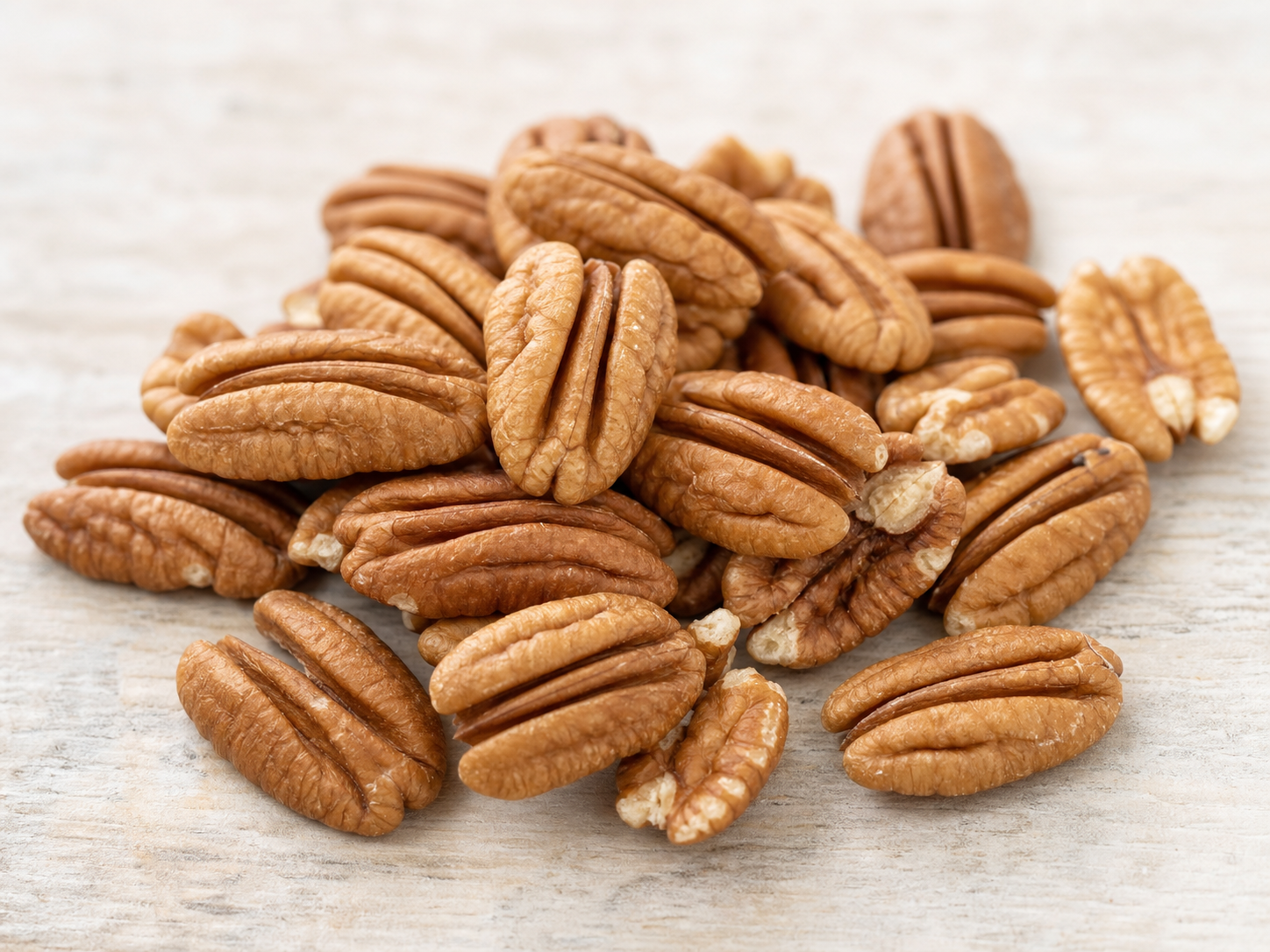
Pecans are the edible kernels of Carya illinoinensis, native from the central and eastern United States into Mexico. They are high in fat, mainly monounsaturated fat, and also provide manganese, copper, vitamin B1, and several polyphenols. Plain, minimally processed pecans are best kept to a modest portion of about 20–25 g.
Overview
Key strengths
Pecans are rich in monounsaturated and polyunsaturated fats and also provide manganese, copper, vitamin B1, magnesium, and zinc.
How to eat it
Use a small portion of plain pecans between meals, or chop them into oats, plain yogurt, vegetable salads, or whole-grain dishes.
What stands out
Pecans are notable for proanthocyanidins and also contain substantial gamma-tocopherol plus ellagic acid, gallic acid, and other phenolics.
Worth noting
Pecans provide about 691 kcal per 100 g, or about 173 kcal per 25 g. Candied, caramel, honey, buttered, or heavily salted products are not nutritionally equivalent to plain pecans.
Basic Nutrition
Showing:100 g Raw pecans
View complete nutrition data
GI note:GI varies with cultivar, food structure, processing, and cooking. Raw grains usually do not have directly applicable human GI data.
No suitable standalone GI measurement was found for pecans, so the page shows “—” rather than 0 or an estimated online value. Low available carbohydrate does not justify assigning a GI.
Data notes:Base nutrition uses USDA SR Legacy “Nuts, pecans” and is not mixed with newer Foundation Foods data.
This page uses one formal nutrition state only: raw pecans. A separate unsalted dry-roasted state should be added only when a complete independent dataset is available.
A 25 g serving is roughly 17 pecan halves, but size varies, so grams are the preferred measure.
Vitamins & Minerals
Only vitamins and minerals providing at least 5% of the FDA Daily Value for adults and children age 4+ at the selected serving are shown.
Vitamin E labeling is based on alpha-tocopherol. Pecans contain substantial gamma-tocopherol, but the 24.4 mg gamma-tocopherol per 100 g cannot be reported as 24.4 mg vitamin E.
View all vitamins and minerals
Percentages show how much the selected serving contributes to the adult Daily Value.
Key Bioactive Compounds
Proanthocyanidins
Flavan-3-ol polymersProanthocyanidins, or condensed tannins, are prominent pecan polyphenols linked with their brown color and mild astringency.
USDA fractions total about 476.8 mg proanthocyanidins per 100 g edible kernel, or about 119 mg per 25 g. This is a database sum, not a directly measured single value.
They show antioxidant activity in laboratory systems, and human studies report some short-term changes in antioxidant and lipid-oxidation markers.
Choose plain pecans with their natural brown surface intact and use raw or gently roasted forms.
Database content is not the amount fully absorbed, and short-term antioxidant changes do not show that pecans treat inflammation or cardiovascular disease.
Ellagic acid, gallic acid & other phenolic acids
Phenolic acids and hydrolyzable-tannin-related compoundsPecans contain ellagic acid, gallic acid, protocatechuic acid, and related phenolics.
Fixed amount: —. Levels vary by cultivar, region, maturity, storage, and method. Shell-extract data should not be used as edible-kernel values.
These phenolics contribute to plant antioxidant activity, but benefits seen in pecan-feeding studies cannot be assigned to one compound.
Choose fresh plain pecans and store them cold. Gentle roasting is reasonable because different phenolics respond differently to heat.
Detecting phenolic acids does not mean ordinary pecan intake has drug-like, detox, anti-inflammatory, or cancer-prevention effects.
Gamma-tocopherol
TocopherolsGamma-tocopherol is a fat-soluble vitamin E family compound and a characteristic antioxidant in pecans.
Raw pecans provide about 24.44 mg gamma-tocopherol per 100 g, or 6.11 mg per 25 g; alpha-tocopherol is about 1.40 mg per 100 g.
Gamma-tocopherol contributes to lipid antioxidant defense; a short trial found plasma levels increased over 8 hours after pecan intake.
Choose plain or gently roasted pecans and store opened nuts sealed, dark, and refrigerated.
Gamma-tocopherol cannot be counted directly toward the alpha-tocopherol vitamin E Daily Value, and food intake is not equivalent to supplementation.
Raw vs. processed
Raw pecans
This is the default nutrition state, with no added oil, salt, or sugar. It provides the cleanest basis for portion and ingredient control.
Lightly roasted
Short roasting can improve aroma and crunch. In one study, fatty acids and tocopherols changed little while some phenolics fell and gallic acid increased. Results depend on time, temperature, and equipment.
Long high-heat roasting or charring
Prolonged high heat increases the risk of lipid oxidation and burnt flavors. There is no need to roast pecans until very dark or charred for crunch.
Chopped or ground
Chopping increases surface area and exposure to air, odors, and oxidation. Pecan pieces and meal should be used faster than intact halves and stored sealed, preferably refrigerated or frozen.
Candied, caramel, or butter-flavored pecans
These products may add substantial sugar, syrup, butter, and salt, so raw-pecan nutrition data no longer apply. Treat them more like a dessert than an equal substitute for plain nuts.
How to Choose & Store
How to choose
- Prefer products whose ingredient list is only pecans.
- Choose unsweetened, unhoneyed, unbuttered, and low-salt or unsalted products.
- Kernels should be plump, dry, and firm.
- Color should be fairly even, usually golden to light brown rather than unusually dark.
- Avoid mold, insect damage, and abnormal black spots.
- Fresh pecans should smell nutty, not paint-like, sour, or rancid.
How to store
- After opening, refrigerate in an airtight container; freeze for longer storage.
- Chopped pecans spoil faster than intact halves and should be used sooner.
- When thawing, keep the package sealed and warm slowly in the refrigerator to reduce condensation on the kernels.
- Discard pecans with rancid odors, mold, insect damage, or unusual dark spots.
Choose pecans with three things in mind: plain and minimally added, not overly dark, and refrigerated after opening.
How to Eat It
Eat as a small plain-nut portion
Use about 20–25 g at a time in place of some cookies, chips, or candy. Pre-portioned servings make quantity easier to control than eating from the bag.
With oats or plain yogurt
Chop pecans into oatmeal, overnight oats, or plain yogurt with berries, apple, or kiwi. Their own fat and crunch make large amounts of honey or syrup unnecessary.
Add to vegetable salads
Add a small amount to salads with leafy greens, tomatoes, cabbage, beans, or fruit. Use vinegar, lemon, and a little olive oil instead of heavy creamy dressing.
Pair with whole grains or roasted vegetables
Sprinkle chopped pecans over brown rice, quinoa, oats, pumpkin, or carrots after cooking to reduce repeated heating.
Make a lower-sugar nut crumble
Mix pecans with oats, flaxseed, or sesame and roast briefly at moderate heat. Keep syrup, butter, and salt light, and avoid charring.
Who Should Take Extra Care
People with nut allergy
Pecans are tree nuts and a major food allergen. People with diagnosed pecan, walnut, or other tree-nut allergy should not test them at home and should check mixed nuts and baked foods for cross-contact warnings.
People Managing Energy Intake
A 25 g serving provides about 173 kcal. Pecans work best as a replacement for other snacks rather than as unlimited extra food. In a 2025 randomized trial, replacing usual snacks with 57 g pecans daily improved some lipid measures but showed a small tendency toward weight gain.
Infants, young children, and people with swallowing difficulties
Whole nuts and large pieces are choking hazards. Young children should receive age-appropriate finely ground pecans, thin nut butter, or pecans mixed well into other foods rather than whole nuts.
People who need to restrict potassium, phosphorus, or specific nutrients
Pecans contain phosphorus, potassium, magnesium, and other minerals. People with kidney disease or individualized restrictions should follow their own prescribed limits rather than adding more because nuts are considered healthy.
People with digestive sensitivity
A very large portion of high-fat nuts may cause bloating, nausea, or changes in bowel habits. Start around 10 g if needed and adjust to tolerance.
Similar Food Alternatives
Walnuts
Walnuts are in the same botanical family and provide more ALA-type plant omega-3, making them useful when a different fatty-acid profile is desired.
Pistachios
Pistachios are especially notable for plant protein, lutein, and zeaxanthin and have a different texture and nutrient profile from pecans.
Hazelnuts
Hazelnuts are rich in monounsaturated fat and alpha-tocopherol and work well in yogurt, oats, and baking.
Almonds
Almonds provide protein, fiber, calcium, and alpha-tocopherol and are firmer in texture than pecans.
Sources
Nutrition Data
Basic Information & Food Safety
Research & References
Haytowitz D., Wu X., Bhagwat S. (2018). USDA Database for the Proanthocyanidin Content of Selected Foods, Release 2.1.
Thomas R.G., Gebhardt S.E. (). Nuts and Seeds as Sources of Alpha and Gamma Tocopherols.
USDA-ARS Nutrient Data Laboratory. DOI / Original
de la Rosa L.A., et al. (2011). Phenolic compounds and antioxidant activity of kernels and shells of pecan nut.
International Journal of Molecular Sciences. DOI / Original
Hudthagosol C., et al. (2011). Pecans acutely increase plasma postprandial antioxidant capacity and catechins and decrease LDL oxidation in humans.
Journal of Nutrition. DOI / Original
Guarneiri L.L., et al. (2021). Pecan-enriched diets decrease postprandial lipid peroxidation and increase total antioxidant capacity in adults at risk for cardiovascular disease.
Nutrition Research. DOI / Original
Al Juhaimi F., et al. (2017). Pecan walnut oil quality and phenolic compounds as affected by microwave and conventional roasting.
Journal of Food Science and Technology. DOI / Original
Hart T.L., et al. (2025). Consuming pecans as a snack improves lipids/lipoproteins and diet quality compared with usual diet in adults at increased risk of cardiometabolic diseases.
American Journal of Clinical Nutrition. DOI / Original