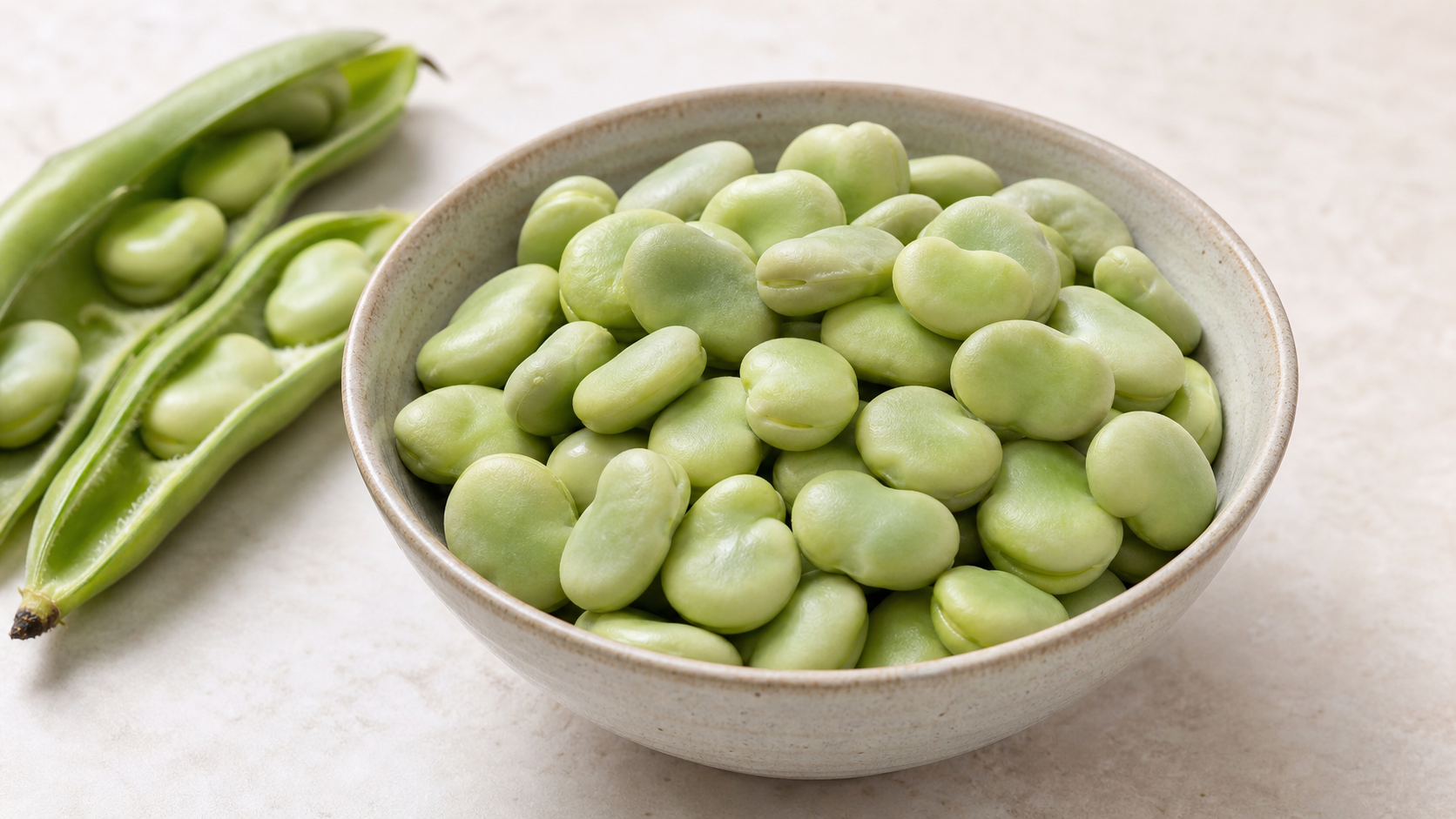
Legumes & Soy Foods · Dry Beans
Fava Bean
Fava beans provide legume protein, dietary fiber, folate, and several minerals. Young fresh beans also provide vitamin C, and the plant naturally contains L-DOPA along with multiple phenolic compounds. However, people with glucose-6-phosphate dehydrogenase deficiency can develop severe hemolysis after eating fava beans, making this the most important safety boundary for this food.
Food Overview
Key strengths
Fresh fava beans have high water content and provide about 72 kcal per 100 g, along with about 5.6 g of protein, 4.2 g of dietary fiber, vitamin C, and folate.
How to Eat It
Fresh fava beans can be blanched, lightly stir-fried, steamed, or added to soups and mixed-grain rice. Mature fava beans should be soaked in advance and thoroughly cooked until soft, then used in stews, thick soups, and bean purées.
What stands out
Fava beans naturally contain L-DOPA, one of their more distinctive phytochemical features. Their seed coats also contain catechin, epicatechin, proanthocyanidins, and other phenolic compounds, but actual amounts vary with cultivar, maturity, seed-coat color, and processing.
Worth noting
People with confirmed or suspected glucose-6-phosphate dehydrogenase deficiency, commonly known in this context as favism risk, should avoid fava beans. Related oxidant compounds can trigger acute hemolysis, and thorough cooking does not guarantee elimination of the risk.
Basic Nutrition
Showing:100 g Cooked Fresh Fava Beans
View complete nutrition data
GI note:GI varies with cultivar, food structure, processing, and cooking. Raw grains usually do not have directly applicable human GI data.
The University of Sydney GI database value of 63 corresponds to a specific sample of frozen fresh fava beans that were then boiled and should not be applied directly to the fresh cooked state on this page.
Data notes:Cooked fresh fava beans refer to young fresh beans boiled in water, drained, and prepared without added salt.
The USDA entry does not provide reliable total-sugar or starch values, so these are shown as “—” rather than automatically entered as 0.
Vitamins & Minerals
By default, data are shown per 100 g for the currently selected state. Only nutrients providing at least 5% of the adult Daily Value at the selected amount are displayed.
View all vitamins and minerals
Percentages show how much the selected serving contributes to the adult Daily Value.
Key Bioactive Compounds
L-DOPA
Bioactive Amino-Acid DerivativeL-DOPA, or levodopa, is a dopamine precursor and one of the more distinctive natural compounds in fava beans.
Specific food amount: —. Levels vary greatly by cultivar, maturity, plant part, and processing, and high values from leaves, flowers, or young pods should not be applied to edible seeds.
L-DOPA can be converted to dopamine, but the amount provided by fava beans is difficult to control consistently.
Eat fava beans as an ordinary legume rather than trying to obtain L-DOPA from large amounts of raw beans, pods, leaves, or powders.
Fava beans do not replace levodopa medication and should not be used to self-treat Parkinson’s disease.
Catechin, Epicatechin & Epigallocatechin
Flavan-3-olsThese flavonoid polyphenols are representative phenolics in fresh fava beans.
Per 100 g, USDA averages for raw fresh beans are 28.96 mg epicatechin, 15.47 mg epigallocatechin, 14.29 mg catechin, and 4.15 mg gallocatechin; cooked values are 7.82, 4.65, and 8.16 mg for the first three, respectively.
These polyphenols show antioxidant activity experimentally, while the food’s overall value also comes from fiber, protein, and folate.
Blanch, boil, steam, or lightly stir-fry; do not undercook mature seeds just to preserve polyphenols.
Laboratory antioxidant capacity does not directly equal anti-inflammatory effects in people.
Proanthocyanidins & Condensed Tannins
PolyphenolsProanthocyanidins are condensed tannins and are representative plant-defense compounds in fava-bean seed coats, affecting coat color, astringency, and appearance during storage.
One study of 10 young fava-bean cultivars measured condensed tannins at about 309.28—958.77 mg catechin equivalents/kg fresh weight, or about 30.9—95.9 mg catechin equivalents/100 g.
Proanthocyanidins show antioxidant activity in vitro and may interact with other food components and gut microbes during digestion.
The tender seed coat of fresh fava beans can be eaten.
More tannin is not always better. A darker seed coat does not mean stronger anti-inflammatory effects in people.
How Preparation Changes Fava Bean
Raw Fresh Fava Beans
In nutrition databases, “raw fresh fava beans” means immature seeds and contains about 81% water, with relatively higher vitamin C and some flavan-3-ol values. “Raw” is an analytical state and does not mean everyone should eat them uncooked.
Cooked Fresh Fava Beans
After boiling, texture softens and vitamin C and some polyphenols decrease, but the beans still provide dietary fiber, folate, and plant protein.
Raw Mature Fava Beans
Mature seeds are low in water and nutrient-dense but hard and also contain phytate, tannins, protease inhibitors, lectins, and fava-bean-specific vicine and convicine glycosides.
Soaked & Cooked
Mature fava beans should be soaked, then cooked in fresh water until completely soft inside. Soaking, changing the water, and thorough heating can reduce some antinutritional factors and improve digestibility, but cannot make fava beans safe for people with G6PD deficiency.
Fried Fava Beans
Crispy fried fava beans are much more energy- and fat-dense, and seasoned versions may also contain substantial salt.
Fermented Products
Fermented products such as broad-bean paste have a different nutrition profile from whole fava beans and often contain substantial salt, so the basic nutrition data on this page should not be applied directly.
How to Choose & Store
How to choose
- Choose fresh pods that are green, naturally glossy, and plump without excessive yellowing.
- Avoid pods with obvious black spots, mold, decay, or off odors.
- Fresh shelled beans should have a natural color, be relatively uniform in size, and not feel slimy.
- Choose mature fava beans that are dry and intact, without insect holes, damp clumps, mold spots, or unusual odors.
- Packaging for mature beans should have clear labeling and production dates.
How to store
- Unshelled pods keep longer than beans removed in advance. Refrigerate after purchase and eat promptly.
- Shelled fresh beans can be kept in a food container.
- Store mature fava beans in a sealed container in a cool, dry, dark place.
- Cool cooked fava beans promptly and refrigerate; do not leave them at room temperature for long periods.
- For longer storage, freeze in meal-sized portions and reheat thoroughly before eating.
When buying fava beans, remember three points: for fresh beans, look for plumpness and color; for mature beans, look for dryness and intact seeds; and for either form, avoid mold or off odors.
How to Include It in Everyday Meals
1. Lightly Stir-Fried Fresh Fava Beans
Blanch or steam fresh fava beans until nearly cooked, then stir-fry briefly with asparagus, mushrooms, carrots, or bell peppers. Use only a small amount of plant oil and avoid large amounts of fatty meat or high-sodium sauce.
2. Fava-Bean Mixed-Grain Rice
Add cooked fava beans to brown rice, white rice, quinoa, or barley. When using mature beans, soak and cook them separately until soft before mixing with the staple so the rice is not finished while the bean centers remain hard.
3. Fava-Bean Vegetable Soup
Combine cooked fava beans with tomatoes, carrots, onions, celery, mushrooms, and leafy greens. Fava beans can add satiety and natural body, so large amounts of cream, flour, or processed meat are unnecessary.
4. Fava-Bean Purée
Mash soft cooked fava beans with a small amount of olive oil, lemon juice, garlic, and herbs and serve with whole-grain bread or as a vegetable dip.
5. Fava-Bean Grain Salad
Combine fully cooked and cooled fava beans with quinoa, tomatoes, cucumber, purple cabbage, spinach, and similar foods, using a small amount of olive oil and vinegar for dressing.
6. Fava-Bean Stew
Mature fava beans can be stewed with pumpkin, tomatoes, eggplant, mushrooms, and spices. Soaking and pre-cooking until soft shortens the total cooking time and prevents vegetables from becoming overcooked while waiting for the beans.
Who Should Take Extra Care
People with G6PD Deficiency / Favism
This is the most important safety warning. In people with G6PD deficiency, eating fava beans can trigger acute hemolytic anemia that may require emergency treatment.
Infants, Young Children & People with a Family History
For infants or young children with a family history of favism, ancestry from higher-prevalence regions, or uncertain newborn-screening results, consult a clinician before first exposure to fava beans. Case reports describe hemolysis in breastfed infants with G6PD deficiency after the mother ate fava beans.
People Taking Certain Medications
Fava beans contain natural L-DOPA. People receiving levodopa treatment for Parkinson’s disease should not suddenly eat large amounts of fava beans or use them to adjust medication doses on their own.
People with digestive sensitivity
Fava beans contain dietary fiber and fermentable oligosaccharides, and large amounts can cause bloating or increased gas. Start with a small portion; for mature beans, soak, change the water, and cook thoroughly until soft.
People managing blood sugar
Fava beans contain carbohydrate. Cooked mature fava beans provide about 19.7 g of carbohydrate per 100 g and about 29.5 g per 150 g, so portions still matter.
People with impaired kidney function
Mature fava beans are relatively high in potassium, phosphorus, magnesium, and protein. People who need to limit potassium, phosphorus, or protein should control portions according to physician or clinical-dietitian advice rather than following a general healthy-eating recipe.
People with Legume Allergies
People who have had clear allergic reactions to fava beans, peas, peanuts, soybeans, or other legumes should be cautious when trying them. Generalized hives, throat swelling, difficulty breathing, or dizziness requires prompt medical care.
Similar Food Alternatives
Green Peas
They are used similarly to fresh fava beans in stir-fries, blanching, soups, and mixed-grain rice.
Edamame
Another immature legume that provides plant protein, dietary fiber, and folate and works well boiled, chilled, or added to grain bowls.
Chickpeas
Chickpeas provide fiber and plant protein and work well in stews, salads, and purées, but do not share fava bean’s L-DOPA or favism risk.
White Kidney Beans
They have a mild flavor and work well in soups, stews, and bean purées.
Substitution Note
People with G6PD deficiency need to avoid fava beans themselves.