Whole Grains & Tubers · Mixed grain and pseudocereal
Buckwheat
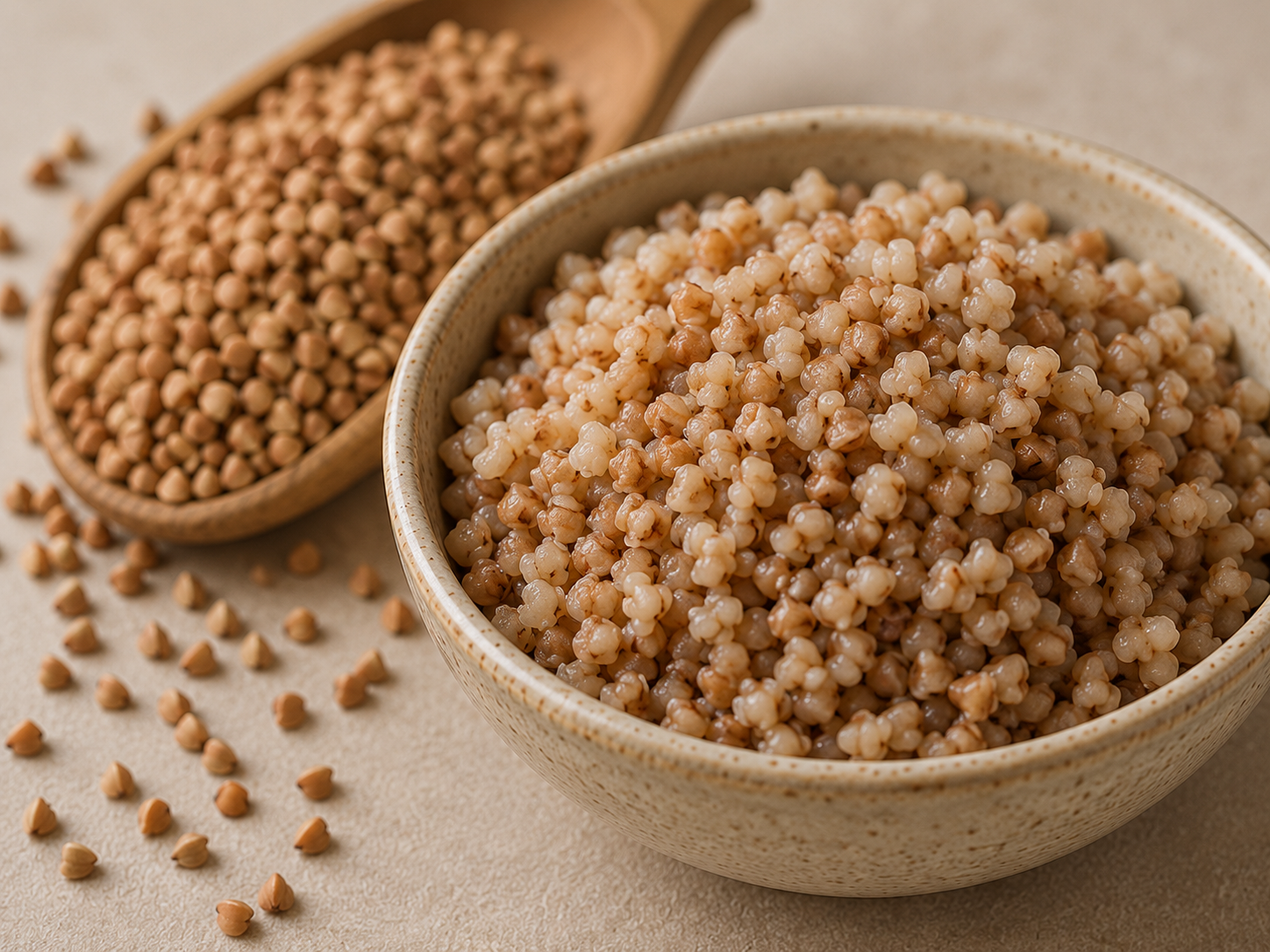
Buckwheat is a naturally gluten-free pseudocereal that provides dietary fiber, plant protein, magnesium, manganese, and copper and also contains plant compounds such as rutin. It can replace part of refined rice and wheat-based staples.
Food Overview
Key strengths
Buckwheat groats provide dietary fiber, plant protein, and several minerals and can increase staple-food variety, but they are not a carbohydrate-free “weight-loss food.”
How to Eat It
Buckwheat groats can be cooked with rice as mixed-grain rice, made into porridge, used in grain bowls, or added to vegetable soup.
What stands out
Prefer intact groats with buckwheat as the only ingredient. Buckwheat flour, cookies, crisps, and noodles are different food forms.
Worth noting
Buckwheat is naturally gluten-free but may have cross-contact with wheat. Buckwheat can also cause food allergy, so people who need a strict gluten-free diet should look for appropriate certification.
Basic Nutrition
Showing:100 g Dry Buckwheat Groats
View complete nutrition data
GI note:GI varies with cultivar, food structure, processing, and cooking. Raw grains usually do not have directly applicable human GI data.
No directly applicable human GI value is available for raw buckwheat groats.
Data notes:Differences between dry and cooked values mainly reflect dilution from absorbed water and do not mean that cooking destroys most nutrients.
“—” means the database does not provide reliable data; “0” means the database records a zero value.
Vitamins & Minerals
Only nutrients providing more than 5% of the Daily Value at the current serving size are displayed.
View all vitamins and minerals
Percentages show how much the selected serving contributes to the adult Daily Value.
Key Bioactive Compounds
Rutin
FlavonoidsRutin is a glycoside of quercetin and one of the most characteristic phytochemicals in buckwheat.
Rutin in common buckwheat grain is usually much lower than in Tartary buckwheat; studies report Tartary buckwheat grain levels about 30—150 times those of common buckwheat. Specific amount: —.
Rutin and the quercetin formed from its metabolism can participate in antioxidant and vascular defenses, but actual intake from common buckwheat depends on cultivar and processing.
Choose intact buckwheat groats or whole-buckwheat flour. Groats do not need prolonged repeated rinsing; for noodles, check the actual buckwheat-flour percentage rather than relying only on the product name.
Research on Tartary buckwheat should not be applied to common buckwheat, and rutin in buckwheat should not be described as treating hypertension, diabetes, or venous disease.
Ferulic Acid & Other Phenolics
Phenolic acids & flavonoidsIn addition to rutin, buckwheat contains quercetin, catechins, ferulic acid, and other phenolics that together make up its phytochemical profile.
Specific amount: —. Values vary substantially with buckwheat cultivar, degree of dehulling, and processing method, and concentrations in outer tissues and the embryo are usually higher than in the starchy endosperm.
These polyphenols can contribute to dietary antioxidant defenses and may be metabolized by gut microbes.
Prefer intact grains or whole-flour products rather than using high-sugar buckwheat cookies and fried buckwheat snacks as the main source.
In-vitro antioxidant capacity of buckwheat extracts cannot be translated directly into definite anti-inflammatory or disease-treatment effects in people.
Resistant Starch
Functional carbohydratesPart of buckwheat starch is not rapidly digested in the small intestine, and cooling after cooking may form retrograded resistant starch.
Specific amount: —. Buckwheat cultivars, isolated starches, and cooking methods differ widely across studies, so there is no single value suitable for all buckwheat groats. Resistant starch is located in the starchy endosperm.
After reaching the colon, resistant starch can be fermented by some gut microbes and may support short-chain fatty-acid production and a normal intestinal environment.
Buckwheat groats should be fully cooked.
Cooling does not turn buckwheat into a “zero-carb” food or clearly cancel out excess intake.
How Preparation Changes Buckwheat
Different processing methods affect nutrient content, bioactive-compound levels, and digestion and absorption.
Intact Buckwheat Groats
CharacteristicsThe grain structure remains intact and works well in mixed-grain rice and grain bowls; digestion is generally slower than for fine flour and puffed products.
NoteCook thoroughly until soft and chew well.
Cooked Buckwheat Groats
CharacteristicsWater absorption dilutes nutrients by weight, while starch gelatinizes and the texture softens.
NoteSome rutin and water-soluble phenolics may decrease or move into the cooking water.
Roasting & Milling
CharacteristicsRoasting enhances the nutty aroma; milling makes buckwheat easier to use in noodles and baked foods.
NoteExcessive roasting is not healthier simply because it is darker, and fine flour may digest more quickly.
Buckwheat Noodles
CharacteristicsA convenient staple food but not equivalent to intact buckwheat groats.
NoteThey often contain wheat flour, so people requiring a strict gluten-free diet must check the ingredient list.
How to Choose & Store
How to choose
- Confirm common buckwheat, sweet buckwheat, or buckwheat groats and do not confuse them with Tartary buckwheat.
- Prefer products whose ingredient list is simply “buckwheat.”
- Choose intact grains with natural color and no insect damage, clumping, or large amounts of fragments.
- They should smell naturally grain-like without moldy, rancid, or damp odors.
How to store
- After opening, store sealed in a cool, dry, dark place.
- Refrigerate or freeze in hot, humid conditions or for longer storage.
- After cooking, cool and refrigerate promptly and generally eat within 3—4 days.
- Cooked food should not remain at room temperature for more than 2 hours.
When buying buckwheat, remember three points: confirm common buckwheat, choose intact groats, and keep ingredients simple.
How to Include It in Everyday Meals
Common uses include cooking buckwheat as rice, porridge, grain salad, or adding it to soups and stews. To better fit an anti-inflammatory, antioxidant-oriented dietary pattern, keep the grains intact when possible, prefer boiling, steaming, and stewing, and use less frying, puffing, and high-temperature searing.
Buckwheat Mixed-Grain Rice
Cooking buckwheat groats with rice, brown rice, or millet is one of the easiest ways to use them regularly.
Rinse briefly before cooking. Firmer groats can be soaked in advance.
Buckwheat Porridge
Buckwheat groats can be cooked alone or with millet, oat groats, red beans, or mung beans.
Keeping some intact grains helps preserve texture and satiety. Avoid cooking or blending the porridge into a completely smooth paste.
Buckwheat Grain Bowl
Combine cooked buckwheat with colorful vegetables, chickpeas, or tofu.
Dress lightly with olive oil, vinegar, lemon, or herbs, and use less sweet or high-sodium sauce.
Soba / Buckwheat Noodles
Buckwheat noodles are a common use, but most products are not made from 100% buckwheat and usually contain wheat flour.
After cooking, pair with mushrooms, seaweed, leafy greens, tofu, eggs, or fish, and use less thick high-sodium broth and large amounts of chili oil.
Refrigerated After Cooking
Cooked buckwheat can be portioned and refrigerated for next-day grain bowls, soups, or mixed-grain meals. Cooling may form some resistant starch, but portions still matter.
Cool promptly, refrigerate, and avoid repeated cooling and reheating.
Who Should Take Extra Care
People with Buckwheat Allergy
Possible symptoms include itching, hives, swelling, vomiting, wheezing, and, in a small number of people, severe reactions. People with a known allergy should avoid buckwheat.
People with Celiac Disease or Those Requiring a Strict Gluten-Free Diet
Choose products clearly labeled or certified gluten-free. Buckwheat noodles, pancakes, and breads must have the full ingredient list checked.
People managing blood sugar
Fully cooked whole buckwheat can be one staple-food option, but it still contains starch. Portion size, grain integrity, and meal pairing all matter.
People with digestive sensitivity
A sudden large increase may cause bloating or more gas. Start with a small serving and cook until soft.
Infants, Young Children & People with Swallowing Difficulty
Cook thoroughly into a soft porridge or soft rice texture and watch for allergic reactions when it is first introduced.
People with impaired kidney function
People who need to restrict minerals should determine the portion according to laboratory results and advice from a physician or registered dietitian.
Similar Food Alternatives
Data Sources & Last Updated
Nutrition Data
Basic Information & Food Safety
Research & References
Sofi, S. A., et al. (2023). Nutritional and bioactive characteristics of buckwheat, and its potential for developing gluten-free products: An updated overview.
Food Science & Nutrition, 11(5), 2256–2276. DOI / Original
Huda, M. N., et al. (2021). Treasure from garden: Bioactive compounds of buckwheat.
Food Chemistry, 335, 127653. DOI / Original
Kreft, I., Fabjan, N., & Yasumoto, K. (2006). Rutin content in buckwheat food materials and products.
Food Chemistry, 98(3), 508–512. DOI / Original
Steadman, K. J., et al. (2001). Minerals, phytic acid, tannin and rutin in buckwheat seed milling fractions.
Journal of the Science of Food and Agriculture, 81(11), 1094–1100. DOI / Original
Steadman, K. J., et al. (2000). Fagopyritols, D-chiro-inositol, and other soluble carbohydrates in buckwheat seed milling fractions.
Journal of Agricultural and Food Chemistry, 48(7), 2843–2847.