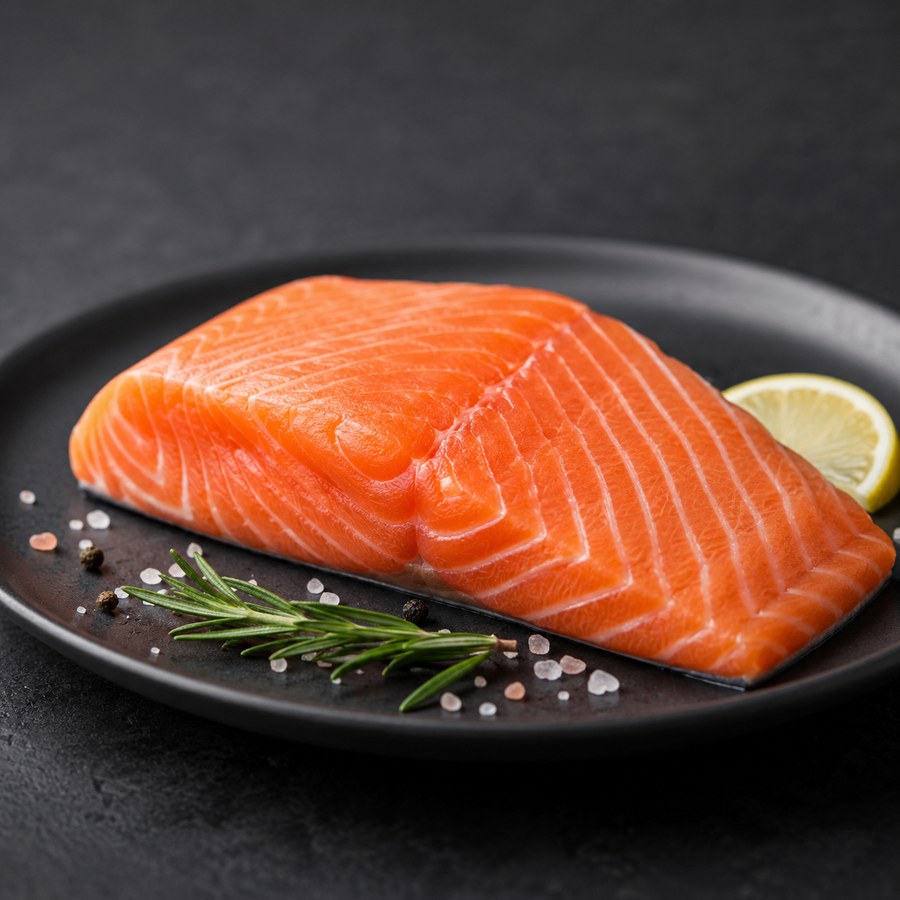
Fish & Seafood
Salmon
“Salmon” covers several species rather than one fixed nutrition profile. This page uses farmed Atlantic salmon as the reference because it is common and has matched raw and cooked data. Species, wild vs. farmed origin, feed, and processing can all change nutrient levels.
Food Overview
Key strengths
Salmon provides both protein and long-chain omega-3 fats. Per 100 g, baked farmed Atlantic salmon provides about 24.5 g protein, 470 mg EPA, and 740 mg DHA.
How to Eat It
Steam, bake, stew, air-fry, or pan-sear briefly with a little oil. Avoid large amounts of butter, cream, syrup, or repeated high-heat cooking until heavily charred.
What stands out
When buying, check the species, origin, farmed or wild status, and whether the product is fresh, frozen, smoked, or cured. A label that only says “salmon” may not match Atlantic-salmon data.
Worth noting
Fresh salmon is not automatically safe to eat raw. Freezing can control some parasites but does not eliminate all harmful microbes; thorough cooking is the lower-risk option.
Basic Nutrition
Showing:85 g Baked Salmon · Farmed Atlantic Salmon
View complete nutrition data
GI note:GI varies with cultivar, food structure, processing, and cooking. Raw grains usually do not have directly applicable human GI data.
Plain salmon contains too little available carbohydrate for GI to be useful, so it is shown as “not applicable,” not 0.
Data notes:Basic nutrition data refer to farmed Atlantic salmon (Salmo salar), skin-on edible portion, in raw and baked states. Sockeye, coho, chinook, pink salmon, rainbow trout, and other salmonids need separate data.
Basic nutrition uses Japanese food-composition entries for farmed Atlantic salmon: raw (food no. 10144) and baked (food no. 10145). Fatty-acid values come from the matching fatty-acid tables.
A common serving is 85 g, about 3 oz, a standard fish serving used in many nutrition references. It is not a fixed daily recommendation for everyone.
Default view is baked farmed Atlantic salmon, 85 g. You can switch to raw salmon or per-100 g values; all states use farmed Atlantic salmon with skin-on edible portion.
GI is shown as “not applicable” because plain salmon contains almost no available carbohydrate. The page distinguishes 0, “—”, and “not applicable” rather than treating them as the same.
Per-100 g protein, fat, and omega-3 values are higher after baking mainly because water falls from 62.1 g to 54.6 g, concentrating nutrients rather than creating new ones.
EPA and DHA still vary among farmed batches because feed composition affects the fatty-acid profile.
Cooked reference values do not include added oil, butter, salt, or sauces used at home.
Vitamins & Minerals
Only vitamins and minerals providing at least 5% of the Daily Value at the current serving are shown. The default is 85 g baked salmon; raw and baked values are separate.
An 85 g baked serving has 15 vitamins and minerals meeting at least 5% of the Daily Value. The top 6 are shown first. Values differ by species, farm conditions, feed, fat content, and cooking method.
View all vitamins and minerals
Percentages show how much the selected serving contributes to the adult Daily Value.
Key Bioactive Compounds
EPA & DHA
Long-Chain Omega-3 Fatty AcidsEPA and DHA are characteristic long-chain omega-3 fats in oily fish.
Per 100 g, raw farmed Atlantic salmon provides about 330 mg EPA and 510 mg DHA; baked salmon about 470 mg and 740 mg. An 85 g baked serving provides about 1.03 g combined.
EPA and DHA support normal cell-membrane, cardiovascular, immune, brain, and retinal functions.
Steam, bake, stew, or pan-sear briefly with little oil; avoid repeated deep-frying or heavy charring.
Salmon helps provide omega-3 fats but does not treat inflammation or high blood lipids, and it is not equivalent to fish-oil or prescription omega-3 products.
Astaxanthin
CarotenoidsAstaxanthin is a carotenoid behind salmon’s orange-red color; wild fish obtain it through food, while farmed Atlantic salmon usually gets it from feed.
In one study of 145 farmed Atlantic salmon, flesh averaged about 5.5 mg/kg, or 0.55 mg per 100 g, with substantial variation among fish and fillet areas.
Astaxanthin has antioxidant properties, but the effects of ordinary salmon servings cannot be separated easily from EPA, DHA, protein, vitamins, and minerals.
Steam, bake, or briefly pan-sear; there is no need to eat salmon raw for astaxanthin.
Flesh color does not reliably show freshness or omega-3 content, and food-level astaxanthin is not equivalent to high-dose supplements.
Selenium
Antioxidant MineralSelenium is an essential trace mineral and part of antioxidant selenoproteins.
Raw farmed Atlantic salmon provides about 19 μg per 100 g; baked salmon about 26 μg. An 85 g baked serving provides about 22 μg, around 40% of the Daily Value.
Selenoproteins support antioxidant defense, thyroid-hormone metabolism, DNA synthesis, and normal immune function.
Get selenium from a varied diet including seafood, eggs, meat, and whole grains.
More selenium is not always better; salmon does not replace supplements prescribed for deficiency or treatment for thyroid disease.
How Preparation Changes Salmon
Different Salmon Species
Atlantic, sockeye, coho, chinook, and pink salmon are different species, with different fat, EPA, DHA, vitamin D, and astaxanthin levels. Market “salmon” can also include rainbow trout.
Raw Salmon
A raw database entry only means uncooked fish; it does not mean the product is safe to eat raw. Freezing controls some parasites but not all harmful microbes, so thorough cooking is safer.
Baked Salmon
Baking reduces water, so protein, fat, EPA, DHA, and several micronutrients become more concentrated per 100 g. Added oil, butter, salt, or sauce is not included in the reference data.
Wild vs. Farmed
Wild and farmed salmon can differ in fat and omega-3 content. Farmed salmon often contains more total fat, but EPA and DHA still depend on feed.
Frozen Salmon
Frozen fish should stay firm with intact packaging. Heavy frost, many ice crystals, damaged packaging, or flexible fish may suggest long storage or thaw-refreeze cycles. Frozen products still need species-specific data.
Smoked or Cured Salmon
Smoked, cured, or seasoned salmon often contains much more sodium and may include sugar or oil. Use the product’s own label rather than plain salmon values.
Canned Salmon
Canned salmon may include skin and softened bones, increasing calcium in some products. Values depend on species, bone content, brine, or oil.
Fried Salmon
Breading, deep-frying, large amounts of butter, or repeated frying raises energy and fat and can cause heavy surface browning.
How to Choose & Store
How to choose
- Look for Atlantic salmon, Atlantic salmon, or Salmo salar if you want data that match this page. “Salmon” alone is not enough to confirm species.
- Check whether it is farmed or wild. In the U.S. market, commercial Atlantic salmon is farmed, while wild salmon usually refers to Pacific species.
- For cooked dishes, choose properly chilled fresh or frozen fish. For raw use, the supplier should explicitly control parasite and microbial risks; “fresh,” “chilled,” or “imported” does not automatically mean sashimi-safe.
- Fresh fish should smell mild, not sour, rancid, or ammonia-like. Fillet edges should not be severely dry or discolored, and the flesh should have some spring.
- Do not judge only by color. Feed, environment, and packaging can affect color, so darker flesh does not prove greater freshness, astaxanthin, EPA, or DHA.
- Avoid frozen packages that are damaged or cracked, contain heavy frost or ice crystals, or have fish that has softened or can bend.
How to store
- Refrigerate promptly at 4°C or below. If not using within about 2 days, seal and freeze.
- FoodSafety.gov gives a home-storage reference of about 1–3 days refrigerated for fatty fish such as salmon and about 2–3 months frozen at −18°C for best quality.
- Thaw preferably in the refrigerator. For faster thawing, seal the fish and place it in cold water; cook immediately after microwave thawing. Do not leave it at room temperature for long periods.
- After handling raw fish, wash hands, knives, boards, utensils, and work surfaces. Keep raw fish and juices away from ready-to-eat foods.
- Discard fish with strong sour, rancid, or ammonia odors, unusual slime, leaking or swollen packaging, prolonged warm storage, or markedly dried and discolored edges.
When buying salmon, confirm the species and intended use, then check dates, packaging, and cold-chain condition. Color alone does not prove quality.
Easy Ways to Eat Salmon
Steamed Salmon
Steam with ginger, scallions, lemon, or herbs and finish with a little lower-sodium soy sauce. Pair with broccoli, mushrooms, or other vegetables.
Baked Salmon
Season with lemon, black pepper, garlic, and herbs and bake until the center is cooked through. Avoid heavy charring and large amounts of honey, syrup, or butter.
Lightly Pan-Seared Salmon
Use a nonstick pan with a little plant oil and cook over medium heat. Crisp the skin lightly without prolonged high heat, and pair with vegetables or whole grains.
Salmon Vegetable Soup
Add salmon pieces to soups with tomatoes, onions, mushrooms, tofu, or leafy greens. Use a clear broth and keep salt, cream, and concentrated stock modest.
Salmon Grain Bowl
Pair cooked salmon with brown rice, quinoa, buckwheat, or other whole grains plus colorful vegetables and legumes. Season with lemon, vinegar, herbs, and a little plant oil.
Cooked Salmon Salad
Flake fully cooked, cooled salmon into leafy greens with tomato, cucumber, avocado, or chickpeas. Eat promptly or keep refrigerated.
Cooking Temperature
Most fish should reach an internal temperature of 63°C. Without a thermometer, look for opaque flesh that flakes easily with a fork.
Who Should Take Extra Care
People with Fish Allergy
People allergic to fish protein should avoid salmon. Heating does not reliably eliminate fish allergens, and people with previous significant reactions should not test small amounts on their own.
Pregnancy, Children, Older Adults & People with Weakened Immunity
These groups are at higher risk from foodborne illness and should avoid raw or undercooked salmon. FDA also lists salmon among lower-mercury 'Best Choices' for pregnancy and breastfeeding.
People Planning to Eat It Raw
Freezing can control some parasites but does not eliminate all bacteria or other harmful microbes. A household freezer is not automatically equivalent to commercial raw-fish controls.
People Restricting Protein, Phosphorus, or Potassium
Salmon is rich in protein and phosphorus and also provides potassium. People with kidney-related restrictions should follow individualized portion guidance.
People Managing Total Energy
Farmed Atlantic salmon is an oily fish. An 85 g baked serving provides about 230 kcal and 16.7 g fat. It can fit weight-management diets, but added oil, butter, sugar, and sauce still matter.
Infants, young children, and people with swallowing difficulties
Cook thoroughly, remove bones carefully, and cut or mash to a texture suitable for swallowing. “Few bones” does not mean bone-free.
People Eating Smoked or Cured Salmon
Smoked and cured salmon can be high in sodium. People limiting sodium should check the product label. High-risk groups should avoid refrigerated smoked fish unless it is cooked in a dish.
Similar Food Alternatives
Sardines
Also provide EPA and DHA. Canned sardines with edible bones can add substantial calcium and are convenient to store.
Atlantic Mackerel
An oily fish with substantial EPA and DHA and a stronger flavor than salmon. Distinguish it from higher-mercury king mackerel.
Rainbow Trout
Similar in texture and cooking style and also provides protein and omega-3 fats, but it is a different species and needs its own nutrition data.
Cod
Leaner and mild-flavored, useful when prioritizing protein with less fat. EPA and DHA are generally lower than in oily salmon.