Spices and herbs
Ginger
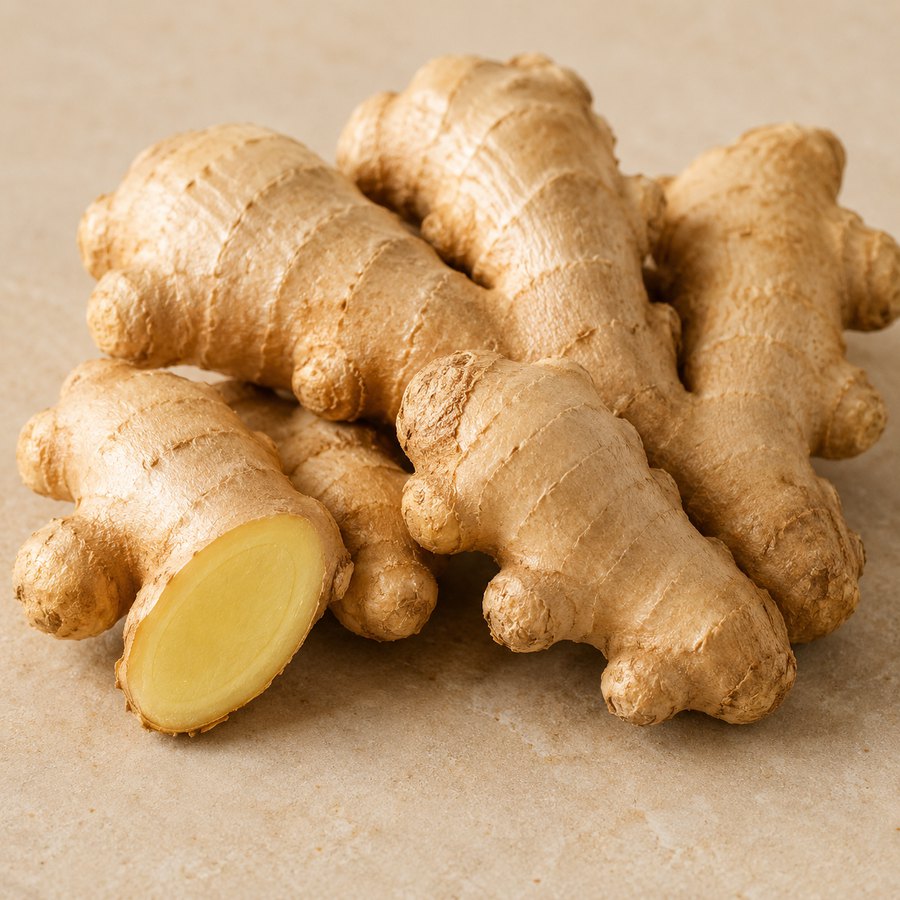
Ginger is the underground rhizome of a Zingiberaceae plant. It is often called “ginger root,” but botanically the edible part is an underground stem, not a root. Fresh ginger has light-brown skin, pale-yellow flesh, and a pungent, aromatic flavor. It works best as a spice for flavor, deodorizing fish or meat, and reducing reliance on salty sauces—not as a major vitamin or mineral source. Fresh ginger is characterized by 6-gingerol; heating and drying shift the balance among gingerols, shogaols, and zingerone.
Food Overview
Key strengths
Typical ginger portions are small, so it is not a major source of vitamins or protein. Its main value is flavor from gingerols and volatile aroma compounds, which can enhance fish, meat, tofu, mushrooms, and vegetables.
How to use it
Slice, julienne, or mince ginger for steamed fish, soups, quick stir-fries, dressings, or low-sugar warm drinks. A small amount is usually enough; there is no need to eat large amounts of raw ginger to chase bioactive compounds.
What stands out
The main compounds to know are 6-gingerol in fresh ginger and 6-shogaol and zingerone, which can increase as ginger is heated or dried. Their proportions vary with variety, maturity, storage, temperature, and cooking time.
Worth noting
Normal culinary amounts are usually well tolerated, but larger amounts of ginger or concentrated products may cause stomach upset, heartburn, diarrhea, or mouth and throat irritation. People taking medicines should not treat high-dose ginger capsules or extracts as equivalent to culinary ginger.
Basic Nutrition
Showing:5 g Ginger
View complete nutrition data
GI note:GI varies with cultivar, food structure, processing, and cooking. Raw grains usually do not have directly applicable human GI data.
Reliable GI data for ordinary ginger are lacking. A typical seasoning portion contains little carbohydrate, so GI is not estimated and is not shown as 0.
Data notes:This page uses one formal food state: fresh mature ginger rhizome, with no added drying or seasoning. Ginger powder, dried slices, candied ginger, pickled ginger, sweet pickled ginger, concentrated ginger juice, sweetened ginger tea, ginger ale, extracts, and capsules should not share the same nutrition state.
Basic nutrition uses the Japanese Standard Tables of Food Composition entry for mature ginger rhizome (food code 06103); clearly inedible or very tough peel is excluded from the edible portion.
The default serving is 5 g, roughly a small amount of slices or minced ginger. It is a website conversion for typical cooking use, not an official intake recommendation. Values are scaled from per 100 g data; 100 g is a database reference, not a typical serving.
GI is shown as “—” because reliable GI data suitable for ordinary ginger are lacking and a usual serving is only a few grams. The page does not estimate GI from carbohydrate, sugar, or starch, and missing data are not shown as 0.
About 1.2 g sugar reflects the sum of glucose, fructose, and sucrose listed in the database; it is not added sugar.
Total fatty acids are very low, so ginger is not a meaningful food source of omega-3.
Because usual portions are small, ginger is not a major source of vitamins or protein. Per-100 g manganese values should not be used to imply that a few slices provide large amounts of minerals.
Vitamins & Minerals
Adult Daily Values are used, and only nutrients reaching at least 5% are shown. At 5 g, only manganese qualifies; per 100 g, manganese, molybdenum, vitamin B6, copper, magnesium, potassium, and niacin equivalents are shown.
The default 5 g serving reaches the 5% Daily Value display threshold only for manganese, at about 0.25 mg or 11%. Other vitamins and minerals stay below the threshold. A 100 g serving is unrealistic for ginger, so its roughly 218% DV manganese value should not be used to exaggerate everyday intake. Values reflect the current database sample and may vary by variety and origin.
View all vitamins and minerals
Key Bioactive Compounds
6-Gingerol
Gingerol-type pungent compounds6-Gingerol is a major pungent compound in fresh ginger and contributes to its warm, sharp flavor.
One study found about 1.35–2.87 mg/g fresh ginger, or roughly 135–287 mg/100 g. This range applies only to the tested samples; variety, maturity, and storage can change the amount.
Laboratory studies link 6-gingerol with oxidative-stress and inflammation-related signaling, but human studies often use powders, extracts, or supplements rather than a few grams of fresh ginger.
Chopping or grating helps release pungent and aromatic compounds. Add some earlier for cooked aroma and a little near the end for a fresher ginger note.
Experimental antioxidant or inflammation-related effects do not mean fresh ginger treats inflammation or replaces medication.
6-Shogaol
Shogaol-type pungent compounds6-Shogaol forms as gingerols dehydrate and is more associated with dried or more extensively heated ginger.
Specific amount: —. Fresh ginger usually contains little 6-shogaol. Heat, time, moisture, and drying method strongly affect levels; experimental heating can lower 6-gingerol while increasing 6-shogaol.
Cell and animal studies show antioxidant and inflammation-related activity, but evidence for ordinary food intakes in humans is limited.
Gentle heating or a small amount of ginger powder gives a different pungent profile from fresh ginger; there is no need to char or repeatedly fry ginger.
More shogaol in dried or heated ginger does not mean it is healthier overall or that it treats chronic disease.
Zingerone
Aromatic phenolic compoundZingerone has a milder, sweeter spicy aroma and can form as gingerol-related compounds change during heating.
Specific amount: —. Its formation depends on temperature, time, pH, and the starting material, so there is no reliable universal value for home-cooked ginger.
Zingerone shows antioxidant and cell-protective potential in experimental systems, but its independent health effect at normal culinary exposure is uncertain.
Moderate heating in soups, porridge, or low-sugar drinks is enough to develop a softer cooked-ginger aroma.
Laboratory activity does not prove that ginger tea detoxifies, treats colds, prevents cancer, or broadly slows aging.
How Preparation Changes Ginger
Fresh ginger
Fresh ginger is high in water and gets its bright, direct pungency mainly from 6-gingerol and volatile aroma compounds. Chopping or grating releases aroma quickly but also speeds drying, oxidation, and flavor loss.
Heated ginger
Heating can dehydrate, split, or otherwise transform some gingerols, increasing the relative share of compounds such as 6-shogaol and zingerone. The extent depends on temperature, time, and moisture; “cooked ginger is more anti-inflammatory” is too simplistic.
Ginger powder
Drying greatly lowers water content, so energy, carbohydrate, and minerals become concentrated per 100 g. The Japanese food database lists about 365 kcal, 72.5 g carbohydrate, and 28 mg manganese per 100 g ginger powder, but real servings are tiny and should not be compared directly with 100 g fresh ginger.
Pickled ginger
Sugar and sodium depend on the recipe. The Japanese food database lists about 2,200 mg sodium per 100 g for vinegar-pickled ginger and about 800 mg for sweet vinegar-pickled ginger; commercial products vary, so check the label.
Recommended page state
The nutrition module keeps only “fresh ginger.” Ginger powder, dried slices, candied ginger, pickled products, concentrated juice, sweetened ginger tea, ginger ale, extracts, and capsules are not state switches because their dehydration, sugar, sodium, concentration, and serving sizes differ substantially.
How to Choose and Store
How to choose
- Choose plump, relatively heavy rhizomes with tight skin, firm texture, and no large shriveled or soft areas.
- The cut surface should be naturally pale yellow, without mold, seepage, slime, obvious spoilage, fermentation, or sour odors.
- Young ginger usually has more water, less fiber, and milder heat; mature ginger is more fibrous and often more pungent and aromatic. Choose based on texture and flavor, but do not assume their bioactive levels are identical.
How to store
- Whole fresh ginger can be wrapped in kitchen paper, placed in a bag, and refrigerated for about 2–3 weeks. Limit surface moisture while preventing excessive drying.
- Cut ginger should be kept dry at the cut surface, sealed, refrigerated, and used soon. Discard it if it becomes soft, slimy, moldy, or develops an unusual fermented smell.
- Store ginger powder sealed, away from light, steam, and stove heat. Refrigerate opened pickled ginger or ginger-juice products as directed on the package rather than using fresh-ginger storage times.
Three things to look for: firm rhizomes, a dry surface, and no mold or rot.
How to Eat It
Steamed fish or tofu with ginger
Julienne ginger and steam it with fish, tofu, mushrooms, and scallions. Ginger adds aroma and can reduce the need for salty soy sauce or heavy sauces. Finish with a little lemon juice or vinegar rather than lots of hot oil.
Quick-stir-fried vegetables with ginger
Stir-fry a small amount of minced ginger with broccoli, bell pepper, mushrooms, cabbage, or beans. Add some early for cooked aroma and some near the end for a fresher ginger note.
Tomato-mushroom ginger soup
Add a few ginger slices to tomato, mushroom, tofu, or fish soup and cook only until the ingredients are done. Use ginger for aroma rather than long simmering, and limit concentrated soup bases, salt, and processed meats.
Ginger-vinegar dressing
Mix a little minced ginger with vinegar, lemon juice, sesame seeds, or a small amount of sesame oil for cucumber, wood ear, tofu, or whole-grain salads. Ginger and acidity can reduce the need for sugar, salt, and rich dressings.
Warm ginger-lemon drink
Steep thin ginger slices in hot water or simmer briefly, then add lemon. There is no need for large amounts of honey, brown sugar, or syrup. It can be a low-sugar warm drink, but it does not replace cold treatment or regular hydration.
Whole-grain porridge with ginger
Add a little minced ginger to millet, oats, pumpkin, or bean porridge. People with sensitive stomachs can use less and cook it well; there is no need to add large amounts for “warming” or “detox” claims.
Who Should Take Extra Care
People prone to heartburn or stomach sensitivity
Larger amounts of ginger, concentrated ginger juice, or supplements may cause heartburn, stomach upset, diarrhea, and mouth or throat irritation. Start with a small amount of cooked ginger and avoid strong ginger juice on an empty stomach.
Pregnant People
Some studies suggest ginger products may help pregnancy-related nausea, but most use standardized preparations or supplements rather than a few slices in food. Persistent nausea or vomiting, or plans to use high-dose supplements, should be discussed with a healthcare professional.
People taking medicines
Normal culinary use is not the same as high-dose supplementation. People taking anticoagulants, antiplatelet drugs, or other long-term medicines should not self-start prolonged high-dose ginger capsules, concentrates, or extracts without checking with a doctor or pharmacist.
Children and people with swallowing difficulty
Ginger is fibrous. Slice finely, grate, or cook until soft rather than swallowing large hard pieces. Children do not need strongly concentrated ginger juice in food.
People allergic to ginger
If eating or handling ginger causes a clear rash, lip swelling, breathing difficulty, or persistent gastrointestinal symptoms, stop exposure and seek medical care as appropriate.
People using supplements
Ginger powders, extracts, and capsules can be far more concentrated than culinary use. “Natural” does not mean every dose is safe, and supplement findings should not be applied directly to a few grams of fresh ginger.
Similar Food Alternatives
Galangal
A cooler, woody, camphor-like rhizome used in Southeast Asian cooking. It is a different plant, so its nutrition and active compounds are not interchangeable with ginger.
Turmeric
A bright-yellow rhizome rich in curcuminoids for curries, stews, and grain dishes; its flavor and compounds differ from ginger.
Garlic
Adds stronger pungent aroma to stir-fries, soups, and steamed dishes and can help reduce salt, but its key compounds are sulfur-based.
Cinnamon
Warm and sweet in oats, coffee, low-sugar drinks, and some stews. It adds aroma but does not replace ginger’s fishy-odor masking role.