Fruits · Berries
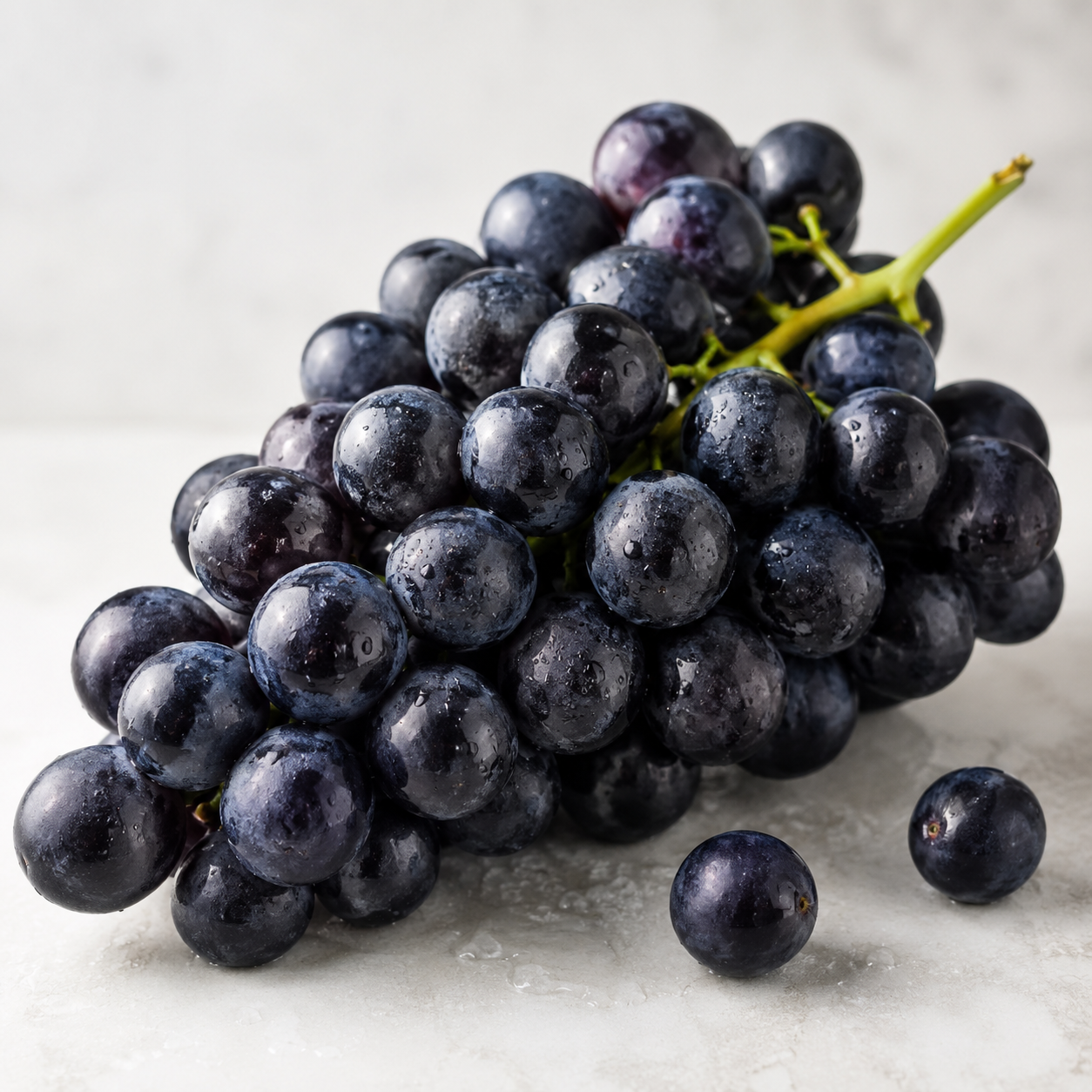
Black Grapes
Black grapes are a group of dark-colored table grapes with anthocyanin-rich skins. Research on grape-seed extracts, red wine, or concentrated polyphenols should not be treated as evidence for the effects of an ordinary serving of fresh black grapes.
Food Overview
Key strengths
Fresh table grapes consist mainly of water and natural carbohydrate. Per 100 g, a representative table-grape entry provides about 69 kcal, 18.1 g of carbohydrate, 15.5 g of natural sugars, and 0.9 g of dietary fiber, along with vitamin K, copper, and a small amount of potassium.
How to Eat It
The simplest way to eat black grapes is to rinse them and eat them whole with the skin. They can also be halved and added to plain yogurt, oats, fruit bowls, vegetable salads, or whole-grain salads.
What stands out
The main difference between black and green grapes is not basic vitamins and minerals but skin pigments and polyphenol composition. Exact levels still vary with cultivar, region, and growing year.
Worth noting
Black grapes are sweet and easy to snack on, so portions can become large without notice. A common 150 g serving provides about 27.2 g of carbohydrate and 23.3 g of natural sugars, so people managing blood glucose or total energy intake should still pay attention to the amount eaten.
Basic Nutrition
Showing:100 g Fresh Black Grapes
View complete nutrition data
GI note:GI varies with cultivar, food structure, processing, and cooking. Raw grains usually do not have directly applicable human GI data.
“Black grapes” describes a color category, not a single cultivar. The GI value of 59 reported for Waltham Cross black grapes cannot be applied to Summer Black, Kyoho, or other black-grape cultivars, so the general page shows GI as “—”.
Data notes:This page includes only a fresh black-grape state. Grape juice, raisins, and extracts are not separate states here.
Basic nutrition uses a USDA entry for fresh European-type table grapes as a general reference and does not imply that every black-grape cultivar has identical values.
A common serving is 150 g, about 1 cup of table grapes. Berry size varies widely, so servings are not defined by a fixed number of grapes.
The database does not provide a reliable starch value, so starch is shown as “—” rather than estimated by subtracting sugars and fiber from total carbohydrate.
Vitamins & Minerals
FDA Daily Values for adults and children age 4 and older are used. Only nutrients reaching at least 5% of the Daily Value at the current serving size are shown, with the top six displayed by default.
View all vitamins and minerals
Key Bioactive Compounds
Anthocyanins
AnthocyaninsAnthocyanins are the main pigments in the skins of black and deep-purple grapes and are usually much lower in cultivars with clear or pale flesh.
Specific amount: —. Anthocyanin content in table grapes varies greatly by cultivar and is concentrated mainly in the skin.
Anthocyanins and their metabolites contribute to the body’s antioxidant defenses, and eating whole grapes may support normal vascular function.
After rinsing, eat the grapes with the skin rather than sucking out the flesh and discarding the skin.
Black grapes cannot treat cardiovascular disease, and the presence of anthocyanins does not make large amounts of grape juice or high-sugar grape products healthy foods.
Proanthocyanidins & Flavan-3-ols
PolyphenolsProanthocyanidins are built from flavan-3-ols such as catechins and are characteristic polyphenols in grape seeds and skins.
Specific amount: —. Proanthocyanidins are found mostly in the seeds and then the skin; seedless grapes naturally contain less of the seed-derived fraction. Values from grape-seed or grape-pomace extracts do not represent whole fresh grapes.
These polyphenols and their metabolites may support vascular function and contribute to dietary antioxidant defenses.
Seeded grapes can be eaten normally, but there is no need to deliberately crush or swallow large amounts of grape seeds to obtain proanthocyanidins.
Doses used in grape-seed extract studies are far higher than those obtained from ordinary servings of fresh grapes, so the same effects cannot be assumed.
Resveratrol
Stilbene PolyphenolsResveratrol is a plant-defense compound produced by grapes in response to pathogens or environmental stress and is found mainly in the skin.
Specific amount: —. Resveratrol in fresh table grapes is usually low and highly variable, depending on cultivar, climate, disease pressure, and storage conditions. Wine and supplement data do not substitute for fresh-grape content.
Resveratrol has been widely studied experimentally, but exposure from ordinary food intake is low and its significance for human health remains uncertain.
Eating grapes normally with the skin is sufficient; there is no need to drink alcohol or take high-dose supplements to obtain resveratrol.
Cell and animal studies do not show that resveratrol in fresh grapes can slow aging, prevent cancer, or extend lifespan.
How Preparation Changes Black Grapes
Eat Whole with the Skin
Eating grapes with the skin retains anthocyanins, resveratrol, and flavonols from the skin and is the form closest to the whole food. The whitish film on the surface is often natural bloom and is not automatically mold or pesticide residue.
Peeling
Peeling still provides water, natural carbohydrate, and some vitamins and minerals, but it removes skin-derived anthocyanins and other polyphenols. Peeling is mainly useful when skin texture is not tolerated or a specific swallowing need exists.
Seeded vs Seedless
Seeds in seeded grapes contain more proanthocyanidins and catechins, but they are hard and are not a required edible part.
Cutting or Blending
Cutting or blending increases contact between the flesh and skin and oxygen, so the grapes should be eaten promptly.
Juicing
Grape juice makes it easier to consume the sugar and energy from a large amount of grapes quickly while providing less dietary fiber. GI databases report grape-juice GI values around 63, but this should not be applied to fresh black grapes.
Drying into Raisins
Raisins have much of the water removed, so sugar and energy are concentrated by weight. Raisins require a separate nutrition state and cannot use the per-100 g values or serving logic of fresh black grapes.
How to Choose & Store
How to choose
- Choose plump, firm, intact berries without obvious shriveling, split skins, leaking juice, or mold.
- Fresh stems are usually greener and flexible. Extensive browning, drying, brittleness, or many loose berries often indicates longer storage.
- Dark cultivars should show the purple-black or blue-black color expected when ripe, but darker color alone does not indicate greater sweetness or better nutrition.
- A uniform white or grayish bloom is usually normal. Fuzzy clustered growth together with soft decay or off odors may indicate mold.
- Check the bottom of the package for pooled juice, split berries, or mold.
How to store
- Remove damaged or moldy berries first. Keep the remaining grapes attached to the stems in a ventilated package in the refrigerator, and do not wash the entire bunch before storage.
- Before eating, rinse only the amount needed under cool running water and drain.
- Under good refrigeration, grapes may keep for about 1–2 weeks, although eating them within 2–3 days of purchase often gives better quality.
- Discard grapes with visible mold, sour or fermented odors, heavy leaking, sliminess, or severe soft decay.
When buying black grapes, remember three things: choose plump berries, look for fresh stems, and avoid mold or leaking juice.
How to Include It in Everyday Meals
Rinse and Eat Fresh
Rinse the black grapes under running water, drain, and eat them with the skin. A common serving can be planned as about 150 g rather than continuously eating from a whole box.
Black Grapes with Plain Yogurt
Halve the grapes and pair them with unsweetened or low-sugar plain yogurt, oats, and a small amount of nuts.
Black Grape Oat Bowl
Cook oats and let them cool slightly, then add halved black grapes, walnuts, or chia seeds. Add the grapes at the end rather than cooking them for a long time, and avoid adding raisins, honey, and syrup at the same time.
Black Grape Vegetable Salad
Halved black grapes can be combined with lettuce, spinach, kale, red cabbage, cucumber, chickpeas, and nuts, then dressed with a little olive oil, vinegar, or lemon juice.
Black Grape Whole-Grain Salad
Add halved black grapes to cooked and cooled quinoa, buckwheat, brown rice, or barley, together with legumes and vegetables. Add the grapes after the grains have cooled to avoid prolonged heating that splits the skins and releases excessive juice.
Whole-Fruit Black Grape Smoothie
Blend a small amount of black grapes with unsweetened yogurt, milk, or unsweetened soy milk and keep the skin and pulp rather than filtering.
Who Should Take Extra Care
People managing blood sugar
There is no single GI value that applies to all black-grape cultivars. Grape juice and raisins should not use fresh-grape serving logic.
Infants, young children, and people with swallowing difficulties
Whole grapes are round and smooth and are a common choking hazard for young children. Do not only cut them crosswise into round discs, and do not offer whole grapes.
People with Grape Allergy
Grape allergy is uncommon but can cause itching or swelling of the lips or mouth, hives, and, rarely, severe reactions. People with a known allergy to grapes or other lipid-transfer-protein-containing fruits should avoid trying them on their own.
People with Impaired Kidney Function or Potassium Restrictions
A typical serving of black grapes is not especially high in potassium, but 150 g still provides about 287 mg. People who have been told to strictly limit potassium should count this toward their daily total rather than assuming fruit can be eaten without limit.
Pregnant People, Older Adults & People with Weakened Immunity
Grapes are usually eaten raw, so refrigeration, washing, and avoiding cross-contamination matter. Rinse under running water before eating and discard berries that are damaged, rotten, or moldy.
Households with Pets
Grapes and raisins can cause serious poisoning in dogs, and even relatively small amounts may pose a risk. Do not feed black grapes to dogs, and promptly pick up any berries that fall on the floor.
Similar Food Alternatives
Blueberry
Blueberries also contain several anthocyanins and work well with yogurt and oats.
Blackcurrant
Blackcurrants are notable for vitamin C and anthocyanins and have a pronounced tart flavor.
Blackberry
Blackberries contain anthocyanins, ellagitannins, and relatively more dietary fiber and can be eaten fresh.
Pomegranate
Pomegranate contains anthocyanins, ellagitannins, and ellagic-acid-related compounds and works well in yogurt, oats, and salads.
Data Sources & Last Updated
Nutrition Data
Basic Information & Food Safety
Research & References
Hunter DC, et al. (2020). Effects of Production Region, Production Systems and Grape Type/Variety on Nutritional Quality Parameters of Table Grapes: Results from a UK Retail Survey.
Foods, 9(12), 1874. DOI / Original
Xia EQ, Deng GF, Guo YJ, Li HB. (2010). Biological Activities of Polyphenols from Grapes.
International Journal of Molecular Sciences, 11(2), 622–646. DOI / Original
Singh CK, et al. (2015). Resveratrol, in Its Natural Combination in Whole Grape, for Health Promotion and Disease Management.
Annals of the New York Academy of Sciences, 1348(1), 150–160. DOI / Original
Crupi P, et al. (2022). Varietal Effect on Composition and Digestibility of Seedless Table Grapes under In Vitro Conditions.
Foods. DOI / Original
Rodríguez-López P, et al. (2022). A Systematic Review of Health Properties, Bioavailability, and Human Trials of Grapes and Non-Fermented Grape Products.
Horticulturae, 8(7), 583. DOI / Original
Foshati S, et al. (2023). The Effect of Whole Grape Products on Blood Pressure and Vascular Function: A Systematic Review and Meta-Analysis of Randomized Controlled Trials.
Nutrition, Metabolism and Cardiovascular Diseases. DOI / Original