Healthy plant oils
Sesame oil
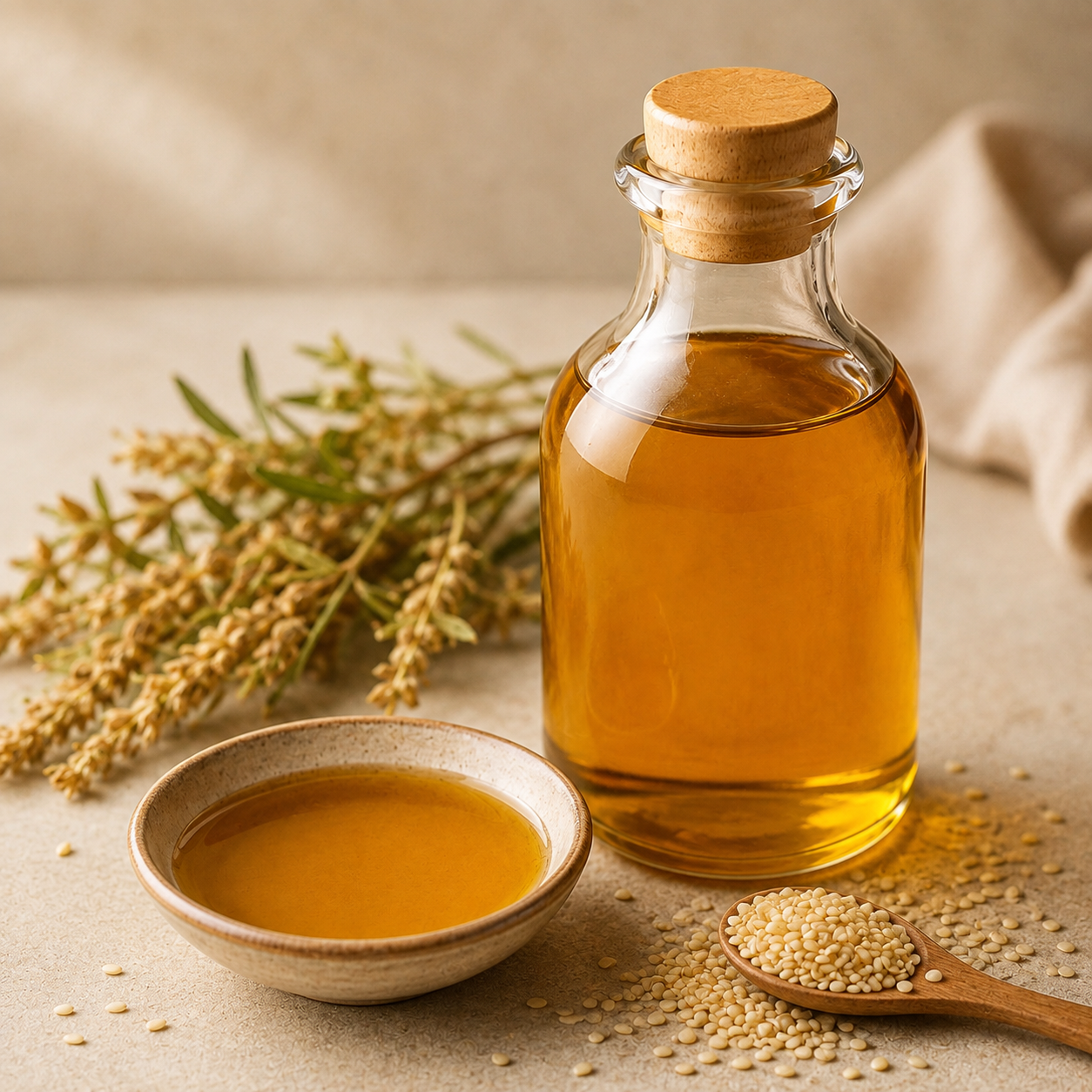
Sesame oil is made from sesame seeds. In Chinese cooking, “fragrant sesame oil” usually refers to oil made from roasted sesame seeds, including small-mill sesame oil. Its fat is mainly linoleic and oleic acids, with sesamin, sesamolin, sesamol, gamma-tocopherol, and phytosterols as notable oil-soluble compounds. It is best used for flavor rather than consumed in large amounts for supposed anti-inflammatory or antioxidant effects.
Food overview
Key strengths
About four-fifths of the fat in sesame oil is unsaturated: roughly 39.7% monounsaturated and 41.7% polyunsaturated. Oleic acid and omega-6 linoleic acid are the main fatty acids.
Best ways to use it
Fragrant sesame oil works well in salads, dipping sauces, noodles, and as a finishing oil for soup, porridge, and cooked vegetables. High heat weakens its aroma and can create burnt flavors, so it is usually better as a seasoning oil.
What stands out
Compared with many plain vegetable oils, sesame oil is notable for lignans such as sesamin and sesamolin, plus gamma-tocopherol and related antioxidant compounds. These also contribute to its relatively good oxidative stability.
Worth noting
Sesame oil is still nearly 100% fat and energy-dense. About 10 g provides 88 kcal, so it is better used to replace some existing oil than added in large amounts.
Basic Nutrition
Showing:100 g Fragrant sesame oil
View complete nutrition data
GI note:GI varies with cultivar, food structure, processing, and cooking. Raw grains usually do not have directly applicable human GI data.
Sesame oil contains no available carbohydrate, so GI does not apply. “—” means not applicable, not a measured GI of 0.
Data notes:This page uses “fragrant sesame oil” as the default state, meaning edible oil made from roasted sesame seeds. Basic nutrition uses the USDA generic sesame-oil entry. That entry does not distinguish Chinese fragrant, small-mill, or refined sesame oil; basic energy and fat are similar, but lignans and tocopherols should not be assumed identical.
Basic nutrition uses USDA FoodData Central, “Oil, sesame, salad or cooking” (FDC ID 171016), for energy, fat, fatty acids, vitamin E, vitamin K, and phytosterols.
A common serving is 10 g, roughly 2 teaspoons. Household spoon volume varies, so grams are used for nutrition calculations rather than treating “1 tablespoon” as an exact weight.
100 g is a database reference amount, not a sensible single serving.
GI is shown as “—” because sesame oil has no available carbohydrate and GI does not apply to pure oils. “—” means not applicable, not a measured GI of 0.
The USDA entry does not provide reliable separate values for water, sugar, or starch, so they are shown as “—” rather than inferred from total carbohydrate.
Sesame oil’s main polyunsaturated fat is omega-6 linoleic acid. It contains little ALA omega-3 and should not be treated as an equal substitute for flaxseed or perilla seed oil.
The Codex standard lists sesame-oil oleic acid at about 34.4%–45.5% and linoleic acid at about 36.9%–47.9%, broadly consistent with USDA generic data.
This page uses one formal nutrition state: fragrant sesame oil. Small-mill and refined sesame oils are shown separately only if independent nutrition and bioactive data are available. Crude sesame oil, blends, flavored oils, tahini, whole sesame, and capsules are not the same food state.
Vitamins & Minerals
Using adult Daily Values, only nutrients reaching at least 5% at the current serving are shown. At 10 g, no listed vitamin or mineral reaches 5%; at 100 g, vitamin K and vitamin E are displayed.
The USDA generic entry lists about 13.6 mcg vitamin K and 1.4 mg alpha-tocopherol per 100 g. Per 10 g, that is about 1.4 mcg and 0.14 mg, both below 5% of the Daily Value, so they are not shown at the default serving. At 100 g, vitamin K is about 11% DV and vitamin E about 9%, but 100 g is a comparison amount, not a recommended serving. Vitamin E is counted as alpha-tocopherol; higher gamma-tocopherol does not directly count toward the Daily Value.
View all vitamins and minerals
Key Bioactive Compounds
Sesamin and sesamolin
Sesame lignansSesamin and sesamolin are characteristic sesame lignans and help distinguish sesame oil from many other vegetable oils.
Commercial samples contain about 0.93–2.89 mg/g sesamin and 0.30–0.74 mg/g sesamolin—roughly 9.3–28.9 mg and 3.0–7.4 mg per 10 g. Cultivar, hulling, roasting, pressing, and refining affect the amount.
These lignans work with tocopherols to slow oxidation; broader metabolic effects seen in experimental research do not establish a clear benefit from ordinary seasoning amounts.
Use sesame oil mainly for flavor, cold dishes, or after cooking.
Ordinary servings are not drug-like and should not be presented as treating high cholesterol, diabetes, arthritis, or inflammation.
Gamma-tocopherol
TocopherolsGamma-tocopherol is one of the main tocopherols in sesame oil and helps protect the oil from oxidation.
Research samples range widely: about 330–387 mg/kg in some Egyptian and Sudanese oils and 563–1095 mg/kg in Iranian samples, or roughly 3.3–11.0 mg per 10 g.
Gamma-tocopherol helps interrupt lipid oxidation and works with sesamol, sesamin, and sesamolin to support storage stability.
Reseal promptly and store in a cool, dry, dark place; smaller bottles reduce long exposure to air and light.
Gamma-tocopherol is not counted directly using alpha-tocopherol vitamin E Daily Values and does not make sesame oil equivalent to a high-dose supplement.
Plant sterols
Plant sterolsPhytosterols are natural plant-oil compounds structurally similar to cholesterol; beta-sitosterol is a major form in sesame oil.
A USDA-derived generic entry lists about 865 mg per 100 g, or 86.5 mg per 10 g. Processing and analytical methods can change the amount.
At sufficient doses, phytosterols can reduce intestinal cholesterol absorption; one human trial used about 1.5 g/day, much more than a 10 g serving of sesame oil.
Do not increase sesame oil just for phytosterols; varied plant foods also provide them.
Normal servings are not equivalent to fortified foods or clinical doses and do not make sesame oil a treatment for high cholesterol.
How processing changes it
Fragrant sesame oil
Sesame seeds are roasted and then pressed or filtered, creating the strong aroma typical of common edible sesame oil.
Small-mill sesame oil
Roasted sesame seeds are stone-ground into a paste and oil is separated by the traditional water-replacement method. The aroma is often stronger, and it is mainly used for cold dishes and seasoning.
Refined sesame oil
Crude sesame oil is refined, usually producing a lighter color and milder aroma. Lignans, tocopherols, phospholipids, and other minor compounds can change with refining, so refined oil should not share the same minor-compound values as fragrant sesame oil.
Crude sesame oil
Crude sesame oil is unrefined raw oil and, under Chinese sesame-oil product classifications, is not a finished oil for direct consumption.
Effect of roasting
Roasting creates sesame oil’s characteristic aroma and changes lignans and tocopherols. Sesamolin can partly convert to sesamol, which works with tocopherols to improve oxidative stability. Higher roasting temperature does not automatically mean better nutrition: different temperatures alter sesamin, sesamolin, sesamol, tocopherols, and browning products, and excessive roasting can create burnt flavors and reduce quality.
Reheating at home
Fragrant sesame oil has already undergone seed roasting. Prolonged high-heat cooking or frying at home weakens the aroma, and its good stability is not a reason to reuse it for repeated deep-frying.
How to choose and store it
How to choose
- Check the product name: choose products clearly labeled “sesame oil,” “fragrant sesame oil,” or “small-mill sesame oil.”
- Check ingredients: pure sesame oil should list only sesame or sesame oil, without soybean, canola, corn, or other oils.
- Check the standard: the product standard, manufacturer, and production-license information should be clear. Under GB/T 8233—2018, sesame oil must not be adulterated with other edible or non-edible oils or contain added flavorings; products with other plant oils should be labeled as blends, not pure sesame oil.
- Check date and packaging: the production date and shelf life should be complete, with an intact, non-leaking package.
- Smell it: the aroma should be natural, not sharply artificial or perfume-like.
- Check bottle size: prefer an amount that can be finished reasonably quickly after opening.
- Do not judge purity by color or aroma alone. Sesame variety and processing affect color, and “redder” or “stronger-smelling” does not automatically mean purer or higher quality.
How to store
- Reseal the bottle promptly after opening.
- Store in a cool, dry, dark place.
- Keep away from the stove, windows, and other hot areas.
- Keep water and food particles out of the bottle.
- Do not pour used or heated oil back into the original container.
- Do not keep it for long periods in a clear condiment bottle.
- Use it within a reasonable time after opening.
- Discard oil with a clear rancid, stale-oil, paint-like, or otherwise abnormal odor.
Remember three points: confirm it is pure sesame oil, check ingredients and the product standard, and choose a small package stored away from light.
How to use it in everyday meals
Salad vegetables
After blanching greens, cucumber, wood ear mushrooms, green beans, or mushrooms, add a small amount of sesame oil, vinegar, and low-sodium soy sauce. It is mainly for aroma, so there is no need to pour in a large amount.
Noodles or buckwheat noodles
Combine cooked noodles with vegetables, tofu, egg, or chicken and add a little sesame oil at the end. Keep thick salty sauces and large amounts of chili oil modest.
Add after soup or porridge is cooked
Add a few drops after cooking and removing from heat. This preserves aroma better than simmering it for a long time.
Make a dipping sauce
Mix with vinegar, minced garlic, scallion, herbs, or a little soy sauce for hot pot, steamed vegetables, and tofu. Sesame oil counts toward total oil intake, especially if tahini or other oils are also used.
Mix with tofu and legumes
Combine with tofu, chickpeas, edamame, or mixed beans plus tomatoes, peppers, and leafy greens for a plant-forward cold dish.
Season fillings
Add a small amount to vegetable, mushroom, or meat fillings for aroma. Keep total oil measured rather than adding more until the smell is stronger.
Who Should Take Extra Care
People with sesame allergy
Sesame is a major food allergen. People with confirmed sesame allergy should generally avoid sesame oil, tahini, and sesame-containing sauces unless an allergy specialist gives different advice.
People Managing Energy Intake
Sesame oil provides about 88 kcal per 10 g. It is better used to replace other oils than added on top of the usual diet.
People with sensitive digestion or diarrhea
A large amount of oil at once can increase nausea, abdominal discomfort, or diarrhea. During active GI upset, keep concentrated oil intake modest and follow individual tolerance.
People hoping to get calcium or iron from sesame oil
Sesame oil contains very little of the calcium, iron, or fiber present in whole sesame seeds. It should not be described as a main food for calcium, iron, or constipation relief.
People managing blood sugar
Sesame oil has no carbohydrate but is still energy-dense. “No GI” or “does not raise glucose directly” is not a reason to ignore total oil and energy intake.
People using it for anti-inflammatory or cholesterol-lowering effects
Sesame oil can be an unsaturated-fat source and flavoring oil, but current component research does not show that ordinary seasoning amounts treat inflammation, high cholesterol, or other chronic disease. Replacing some saturated fat matters more than simply adding more oil.
Similar Food Alternatives
Extra Virgin Olive Oil
Works for salads and many household cooking uses. It lacks sesame aroma but can substitute when that flavor is not needed.
Camellia oil
Milder in flavor and suitable for everyday cooking. If the main need is stir-frying rather than aroma, it is easier to use than fragrant sesame oil.
Low-erucic-acid canola oil
Neutral in flavor and useful as a main cooking oil. Canola can handle cooking while sesame oil is reserved for finishing and aroma.
Walnut oil
Has a nutty flavor and works well in salads and after cooking, offering another option for cold dishes and grain-based meals.