Nuts & Seeds · Seeds
Sesame seeds
Sesame seeds provide mostly unsaturated fat, plant protein, fiber, and minerals. They are especially known for sesame lignans and gamma-tocopherol. Because they are usually used as a topping or seasoning, a practical amount is about 5–10 g, preferably lightly ground or chewed well rather than eaten in large amounts.
Food overview
Key strengths
Sesame is high in fat, but most of it is mono- and polyunsaturated. Whole unhulled seeds also provide copper, manganese, magnesium, iron, zinc, calcium, and thiamin.
How to use it
Lightly grind sesame and sprinkle it over vegetables, whole grains, plain yogurt, oats, or soy foods, or use a small amount of tahini in dressings.
What stands out
Sesamin and sesamolin are sesame’s most characteristic lignans, while gamma-tocopherol is its main tocopherol. Roasting also changes the profile and measurable amount of phenolic compounds.
Worth noting
Sesame is energy-dense. Tahini, sesame powder, and sesame sweets are easier to overeat than a small sprinkle of whole seeds, and sweetened sesame products may contain substantial sugar and added fat. Sesame is also an important food allergen.
Basic Nutrition
Showing:100 g Raw sesame seeds, whole and unhulled
View complete nutrition data
GI note:GI varies with cultivar, food structure, processing, and cooking. Raw grains usually do not have directly applicable human GI data.
Available carbohydrate is low and there is no suitable standard GI value to enter. Low available carbohydrate does not mean GI equals zero.
Data notes:The default state is raw sesame: whole, unhulled, and unsalted.
Basic nutrition uses USDA FoodData Central whole sesame entry FDC 170150 and should not be mixed with hulled sesame-kernel entry FDC 169412.
A 10 g portion is close to a level tablespoon, but actual weight varies with seed size and measuring method.
Vitamins & Minerals
The default view uses 100 g raw sesame; switching to 10 g scales the values. Only vitamins and minerals reaching at least 5% of the FDA Daily Value for adults and children age 4+ are shown.
Whole unhulled sesame is relatively high in calcium. Hulled sesame, some tahini, and different brands can contain much less, so use the matching food state or product label.
View all vitamins and minerals
Percentages show how much the selected serving contributes to the adult Daily Value.
Key Bioactive Compounds
Sesamin and sesamolin
Sesame lignansSesamin and sesamolin are sesame’s characteristic fat-soluble lignans.
Levels vary widely by cultivar. Research samples contained about 2.10–5.98 mg/g sesamin and 1.52–3.76 mg/g sesamolin; another 11-genotype analysis found sesamin around 0.67–6.35 mg/g. These are study ranges, not fixed retail values.
Laboratory, animal, and some human studies suggest effects on antioxidant, lipid, or inflammatory markers, but human results are inconsistent.
Lightly grind or chew sesame and use it with vegetables, grains, or soy foods. Roast only until fragrant.
Ordinary sesame portions are not medicinal and have not been shown to treat chronic disease.
Gamma-tocopherol
TocopherolsGamma-tocopherol is one of sesame’s most abundant tocopherols and contributes to seed and oil stability.
Japanese data list about 22.0 mg gamma-tocopherol per 100 g whole sesame, or 2.2 mg per 10 g; alpha-tocopherol is about 0.1 mg/100 g.
Gamma-tocopherol contributes antioxidant protection in a lipid-rich food and interacts with sesame lignans.
Sesame already contains fat. Store it sealed and dark; refrigerate ground sesame and use it promptly.
Vitamin E Daily Value is based mainly on alpha-tocopherol, so 22 mg gamma-tocopherol is not 22 mg of label vitamin E.
Sesamol and other phenolic compounds
Phenolic compoundsSesamol is a characteristic sesame phenolic that can increase during roasting as lignans are transformed.
Fixed amount: —. Variety and roasting conditions differ too much for one general value. Some research samples contained about 0.16–3.24 mg/g.
Sesamol and related phenolics show antioxidant activity in laboratory tests and contribute to oil stability.
Roast gently over medium-low heat, stirring, and stop once fragrant rather than dark or bitter.
Higher lab antioxidant activity after roasting does not mean hotter is healthier; high heat can reduce tocopherols and oxidize fats.
How Preparation Changes Sesame Seeds
Raw sesame
Unroasted, unhulled, and unseasoned sesame is the default nutrition state. Its flavor is mild; lightly grind or briefly toast before use if desired.
Lightly roasted sesame
Roasting intensifies aroma and changes lignans, sesamol, gamma-tocopherol, and total phenolics. Some studies find moderate roasting raises total phenolics or laboratory antioxidant measures, while hotter or longer roasting can reduce some compounds.
Hulled sesame
Removing the seed coat gives a smoother, less bitter seed but can markedly change calcium, iron, and other mineral values. Nutrition data for whole unhulled sesame should not be copied to hulled seeds.
Ground sesame
Grinding releases aroma and oil and makes sesame easier to mix into foods, but the greater surface area speeds oxidation. Store ground sesame sealed and refrigerated and use it promptly.
Tahini
Tahini is made from hulled or unhulled sesame that may be roasted before grinding. Products may also contain sesame oil, other oils, sugar, or salt, so whole raw sesame data do not apply. Check whether it is hulled, the ingredient list, and the product’s calcium, sodium, and energy values.
Black vs. white sesame
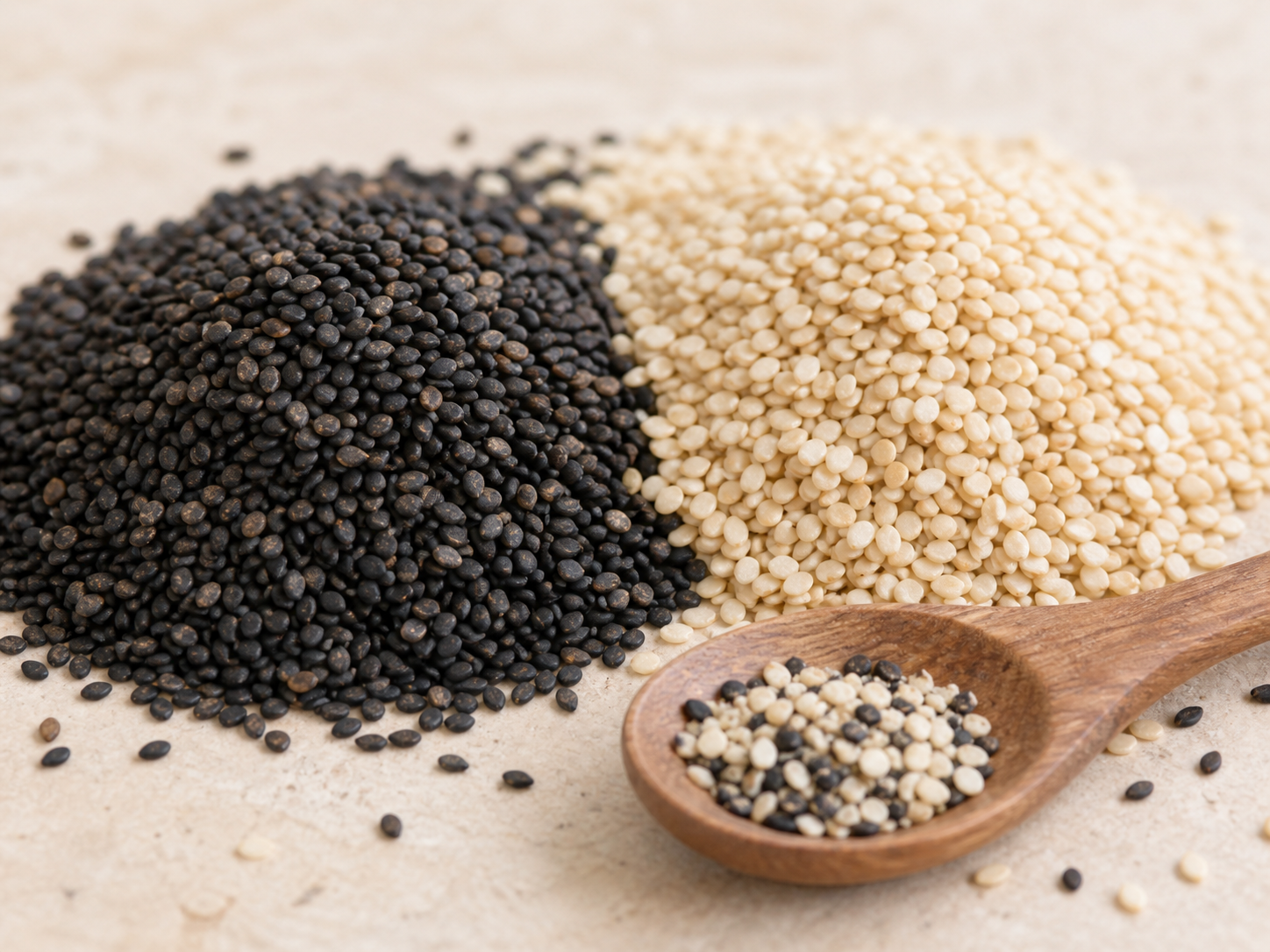
Black and white sesame differ in seed-coat color and variety. Lignans, fatty acids, and tocopherols can vary among colors and cultivars, but color does not reliably predict the full nutrient profile. Black sesame is not automatically more nutritious, and white sesame is not devoid of antioxidants.
How to choose and store
How to choose
- Choose plump, fairly uniform seeds with natural color, a dry loose texture, and no obvious clumping or artificial-looking color.
- Avoid insect damage, mold, and excessive debris. Fresh sesame should smell naturally nutty, not like paint, rancid oil, or stale fat.
- For packaged plain sesame, the ingredient list should ideally contain only sesame. Choose lower-sugar, lower-salt, lower-added-fat versions when flavored.
- Black sesame naturally varies somewhat in color; white sesame may range from ivory to pale yellow or light brown.
How to store
- Store whole sesame in an airtight container in a cool, dry, dark place.
- For larger quantities or warm, humid climates, refrigerate or freeze airtight to slow oxidation.
- Ground sesame oxidizes faster; refrigerate after opening and use promptly.
- When removing chilled or frozen sesame, keep the container sealed until it warms to room temperature to reduce condensation.
- Discard sesame with a pronounced rancid or paint-like smell, persistent sour-bitter taste, damp clumping, mold, or insect damage.
When buying sesame, check whether it is hulled, choose plain products, and store opened seeds sealed and away from light.
How to use it in everyday meals
Sprinkle over vegetables and soy foods
Lightly grind 5–10 g sesame and sprinkle over blanched greens, spinach salads, tofu, green beans, or mushrooms. Pair with vinegar, lemon, and a little soy sauce rather than large amounts of sesame oil or salty sauce.
Add to whole grains and porridge
Sprinkle a small amount over brown rice, oat groats, quinoa, or mixed-grain rice after cooking. Adding it at the end preserves aroma and avoids prolonged heating.
With oats or plain yogurt
Add ground sesame to oatmeal, overnight oats, or plain yogurt with berries, apple, or kiwi. Skip large amounts of syrup, condensed milk, or sweetened sesame powder.
Make a sesame dressing
Thin a small amount of plain tahini with water, vinegar, or lemon, then add garlic and a little soy sauce. Use with vegetables, tofu, or buckwheat noodles. Tahini is energy-dense, so extra sesame oil is usually unnecessary.
Add to whole-grain baking
Sprinkle a small amount over whole-grain bread, multigrain flatbreads, or lower-sugar baked foods. Avoid adding a lot of butter, sugar, and refined flour just to increase sesame.
Make a lower-salt sesame seasoning
Mix roasted sesame with a small amount of salt for grains or vegetables. Keep sesame much more abundant than salt, and do not treat salty sesame seasoning as unlimited.
Who Should Take Extra Care
People with sesame allergy
Sesame can cause severe food-allergic reactions. People with known sesame allergy should avoid sesame, tahini, sesame oil, and sesame-containing breads, cookies, sauces, and seasonings, and should check cross-contact statements.
People Managing Energy Intake
A 10 g serving provides about 57 kcal. A small sprinkle is usually modest, but tahini, sesame powder, and sesame sweets make it easy to consume tens of grams. Use sesame to replace some other fats or snacks rather than simply adding large amounts.
People with kidney disease or mineral restrictions
Sesame contains phosphorus, potassium, magnesium, and other minerals. People following low-phosphorus, low-potassium, or other renal diets should use individualized portions rather than increasing sesame just because it is nutrient-dense.
People with digestive sensitivity
A large amount of tahini or ground sesame may cause bloating, nausea, or bowel changes because of its fat and fiber. Start around 5 g if you are sensitive and adjust to tolerance.
People relying on sesame for calcium or iron
Whole unhulled sesame is mineral-rich, but typical portions are small and hulling can markedly reduce calcium. Sesame can contribute to a varied diet but should not be presented as a stand-alone solution for calcium or iron deficiency.
Infants and young children
For first exposure, use an age-appropriate form such as a small amount of unsweetened, unsalted tahini thinned and mixed into another food. Avoid feeding very thick, sticky tahini directly to children with limited swallowing skills, and watch for allergy symptoms.
Similar Food Alternatives
Flaxseed
Also contains plant lignans and can replace some sesame when adding variety to seeds. It is best ground before eating.
View details →Chia seeds
Forms a gel after absorbing water and works well in oats, plain yogurt, or drinks, though its texture and uses differ from sesame.
View details →Sunflower seeds
Work well as a crunchy topping for salads, oats, and whole grains and provide a different nutty texture from sesame.
View details →Pumpkin Seeds
Larger and more substantial, suitable as a plain snack or added to salads, grains, and vegetables.
View details →Data Sources & Last Updated
Nutrition Data
Basic Information & Food Safety
Research & References
Williamson KS, Morris JB, Pye QN, et al. (2008). A survey of sesamin and composition of tocopherol variability from seeds of eleven diverse sesame genotypes using HPLC-PAD-ECD.
Phytochemical Analysis, 19(4), 311–322. DOI / Original
Dar AA, Verma NK, Arumugam N. (2019). Assessment of variability in lignan and fatty acid content in the germplasm of Sesamum indicum L.
Andargie M, Vinas M, Rathgeb A, et al. (2021). Lignans of Sesame: A Comprehensive Review.
Molecules, 26(4), 883. DOI / Original
Wan Y, Li H, Fu G, et al. (2015). The relationship of antioxidant components and antioxidant activity of sesame seed oil.
Jannat B, Oveisi MR, Sadeghi N, et al. (2013). Effect of Roasting Process on Total Phenolic Compounds and γ-tocopherol Contents of Iranian Sesame Seeds.
Chen Y, et al. (2019). Effects of thermal preparation and in vitro digestion on sesame lignans and antioxidant activity.
Chen Y, et al. (2020). Effect of roasting and in vitro digestion on phenolic profiles and antioxidant activity of sesame seeds.
Wu JHY, Hodgson JM, Puddey IB, et al. (2009). Sesame supplementation does not improve cardiovascular disease risk markers in overweight men and women.