Spices and herbs · Allium-family aromatic
Garlic
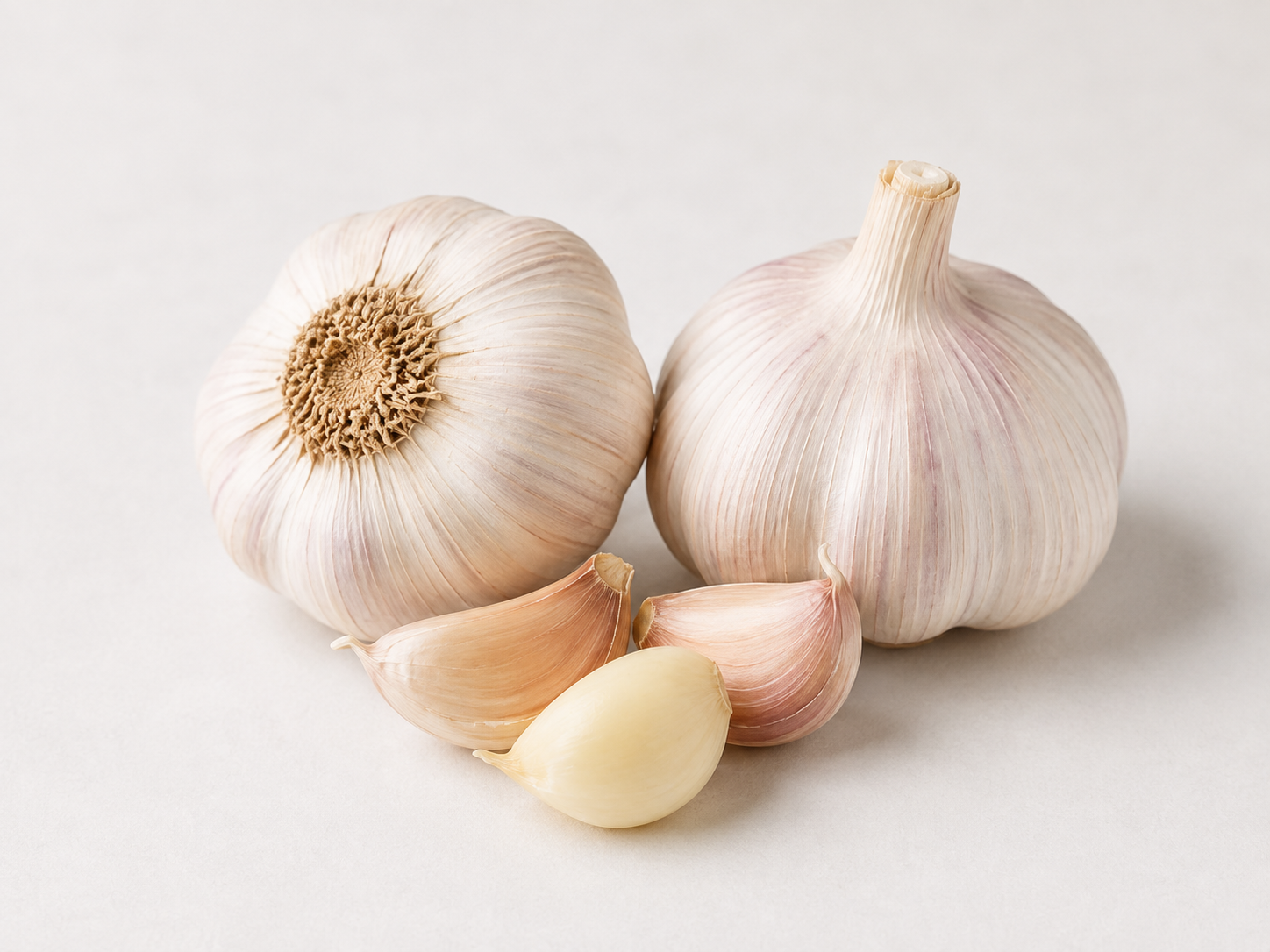
Garlic is a bulb-forming Allium in the amaryllis family, and the edible bulb is made of multiple cloves. Its dietary value comes mainly from strong flavor, sulfur compounds, and fructans—not from getting large amounts of vitamins or minerals from one or two cloves. Intact cloves do not contain a fixed large amount of allicin; crushing, chopping, or chewing lets alliin meet alliinase, rapidly forming allicin and other thiosulfinates.
Food Overview
Key strengths
Garlic adds strong aroma and pungency with a small amount, which can reduce reliance on salt, sugar, and heavy sauces. It contains alliin, allicin-related compounds, and other sulfur compounds that make it one of the most characteristic Allium foods.
How to use it
Use chopped garlic in dressings, stir-fries, steamed dishes, and stews, or roast whole cloves. Finer chopping causes more tissue disruption and usually a sharper aroma; long-cooked whole cloves become milder and sweeter.
What stands out
Intact cloves do not contain a fixed large amount of allicin. When garlic is chopped, crushed, or chewed, alliin and alliinase come into contact and rapidly form allicin and other thiosulfinates.
Worth noting
Garlic is usually used as a seasoning. One clove is about 3 g, so per-100 g vitamin and mineral values can look impressive while greatly exceeding a typical serving.
Basic Nutrition
Showing:100 g Raw garlic
View complete nutrition data
GI note:GI varies with cultivar, food structure, processing, and cooking. Raw grains usually do not have directly applicable human GI data.
No traceable standard GI measurement suitable for ordinary raw garlic was found, so GI is shown as “—” rather than estimated from sugar or carbohydrate or displayed as 0.
Data notes:This page uses one nutrition state: raw garlic. Because no comparable, sufficiently complete cooked-garlic database entry was found, there is no raw/cooked nutrition toggle; cooking effects are explained separately.
Basic nutrition uses USDA SR Legacy “Garlic, raw” (FDC ID 169230). It does not mix in newer Foundation Foods data or black garlic, solo garlic, garlic powder, pickled garlic, sweet pickled garlic, jarred minced garlic, garlic oil, or aged garlic extract. USDA labels SR Legacy as a historical database last updated in 2018.
The default is per 100 g edible cloves; a common serving is 1 clove, about 3 g, scaled from per-100 g data. Clove size varies by variety and position in the bulb, so an actual clove may not weigh exactly 3 g.
GI is shown as “—” because no traceable standard GI measurement suitable for ordinary raw garlic was found. It is not shown as 0 and is not estimated from sugar or carbohydrate.
Omega-3 and omega-6 are shown from the database’s 18:3 and 18:2 fatty-acid entries. Total fat is very low, so these are not major nutritional advantages of garlic.
A 3 g clove is only about 3% of the per-100 g amount and does not reach 5% Daily Value for any listed vitamin or mineral. Garlic should not be presented as a major everyday source of vitamin C, calcium, or selenium; its value is more about flavor and bioactive compounds.
Vitamins & Minerals
Only vitamins and minerals reaching at least 5% Daily Value are shown. Fourteen qualify per 100 g, but none qualify at the common 3 g serving.
At a common serving of 1 clove, about 3 g, no vitamin or mineral reaches the 5% Daily Value display threshold. Per-100 g values can look high, but a 3 g clove is only about 3% of that amount. Garlic is not a major source of vitamin C, calcium, or selenium at normal seasoning portions. Percentages use current FDA Daily Values and are rounded.
View all vitamins and minerals
Percentages show how much the selected serving contributes to the adult Daily Value.
Key Bioactive Compounds
Alliin–allicin system
Sulfur-containing compoundsAlliin is a sulfur precursor in intact garlic. Chopping or crushing lets alliinase convert it to allicin, creating garlic’s sharp aroma.
Fresh-garlic alliin is often reported around 6–14 mg/g, or 600–1,400 mg/100 g, but varieties and methods differ. Allicin is not stored at one fixed level; it forms after tissue damage and then breaks down, so no universal amount is listed.
Allicin-related compounds show antioxidant and inflammation-related activity in laboratory research. Some supplement trials report small cholesterol or blood-pressure changes, but formulations vary.
Chop, crush, or press before gentle cooking. A brief rest is reasonable; no exact waiting time is required.
Cell and supplement findings do not show that a clove of garlic treats inflammation or cardiovascular disease.
Diallyl sulfides
Organosulfur compoundsDAS, DADS, and DATS are fat-soluble sulfur compounds formed as allicin breaks down or transforms.
One analysis found about 0.8–3.25 mg/100 g DAS, 2.04–6.73 mg/100 g DADS, and 6.07–35.66 mg/100 g DATS in specific samples. Chopping, resting, heating, oil contact, and testing method can change the profile.
These compounds affect oxidative and inflammation-related pathways in cell and animal studies, but experimental concentrations are usually much higher than food exposure.
Cooking changes rather than eliminates sulfur compounds. Use low to medium heat and avoid prolonged charring of minced garlic.
Isolated-compound or extract studies do not show that ordinary food amounts treat cancer, cardiovascular disease, or chronic inflammation.
Fructans
Functional carbohydratesFructans are fermentable fructose-based carbohydrates and a major storage carbohydrate in garlic cloves.
Studies vary widely: one reported about 14.19 g/100 g on average with a 2.58–23.0 g/100 g range, while another measured about 25.1 g/100 g inulin-type fructans.
Fructans can reach the colon and be used by some gut microbes. In-vitro fermentation suggests bifidobacterial growth, but this does not prove a clinical benefit.
People who tolerate garlic can use normal food amounts. For low-FODMAP eating, filtered garlic-infused oil can provide flavor because fructans dissolve in water, not oil.
In IBS or fructan sensitivity, garlic can trigger bloating, pain, and bowel changes; “prebiotic” does not mean everyone should eat more.
How Preparation Changes Garlic
Whole raw cloves
In intact cloves, alliin and alliinase are largely separated, so little allicin is formed. Swallowing a whole clove is not equivalent to chopping or chewing it thoroughly.
Sliced, crushed, or minced
Tissue damage lets alliin meet alliinase, quickly forming allicin and other thiosulfinates. Minced garlic is usually sharper than whole cloves or thick slices, but its compounds also change more quickly during storage and high heat.
Brief stir-frying or steaming
Heat reduces alliinase activity and changes allicin and its breakdown products, but cooked garlic still contains multiple sulfur compounds and can retain some in-vitro antioxidant activity.
Whole-clove roasting or long stewing
Pungency falls and the flavor becomes softer and slightly sweet. Prolonged heat reduces original allicin-forming capacity but produces other volatile and oil-soluble sulfur compounds.
Charred minced garlic
Small garlic pieces and natural sugars can burn quickly. Blackened garlic tastes bitter and conflicts with the goal of avoiding excessive high heat and charring.
Black garlic and aged garlic extract
Black garlic and aged garlic extract have different sulfur-compound profiles from fresh garlic. Aging can convert some reactive, unstable compounds into more stable molecules such as S-allyl cysteine, so these products should not share this page’s data.
How to Choose and Store
How to choose
- Choose intact bulbs that feel firm and reasonably heavy, with relatively dry, tight outer skins rather than damp or soft layers.
- Cloves should be plump and firm, without large sunken areas, rot, mold, or leakage. Mild sprouting does not always mean spoilage, but flavor, texture, and storage life may decline.
- An intact bulb should not smell strongly rotten, sour, rancid, or moldy before it is cut.
- Jarred minced garlic, garlic sauces, and pickled garlic are processed foods. Check labels for salt, sugar, oil, preservatives, and acidity regulators rather than applying raw-garlic nutrition data.
How to store
- Whole bulbs: store in a cool, dry, dark, well-ventilated place. Avoid sealing them long-term in damp plastic bags or keeping them near stove heat, steam, or direct sun.
- Peeled cloves: refrigerate in a clean sealed container and use promptly. Discard if slimy, unusually soft, moldy, or rotten-smelling.
- Chopped garlic: best cut close to use for flavor. If prepared ahead, refrigerate it sealed and avoid long storage.
- Homemade garlic oil: garlic in oil creates a low-oxygen environment. Do not store it long at room temperature; refrigerate below 4°C and use within 4 days, or freeze for longer storage.
Three things to look for: firm bulbs, dry skins, and no mold or soft rot.
How to Eat It
Raw minced-garlic dressing
Mix chopped or crushed garlic with vinegar, lemon juice, a little soy sauce, and sesame oil for cucumber, wood ear, eggplant, tofu, or mixed-bean salads. Raw garlic is irritating for some people, so start small rather than adding a lot for allicin.
Garlic stir-fried vegetables
Use sliced or minced garlic with broccoli, spinach, choy sum, asparagus, mushrooms, or bean sprouts. Cook over low to medium heat with a small amount of plant oil; once fragrant, add the vegetables rather than browning the garlic deeply.
Steamed dishes with garlic
Spread minced garlic over eggplant, okra, mushrooms, tofu, fish, or shellfish and steam until cooked. A little fresh garlic can be added after steaming for aroma while keeping salty sauces and excess oil modest.
Tomato-garlic stew
Stew whole or sliced garlic with tomato, onion, legumes, mushrooms, and vegetables. Long cooking softens garlic’s pungency and can reduce reliance on cream or salty soup bases.
Roasted garlic
Trim the top of a whole bulb, add a little olive oil, wrap, and roast until soft. Spread on whole-grain bread or mash into hummus, potatoes, or vegetable dips; avoid loading it with butter, cheese, salt, or heavy charring.
Garlic with whole grains or legumes
Season cooked brown rice, quinoa, chickpeas, lentils, or white beans with a little sautéed garlic, herbs, vinegar, and olive oil. Garlic adds flavor while the meal gets fiber and plant protein from the other foods.
Who Should Take Extra Care
People with IBS or fructan sensitivity
Garlic is high in fructans, so even small amounts may trigger bloating, abdominal pain, gas, or bowel changes. During a low-FODMAP phase, garlic cloves are often limited; filtered garlic-infused oil, chives, or scallion greens can provide flavor instead.
People with reflux or sensitive stomachs
Raw garlic can provoke heartburn, nausea, bloating, or stomach discomfort more than cooked garlic. Use less raw garlic and try whole cloves that are stewed or roasted.
People allergic to garlic
Garlic allergy is uncommon but possible. People with a known allergy should avoid it and watch for hidden garlic in powders, sauces, seasoning blends, and restaurant foods.
People taking anticoagulants or preparing for surgery
Normal seasoning use is not the same as high-dose garlic supplements. Supplements may increase bleeding risk; people taking anticoagulants, aspirin, or preparing for surgery should discuss supplements or sustained high intake with a clinician.
Pregnancy and breastfeeding
Using garlic as a normal food or seasoning differs from high-dose supplements. Safety data for amounts beyond usual food use are limited in pregnancy and breastfeeding, so prolonged high-dose use is not recommended without professional advice.
People applying garlic to the skin
Do not leave fresh raw garlic paste on skin, pimples, corns, or wounds. Direct topical exposure can cause severe irritation and even chemical burns.
People making homemade garlic oil
Garlic oil stored sealed at room temperature can support botulinum toxin formation. Make only small amounts, eat promptly, or refrigerate for no more than 4 days; smell cannot confirm safety.
Similar Food Alternatives
Onion
Another Allium suited to stir-fries, soups, stews, and roasting. It is milder and sweeter than raw garlic.
Shallot
Its aroma falls between garlic and onion and works in salads, stir-fries, and sauces, but fructan tolerance is still individual.
Leek
Lower pungency; useful in soups, stews, and roasted vegetables for a softer Allium aroma.
Chives or scallion greens
Add near the end of cooking for a fresh onion-like aroma. For low-FODMAP diets, chives and scallion greens are often easier to fit than garlic cloves.