Fruits · Berries
Blackcurrant
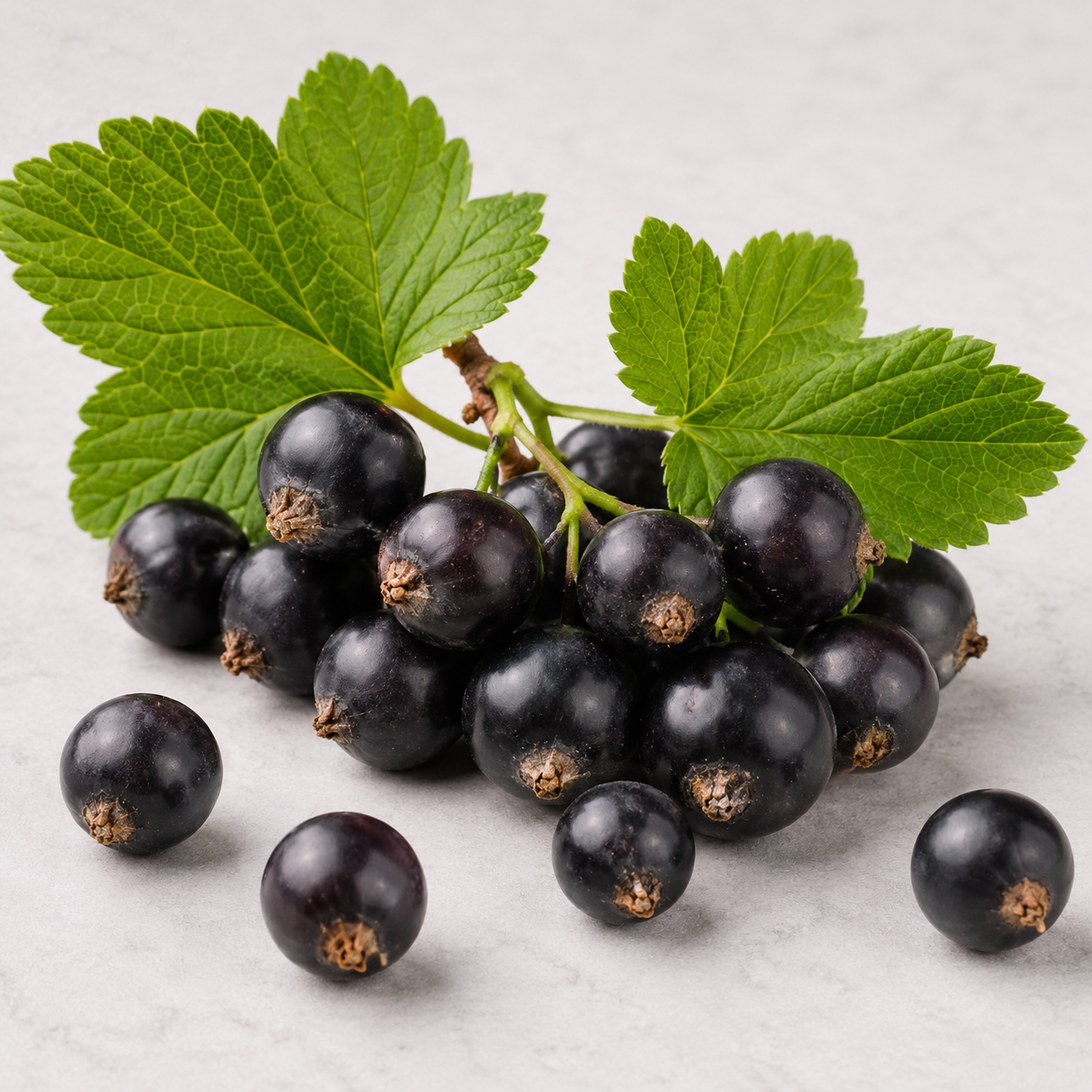
Blackcurrants are intensely flavored, distinctly tart, deep-purple berries. Fresh fruit provides substantial vitamin C and dietary fiber, while the dark purple-black color comes mainly from anthocyanins derived from delphinidin and cyanidin. Eating the whole fresh fruit preserves its natural structure and makes it easier to limit added sugar than choosing juice, jam, or sweetened dried fruit.
Food Overview
Key strengths
According to Norway's official food composition table, 100 g of fresh blackcurrants provides about 55 kcal, 5 g of dietary fiber, and 159 mg of vitamin C, along with vitamin E, copper, potassium, iron, and magnesium.
How to eat it
Ripe blackcurrants can be eaten whole, but they are usually tarter and more intensely flavored than blueberries or strawberries and may have a noticeable herbal aroma.
What stands out
Anthocyanins are the main phytochemicals in blackcurrants. Studies commonly identify delphinidin-3-O-rutinoside, cyanidin-3-O-rutinoside, delphinidin-3-O-glucoside, and cyanidin-3-O-glucoside as major forms, with the rutinosides often making up a large share.
Worth noting
Many products labeled "blackcurrant" are actually juice drinks, candy, jam, flavored yogurt, dried fruit, or concentrated powder. They may contain only a little blackcurrant along with added sugar, syrup, juice concentrate, or flavoring, so fresh-blackcurrant nutrition data should not be applied to them.
Basic Nutrition
Showing:100 g Fresh Blackcurrants
View complete nutrition data
GI note:GI varies with cultivar, food structure, processing, and cooking. Raw grains usually do not have directly applicable human GI data.
There is no reliable GI value traceable to a standard human GI test specifically for whole fresh blackcurrants. The commonly cited online value of 15 is not used because an original test source is lacking.
Data notes:Sections 02 and 03 use the Norwegian official food composition entry "Blackcurrants, raw" consistently and do not mix in missing fields from older USDA entries.
In this database, carbohydrate means available carbohydrate—the sum of sugars and starch—while dietary fiber is listed separately.
This page includes only whole fresh blackcurrants. The typical serving is also 100 g, so switching serving views does not change the nutrition values.
Vitamins & Minerals
Using FDA adult Daily Values, only nutrients reaching at least 5% of the Daily Value at the current serving are shown. The first six appear by default, with additional qualifying nutrients in the expanded view.
View all vitamins and minerals
Percentages show how much the selected serving contributes to the adult Daily Value.
Key Bioactive Compounds
Anthocyanins
AnthocyaninsThe deep purple-black color of blackcurrants comes mainly from glycosides of delphinidin and cyanidin, especially rutinosides and glucosides.
Some research summaries report about 113–158 mg of anthocyanins per 100 g of fresh blackcurrants, although cultivars and ripeness can shift values substantially.
Anthocyanins contribute to dietary antioxidant exposure.
Choose whole fresh fruit or unsweetened frozen berries. If making a puree, keep the skin; with juice and jam, pay attention to added sugar.
Blackcurrants do not treat eye disease, correct myopia, or replace cardiovascular medication.
Vitamin C
Water-soluble vitaminBlackcurrants are among the more vitamin-C-rich common berries. Their tartness also reflects their organic acids and vitamin C content.
Raw blackcurrants average about 180 mg of vitamin C per 100 g in some composition data, mainly in the pulp and juice-containing tissues. Cultivar, ripeness, postharvest storage, and processing can cause substantial variation.
Vitamin C supports collagen formation, normal immune function, and antioxidant defenses, and it can enhance absorption of non-heme iron from plant foods.
Fresh or frozen fruit can both be used. Eat thawed berries promptly, avoid prolonged cooking, and keep the skin and pulp when making drinks.
A high vitamin C content does not mean blackcurrants prevent all infections, and there is no need to use sugary blackcurrant drinks as a vitamin C source.
Proanthocyanidins & Flavonols
PolyphenolsBlackcurrants also contain polyphenols such as proanthocyanidins, quercetin, and myricetin, which contribute to their complex phytochemical profile.
Amount: —. Studies vary substantially in cultivar, extraction method, and units, so there is no single value suitable for commercial blackcurrants.
These polyphenols and their metabolites may support normal vascular function and contribute to antioxidant defenses.
Prefer whole berries, pulpy puree, or lower-sugar products rather than relying on high-sugar jam or syrup as the main source.
Strong antioxidant activity in laboratory tests does not mean eating blackcurrants directly "eliminates free radicals" in the body or resolves chronic inflammation.
How Preparation Changes Blackcurrant
Whole Fresh Fruit
Whole fresh fruit keeps the skin, pulp, seeds, and dietary fiber and is the default form discussed on this page.
Freezing
Freezing extends availability and can preserve some anthocyanins and vitamin C well at low temperatures, although ice crystals disrupt cell structure, so thawed berries are usually softer and release dark-purple juice. Choose unsweetened products containing only blackcurrants, take out only what you need, minimize repeated thawing and refreezing, consume the thawed juice too, and eat promptly.
Pureed Whole Fruit
Blending whole blackcurrants into an unstrained puree keeps the skin, seeds, and dietary fiber. Results from human studies using 75 g of whole-fruit puree cannot be directly extrapolated to strained juice or anthocyanin capsules.
Juicing & straining
Juicing and straining out the skin, seeds, and pulp removes some dietary fiber and polyphenols from the solid fraction. Fresh-blackcurrant nutrition data should not be applied to these products, and they should not be treated as whole fruit.
Heating & Stewing
Vitamin C is sensitive to heat, oxygen, and storage, and anthocyanins are also affected by temperature and processing conditions. Heat processing and high-pressure processing can affect vitamin C, anthocyanins, and post-digestion bioaccessibility differently.
Jam & Syrup
Jam and syrup are usually heated and contain substantial added sugar. Use them in small amounts as condiments, not as a serving of whole fruit.
Dried & Freeze-Dried Fruit
Conventional dried blackcurrants may contain added sugar or juice concentrate. 100 g of fresh blackcurrants is not equivalent to 100 g of dried or freeze-dried fruit, and freeze-dried powder, blackcurrant powder, and extracts are outside this page's nutrition data.
How to Choose & Store Blackcurrant
How to choose
- Ripe blackcurrants should be evenly deep purple to nearly black; many red or green berries or markedly uneven color may indicate incomplete ripeness
- Choose plump berries with intact skin, some firmness, a dry surface, no mold or leaking juice, and no extensive shriveling
- Berries still attached to intact clusters are often less crushed than loose, damaged fruit; remove individual berries just before use
- Avoid gray-white mold, large pools of purple juice at the bottom of the package, sliminess, fermented or sour spoilage odors, extensive skin splitting, or obvious pooled moisture
How to store
- Chill promptly after purchase and refrigerate in a covered container or sealed bag.
- Rinse gently under cold running water just before eating, remove stems, leaves, and damaged berries, do not use soap or detergent, drain well, and eat promptly
- Remove moldy, split, or leaking berries immediately and inspect nearby fruit carefully.
- Discard berries if there is mold, a clear alcoholic or fermented odor, sliminess, heavy leakage, unusual package swelling, or an obvious spoilage smell
When buying blackcurrants, remember three things: deep purple-black color, plump berries, and no mold or heavy juice leakage in the package.
How to Use Blackcurrant in Everyday Meals
Eat as fresh fruit
Rinse, drain, and remove the stems just before eating, then enjoy the berries whole. Because they are distinctly tart, about 100 g at a time is sufficient; there is no need to eat a very large portion simply to maximize anthocyanin intake.
Blackcurrants with Plain Yogurt
Add fresh blackcurrants to plain yogurt or unsweetened Greek yogurt; the creamy flavor helps balance their tartness. Add a little oats, walnuts, chia seeds, or flaxseed if desired.
Blackcurrant Oatmeal
Let cooked oats cool slightly before adding whole blackcurrants to avoid unnecessary prolonged heating. Pair with milk, unsweetened soy milk, and nuts for a breakfast that includes whole grains, protein, fat, and fruit.
Mixed Berry Bowl
Combine blackcurrants with blueberries, strawberries, blackberries, or raspberries for a mix of color, tartness, and texture. A little plain yogurt, lemon zest, or mint is enough; there is no need for large amounts of condensed milk or syrup.
Whole-Fruit Blackcurrant Smoothie
Blend blackcurrants with plain yogurt, milk, or unsweetened soy milk without straining out the skin or seeds. a little oats or nuts can be added, but avoid combining juice, honey, syrup, and several high-sugar fruits in the same drink.
A smoothie retains dietary fiber, but the drinkable format makes it easier to consume a large portion quickly, so total fruit quantity still matters.
Blackcurrant Grain or Green Salad
a little blackcurrants can be added to quinoa, buckwheat, or brown-rice salads with spinach, kale, nuts, beans, and a little olive oil.
Who Should Take Extra Care
People managing blood sugar
Fresh blackcurrants provide about 7.6 g of sugar and 5 g of dietary fiber per 100 g, but there is no reliable standard human GI value.
People with digestive sensitivity
Blackcurrants are quite acidic and contain substantial dietary fiber and small seeds. Start with a smaller portion, pair with yogurt, oats, or other foods, avoid eating a large amount on an empty stomach, and adjust to your own tolerance.
People Allergic to Blackcurrants or Related Fruits
Blackcurrant allergy is uncommon but has been reported. If eating them causes swelling of the lips or throat, widespread hives, wheezing, difficulty breathing, or marked dizziness, stop eating them and seek prompt medical care.
People with impaired kidney function
Fresh blackcurrants provide about 346 mg of potassium per 100 g. Whether restriction is needed depends on kidney function, blood potassium, dialysis status, medications, and the rest of the meal; do not completely avoid them simply because "fruit contains potassium."
Infants, young children, and people with swallowing difficulties
Blackcurrants are small, round berries with seeds. For infants, older adults, or people with swallowing difficulty, flatten or crush them, or make a puree that keeps the pulp, and adjust the texture to swallowing ability rather than serving whole berries that can be swallowed quickly.
People Sensitive to Acidity or with Sensitive Teeth
Blackcurrants are quite tart. Drink plain water afterward or eat them with a meal, and avoid holding them in the mouth for long periods. Do not add large amounts of sugar to drinks simply to offset the tartness.
Similar Food Alternatives
Blueberry
Another dark berry rich in anthocyanins, blueberries are usually milder than blackcurrants and easier to eat whole.
Blackberry
Blackberries also provide anthocyanins and substantial dietary fiber and can be eaten whole or added to yogurt.
Strawberry
Strawberries are rich in vitamin C, generally sweeter, and widely available, making them an easy everyday substitute.
Mulberry
Ripe mulberries contain anthocyanins and other polyphenols, with a soft texture and usually greater sweetness.
Data Sources & Last Updated
Nutrition Data
Basic Information & Food Safety
Research & References
Šimerdová B, et al. (2021). Evaluation of Anthocyanin Profiles in Various Blackcurrant Cultivars over a Three-Year Period.
Foods, 10(8), 1745. DOI / Original
Cao L, et al. (2021). Extraction, Identification, and Health Benefits of Anthocyanins in Blackcurrants.
Applied Sciences, 11(4), 1863. DOI / Original
Mattila PH, et al. (2016). High variability in flavonoid contents and composition between different North-European currant varieties.
Food Chemistry. DOI / Original
Lappi J, et al. (2020). Blackcurrant lowers sugar-induced postprandial glycaemia independently and in a product with fermented quinoa: a randomised crossover trial.
British Journal of Nutrition. DOI / Original
Trych U, et al. (2020). The Bioaccessibility of Antioxidants in Black Currant Puree after High Pressure Processing and Thermal Processing.
Molecules. DOI / Original
Skorupińska A, et al. (2025). The Influence of Storage Technologies on the Quality and Storability of Blackcurrant (Ribes nigrum) ‘Tihope’ cv.
Agriculture, 15(23), 2449. DOI / Original