Spices and herbs · Cinnamon-family spice
Ceylon cinnamon
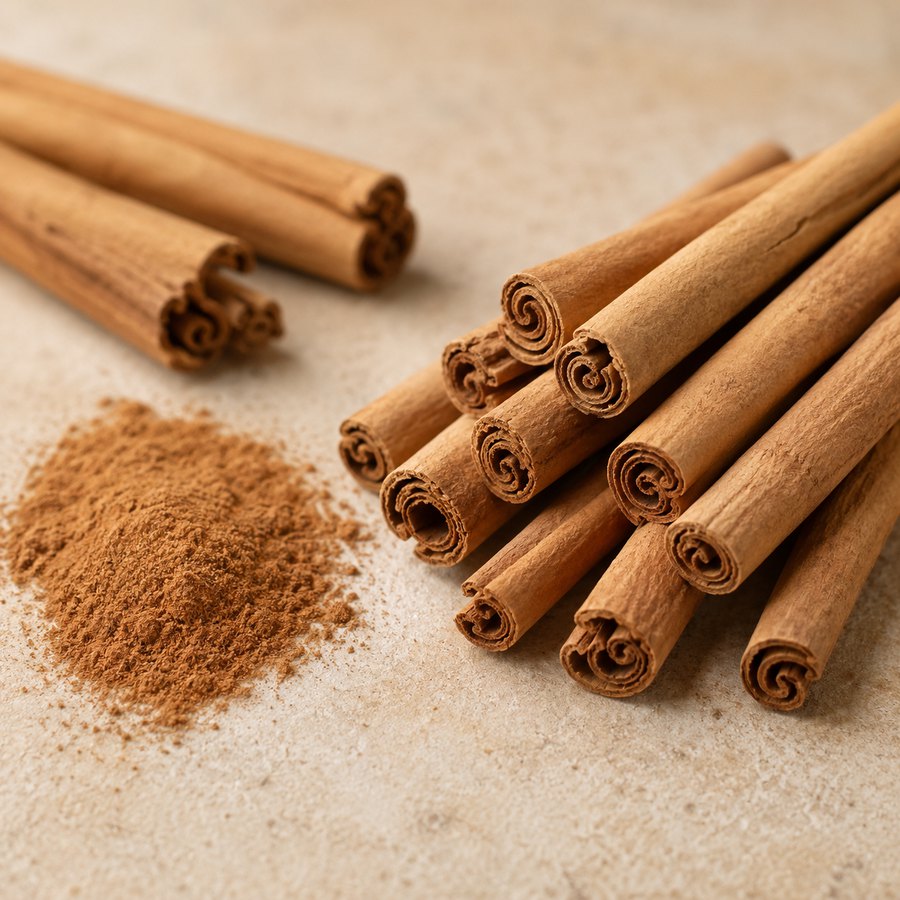
Ceylon cinnamon is the dried inner bark of a Cinnamomum species traditionally associated with Sri Lanka. Its quills are usually made of many thin bark layers rolled together, whereas Cassia-type cinnamon is typically thicker and made of one or a few layers. Ceylon cinnamon is not important because it supplies large amounts of vitamins; its main use is adding sweet, woody aroma with a small amount while providing compounds such as cinnamaldehyde and proanthocyanidins. Compared with Cassia cinnamon, it usually contains only low or trace coumarin, which can make it a better option for frequent use—but “low coumarin” does not mean unlimited intake.
Food Overview
Key strengths
A small amount of Ceylon cinnamon adds sweet, woody, warm spice to oats, coffee, cocoa, fruit, and stews, which can reduce reliance on syrup, cream, or very sweet flavorings. Bark powder provides cinnamaldehyde and proanthocyanidins, but typical daily use is only about 1–3 g.
How to use it
Add to oats, plain yogurt, coffee, cocoa, stewed apples, whole-grain baking, curries, or stews, or steep a cinnamon quill in a warm drink. Use it as a spice rather than swallowing large spoonfuls of powder every day.
What stands out
The most important buying point is whether the label actually says Ceylon cinnamon, Cinnamomum verum, or Cinnamomum zeylanicum. Powder is difficult to identify reliably by color, smell, or taste alone; the many thin layers of a quill are easier to recognize.
Worth noting
Current evidence does not clearly support cinnamon as a treatment for disease and cannot establish that cinnamon supplements reliably improve diabetes or weight-loss outcomes. Normal culinary amounts are usually low risk, but large or prolonged use can cause gastrointestinal symptoms, allergy, or drug interactions.
Basic Nutrition
Showing:100 g Ceylon cinnamon powder
View complete nutrition data
GI note:GI varies with cultivar, food structure, processing, and cooking. Raw grains usually do not have directly applicable human GI data.
Reliable GI data for ordinary Ceylon cinnamon are lacking. Although cinnamon powder contains carbohydrate, much of it is fiber and a typical serving is only about 1 tsp, so GI is not estimated from carbohydrate or sugar.
Data notes:The default food is pure Ceylon cinnamon bark powder, species Cinnamomum verum. The default state is ground Ceylon cinnamon, shown per 100 g, with a common serving of 1 tsp, about 2.6 g.
The USDA “Spices, cinnamon, ground” entry does not distinguish Ceylon, Chinese, Indonesian, or other cinnamon species. This module therefore uses generic ground-cinnamon nutrition as a reference, not species-specific Ceylon data. Species identity and bioactive-compound information come from Ceylon-specific sources.
A common serving is 1 tsp, about 2.6 g, scaled from per-100 g data. Fiber, manganese, and calcium look high per 100 g, but 100 g is not a realistic daily amount. A teaspoon is only about 2.6 g, so Ceylon cinnamon does not replace vegetables, whole grains, nuts, or dairy as a major nutrient source.
The USDA entry reports total sugars and fatty acids but not a usable starch value, so starch is shown as “—” rather than estimated by subtracting fiber and sugars from total carbohydrate.
GI is shown as “—” because reliable GI data suitable for ordinary Ceylon cinnamon are lacking. The page does not infer GI from carbohydrate or sugar and does not show 0. “No reliable data” is not the same as “tested at 0.”
Vitamins & Minerals
Only vitamins and minerals reaching at least 5% Daily Value are shown. Fourteen qualify per 100 g generic ground cinnamon; at 1 tsp, about 2.6 g, only manganese qualifies.
At a common serving of 1 tsp, about 2.6 g, only manganese reaches the 5% Daily Value threshold—about 0.45 mg or 20%. Calcium, iron, vitamin K, and other nutrients can look high per 100 g but fall below the display threshold at normal seasoning amounts. The base composition comes from a generic ground-cinnamon entry that did not identify species; percentages use current FDA Daily Values and are rounded.
View all vitamins and minerals
Percentages show how much the selected serving contributes to the adult Daily Value.
Key Bioactive Compounds
Cinnamaldehyde
Aromatic aldehydeCinnamaldehyde is a key aromatic compound in Ceylon cinnamon bark and drives much of its sweet, woody, warm-spice aroma.
The U.S. Pharmacopeia specifies 1.0%–3.2% cinnamaldehyde on a dry basis in compliant Ceylon cinnamon bark powder—about 1.0–3.2 g/100 g or roughly 26–83 mg per 2.6 g teaspoon. This is a quality range, not a guarantee for every retail product.
Cell and animal studies show antioxidant, inflammation-related, metabolic, and antimicrobial activity, but ordinary culinary effects in humans are uncertain.
A little powder in oats, coffee, cocoa, fruit, or stews gives strong aroma; keep the container sealed to protect volatile compounds.
Laboratory effects do not show that cinnamon treats infection, diabetes, or chronic inflammation.
Proanthocyanidins
PolyphenolsCeylon cinnamon contains proanthocyanidins such as procyanidin B2, cinnamtannin B1, and related oligomers.
The U.S. Pharmacopeia specifies at least 0.4% proanthocyanidins on a dry basis—about ≥400 mg/100 g or ≥10.4 mg per 2.6 g teaspoon—based on combined procyanidin B2 and cinnamtannin B1, not total polyphenols.
These polyphenols have antioxidant activity in experimental systems. Glucose-related findings often come from extracts or cinnamon products with unclear species identity.
Mix a small amount of powder into oats, yogurt, or fruit. A quill infusion provides aroma and some soluble compounds but not all bark fiber.
Laboratory antioxidant capacity does not prove anti-aging effects or reliable glucose lowering from one teaspoon a day.
Cinnamic acid and other phenylpropanoids
Aromatic phenylpropanoidsCeylon cinnamon also contains cinnamic acid, eugenol, hydroxycinnamaldehydes, methoxycinnamaldehydes, and small amounts of cinnamyl alcohol.
The U.S. Pharmacopeia specifies total phenylpropanoids at 1.1%–3.5% of dry bark powder, including cinnamaldehyde and related compounds. Because cinnamaldehyde makes up much of the total, individual amounts cannot be reliably calculated and are shown as “—”.
These compounds contribute to aroma and show antioxidant, antimicrobial, or inflammation-related activity in experimental studies, but food-dose human effects are unclear.
Choose pure Ceylon cinnamon bark products and use small culinary amounts; essential oils and concentrated extracts are unnecessary.
Powder, extracts, and essential oil are not interchangeable, and detecting a compound does not mean it reaches experimental concentrations in the body.
How Preparation Changes Ceylon Cinnamon
Ceylon cinnamon quills
Ceylon quills are made from many thin layers of inner bark rolled together, often resembling a tightly rolled cigar in cross-section. Their structure makes species identification easier than with powder. Use them in stews, infusions, or spice broths and remove the quill before serving rather than swallowing large dry bark pieces.
Ceylon cinnamon powder
Ground Ceylon cinnamon works well in oats, yogurt, coffee, and baking, but once powdered it is hard to distinguish Ceylon from Cassia by appearance alone. Rely on the botanical name, origin, and testing information. These nutrition data apply to Ceylon cinnamon powder. Edible cinnamon is harvested and dried bark rather than fresh raw bark.
Cinnamon infusion
A quill or small amount of powder can be steeped in hot water. The drink captures aroma and some water-soluble compounds, but if bark or sediment is not consumed it does not provide all of the fiber or non-water-soluble components. Do not market “cinnamon water” as a detox, glucose-lowering, or fat-loss drink.
Baking and stewing
Ceylon cinnamon works in baking, stewed apples, curries, and savory stews. Heating changes the release and retention of volatile aromas, but there is not enough evidence that one home-cooking method gives a stronger anti-inflammatory effect. Moderate heat, less added sugar, and avoiding charring are sufficient.
Cassia-type cinnamon
Chinese, Vietnamese, and Indonesian cinnamon are different species or commercial types and generally contain more coumarin. These cinnamons should not share Ceylon cinnamon’s species description, coumarin level, or pharmacopoeial quality standards.
Cinnamon extracts and essential oil
Extracts, essential oils, capsules, and concentrates contain compounds at much higher concentrations than normal seasoning use and should not share ground-cinnamon data. Essential oil should not be swallowed as if it were ordinary cinnamon powder.
How to Choose and Store
How to choose
- Check the species name: look for Ceylon cinnamon, Cinnamomum verum, or Cinnamomum zeylanicum. A label that only says “cinnamon,” “cinnamon powder,” or a generic market name does not prove it is Ceylon, because products may not clearly identify the species or plant part.
- Check quill structure: Ceylon quills are usually light to yellow-brown, thin-barked, brittle, and made of many rolled layers. Cassia quills are usually thicker and more like one layer curling inward.
- Check origin and traceability: Sri Lanka is the classic source of Ceylon cinnamon, but “imported from Sri Lanka” does not replace a botanical name. Prefer products that also provide species, plant part, batch, origin, and testing or quality-control information.
- Check lead and other contaminants: FDA has issued public-health alerts for elevated lead in specific ground-cinnamon brands and lots. This does not mean all cinnamon is contaminated. For frequent use, favor reliable sources with transparent batch testing. “Organic” alone does not prove absence of lead, other heavy metals, adulteration, or species mixing.
How to store
- Store powder sealed in a cool, dry, dark place away from the stove, steam, and sink. Use a dry spoon and avoid leaving the container open for long periods.
- Store quills sealed and dry as well. Moisture can cause clumping, mold, or loss of aroma; dry spices do best in a clean, cool, dry place.
- Discard cinnamon with visible mold, damp clumps, insects, unusual chemical odor, rancid or musty smell, damaged packaging, unknown provenance, or a lot covered by a regulatory alert or recall.
- Do not use products with damaged packaging, unknown provenance, or batches covered by regulatory alerts or recalls.
Three checks: verify the botanical name, look for thin multilayer quills, and prefer transparent batch testing.
How to Eat It
Ceylon cinnamon oats
Add about 1/4–1/2 tsp to cooked or overnight oats with apple, blueberries, nuts, or plain yogurt. Use the aroma of cinnamon and fruit to reduce honey, syrup, or brown sugar rather than ignoring the breakfast’s added sugar because cinnamon is present.
Plain yogurt and chia seeds
Mix a small amount into plain yogurt, unsweetened soy yogurt, or chia pudding with berries, walnuts, or almonds. Start small to avoid mouth dryness or irritation from too much powder.
Coffee, cocoa, or tea
Add a little before brewing coffee, or warm a quill briefly with tea, cocoa, or unsweetened plant milk. Use cinnamon for aroma instead of adding lots of syrup, condensed milk, or cream.
Stewed apples or baked fruit
Add a little cinnamon and nuts to apples, pears, peaches, or pumpkin during cooking. Fruit is already sweet, so large amounts of white sugar or butter are usually unnecessary, and heavy charring should be avoided.
Curries and stews
Use a quill in bean curries, tomato stews, or chicken or beef dishes with turmeric, ginger, black pepper, cardamom, and cloves. Remove it after cooking and limit concentrated soup bases or salty sauces.
Whole-grain baking
Use Ceylon cinnamon in whole-wheat bread, oat muffins, or nut-based baked foods. Cinnamon can add sweet aroma but does not offset large amounts of refined sugar, butter, or refined flour.
Who Should Take Extra Care
People with abnormal liver function
Ceylon cinnamon usually contains far less coumarin than Cassia, but trace amounts can still occur. People with liver disease, abnormal liver enzymes, or medicines that may affect the liver should not self-use high-dose cinnamon powder, capsules, or extracts long term. The coumarin tolerable daily intake of 0.1 mg/kg body weight/day is intended for long-term average exposure; products with uncertain species or possible blending cannot be judged from the word “cinnamon” alone.
People taking long-term medicines
Normal seasoning use is not the same as high-dose supplements. People taking glucose-lowering drugs, cancer therapies, or other long-term medicines should check with a clinician or pharmacist before prolonged use of cinnamon capsules, extracts, or large amounts of powder. Potential interactions exist, but the real clinical significance is not always clear.
Pregnancy & Breastfeeding
Normal food use is generally considered lower risk, but safety data are insufficient for large amounts or concentrated supplements during pregnancy and breastfeeding.
People with sensitive digestion
Larger amounts can cause stomach upset, nausea, or other gastrointestinal symptoms. People with sensitive mouths, reflux, or stomach discomfort should start small and avoid swallowing dry powder on an empty stomach.
People allergic to cinnamon
Cinnamon powder, oil, or cinnamon-containing products can cause skin irritation, mouth irritation, or allergic reactions. Stop use and seek care for marked rash, lip swelling, breathing difficulty, or persistent oral burning.
Children and people with swallowing difficulty
Do not let children swallow spoonfuls of dry cinnamon. Fine powder can be inhaled into the airways, and “cinnamon challenges” can cause serious injury. Use only small amounts mixed into food and prefer products from clear sources that are not covered by lead alerts.
People managing blood sugar
Evidence on cinnamon supplements and glucose control is inconsistent, and many studies do not clearly identify the cinnamon species. Ceylon cinnamon does not replace glucose-lowering medication, diet changes, exercise, or glucose monitoring.
Similar Food Alternatives
Chinese cinnamon / cassia
Stronger aroma and generally more coumarin. Useful in braises and spice blends, but it is a different species and should not share Ceylon cinnamon’s long-term intake assumptions.
Vietnamese / Saigon cinnamon
Strong, sweet-hot aroma for baking or stews. It is not Ceylon cinnamon and has a different coumarin and volatile profile.
Cardamom
Fresh, citrusy, floral aroma for coffee, oats, yogurt, curries, and lower-sugar baking. It can add fragrance without providing cinnamaldehyde.
Ginger
Fresh and pungent for warm drinks, soups, fish, and vegetables. It has different compounds but can also add flavor while reducing some salt or sugar.