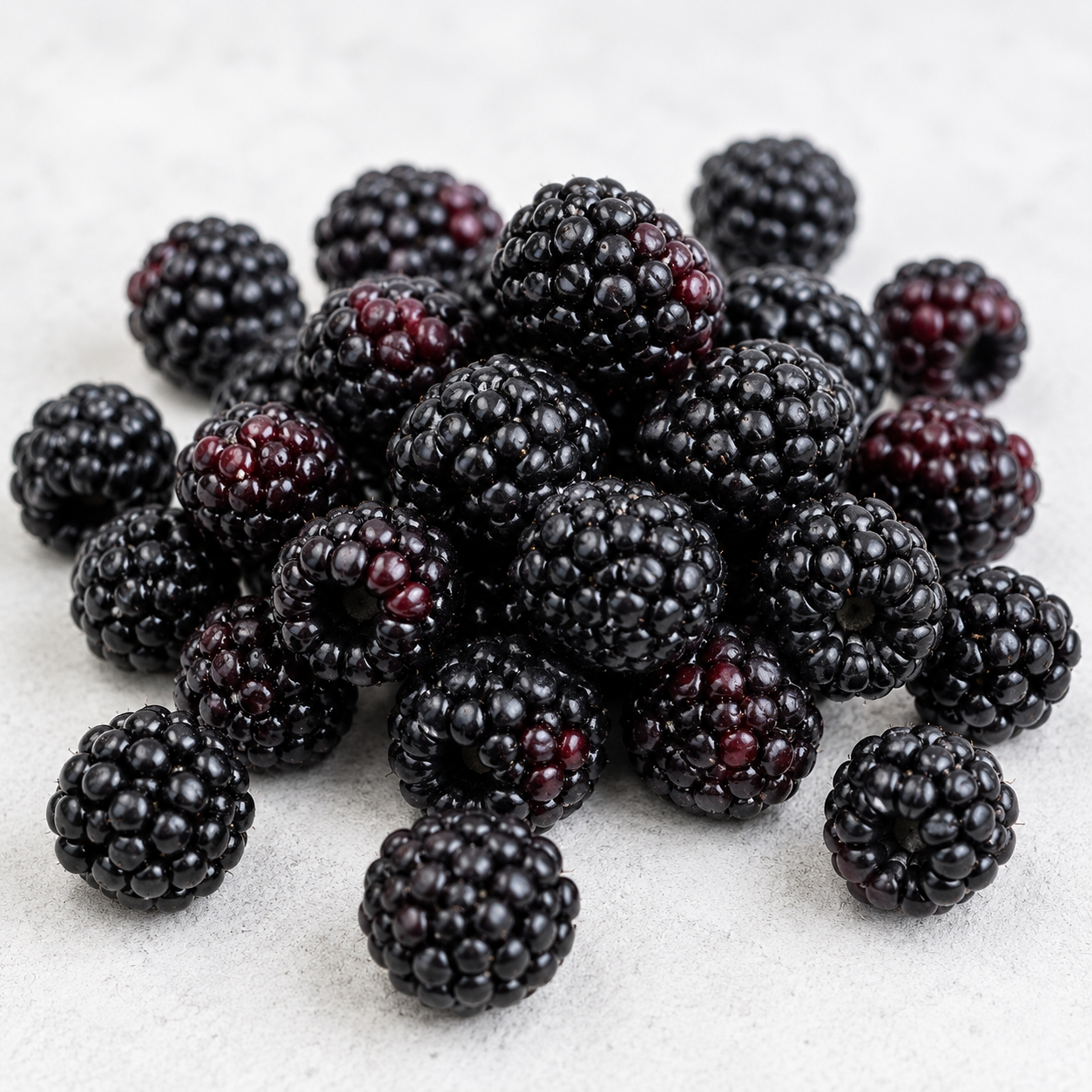
Fruits · Berries
Black Raspberry
Black raspberry is a deep purple-black berry known especially for cyanidin-based anthocyanins, ellagitannins, and ellagic acid. Composition varies by cultivar, ripeness, and growing conditions. A sufficiently complete authoritative nutrition database specific to fresh Rubus occidentalis is not available for this page, so generic red-raspberry USDA values are not used as substitutes. Experimental research should not be interpreted as evidence that black raspberries can treat disease.
Food Overview
Key strengths
Black raspberries are known for their deep purple-black color, which comes mainly from anthocyanins. They also contain dietary fiber and other basic nutrients, but a sufficiently complete authoritative nutrition database specific to fresh Rubus occidentalis is not available for this page, so generic red-raspberry USDA values are not used as substitutes.
How to Eat It
Black raspberries can be eaten fresh or paired with plain yogurt, oats, nuts, whole-grain salads, or other fruit. If using them in purées or smoothies, keep the whole pulp rather than straining out the fiber.
What stands out
The most characteristic bioactive compounds in black raspberries are cyanidin glycosides, along with ellagitannins, ellagic acid, and smaller amounts of flavonols and phenolic acids.
Worth noting
Fresh black raspberries are highly perishable and are best eaten soon after purchase. Jam, juice, syrup, and baked fillings are not nutritionally equivalent to whole fresh fruit, especially because of added sugar and anthocyanin losses during processing.
Basic Nutrition
Showing:100 g Raw Black Raspberries
View complete nutrition data
GI note:GI varies with cultivar, food structure, processing, and cooking. Raw grains usually do not have directly applicable human GI data.
No reliable human GI value specifically for fresh Rubus occidentalis was found. GI values from red raspberries, blackberries, mixed berries, or beverages are not used, and GI is not estimated from sugar content.
Data notes:This page includes only a raw black raspberry state; separate cooked or frozen nutrition states are not provided.
The default and common serving size are both 100 g.
This page covers fresh raw black raspberry (Rubus occidentalis). A sufficiently complete authoritative species-specific nutrition data set is not available for the basic nutrition table, so values from generic red raspberries, blackberries, blackcurrants, mulberries, or Rubus coreanus are not substituted.
Black raspberries do not share data with blackberries, red raspberries, blackcurrants, mulberries, or Rubus coreanus.
Vitamins & Minerals
FDA Daily Values for adults and children age 4 and older are used. Only nutrients providing at least 5% of the Daily Value at the current serving size are shown, with the top six displayed by default.
No vitamin or mineral reaches 5% of the Daily Value in the selected serving.
View all vitamins and minerals
Key Bioactive Compounds
Anthocyanins
Polyphenols | AnthocyaninsBlack raspberry anthocyanins are mainly cyanidin glycosides, including cyanidin-3-rutinoside, cyanidin-3-xylosylrutinoside, cyanidin-3-glucoside, and cyanidin-3-sambubioside. Total anthocyanins in one Bristol cultivar were reported at about 325.5 mg/100 g, but this indicates a potentially high level in a specific cultivar and should not be treated as a fixed value for all black raspberries. Processing, heat, oxygen, light, and storage can all affect anthocyanin content.
Ellagitannins & Ellagic Acid
Hydrolyzable Tannins | PolyphenolsBlack raspberries contain ellagitannins, which can release ellagic acid during analysis, digestion, or hydrolysis. In one cultivar, total ellagic acid measured after hydrolysis was about 323.5 mg/100 g. This should not be presented as the amount of free ellagic acid in fresh fruit or as a universal value. Heating, juicing, clarification, and storage can alter both content and available forms.
Flavonols & Other Phenolics
Flavonols, flavanols, and phenolic acidsBlack raspberries also contain quercetin-3-glucoside, quercetin-3-rutinoside, myricetin glycosides, dihydrokaempferol glycosides, epicatechin, caffeic acid, p-coumaric acid, and small amounts of free ellagic acid. These are generally present at lower levels than the major anthocyanins, and current evidence is mainly compositional and mechanistic.
Limits of Human Evidence
Small human studies have examined freeze-dried powder or extracts in relation to absorption, vascular function, blood pressure, blood lipids, and inflammation-related markers, but participant numbers are small and concentrated forms are often used. These findings cannot be translated directly into claims that a small serving of fresh fruit treats hypertension, metabolic syndrome, inflammation, or cancer.
How Preparation Changes Black Raspberry
Fresh, Raw
Fresh black raspberries retain the whole pulp, seeds, and dietary fiber while avoiding anthocyanin losses from heating and prolonged processing. They can be eaten on their own, added to plain yogurt, or mixed into oats and salads.
Frozen, Unsweetened
Freezing is useful for longer storage, and freezing alone generally has a relatively small immediate effect on anthocyanins. Avoid repeated thawing and refreezing.
Puree or smoothie
Blending the whole berries with their seeds retains most of the dietary fiber. Avoid straining and added syrups; pair with plain yogurt, milk, or unsweetened soy milk, and drink soon after blending.
Juice
Juicing or clarification removes much of the pulp and dietary fiber, and anthocyanins may decline during processing and storage. Check whether products contain added sugar, syrup, or juice concentrate, whether they are actually juice drinks, and how large the serving is.
Jam & Baked Products
Jam usually involves heating and substantial added sugar, while baked fillings may also contain sugar, butter, or refined flour.
How to Choose & Store
How to choose
- Look for labels such as Black raspberry, Blackcap raspberry, or Rubus occidentalis rather than relying on dark color alone.
- Choose evenly deep purple-black berries that are intact and relatively dry, without crushed fruit, leaking juice, mold, or off odors.
- Ripe berries may soften or change shape slightly, but they should not be watery, slimy, or decomposing.
- For frozen fruit, purée, or jam, prefer short ingredient lists with no or little added sugar and without large amounts of syrup, flavoring, or coloring.
How to store
- Refrigerate promptly after purchase. Do not wash before storage; use a ventilated or perforated container and avoid crushing the fruit.
- For best quality, eat within about 1–2 days. Rinse gently under cool running water just before eating; do not use detergents.
- For longer storage, rinse lightly, drain thoroughly, freeze in a single layer, then transfer to a sealed bag and label with the date.
- Discard berries with visible mold, heavy leaking, sliminess, fermented or rotten odors, or severe collapse and decay.
When buying black raspberries, remember three things: confirm the species or product name, choose intact deep purple-black fruit, and avoid mold or leaking juice.
How to Include It in Everyday Meals
1. Pair with Plain Yogurt
Add rinsed black raspberries to plain yogurt, with a little oats, walnuts, or chia seeds if desired. Because the fruit is delicate, rinse gently just before eating rather than soaking or rubbing repeatedly.
2. Add to Oats or Overnight Oats
Pair black raspberries with oats and milk or unsweetened soy milk. Keep the whole pulp rather than blending and straining it, and avoid heavily sweetened flavored oats.
3. Make a Whole-Fruit Smoothie
Blend black raspberries with plain yogurt, unsweetened soy milk, or milk; a little banana can be added for texture. Keep the pulp and seeds rather than straining the drink into juice.
4. Add to Vegetable or Whole-Grain Salads
Add a little black raspberries to salads with spinach, arugula, red cabbage, quinoa, or chickpeas, and dress with olive oil, lemon juice, or vinegar. Because black raspberries crush easily, add them last and toss gently.
5. Make a Quick, Lower-Sugar Berry Sauce
Gently heat black raspberries over low heat for a short time and lightly crush them, adding a little lemon juice if desired. Use as a topping for yogurt, oats, or whole-grain bread.
6. Mix with Other Berries
When fresh black raspberries are limited, combine them with blueberries, strawberries, red raspberries, or blackberries. This increases fruit variety and avoids eating large amounts of a single berry solely to obtain one bioactive compound.
Who Should Take Extra Care
People with Berry Allergies
Raspberry allergy is uncommon, but severe systemic reactions have been reported. Seek prompt medical care for difficulty breathing, widespread hives, throat swelling, or dizziness.
People with pollen-food syndrome
Some people with pollen allergy may develop itching, tingling, or mild swelling of the mouth, lips, or throat after eating raw fruit. Stop eating the food and consult an allergy specialist if symptoms recur.
People with digestive sensitivity
Black raspberries contain dietary fiber, but a sufficiently reliable Rubus occidentalis-specific value is not available for this page. People who usually eat few berries or little fiber may still experience bloating, more frequent bowel movements, or discomfort after a large serving, so portion size can be increased gradually.
People managing blood sugar
No reliable human GI value specifically for fresh Rubus occidentalis was found, and this page does not use generic red-raspberry carbohydrate or sugar values as substitutes. People managing blood glucose should focus on actual portion size and the overall meal rather than assuming a fixed GI or nutrient value for all black raspberries.
Infants, young children, and people with swallowing difficulties
For people with weaker chewing or swallowing ability, crush or chop the berries or serve them as an unstrained purée, adjusting texture as needed. Supervise eating and avoid rapidly swallowing large handfuls.
People Using Concentrated Powders or Extracts
Fresh fruit, freeze-dried powder, and high-concentration extracts provide very different exposure levels. Some human studies use capsules, freeze-dried powders, or standardized extracts, and their results cannot be converted directly into effects from ordinary fresh fruit.
Similar Food Alternatives
Red Raspberries
Red raspberries are the closest substitute in food form and use and are also high in dietary fiber.
Blackberry
Another dark Rubus berry. Blackberries are generally larger and retain a solid core after picking, so their texture and structure differ from black raspberries.
Blueberry
More widely available and also rich in anthocyanins, blueberries work well with yogurt, oats, and whole-grain breakfasts.
Blackcurrant
Deeply colored and tart, blackcurrants work well as frozen fruit, purée, or in small mixed servings.
Data Sources & Last Updated
Nutrition Data
Basic Information & Food Safety
Research & References
Tulio AZ Jr., et al. (2008). Cyanidin 3-Rutinoside and Cyanidin 3-Xylosylrutinoside as Primary Phenolic Antioxidants in Black Raspberry.
Journal of Agricultural and Food Chemistry. DOI / Original
Bobinaitė R., et al. (2012). Variation of total phenolics, anthocyanins, ellagic acid and radical scavenging capacity in various raspberry cultivars.
Food Chemistry. DOI / Original
Kula M., et al. (). Phenolic composition of fruits from different cultivars of red and black raspberries.
Journal of Agricultural and Food Chemistry. DOI / Original
Hager TJ., et al. (2008). Processing and Storage Effects on Monomeric Anthocyanins, Percent Polymeric Color, and Antioxidant Capacity of Processed Black Raspberry Products.
Journal of Food Science. DOI / Original
Tian Q., et al. (2006). Urinary excretion of black raspberry anthocyanins and their metabolites.
Research article. DOI / Original
Jeong HS., et al. (2016). Black raspberry extract increased circulating endothelial progenitor cells and improved arterial stiffness in patients with prehypertension.
Research article. DOI / Original
Myung SK., et al. (2016). Beneficial effects of black raspberry extract on lipid profiles and vascular endothelial function in patients with metabolic syndrome.
Journal of Lipid and Atherosclerosis. DOI / Original