Fermented foods · Fermented Soy Foods
Natto
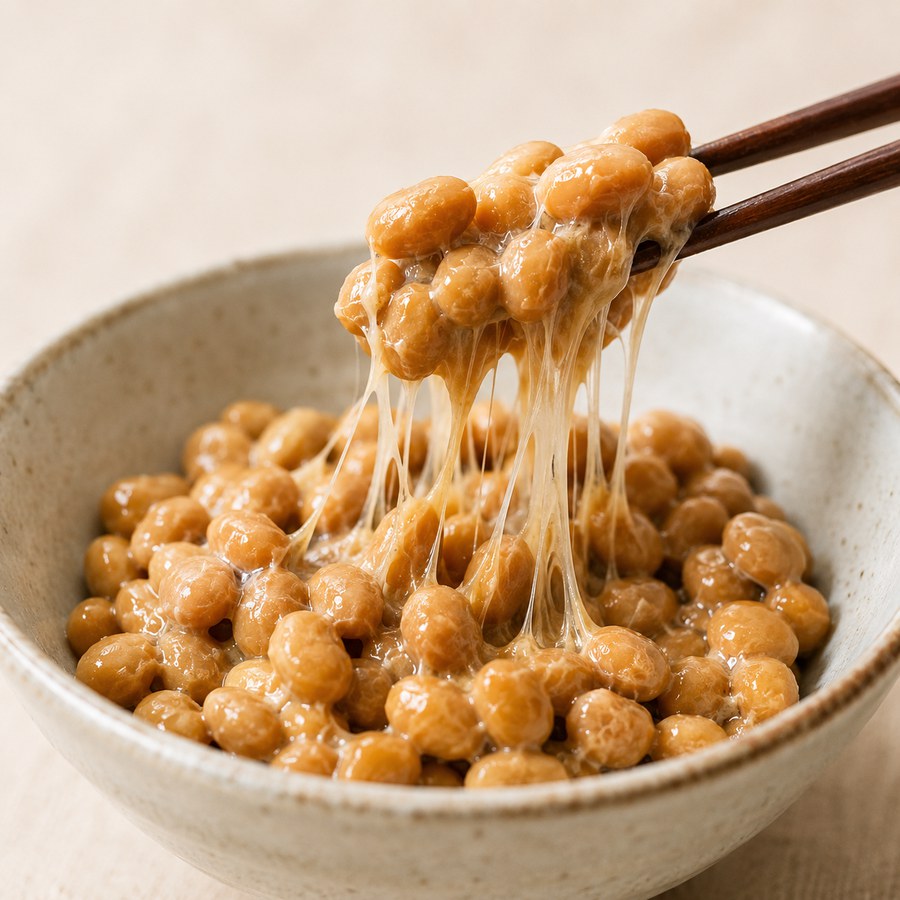
Natto is a traditional soybean food made by fermenting cooked whole soybeans with Bacillus subtilis var. natto. It retains soybean protein, fiber, and minerals while fermentation produces distinctive compounds such as vitamin K2, nattokinase, and poly-gamma-glutamic acid. This page covers plain, refrigerated stringy natto made from whole soybeans; nutrition data exclude the included sauce, mustard, sugar, scallions, and other seasonings.
Food overview
Key strengths
Natto is made from whole soybeans and provides about 16.5 g protein, 9.5 g fiber, and 10 g fat per 100 g, plus magnesium, iron, copper, manganese, and folate. Compared with plain cooked soybeans, its most distinctive features are fermentation-derived vitamin K2, sticky poly-gamma-glutamic acid, and the fibrinolytic enzyme nattokinase.
How to eat it
Good over rice or with tofu, soba, okra, nori, scallions, tomatoes, and leafy greens. Plain natto is naturally very low in sodium; most salt comes from the packet of seasoning sauce, so using less or none can meaningfully reduce sodium.
What stands out
Natto's vitamin K is mainly long-chain vitamin K2, especially MK-7. The amounts of MK-7, nattokinase, and isoflavones vary with soybean variety, bacterial strain, fermentation temperature and time, and analytical method, so one fixed value should not be applied to every brand.
Worth noting
Natto is very high in vitamin K2. People taking warfarin or other vitamin K antagonists generally need to avoid it rather than simply eating a smaller amount or heating it. People with soy allergy should also avoid natto.
Basic Nutrition
Showing:100 g Plain natto
View complete nutrition data
GI note:GI varies with cultivar, food structure, processing, and cooking. Raw grains usually do not have directly applicable human GI data.
A searchable GI value of 56 is for white rice eaten with natto, not natto alone. This page therefore shows “—” rather than assigning 56 to natto.
Data notes:This page uses one formal food state: plain natto made from whole soybeans, fermented with natto bacteria and sold refrigerated. Nutrition data exclude packet sauces, mustard, sugar, scallions, and other seasonings, and do not cover black-soybean natto, chopped natto, freeze-dried natto, natto powder, nattokinase capsules, or concentrated extracts.
Basic nutrition data come from Japan's Standard Tables of Food Composition entry for stringy natto (food code 04046).
Data are shown per 100 g; a common serving is about one 50 g pack. Retail packs are often about 40–50 g, so use the package net weight for the actual serving.
GI is shown as “—”. A searchable GI value of 56 is for a meal of white rice plus natto, not natto alone, so 56 should not be presented as natto's GI.
The database lists cholesterol as trace (Tr), so it should not be automatically converted to 0.
Sodium from the included seasoning sauce should not be represented by plain natto's value of only about 2 mg per 100 g.
Vitamins & Minerals
Uses current FDA Daily Values and shows only nutrients providing at least 5% DV at the selected serving. The first six are shown by default, with the rest in the expanded area. At about 50 g, calcium, niacin, and vitamin B1 fall below 5% DV.
Percentages are calculated from the Japanese food-composition values using current FDA Daily Values and rounded. At 100 g, the first six qualifying nutrients are shown by default and others meeting the 5% threshold appear in the expanded area. At a common 50 g serving, calcium, niacin, and vitamin B1 fall below 5% DV and are no longer shown.
View all vitamins and minerals
Percentages show how much the selected serving contributes to the adult Daily Value.
Key Bioactive Compounds
Vitamin K2 (MK-7)
Fat-Soluble VitaminMK-7 is natto's most distinctive form of vitamin K2 and is produced during fermentation. It contributes to normal blood clotting and activation of vitamin-K-dependent proteins involved in bone health.
The Japanese food-composition database lists about 600 micrograms vitamin K per 100 g of plain natto and notes that this includes MK-7, expressed using MK-4 molecular-weight equivalents. Direct testing of specific natto samples has reported about 775–902 micrograms MK-7 per 100 g. Because the analytical and conversion methods differ, these values should not be averaged.
Vitamin K supports normal coagulation and the carboxylation of bone-related proteins such as osteocalcin. Reviews suggest habitual natto intake is associated with higher serum MK-7, better osteocalcin carboxylation, and some bone-density measures, but much of the evidence is observational or quasi-experimental.
For most healthy adults, about 40–50 g plain natto can count as a serving of soy food alongside vegetables, whole grains, and other protein foods. MK-7 is fat-soluble, but natto already contains some fat, so extra oil is not needed for absorption.
Natto's vitamin K2 does not replace osteoporosis treatment or guarantee fracture prevention. People taking warfarin should not freely vary natto intake because its MK-7 can substantially interfere with anticoagulation.
Nattokinase
Fermentation-derived enzymeNattokinase is a protease produced during natto fermentation. In laboratory assays it can break down fibrin, which is why it is one of natto's most discussed fermentation products.
There is no reliable universal average for commercial natto in mg/100 g or FU/100 g. Early work reported roughly 40 older fibrinolytic activity units per gram of wet natto, while specific optimized fermentation products reached about 145 FU/g. Values from different strains, fermentation conditions, and assays are not directly interchangeable.
Nattokinase has fibrin-degrading activity in vitro, and some nattokinase supplement studies have examined blood pressure or coagulation-related outcomes. Standardized enzyme doses used in supplements are not equivalent to the activity in a typical pack of natto.
If you want to minimize heat-related loss of enzyme activity, eat natto cold or warm it only briefly. Cooked natto still provides soybean protein, fiber, and minerals. There is no need to eat large amounts raw or use unverified concentrated products just for nattokinase.
Laboratory fibrin breakdown does not mean eating natto can “dissolve blood clots.” Natto cannot replace anticoagulants, antiplatelet drugs, or cardiovascular treatment, and supplement doses should not be chosen from food information.
Soy Isoflavones
Plant polyphenolsSoy isoflavones include daidzein, genistein, and their glycoside forms. Fermentation changes their profile and may increase the proportion of some more readily absorbed aglycones.
There is no single average for all commercial natto. One specific fermented sample contained about 139.5 mg total isoflavones per 100 g; another study found that after 24 hours of fermentation, total isoflavones were about 1.62 times and aglycones about 3.07 times those in unfermented soybeans. Soy variety, strain, fermentation time, and analytical method all affect the result.
Isoflavones show antioxidant activity in vitro and may contribute to antioxidant defenses. Soy-food intake has been studied in relation to cardiovascular and bone outcomes, but natto's isoflavones should not be interpreted separately from its protein, fiber, fat, and other fermentation products.
Choose whole natto rather than chasing high-dose isoflavone extracts. Pair it with tomatoes, leafy greens, mushrooms, and whole grains for a broader mix of plant compounds; large daily amounts are not needed just for isoflavones.
In-vitro antioxidant or antiglycation effects do not prove anti-inflammatory, anticancer, or anti-aging benefits from ordinary servings. Whole soy foods also should not be equated with high-dose isoflavone supplements.
How processing changes natto
Cooked soybeans vs. natto
Cooked soybeans already provide protein, fat, fiber, and minerals. Fermenting them with natto bacteria produces substantial MK-7, nattokinase, and sticky poly-gamma-glutamic acid and also changes the form of some isoflavones.
Plain natto
Plain natto is naturally very low in sodium, about 2 mg per 100 g. Stirring before eating preserves its typical sticky texture, but there is no reliable evidence that a specific number of stirs meaningfully increases vitamin K2 or nattokinase.
Adding the seasoning sauce
The included sauce adds sodium and may contain sugar, wheat, fish ingredients, mustard, or sesame. The basic nutrition panel should still represent plain natto; once seasoned, use the specific product label.
Heating natto
Heat changes bacterial activity, stickiness, and some enzymes. Nattokinase activity can fall with temperature and heating time; one small experiment also found that thorough boiling markedly reduced MK-7 in the sample. This does not make natto safe for people taking warfarin.
Freezing natto
Unopened natto can be frozen and then thawed slowly in the refrigerator. Freezing and thawing may change bean texture and stickiness, but it is generally more suitable for longer storage than keeping natto at room temperature.
Chopped natto
Chopped natto is usually fermented from broken soybeans and has a softer texture. Its nutrient and vitamin K profile can differ from whole-bean natto, so this page's data should not be reused unless a matching database entry is available.
How to choose and store
How to choose
- Check the ingredient list: choose plain products based mainly on soybeans and natto bacteria. If sauce and mustard are included, review sodium, sugar, and allergen information separately.
- Check refrigeration: natto is normally a refrigerated fermented food. Choose intact packages kept consistently cold, without swelling, damage, or leaks.
- Check the soybean form: whole-bean, chopped, black-soybean, and small-bean natto differ in texture and data. This page applies only to plain whole-soybean natto.
- Check the date: follow the labeled refrigeration conditions and use-by guidance. The date applies to unopened product kept continuously cold; opened natto should not be stored until that date automatically.
How to store
- Unopened: keep refrigerated at the temperature stated on the package. Room-temperature storage allows fermentation to continue and can quickly change odor, color, and texture.
- After opening: eat promptly and avoid repeated trips between room temperature and the refrigerator. Do not leave the seasoning packet out for long periods either.
- Freezing: unopened natto can be frozen for later use. Thaw it in the refrigerator; high-power microwave thawing can noticeably change texture and some fermentation-derived components.
- Discard if the package is damaged or leaking, there is unusual mold, severe discoloration, a rotten odor, or it has been without refrigeration for too long. Natto naturally smells strongly fermented and forms white sticky strands, so those features alone do not indicate spoilage.
When buying natto, remember three things: simple ingredients, continuous refrigeration, and the sodium and allergens in the seasoning packet.
How to use natto in everyday meals
Natto grain bowl
Stir one 40–50 g pack and serve over brown rice, oat rice, or mixed grains with cucumber, carrot, nori, and scallions. Use only part of the sauce packet, or a little vinegar and reduced-sodium soy sauce, to keep sodium down.
Natto vegetable salad
Mix natto with okra, tomatoes, cucumber, red cabbage, or blanched spinach, plus a little vinegar, mustard, and sesame. The vegetables add vitamin C and polyphenols; people prone to bloating can start with half a pack.
Natto tofu bowl
Top soft tofu with natto, nori, scallions, and a little sesame. Because both natto and tofu are soy foods, people prone to bloating do not need large amounts of both at once; add vegetables and whole grains instead.
Natto soba
Combine cooled soba with natto, okra, mushrooms, and nori, using a small amount of diluted noodle sauce. Choose noodles with a higher buckwheat proportion and a simple ingredient list, and limit concentrated sauce and chili oil.
Natto omelet
Add a small amount of natto and scallions when the eggs are nearly set and finish quickly over low to medium heat. Heating changes nattokinase and stickiness but preserves protein and most basic nutrients. During pregnancy, in older adults, or with weakened immunity, cook eggs thoroughly.
Natto miso soup
After the soup is finished and the heat is off, add a small amount of natto with tofu, mushrooms, and leafy greens. Both natto sauce and miso can add sodium, so avoid using large amounts of both and do not boil for a long time.
Who Should Take Extra Care
People Taking Warfarin
Natto is exceptionally high in MK-7, which remains in the body for a relatively long time and can substantially weaken warfarin's anticoagulant effect. People taking warfarin are generally advised to avoid natto rather than merely keep intake “consistent”; whether any intake is acceptable should be decided by the clinician managing anticoagulation.
People taking other anticoagulants or antiplatelet drugs
Other drugs do not necessarily work through vitamin K, so warfarin rules should not be automatically applied. However, nattokinase supplements may affect coagulation or bleeding risk, so people on these medicines should not add high-dose nattokinase products on their own.
People with soy allergy
Natto is made from whole soybeans and should be avoided with soy allergy. Also check the sauce packet for wheat, fish, sesame, mustard, and other allergens.
People with sensitive digestion
Natto contains fiber and fermentable soy oligosaccharides, which can cause bloating, gas, or bowel changes in some people. Start with half a pack and increase only if well tolerated.
People with impaired kidney function
A 50 g serving of plain natto provides about 330 mg potassium and 95 mg phosphorus. People who need to limit potassium, phosphorus, or protein should set portions according to kidney function and dietitian guidance rather than simply increasing intake because it is fermented.
Infants, Young Children & People with Weaker Swallowing Ability
Whole natto beans are sticky and may be hard to chew or swallow. Chopped natto, further-mashed beans, or mixing with soft rice can be easier; people with swallowing difficulty may need supervision.
People sensitive to fermented-food odors
Natto naturally has a strong ammonia-like fermented aroma. Start with a small refrigerated portion and pair with scallions, nori, vinegar, or mustard rather than masking it with a lot of salty sauce.
Similar Food Alternatives
Tempeh
Another whole-soy fermented food with a firm texture suited to pan-searing, baking, and stewing. It provides protein and fiber but does not have the same MK-7 and nattokinase profile as natto.
Cooked soybeans
Retain the protein, fat, fiber, and minerals of whole soybeans with a milder flavor. They lack natto's sticky texture and most of its characteristic fermentation products.
Tofu
Soft in texture and easy to pair with other foods, making tofu a more widely accepted soy protein source, though it usually contains less fiber than whole-bean natto.
Reduced-sodium miso
Another fermented soy food used mainly in soups and sauces. Even reduced-sodium versions should be checked for sodium and used as seasonings, not as a serving-for-serving substitute for natto.