Fish & Seafood · Shellfish
Mussel
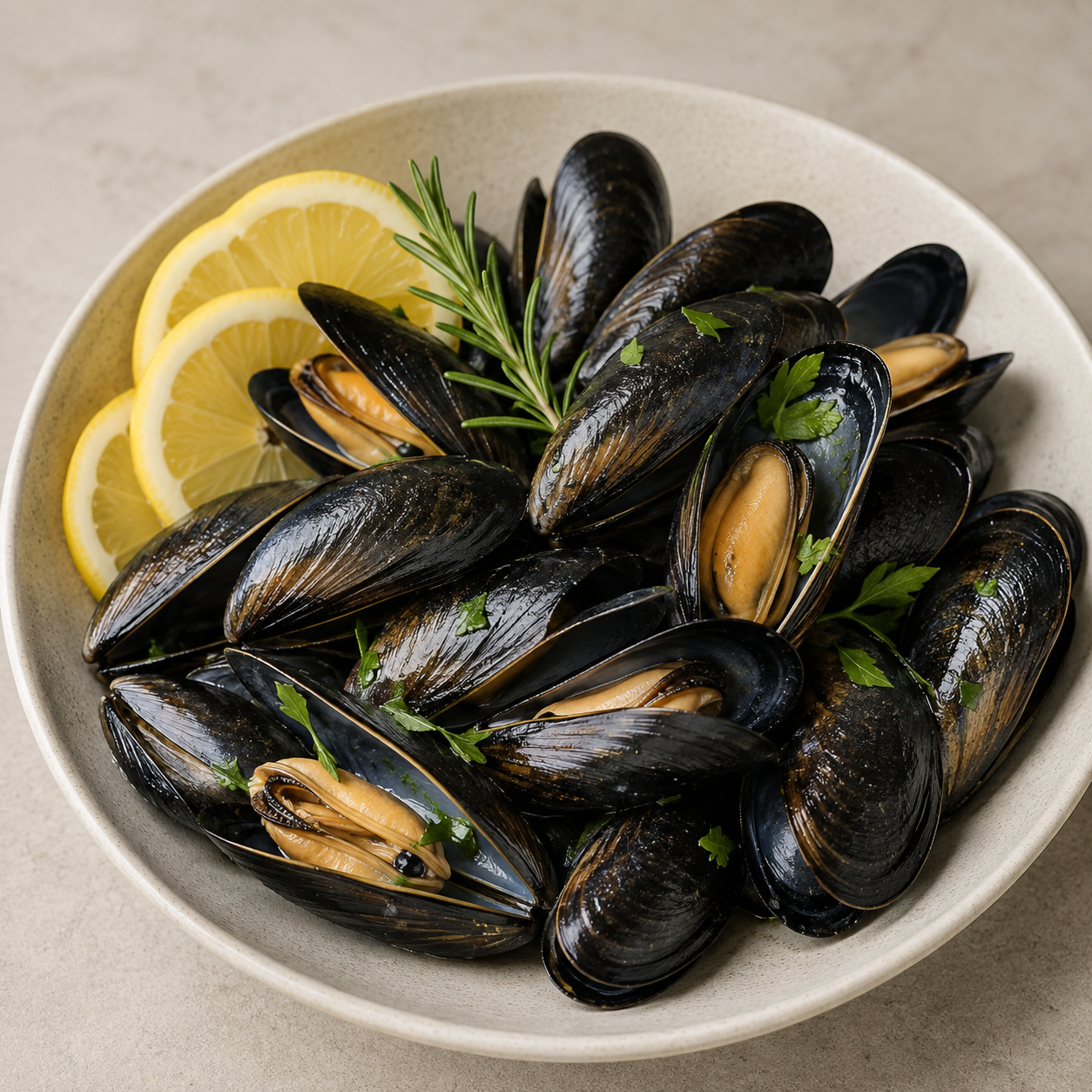
Mussels are bivalve mollusks; the edible portion is the soft tissue inside the shell. Blue mussels usually have blue-black, purple, or dark-brown shells and are commonly farmed on ropes, stakes, or seabeds. They provide protein, vitamin B12, selenium, iron, manganese, and long-chain omega-3s, but safety depends heavily on harvest waters, cold chain, and thorough cooking. This page is limited to the shelled edible portion of blue mussels (Mytilus edulis), with cooked moist-heat preparation as the default nutrition state.
Food overview
Key strengths
Cooked blue mussels provide about 23.8 g protein per 100 g and are rich in vitamin B12, selenium, manganese, and iron. Total fat is modest, but they still provide EPA and DHA, combining marine omega-3s with several micronutrients.
Best ways to eat it
Steam, simmer in soup, braise with tomato, serve with whole-grain pasta, or add to a mixed-grain seafood dish. Mussels are naturally savory, so they usually do not need large amounts of salt, butter, or salty seafood sauce.
What stands out
Nutrient content varies with species, season, growing area, reproductive cycle, and processing. A 2024 study of farmed Norwegian blue mussels found protein and omega-3 levels that differed somewhat from older USDA data, so one test result should not be treated as a fixed composition for all mussels.
Worth noting
Mussels are filter-feeding bivalves and can accumulate algal shellfish toxins in some waters. Normal steaming, freezing, or home rinsing cannot reliably remove these toxins, so buy commercially sourced products with clear harvest information rather than eating mussels gathered from uncertain areas.
Basic Nutrition
Showing:100 g Cooked mussels
View complete nutrition data
GI note:GI varies with cultivar, food structure, processing, and cooking. Raw grains usually do not have directly applicable human GI data.
Reliable GI data for plain mussels with a clearly defined method and food state are lacking, so GI is shown as “—”, not estimated or displayed as 0.
Data notes:This page defines “mussel” as blue mussel, Mytilus edulis. Nutrition refers to shelled edible tissue and excludes shells, cooking liquid, butter, cream, wine, salt, and sauces.
New Zealand green-lipped mussels (Perna canaliculus) are a different species and should not use this page’s nutrition or bioactive data. This page also excludes green mussels, Mediterranean mussels, dried mussels, smoked mussels, oil-packed canned mussels, and green-lipped mussel extracts or supplements.
Two nutrition states are included: cooked mussels and raw mussels. Cooked moist-heat preparation is the default. The raw state is for nutrient comparison only, not a recommendation to eat mussels raw.
The common serving uses the USDA 3 oz edible portion, about 85 g. Serving values are scaled from per-100 g data and exclude broth and added seasonings.
Basic nutrition uses USDA FoodData Central entries for cooked blue mussels, moist heat (FDC 174217) and raw blue mussels (FDC 174216).
Cooking lowers water content, so protein, energy, and many micronutrients look higher per 100 g. This is mainly a concentration effect, not evidence that heating creates nutrients.
GI is shown as “—” because reliable GI data for plain mussels with a clearly defined testing method and food state are lacking. It is not estimated from carbohydrate content and is not shown as 0.
The database does not fully separate every omega-6 fatty acid, so total omega-6 is not calculated. Reliable sugar and starch values are also unavailable, so both are shown as “—” rather than assumed to be 0.
Vitamins & Minerals
Only vitamins and minerals reaching at least 5% DV are shown. Cooked mussels per 100 g are the default; switching to 85 g scales the same items down proportionally. The raw state is for basic nutrition comparison and does not show detailed vitamin/mineral cards.
The USDA cooked-mussel entry does not provide reliable values for vitamins D, E, and K, so these are not automatically shown as 0. Per 100 g, 17 vitamins and minerals exceed 5% DV; the top six are shown first, with the rest expandable. The same nutrients appear for the 85 g serving with proportionally lower amounts.
View all vitamins and minerals
Percentages show how much the selected serving contributes to the adult Daily Value.
Key Bioactive Compounds
EPA & DHA
Long-Chain Omega-3 Fatty AcidsEPA and DHA are characteristic long-chain omega-3s in marine foods. Even though mussels are not high-fat, they still provide meaningful amounts of both.
The USDA cooked blue-mussel entry reports about 276 mg EPA and 506 mg DHA per 100 g, about 782 mg combined; an 85 g serving provides about 665 mg EPA+DHA. A 2024 batch of steamed Norwegian blue mussels measured about 271 mg EPA and 220 mg DHA per 100 g, around 491 mg combined. The difference shows how season, origin, sample composition, and analysis can affect results.
EPA and DHA are obtained directly from seafood. Because conversion of plant ALA to EPA and DHA is limited, eating seafood that already contains these fats is one direct way to increase long-chain omega-3 intake.
Steaming, soup, and brief braising all work well. Research suggests steaming retains blue-mussel fatty acids reasonably well; there is no need to deep-fry or add large amounts of butter to increase omega-3 intake.
Mussels provide EPA and DHA, but they do not replace lipid-lowering drugs, anticoagulants, or cardiovascular treatment. Actual omega-3 content also cannot be inferred from the word “mussel” alone.
Taurine
Sulfur-containing amino-acid derivativeTaurine is a water-soluble sulfur-containing compound found in shellfish and other animal foods and is one of the representative free amino acids in mussels.
In one 2024 blue-mussel sample, raw mussels contained about 34.7 mg taurine per g dry weight and steamed mussels about 26.5 mg/g dry weight. The same study measured about 78.6% water in steamed samples, roughly equivalent to about 570 mg per 100 g wet weight. This is only an estimate for that batch, not a universal value for retail mussels.
The body can synthesize some taurine, and it participates in several normal physiological processes. Mussels can be a dietary source, but the independent effects of ordinary food-level taurine intake in healthy adults are not well established.
Taurine is water-soluble and some may move into cooking liquid. With steamed mussels or tomato mussel soup, some broth can be eaten if it is not overly salty.
Food-based taurine should not be equated with high-dose taurine supplements, and it does not justify claims that mussels improve athletic performance, treat cardiovascular disease, or slow aging.
Selenium
Antioxidant-related micronutrientsSelenium is an essential trace mineral and part of several selenoproteins and antioxidant-enzyme systems. It also supports thyroid-hormone metabolism and cellular protection.
Cooked blue mussels provide about 89.6 µg selenium per 100 g, around 163% DV; an 85 g serving provides about 76.2 µg. Values vary by area, season, and individual.
Selenoproteins such as glutathione peroxidases and thioredoxin reductases help protect cells from excessive oxidative damage and support normal thyroid-hormone synthesis and metabolism.
Use mussels as one seafood option within a varied diet rather than stacking them with high-dose selenium supplements. Pairing them with vegetables, whole grains, and legumes is more balanced than chasing one micronutrient.
Selenium is essential, but more is not always better. Clinical trials do not support high-dose selenium supplements as a reliable way for healthy people to prevent cardiovascular disease or cancer.
Raw, cooked, and processed forms
Raw mussels
Raw blue mussels provide about 86 kcal and 11.9 g protein per 100 g, with about 80.58 g water. The raw state is shown for nutrient comparison only because raw mussels carry microbial and environmental risks.
Steamed mussels
Steaming reduces water content, concentrating protein, fat, and micronutrients per 100 g. A 2024 study found that steaming retained essential amino acids and fatty acids reasonably well, although some water-soluble taurine moved into the cooking liquid.
Boiled mussels and mussel soup
Boiling can move some taurine, minerals, and savory compounds into the broth. The broth can be eaten, but keep salt, bouillon, cream, and salty sauces moderate.
Baked and gratin-style mussels
Moderate baking adds flavor, but avoid cooking until the meat is dry or heavily charred. Butter- or cheese-baked mussels can contain much more energy, saturated fat, and sodium than the plain cooked values on this page.
Frozen mussels
Frozen products are convenient; use the package label for final nutrition. Avoid packs with damage, heavy frost, or clear thaw-refreeze signs. Thaw in the refrigerator overnight, or seal and thaw under cold water when needed quickly.
Dried mussels and oil-packed canned mussels
Drying removes water and greatly concentrates protein, minerals, and sodium per 100 g. Oil-packed, brined, and seasoned products can add fat or sodium, so do not apply the plain cooked-mussel data to them.
How to choose and store
How to choose
- Check the product name: packaging should identify species, origin, and processing state when possible. If it says New Zealand green-lipped mussel or Perna canaliculus, it is not the blue mussel used for this page’s data.
- Check source labels: for live or shelled shellfish, favor commercial products with harvest, processing, and certification information. Shellfish tags help trace harvest waters and processors.
- Check shells: live mussels should have intact shells. Discard cracked shells; live mussels that do not close after tapping should not be purchased or used.
- Check frozen packaging: the package should be intact, without excessive frost or ice crystals. The mussel meat should remain firm and frozen, not softened or obviously thawed and refrozen.
How to store
- Refrigerate promptly after purchase. FDA advises storing seafood at 4°C or below if it will be eaten within two days; otherwise freeze it.
- Do not store live mussels submerged or airtight. They need cold temperatures and some airflow, so avoid sealed airless containers and do not soak them in fresh water. Follow seller instructions and cook promptly.
- Keep raw and cooked foods separate. Clean hands, knives, boards, and containers that contact raw mussels, and avoid cross-contamination with cooked foods, salads, or other ready-to-eat items.
- Check doneness: most seafood should reach an internal temperature of about 63°C. Shell-on mussels should open during cooking; discard any that remain closed after cooking.
- Check for spoilage: do not eat mussels with sour, rotten, strongly fishy, or ammonia-like odors. Cooked mussels that smell of ammonia should also be discarded.
When buying mussels, remember three things: clear species and source, intact live shells, and continuous cold storage.
How to use it in everyday meals
Lemon-herb steamed mussels
Steam cleaned mussels with a little water, garlic, lemon, and parsley until the shells open, then stop cooking and discard unopened shells. Their natural savory flavor usually makes large amounts of salt or butter unnecessary; a little broth can be eaten if it is not too salty.
Tomato mussel soup
Make a broth with tomato, onion, garlic, celery, and mushrooms, then add mussels and cook until they open. Vegetables add fiber and polyphenols; keep cream, bouillon, and processed meats modest.
Mussels with whole-grain pasta
Toss cooked mussels with whole-wheat pasta, tomato, spinach, herbs, and a little olive oil. Add the mussels near the end and heat through without repeatedly cooking them until dry. Keep salty pasta sauces moderate.
Mussel mixed-grain risotto
Cook brown rice, barley, or oat groats until nearly done, then add mussels and colorful vegetables. Mussels provide protein and flavor, so there is no need to add sausage, bacon, or large amounts of cheese.
Mussel, bean, and vegetable pot
Simmer white beans or chickpeas with tomato, kale, or broccoli, then add mussels at the end. Beans add fiber, while mussels add vitamin B12 and marine fats. Watch total sodium from canned beans, seafood broth, and sauces.
Cooked mussel grain salad
Mix thoroughly cooked and cooled mussel meat with quinoa, tomato, bell pepper, cucumber, and herbs, using lemon and a little olive oil. Refrigerate after preparation and eat promptly rather than leaving it at room temperature.
Who Should Take Extra Care
People allergic to mussels or molluscan shellfish
Mussels are bivalve mollusks. People with diagnosed allergy to mussels, clams, oysters, or other mollusks should follow allergy-specialist advice and watch for cross-contact in seafood soups, sauces, and mixed seafood dishes. Crustacean allergy and mollusk allergy are not identical, so tolerance of shrimp does not prove mussels are safe.
Pregnant people, children, older adults, and people with weakened immunity
These groups are at higher risk of severe foodborne illness. They should avoid raw or undercooked mussels and choose commercially sourced products with clear harvest and cold-chain information.
People who harvest shellfish themselves
Do not judge safety only by water appearance, smell, or whether the mussels look alive. Shellfish toxins can be present in normal-looking mussels, and ordinary cooking or freezing may not destroy them. Follow local harvest closures and shellfish-safety advisories.
People limiting sodium, phosphorus, or protein
An 85 g serving of cooked mussels provides about 314 mg sodium, 242 mg phosphorus, and 20.2 g protein. People with kidney impairment or prescribed dietary limits should count this toward the whole day and reduce added salt, broth, and sauces.
People taking supplements
One serving of mussels already provides substantial vitamin B12, selenium, and manganese. Food intake is not the same as a high-dose supplement, but people who regularly combine multiple selenium- or manganese-containing supplements should review their total intake.
Infants, Young Children & People with Weaker Swallowing Ability
Remove all shell fragments, byssal threads, and tough tissue. Cut cooked mussel meat into small, easy-to-swallow pieces and supervise eating, especially for young children.
Similar Food Alternatives
Clams
Another bivalve that provides protein, vitamin B12, and iron and works well in soups or steamed dishes, but its sodium, iron, and omega-3 values should not be copied from mussels.
Oyster
Notable for vitamin B12, zinc, and copper. They can fill a similar culinary role, but their food-safety issues, texture, and mineral profile differ.
Scallops
Milder in flavor and a good protein source, suitable for steaming, soups, and vegetable dishes. Their fat and long-chain omega-3 content should not be assumed to match mussels.
Sardines
Not shellfish, but another source of EPA, DHA, vitamin B12, and selenium. Useful when the main goal is marine omega-3s, with a different fat, calcium, and sodium profile.